
Florida Employment Contract (Free PDF Template)
A Florida employment contract changes the legal relationship between an employer and employee the moment it’s signed, and the change most employers don’t anticipate is what they’ve given up rather than what they’ve gained. Florida presumes all employment is at-will, meaning either side can end the relationship at any time for almost any reason, but once an employment agreement florida defines the grounds for termination or sets a specific duration, that presumption disappears and the employer is now bound by whatever the contract says cause means.
I’ve worked with small business owners who included a “termination for cause” provision because it sounded professional, then discovered they couldn’t let a genuinely underperforming employee go without triggering a breach of contract claim — and if the dispute also involves an action for unpaid wages, F.S. § 448.08 allows a court to award the prevailing party costs and reasonable attorney’s fees, potentially making the dispute more expensive than a standard contract case.The employee contract florida template below is built to give employers the protections they actually want without quietly eliminating the flexibility Florida law gives them by default.
Candice Hayden, Legal Writer
Carly Johansson, Florida Contract Attorney Last updated: September 26, 2026
Florida Employment Contract (PDF, Printable, Fillable)
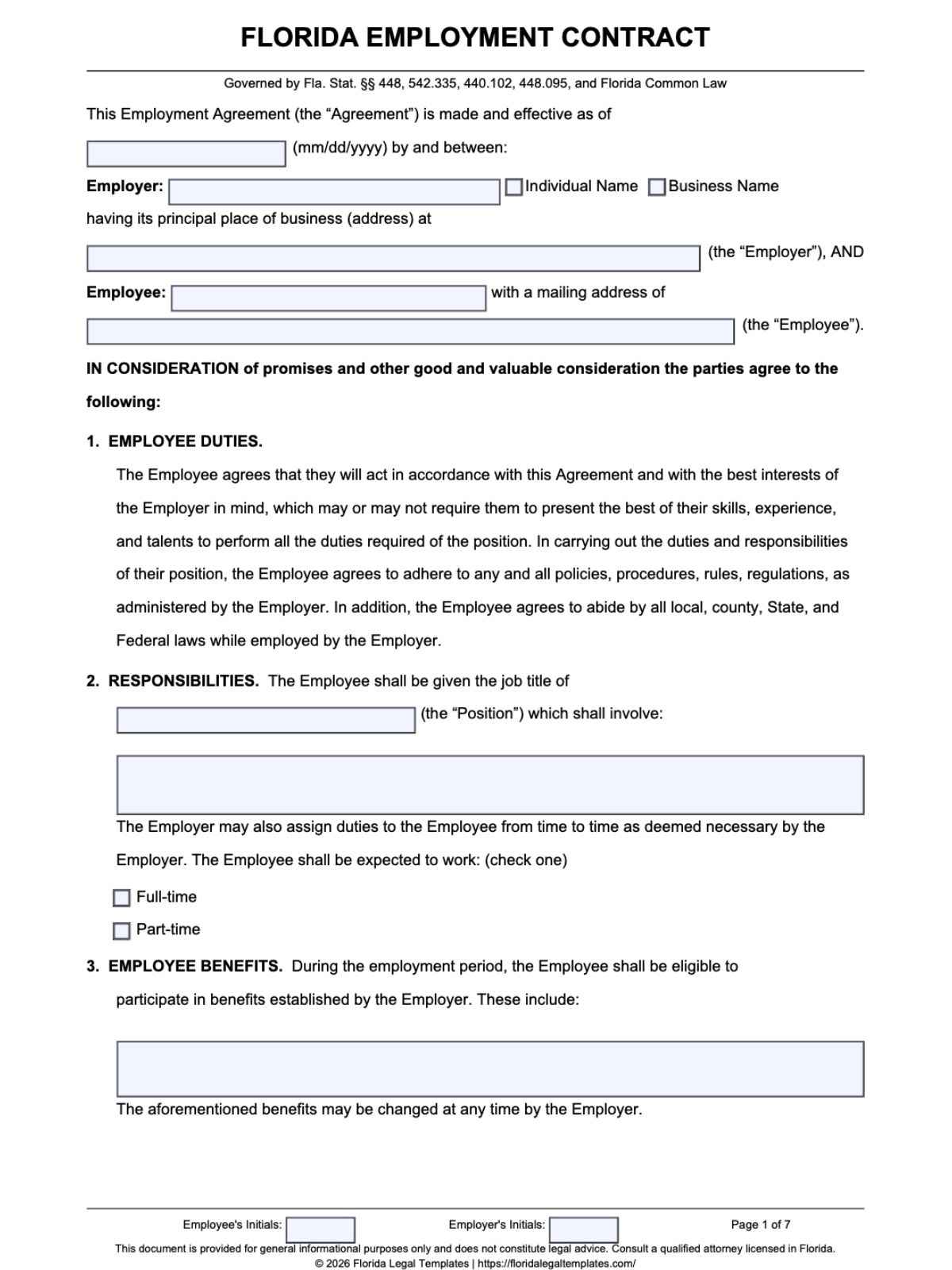
A Florida employment contract template gives employers and employees a practical way to put the agreed job duties, pay, employment status, and termination terms into writing before the employment relationship begins.
What the document includes:
- Employer and employee identification
- Job title and duties
- Compensation structure (salary, bonuses, benefits)
- Employment type (at-will or fixed-term)
- Term and termination provisions
- Confidentiality obligations
- Intellectual property ownership
- Restrictive covenants (if included)
- Dispute resolution and governing law
Who should use this:
- Businesses hiring employees
- Startups formalizing employment relationships
- Employers offering executive or fixed-term roles
- Employees reviewing job contract terms
When this template may NOT be sufficient:
- Agreements involving complex equity or executive compensation structures
- Highly customized non-compete clauses requiring strict statutory compliance
- Unionized or collective bargaining arrangements
- Multi-state employment relationships
Even a strong employee contract Florida should be tailored for specialized or high-risk employment scenarios.
What Is a Florida Employment Contract?
A job contract Florida is a private agreement that sets the legal framework for an employment relationship.
Employment agreements are often confused with contractor arrangements, especially in businesses using both W-2 employees and freelancers. Employers reviewing classification risks may also want to compare how a contractor relationship agreement differs from a traditional employee hiring structure under Florida law.
Legal framework:
Florida employment agreements can implicate several different bodies of law. For example, § 725.01 addresses agreements that cannot be performed within one year, while § 542.335 governs many restrictive covenants; Chapter 448 contains additional Florida employment rules, including wage and employment-eligibility provisions.
Legal nuance:
Florida follows an at-will employment doctrine. This means employment can be terminated at any time unless a contract specifically alters that arrangement.
Critical distinction:
- At-will employment: No guaranteed duration; either party can terminate freely
- Contract employment: Defined duration, protections, or termination conditions
Execution validity:
Ordinary employment agreements generally do not require notarization or witnesses, but execution requirements depend on the particular agreement. For example, § 725.01 requires a signed writing for an agreement that cannot be performed within one year.
Practical implication:
Be especially careful when an agreement describes employment as ‘at-will’ but elsewhere promises a fixed term, termination only for cause, or a specific severance payment. Florida courts recognize at-will employment, but contractual language can create enforceable obligations that change the parties’ rights.
Key Florida Laws That Affect Florida Employment Contract
Summary of Applicable Laws
| Topic / Issue | Florida Legal Rule | Governing Statute |
|---|---|---|
| Statute of Frauds | Any employment contract guaranteeing a term that cannot be fully performed within the space of one year from its making must be in writing and signed by the party to be charged. Oral contracts extending beyond one year are unenforceable. | Fla. Stat. § 725.01 |
| Age / Capacity | Except for statutory exceptions, Florida generally prohibits employment of minors 13 years old or younger, while minors ages 14–17 remain subject to Florida child-labor restrictions on hours and certain work. | Fla. Stat. § 450.021 |
| Restrictive Covenants | While Florida does not require “magic words” to form a basic at-will employment contract, if the contract includes a non-compete or non-solicitation clause, it must meet strict statutory criteria to be valid. The restriction must be in writing and signed by the person against whom enforcement is sought, and the party seeking enforcement must plead and prove one or more legitimate business interests supporting the restraint. (e.g., trade secrets, valuable confidential business information, substantial relationships with specific prospective or existing customers). | Fla. Stat. § 542.335 |
| Workers’ Compensation | An employee’s agreement to waive rights to workers’ compensation benefits under Chapter 440 is invalid under Fla. Stat. § 440.21. | Fla. Stat. § 440.21 |
| Minimum Wage | Cannot contract below state minimum wage ($14.00 until Sept. 29, 2026; $15.00 effective Sept. 30, 2026). | Fla. Const. Art. X, § 24 |
Under Fla. Stat. § 95.11(5)(d), an action to recover wages, overtime, or damages or penalties concerning payment of wages and overtime generally must be brought within two years; a separate five-year period generally applies to actions founded on a written contract under § 95.11(2)(b).
Employment contracts frequently include confidentiality and restrictive covenant provisions designed to protect business operations and proprietary information. Businesses handling sensitive client data or internal systems often pair employment terms with a separate confidentiality protection agreement to strengthen trade secret and information security protections.
Practical Impact & Document Clauses
These laws directly determine whether a Florida employment contract is enforceable.
Under Fla. Stat. § 725.01, any employment contract that cannot be performed within one year must be in writing. An oral employment agreement that falls within § 725.01 because it is not to be performed within one year generally must be in writing and signed by the party to be charged to be enforceable.
If your contract includes a non-compete or non-solicitation clause, it must comply with Fla. Stat. § 542.335. The restriction must:
- Be in writing
- Be signed by the employee
- Protect legitimate business interests
For a post-employment restrictive covenant against a former employee, agent, or independent contractor, § 542.335 generally presumes a restraint of more than two years unreasonable when the restraint is not associated with a qualifying sale of a business interest and is not predicated on protecting trade secrets. However, if a restrictive covenant is overbroad, overlong, or otherwise not reasonably necessary to protect an established legitimate business interest, § 542.335 directs the court to modify the restraint and grant only the relief reasonably necessary to protect that interest.
New Florida Option: Garden Leave Agreements May Change How Employers Draft Employment Contracts
If you’re hiring a key executive or high-earning employee under Florida’s CHOICE Act, a traditional non-compete may no longer be your only option. Florida’s statutory framework for “garden leave” agreements allows a covered employee to remain employed and continue receiving the required salary and benefits during a notice period of up to four years, provided the agreement satisfies the requirements of §§ 542.43–542.44, including the statutory rules governing services and activities during the notice period. (Statutory authority: Fla. Stat. §§ 542.41–542.45; garden leave rules: Fla. Stat. § 542.44).
This matters because employers often copy a standard non-compete into every employment contract without considering whether a statutory garden leave provision better fits executives, sales directors, or key personnel with access to sensitive customer relationships. Note that under Fla. Stat. § 542.43, these statutory garden leave protections apply to “covered employees” whose salary is greater than twice the applicable county annual mean wage, as defined by the statute.
For many small businesses, the practical takeaway is simple: if protecting customer goodwill or confidential information is your primary concern for high-level personnel, have counsel determine whether a garden leave provision under Chapter 542 is more appropriate than relying solely on a conventional non-compete clause under Fla. Stat. § 542.335. Using the wrong approach can lead to unnecessary litigation or leave valuable business interests less protected than intended.
Workers’ compensation rights cannot be waived under Fla. Stat. § 440.21. Any clause attempting to shift costs or waive benefits is void.
Additionally, under the Florida Constitution (Art. X, § 24), an employment contract cannot set wages below the state minimum wage.
In real-world terms:
- A clause that violates a specific statutory requirement may be invalid or unenforceable, while some overbroad restrictive covenants may instead be modified by a court under § 542.335.
- Employers may face liability for non-compliance
- Poorly drafted contracts increase dispute risk and enforcement failure
When to Use Florida Employment Contract
A written Florida employment agreement becomes most useful when the parties need more detail than a basic offer letter—for example, a fixed term, defined compensation package, confidentiality obligations, or a negotiated termination provision.
Common use cases:
- Hiring employees under defined conditions
- Offering fixed-term or executive employment
- Establishing compensation, duties, and expectations
Practical scenarios:
A Florida employment agreement is particularly useful when the parties are changing the default at-will arrangement or documenting terms that may matter later. For example, a fixed-term management agreement can bring § 725.01 into play if the promised performance extends beyond one year, while a confidentiality or restrictive-covenant provision may require separate attention under Chapter 542.
When NOT to use:
A Florida employment contract should not be used as a substitute for an agreement designed for a different legal relationship. Independent contractors may require a separate agreement, while collective bargaining relationships can involve additional governing terms. For employees, the key question is whether the written agreement accurately documents the compensation, duties, duration, and termination terms the parties actually intend.
Using the right agreement helps keep the written terms consistent with the actual employment arrangement, especially when the parties are changing the default at-will relationship or adding restrictions governed by Florida law.
Formal employment contracts are especially useful for management roles, specialized staff, and long-term business operations where responsibilities must be clearly documented. Companies hiring advisory or strategy-focused personnel sometimes also use separate professional consulting terms when outside expertise overlaps with internal employment functions.
How to Create or Fill Out the Florida Employment Contract
Creating a Florida employment contract template requires careful alignment with Florida law.
Step-by-step process:
- Identify employer and employee
- Include full legal names
- Define job role and responsibilities
- Clearly outline duties and expectations
- Specify compensation and benefits
- Salary, bonuses, and benefits structure
- Define employment type
- At-will or fixed-term
- Include termination provisions
- Notice requirements and grounds for termination
- Add confidentiality and IP clauses
- Protect business information and ownership of work
- Insert restrictive covenants (if applicable)
- Ensure compliance with Fla. Stat. § 542.335
- Ensure compliance with wage and labor laws
- Confirm wages meet minimum requirements
- Add dispute resolution and governing law
- Specify Florida jurisdiction
- Execute agreement
- The parties should sign the agreement, and any signature requirements that apply to a particular provision should be satisfied, including the requirements of § 725.01 or § 542.335 where applicable.
Practical tips:
- Clearly state at-will status if intended
- Avoid overly broad non-compete clauses
- Ensure the contract reflects actual working conditions
If compensation includes milestone payments, commissions tied to transactions, or ownership-related incentives, employers may also require separate written business transaction provisions to clearly document financial obligations beyond standard payroll terms.
Limitations and Legal Considerations
Before signing a Florida employment agreement, make sure the important terms match what you actually agreed to. If you’re promising employment for more than a year, Fla. Stat. § 725.01 may require a written agreement. Non-compete and other restrictive-covenant terms also have to meet the requirements of § 542.335, while certain qualifying executive arrangements may fall under the CHOICE Act in §§ 542.41–542.45. And an employment contract cannot waive workers’ compensation rights under § 440.21. If the job involves another state or is for an executive position, a standard Florida form may not cover everything you need.
The Accrued PTO Forfeiture and E-Verify Contingency Traps
Employers frequently overlook two critical Florida-specific operational rules when drafting standard employment agreements:
-
The PTO Payout Forfeiture Rule: Unlike jurisdictions that treat accrued Paid Time Off (PTO) as vested wages, Florida law contains zero statutory requirement compelling private employers to pay out unused accrued vacation or PTO upon termination. Instead, Florida courts look primarily to the express written terms of the employer’s policy or employment contract, since no wage statute fills the gap. If an employer wishes to enforce a “use-it-or-lose-it” policy or stipulate that accrued PTO is completely forfeited upon voluntary resignation or termination for cause, that forfeiture rule should be explicitly and unambiguously written into the policy or contract. If the agreement is silent or ambiguously states that PTO “accrues each pay period,” departing employees have in some cases argued that an implied contract or established administrative practice entitles them to a cash payout upon separation — so unclear accrual language, more than any statute, is the real source of an employer’s exposure here.
- The heading should not call this a mandatory contract clause. The underlying compliance rule is accurate, but § 448.095 requires covered employers to use E-Verify for new employees and verify employment eligibility within three business days; it does not require every employment contract to contain an E-Verify contingency clause. For private employers with 25 or more employees, Fla. Stat. § 448.095 requires use of the federal E-Verify system for new employees, with employment eligibility generally verified within three business days after the employee begins working for pay. The statute does not require every employment contract to contain an E-Verify contingency clause. Instead, covered employers should maintain procedures for timely verification and compliance with the statute, including the applicable cure process and penalties for repeated noncompliance.
An employment agreement cannot override statutory employee protections or transfer legal authority unrelated to the employment relationship. In situations involving operational or financial decision-making authority, businesses may require a separate durable authorization document instead of relying solely on employment contract language.
Common Mistakes to Avoid
Failing to clarify at-will status
Consequence: Contract may unintentionally create termination restrictions.
Using oral agreements for long-term employment
Consequence: Agreement becomes unenforceable under Fla. Stat. § 725.01.
Including unenforceable non-compete clauses
Consequence: A restrictive covenant that lacks a legitimate business interest is void and unenforceable under Fla. Stat. § 542.335, while a restraint that is overbroad or overlong may be modified by the court.
Attempting to waive employee rights
Consequence: Clause is invalid under Fla. Stat. § 440.21 and Florida law.
Ignoring wage and labor law requirements
Consequence: Employer liability and potential penalties.
Frequently Asked Questions (FAQ)
Is a Florida employment contract required for hiring employees?
No. Florida does not require a written contract for employment, as the default is at-will. However, a contract is useful for defining terms and protections.
When must an employment contract be in writing in Florida?
Under Fla. Stat. § 725.01, contracts exceeding one year must be in writing.
Can a Florida employment contract override at-will employment?
Yes. A contract can modify at-will status by defining specific terms, duration, or termination conditions.
Are non-compete clauses enforceable in Florida employment contracts?
Yes, but only if they comply with Fla. Stat. § 542.335 and protect legitimate business interests.
A well-drafted Florida employment agreement should make the parties’ actual deal clear especially the employment status, compensation, termination rights, confidentiality obligations, and any restrictive covenant. Before using a fixed-term or executive agreement, check the current Florida statutory requirements that apply to the specific terms.
Legal Disclaimer: This article provides general legal information about Florida employment contracts and is not legal advice. Laws and requirements can change, and the information may not apply to your specific situation. Consider consulting a qualified Florida attorney before relying on this information or signing an employment agreement.