
Florida Partnership Agreement [Free Printable PDF & WORD]
A Florida partnership agreement isn’t required to form a partnership — two or more people carrying on as co-owners a business for profit can form one under Fla. Stat. § 620.8202, even if they did not intend to create a partnership, and that’s exactly where most partnership disputes begin. Without a written agreement in place, Florida’s default rules under the Revised Uniform Partnership Act govern everything from how profits are divided to how decisions get made, and Without an agreement providing otherwise, Florida’s default rule gives each partner an equal share of partnership profits, regardless of differences in capital or other contributions.
Partners can have very different understandings of their arrangement and discover mid-dispute that the state’s default rules apply to their situation, including the fiduciary duties set out in Fla. Stat. § 620.8404. A partnership agreement can modify some aspects of those duties, but § 620.8103 does not permit the duty of loyalty or the obligation of good faith and fair dealing to be eliminated, and it may not unreasonably reduce the duty of care. The partnership contract florida template below is built around what those default rules actually say, so the agreement your partnership operates under is the one you chose rather than the one Florida assigned you by default.
Candice Hayden, Legal Writer
Carly Johansson, Florida Contract Attorney Last updated: September 26, 2026
Florida Partnership Agreement (PDF, Printable, Fillable)
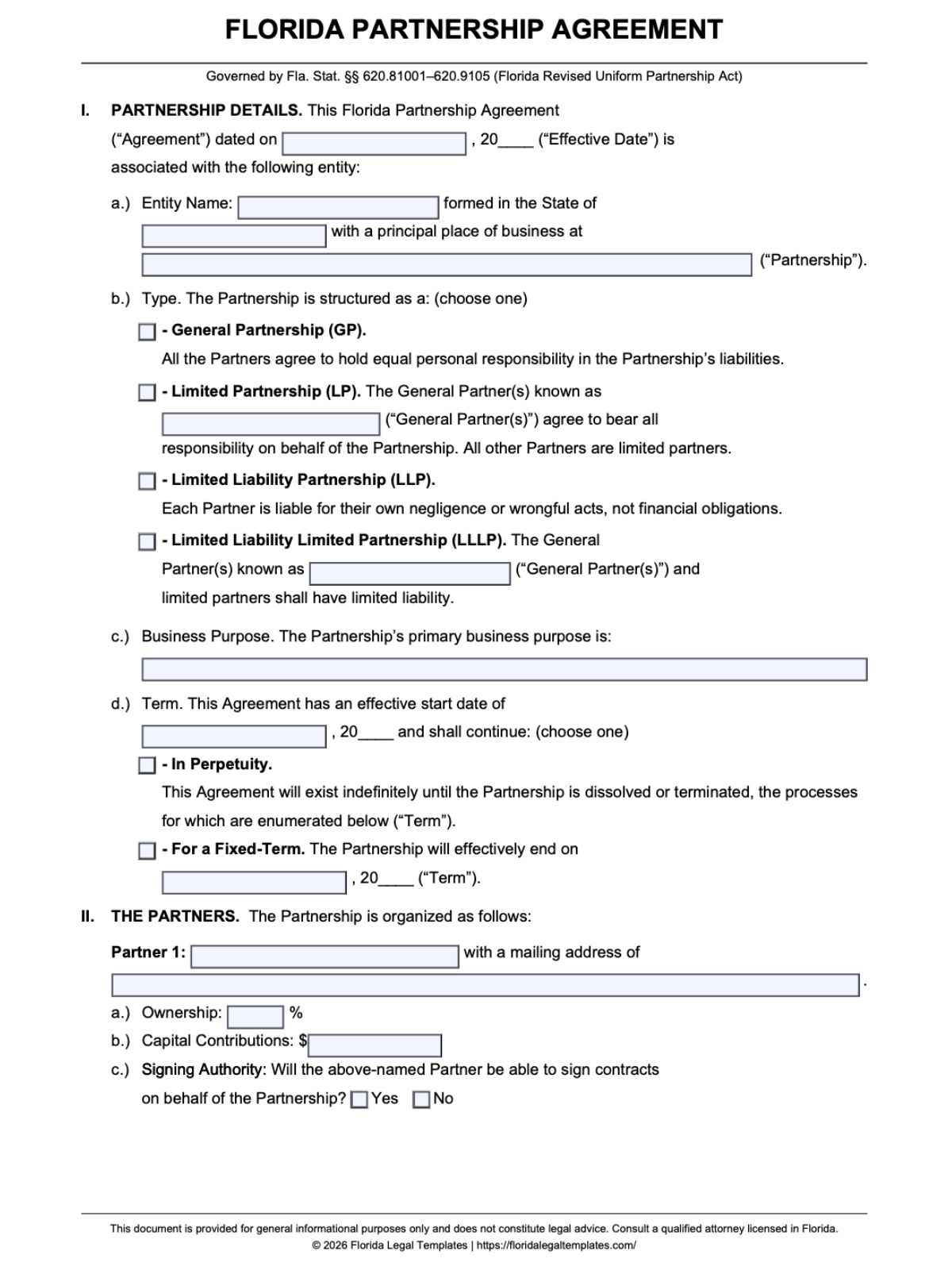
A partnership contract Florida template provides a structured framework to define the relationship between partners and avoid relying on default statutory rules.
What the document includes:
- Identification of partners (individuals or legal entities)
- Business purpose and operational structure
- Capital contributions of each partner
- Profit and loss allocation
- Management roles and decision-making authority
- Partner duties and responsibilities
- Admission and withdrawal of partners
- Dissolution and winding-up procedures
- Dispute resolution and governing law
Who should use this:
- Small businesses forming a general partnership
- Co-founders launching a business together
- Investors entering profit-sharing arrangements
- Partnerships involving individuals, LLCs, or corporations
When this template may NOT be sufficient:
- Partnerships with complex equity structures or layered ownership
- Real estate partnerships requiring formal authority filings
- Businesses needing liability protection (LLC or corporation preferred)
- High-value partnerships requiring customized fiduciary arrangements
A partnership deed Florida is most effective when tailored to the specific structure and risk level of the business. (Note: In Florida law, the term “deed” is reserved for real property transfers. The statutory term under RUPA is “Partnership Agreement”).
What Is a Florida Partnership Agreement?
A Florida partnership agreement is the contract partners use to set the internal rules for their business. That matters because Fla. Stat. § 620.8103 generally makes the partnership agreement the starting point for relations among partners, subject to statutory limits on what the agreement can change.
Partnership agreements are often used alongside other business contracts when partners divide operational responsibilities, client services, or ownership rights. Businesses providing professional services through a partnership structure may also rely on a separate client services agreement or detailed consulting engagement contract to govern outside business relationships.
Legal framework:
- Governed by the Florida Revised Uniform Partnership Act (RUPA)
- Codified under Fla. Stat. §§ 620.81001–620.9902.
Legal nuance:
Florida does not require a written agreement to form a partnership. Under state law, a partnership arises when two or more persons operate a business for profit—even if they never intended to create one.
What the agreement actually changes
A written agreement lets partners set the rules for profits, management, contributions, admissions, withdrawals, and other internal matters instead of leaving those questions to Florida’s statutory defaults. Fla. Stat. § 620.8103 makes the partnership agreement the starting point for relations among the partners, subject to the statute’s nonwaivable provisions.
Execution validity:
- No notarization required
- No witnesses required
- Agreement can be written, oral, or implied
Key implication:
If the partners do not set their own terms, Chapter 620 supplies default rules for matters such as profit allocation, management, and other aspects of the partnership relationship.
Key Florida Laws That Affect Florida Partnership Agreement
Summary of Applicable Laws
| Topic / Issue | Florida Legal Rule | Governing Statute |
| Governing Law | For a Florida general partnership, Chapter 620, Part II supplies the Revised Uniform Partnership Act rules governing the partnership, subject to the applicable governing-law rules in Fla. Stat. § 620.8106. | Fla. Stat. §§ 620.8101–620.9902 |
| Formation Rule | Partnership forms automatically when 2+ persons operate for profit. | Fla. Stat. § 620.8202 |
| Statute of Frauds | A partnership agreement may be written, oral, or implied, but Florida’s Statute of Frauds can require a signed writing for an agreement that falls within § 725.01, including an agreement that cannot be performed within one year. | Fla. Stat. § 725.01 |
| Partner Eligibility | Florida generally removes the disability of nonage at age 18, while Fla. Stat. § 620.8101(11) defines “person” broadly enough to include individuals and various legal or commercial entities, including corporations, LLCs, trusts, partnerships, and other business entities. | Fla. Stat. § 743.07 & § 620.8101(12) |
| Non-Waivable Duties | A partnership agreement cannot eliminate the duty of loyalty or the obligation of good faith and fair dealing, and it cannot unreasonably reduce the duty of care. | Fla. Stat. § 620.8103 |
| Statement of Partnership Authority | Optional filing that can state which partners have authority to transfer partnership real property and can also state or limit authority for other transactions. | Fla. Stat. § 620.8303 |
Florida partnership disputes frequently involve access to confidential records, customer relationships, and proprietary business information. Partnerships handling sensitive operational data often strengthen internal protections with a separate business confidentiality agreement to help preserve trade secrets and limit unauthorized disclosures between partners or third parties.
Why a Statement of Partnership Authority matters more for real estate than ordinary contracts
Many Florida partnerships never file a Statement of Partnership Authority because the filing is optional. The practical value appears only when the partnership owns or plans to acquire real property. Under Fla. Stat. § 620.8303, a properly filed statement can identify which partner has authority to transfer or mortgage partnership real estate. “For partnership real property, a certified copy of the filed statement recorded in the office for recording transfers of the property can provide the statutory notice and reliance effects described in § 620.8303. By contrast, simply filing the statement with the Florida Department of State does not automatically protect the partnership in every contract signed by a partner or prevent disputes over other business decisions.
This catches many partners by surprise after a closing has already been scheduled. A title company may ask for evidence that the person signing has authority to convey partnership property. If the partnership agreement is silent and no recorded Statement of Partnership Authority exists, additional affidavits, partner consents, or corrective documents may be required before the transaction can close. For partnerships that expect to buy, sell, or refinance commercial property, recording this authority early can eliminate avoidable delays and reduce challenges to a partner’s signing authority.
Practical Impact & Document Clauses
These rules matter when you decide who can manage the business, who can sign for it, and how the partners will divide profits and responsibilities.
Under Fla. Stat. § 620.8202, a partnership can form automatically through conduct. This creates risk—partners may be legally bound without realizing it. A written agreement does not prevent the partnership from forming, but it can reduce uncertainty by setting the partners’ rights and obligations in advance.
Florida’s partnership fiduciary duties are set out in Fla. Stat. § 620.8404, while Fla. Stat. § 620.8103 establishes which provisions of a partnership agreement may not be varied. These duties include:
- Duty of loyalty
- Duty of care
- Obligation of good faith and fair dealing
A partnership agreement cannot eliminate the duty of loyalty or the obligation of good faith and fair dealing, and it cannot unreasonably reduce the duty of care under Fla. Stat. § 620.8103.
Under Fla. Stat. § 725.01, a signed writing may be required when a partnership agreement is one that cannot be performed within one year from the time it is made.
Additionally, a partnership that conducts business under a fictitious name may need to comply with Fla. Stat. § 865.09,subject to the statute’s exemptions for partnerships and other entities using their registered or legal name.
In real-world terms:
In practice, the biggest exposure is usually authority and personal liability. Each partner is an agent of the partnership for ordinary-course business under Fla. Stat. § 620.8301, while § 620.8306 generally makes partners jointly and severally liable for partnership obligations.
When to Use Florida Partnership Agreement
A Florida partnership agreement becomes especially useful when the partners contribute different amounts of money, property, labor, or expertise and want those arrangements documented before a dispute arises.
Common use cases:
- Starting a business with partners
- Formalizing profit-sharing arrangements
- Defining management roles and responsibilities
Practical scenarios:
Partnerships can also raise different drafting issues depending on how they operate—for example, a family business may need clear succession and withdrawal terms, while a real-estate partnership may need careful authority provisions for property transactions.
When NOT to use:
A partnership agreement is not a substitute for choosing the correct legal structure. If the parties want limited liability, they should evaluate an LLC, corporation, or limited liability partnership rather than assuming a general partnership provides the same protection.
The practical value is in spelling out the rules before a disagreement arises: for example, who manages the business, how profits are divided, and what happens when a partner wants to leave.
A written partnership agreement becomes especially important when multiple parties contribute different levels of funding, labor, or expertise to the business. In partnerships involving financing arrangements or capital contributions between partners, businesses sometimes also document repayment obligations through separate business lending terms to avoid future disputes over contributed funds.
How to Create or Fill Out the Florida Partnership Agreement
Creating a partnership contract Florida requires careful structuring of roles, rights, and obligations.
Step-by-step process:
- Identify all partners
- Include individuals or legal entities
- Define business purpose and structure
- Clearly outline the nature of the business
- Specify capital contributions
- Cash, property, or services contributed
- Establish profit and loss distribution
- Define percentages explicitly
- Define management and authority
- Clarify decision-making rights
- Include fiduciary duties acknowledgment
- Reflect statutory obligations
- Add admission and withdrawal rules
- Define how partners enter or exit
- Define dissolution procedures
- Outline exit and winding-up process
- Include dispute resolution and governing law
- Specify Florida jurisdiction
- Execute agreement
- Signed by all partners
If the partnership will buy, transfer, or jointly own business assets, the parties may also need separate written asset purchase provisions to clearly document ownership transfers and payment obligations outside the partnership structure itself.
Practical tips:
- Clearly define authority to prevent unauthorized commitments
- Avoid vague profit-sharing terms
- Align agreement with actual business operations
Limitations and Legal Considerations
A Florida partnership agreement gives the partners substantial flexibility, but Chapter 620 places specific limits on what they can change by contract.
Key limitations:
- The agreement cannot eliminate the duty of loyalty or the obligation of good faith and fair dealing.
- It cannot unreasonably reduce the statutory duty of care.
- Certain information, dissociation, dissolution, and third-party rights also cannot be altered beyond the limits set by Fla. Stat. § 620.8103.
Florida-specific constraints:
- Must comply with RUPA
- A signed writing may be required when the partnership agreement falls within Florida’s Statute of Frauds, including certain agreements that cannot be performed within one year.
High-risk scenarios:
- Operating without a written agreement
- Assuming equal ownership without defining shares
- Allowing partners to bind the business without limits
Edge cases:
- Partnerships involving LLCs or corporations
- Real estate partnerships requiring authority clarity
- Silent or passive partners
The practical point is to identify those limits before the partners rely on a clause that Chapter 620 does not allow them to change.
The 1-Year Lingering Authority Trap and Statement of Dissociation
When a partner leaves, retires, or is expelled from a Florida general partnership, co-founders routinely assume that signing an internal buyout or exit agreement completely terminates that partner’s authority to act on behalf of the business. This misunderstanding can leave the partnership exposed to the one-year lingering-authority rule under Fla. Stat. § 620.8702. Under Florida’s Revised Uniform Partnership Act, the partnership can remain bound by certain acts of a dissociated partner for up to one year after dissociation when the statutory conditions in § 620.8702 are satisfied.
An internal agreement alone does not provide the statutory notice effect of a Statement of Dissociation; filing the statement limits the dissociated partner’s authority for purposes of § 620.8303, and nonpartners are deemed to have notice 90 days after filing. Under Fla. Stat. § 620.8704, a dissociated partner or the partnership may file a Statement of Dissociation with the Florida Department of State, Division of Corporations. A Statement of Dissociation is a statutory limitation on the dissociated partner’s authority, and a nonpartner is deemed to have notice of the dissociation 90 days after the statement is filed. Failing to address the dissociation can leave the partnership exposed to transactions that satisfy the statutory conditions for binding the partnership, so the filing should be considered promptly when a partner leaves.
A partnership agreement cannot eliminate statutory fiduciary obligations or grant unlimited authority to individual partners. In situations involving broader financial or operational authority, partners may require a separate Florida legal authorization document rather than relying solely on boilerplate partnership language.
Common Mistakes to Avoid
Not having a written agreement
Consequence: Default Florida rules apply, often leading to unintended outcomes.
Assuming equal ownership
Consequence: Unless the partners agree otherwise, each partner is entitled to an equal share of partnership profits regardless of the amount contributed.
Failing to define authority
Consequence: Under Fla. Stat. § 620.8306, partners of an ordinary partnership are generally jointly and severally liable for partnership obligations, subject to statutory exceptions such as limited liability partnership status. Without a written agreement limiting authority, one partner’s bad contract could put your personal assets at risk.
Attempting to waive fiduciary duties
Consequence: A provision that attempts to eliminate a nonwaivable fiduciary duty is unenforceable to the extent it conflicts with Fla. Stat. § 620.8103.
Ignoring fictitious name registration
Consequence: Compliance issues under Fla. Stat. § 865.09.
Frequently Asked Questions (FAQ)
Can a partnership exist in Florida without a written agreement?
Yes. Under Fla. Stat. § 620.8202, a partnership can form automatically through business activity.
When must a Florida partnership agreement be in writing?
Under Fla. Stat. § 725.01, a signed writing may be required when the agreement cannot be performed within one year from the time it is made.
Can a partner bind the business without consent of others?
Generally, yes for acts apparently within the ordinary course of partnership business, subject to the rules in Fla. Stat. § 620.8301 and any applicable statement of partnership authority.
Can fiduciary duties be waived in a Florida partnership?
Not entirely. Under Fla. Stat. § 620.8103 and 620.8404, the duty of loyalty and duty of care are subject to statutory limits on modification, and the obligation of good faith and fair dealing cannot be eliminated.
The best time to settle the profit split, management rules, signing authority, and exit terms is before the partners disagree. Putting those terms in the agreement gives the business a clearer set of rules to follow instead of leaving every unanswered question to Chapter 620’s defaults.
Legal disclaimer: This article provides general legal information about Florida partnership agreements and is not legal advice. Florida partnership law can vary based on the partnership’s structure, agreement, conduct, and circumstances. Consider consulting a Florida attorney for advice about a specific partnership or dispute.