Florida Disabled Parking Permit Form | Free PDF
The Florida Disabled Parking Permit Form (HSMV 83039) allows individuals with qualifying mobility impairments or other eligible disabilities to apply for a government-issued parking placard. Florida offers permanent, temporary, and lifetime disabled parking permits, depending on the applicant’s medical condition and eligibility.
The application requires personal information and certification from an authorized medical practitioner before it can be processed by a county tax collector’s office or license plate agency. However, completing the form does not automatically authorize someone to use accessible parking spaces. The official placard must first be issued by the state.
Candice Hayden, Legal Writer
Carly Johansson, Florida Contract Attorney Last Updated: November 21, 2026
Free Florida Disabled Parking Permit Form (PDF)
Get PDF
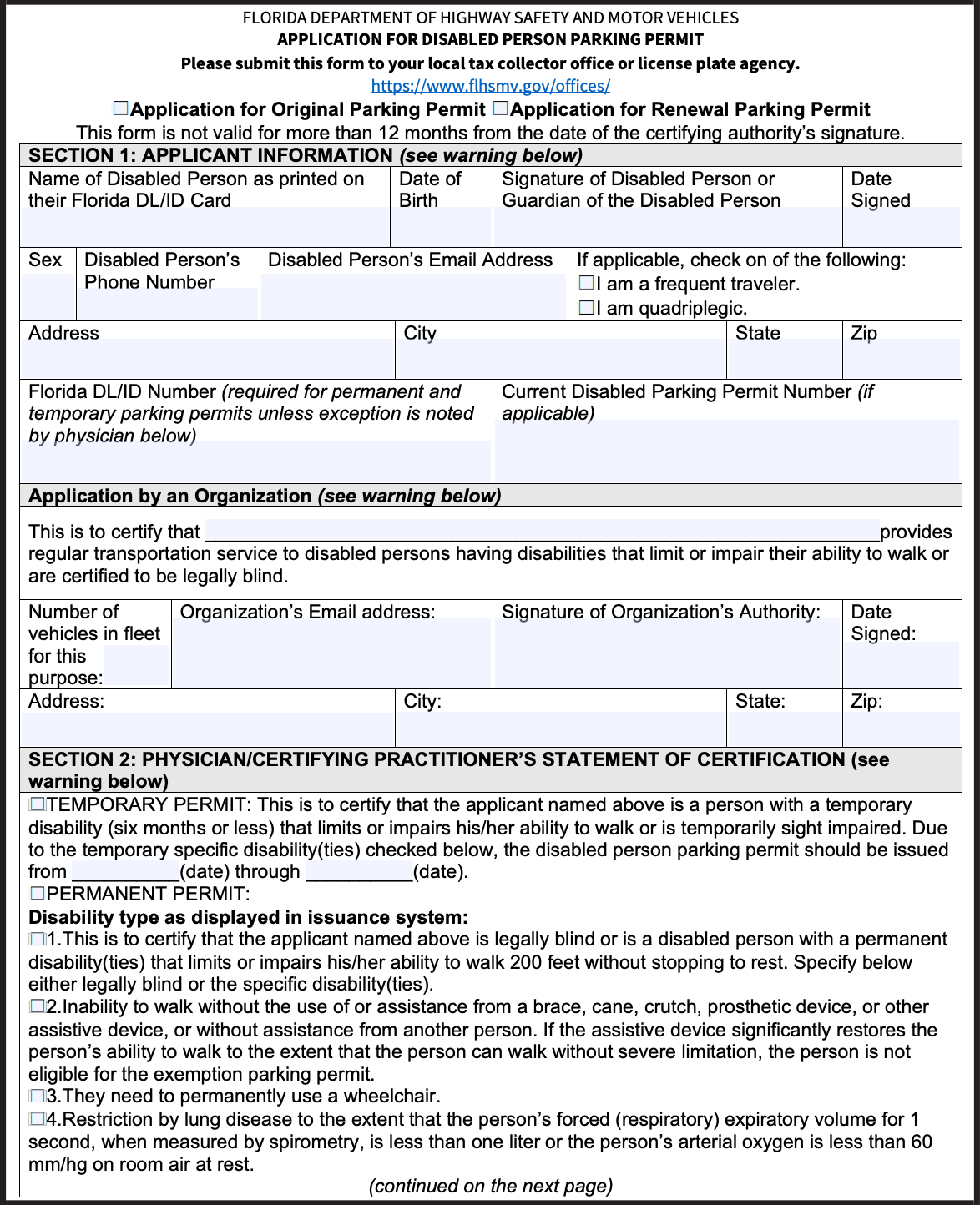
Florida residents can use Form HSMV 83039, Application for Disabled Person Parking Permit, to request an official disabled parking placard. FloridaLegalTemplates provides this form in PDF format for applicants who need to apply for a permanent, temporary, or qualifying lifetime disabled parking permit.
The form version identified for this page is HSMV 83039 (Rev. 10/26).
You can also access the official state application directly from the Florida Department of Highway Safety and Motor Vehicles (FLHSMV): Official Florida Disabled Person Parking Permit Application (HSMV 83039)
The FLHSMV website currently provides Form HSMV 83039 marked Rev. 06/22/22. However, this version does not reflect the 2026 statutory changes concerning lifetime permits and permanent permit renewals. It also does not include all the certification language and warning placements required under Florida Statutes § 320.0848. Before submitting an application, applicants should confirm with their local tax collector or license plate agency which version is currently accepted.
The application collects information from the person requesting the permit and requires a medical certification from an authorized practitioner. The issuing agency also completes its designated processing section.
The form is intended for applicants seeking:
- Permanent or long-term permits: For qualifying disabilities that substantially affect mobility.
- Temporary permits: For temporary mobility impairments expected to last for a limited period.
- Lifetime permits: For individuals certified as permanently disabled because of permanent dismemberment or amputation who need the parking permit because of that condition.
Remember that submitting a signed HSMV 83039 does not give you immediate parking privileges. The application must be processed, and FLHSMV or its authorized agent must issue the official placard with the required validation stickers.
How to Get a Disabled Parking Permit in Florida: Eligibility Requirements
Florida does not issue disabled parking permits simply because someone has a medical diagnosis or physical disability. The applicant must meet the specific eligibility criteria established under Florida Statutes § 320.0848.
For permanent or long-term permits, the medical condition must meet the statutory mobility or legal-blindness requirements. Temporary permits are available for qualifying temporary mobility impairments, while lifetime permits have a separate eligibility category for permanent dismemberment or amputation.
Permanent or Long-Term Disabled Parking Permit
A permanent or long-term Florida disabled parking permit is available to someone who is legally blind or has a qualifying medical condition that makes walking 200 feet without stopping to rest impossible.
Florida law identifies several qualifying conditions, including:
- Inability to walk without assistance: A person cannot walk without using a brace, cane, crutch, prosthetic device, or another assistive device, or without assistance from another person. However, if the device significantly restores walking ability so that the person can walk without severe limitation, the person does not qualify under this criterion.
- Permanent wheelchair use: A person needs to permanently use a wheelchair for mobility.
- Qualifying lung disease: The condition limits respiratory function to the extent that forced expiratory volume in one second is less than one liter, or arterial oxygen is below 60 mm/Hg on room air at rest.
- Portable oxygen use: A person requires portable oxygen.
- Qualifying cardiac condition: Functional limitations are classified as Class III or Class IV under American Heart Association standards.
- Severe walking limitations: An arthritic, neurological, or orthopedic condition severely limits the person’s ability to walk.
- Legal blindness: The applicant is currently certified as legally blind.
The medical practitioner must certify that the applicant meets the applicable statutory criteria. Having arthritis, a heart condition, or another listed diagnosis does not automatically qualify someone. The condition must satisfy the specific legal eligibility requirements.
A permanent or long-term permit can be issued for up to four years and expires on the applicant’s birthday.
Temporary Disabled Parking Permit
A Florida temporary disabled parking permit is intended for someone experiencing a mobility impairment that is expected to improve or resolve over time.
For example, an individual recovering from surgery or a serious injury may have difficulty walking for several months and require temporary accessible parking privileges during recovery.
The application must contain medical certification from an authorized practitioner identifying the temporary condition and the period for which the permit is needed.
Under § 320.0848(3), the following rules apply:
- A temporary permit is issued for the period specified by the certifying practitioner.
- The maximum validity period is six months.
- The statutory fee is $15.
- The permit must display its expiration date prominently.
- A new application and medical certification are required when another temporary permit is requested after the previous one expires.
Florida law also provides that a person cannot be required to pay the disabled parking permit fee more than once within a 12-month period from the previous fee payment.
Temporary permits are not renewed in the same way as permanent permits. Applicants who continue to experience qualifying mobility limitations must complete the required application process again.
Lifetime Disabled Parking Permit for Permanent Dismemberment or Amputation
Florida introduced a separate lifetime disabled parking permit category through the 2025 statutory amendments that became effective July 1, 2026.
This category applies to a person who:
- Has permanent dismemberment or an amputation.
- Is certified as permanently disabled because of that condition.
- Needs a disabled parking permit because of the permanent dismemberment or amputation.
A lifetime permit is different from an ordinary permanent permit. While a permanent permit expires and is subject to the applicable renewal process, a lifetime permit remains valid from its issuance date until the permit holder’s death.
It is not subject to the ordinary four-year renewal requirement under § 320.0848(1)(a)3.
The lifetime category is specifically tied to permanent dismemberment or amputation. A person does not qualify for this permit simply because another medical condition is expected to last for life.
Can a Parent or Guardian Apply on Behalf of Someone With a Disability?
Yes. A parent or legal guardian can complete and sign the applicant’s portion of Form HSMV 83039 when applying on behalf of someone who cannot complete the application themselves.
This is particularly relevant when the applicant is a minor or an individual who needs assistance with the application process.
However, the parent or guardian’s signature does not replace the medical certification. An authorized practitioner must still complete the appropriate disability certification section.
The application must contain all three required signatures:
- The physician or other authorized certifying practitioner.
- The applicant or the applicant’s parent or guardian.
- The employee of the authorized issuing agency who processes the application.
Florida law does not establish a minimum age for disabled parking permit eligibility. Additionally, under § 322.051(1), a person with a disability who applies for a disabled parking permit may obtain a Florida identification card regardless of age.
Who Can Sign the Florida Disabled Parking Permit Application?
Not every healthcare professional is legally authorized to certify eligibility for a Florida disabled parking permit.
Under § 320.0848(1)(b)2., Florida identifies specific medical practitioners who can complete the disability certification on HSMV 83039.
The practitioner must evaluate the applicant’s condition and certify that it satisfies the applicable eligibility requirements.
Florida-Authorized Medical Certifying Practitioners
The following professionals are authorized to certify disability eligibility under Florida law:
- Physicians: Licensed under Chapter 458 or Chapter 459, Florida Statutes.
- Chiropractors: Licensed under Chapter 460.
- Podiatric physicians: Licensed under Chapter 461.
- Optometrists: Licensed under Chapter 463, for qualifying visual impairments such as legal blindness.
- Advanced Practice Registered Nurses (APRNs): Licensed under Chapter 464 and working under the required protocol of a licensed physician.
- Physician Assistants: Licensed under Chapter 458 or Chapter 459.
The practitioner must complete the medical certification accurately, including the applicable disability classification, eligibility information, duration of the condition, and professional identification details.
A healthcare professional who does not fall within the statutory categories cannot certify the application merely because they are familiar with the applicant’s medical history.
Can an Out-of-State Doctor Certify HSMV 83039?
Yes. A physician licensed in another state can certify a Florida disabled parking permit application, but additional documentation is required.
The physician must:
- Hold a comparable medical license in another state.
- Provide documentation showing their out-of-state licensure.
- Submit a signed statement verifying their knowledge of Florida’s disabled parking permit eligibility guidelines.
These additional requirements matter for applicants who receive medical treatment outside Florida but need a Florida-issued parking permit.
An out-of-state doctor’s signature alone is not sufficient when the required licensing documentation and signed eligibility statement are missing.
The requirements are established under § 320.0848(1)(b)2.
What Information Is Required on Form HSMV 83039?
Form HSMV 83039 contains different sections for the applicant, medical certifying practitioner, and issuing agency. Each party has a separate responsibility, so applicants should avoid completing fields intended for the medical provider or government employee.
Applicant Information
The applicant’s section identifies the individual requesting the Florida disabled parking placard.
The information generally includes:
- Full legal name.
- Date of birth.
- Residential and mailing address.
- Contact information.
- Florida driver’s license or identification card number.
- Existing parking permit number, when applicable.
- Information relating to an additional placard, if requested.
- Applicant’s signature or the signature of their parent or guardian.
The identification number is particularly important because Florida law requires the placard to display the applicant’s driver’s license or state identification card number.
There is an exception for applicants whose disability prevents them from physically visiting or being transported to a driver license or tax collector office to obtain Florida identification. This exception requires the appropriate physician certification.
Physician or Certifying Practitioner’s Information
The medical certification section establishes whether the applicant meets Florida’s disability requirements.
The authorized practitioner must provide the applicable information, including:
- The applicant’s qualifying disability.
- Appropriate disability classification.
- Whether the application is for a permanent or temporary permit.
- Applicable eligibility criteria.
- Duration of the medical condition.
- Practitioner’s full name.
- Business address.
- Certification or license number.
- State of licensure.
- Practitioner’s signature and certification date.
For a second placard, the required justification must also be provided. Florida may issue no more than two disabled parking permits to one eligible applicant. A second permit may be issued only if the applicant states that they are a frequent traveler or a quadriplegic.
The medical provider should select the qualifying medical criteria based on the actual examination and statutory requirements rather than simply relying on the applicant’s description of their condition.
Special Exception for Applicants Unable to Obtain Florida Identification
Florida normally requires the disabled parking placard to display the applicant’s Florida driver’s license or state identification card number.
However, § 320.0848(2)(a) provides an exception for certain applicants with severe disabilities.
The exception applies when the severity of the disability prevents the individual from physically visiting or being transported to a driver license or tax collector office to obtain the necessary Florida identification.
In this situation, the certifying physician can sign the exemption section of the parking permit application.
This allows the applicant to be exempted from obtaining the driver’s license or identification card number that would otherwise appear on the placard.
The exception is not automatic. The physician must certify the qualifying circumstances on the application.
Agency Processing Section
The final portion of the application is reserved for the authorized issuing agency.
The employee processing the application reviews the submitted information and completes the applicable government processing section.
Applicants should leave this portion blank when submitting HSMV 83039. It is not a field that the applicant or their physician should complete.
The processing employee’s signature is also one of the three signatures identified under § 320.0848(1)(c)3.
Mandatory Certification Language and False-Statement Warning
Florida law requires specific statements to appear on the disabled parking permit application.
These are statutory requirements rather than optional wording that applicants or medical providers can modify.
Mandatory statement on the certificate of disability:
The certificate must contain the following statement in bold letters:
A disabled parking permit may be issued only for a medical necessity that severely affects mobility.
The application must also contain a criminal penalty warning immediately below the physician’s signature and immediately below the applicant’s signature.
The prescribed statutory warning is:
Knowingly providing false information on this application is a misdemeanor of the first degree, punishable as provided in s. 775.082, Florida Statutes, or s. 775.083, Florida Statutes. The penalty is up to 1 year in jail or a fine of $1,000, or both.
These requirements come from § 320.0848(1)(c) and (5).
Knowingly providing false or misleading information can result in first-degree misdemeanor charges. False certification can also expose a medical practitioner to professional licensing discipline.
Applicants should therefore use the current official application rather than modifying an older form or removing its required disclosures.
How to Fill Out Florida Form HSMV 83039
Completing the Florida disabled parking permit application involves more than entering personal information. The applicant and the medical practitioner must provide the information relevant to the requested permit classification.
The following steps help prevent missing information and avoidable processing problems.
Step 1 – Enter the Applicant’s Personal Information
Start with the applicant’s identification and contact information.
Enter the full legal name, date of birth, address, and other requested details. The information should correspond with the applicant’s Florida identification records wherever applicable.
Provide the Florida driver’s license or identification card number in the designated field.
If the applicant cannot obtain Florida identification because of the severity of their disability, discuss the statutory physician-certified exception with the medical provider before submitting the application.
For an existing permit holder, enter the current permit number whenever the form requests it.
Step 2 – Determine the Appropriate Permit Type
Identify whether the application concerns a temporary, permanent, or qualifying lifetime disabled parking permit.
The appropriate classification depends on the applicant’s medical circumstances and the statutory requirements.
For example, someone with a temporary mobility impairment following surgery may qualify for a temporary permit, while someone with a qualifying long-term condition may be eligible for a permanent permit.
A lifetime permit requires the separate statutory criteria concerning permanent dismemberment or amputation.
Do not select a medical eligibility category solely because a diagnosis appears on the form. The authorized practitioner must certify that the applicant meets the relevant requirements.
Step 3 – Have the Authorized Practitioner Complete the Medical Certification
Arrange for an authorized medical practitioner to complete the certification section.
The practitioner should identify the applicable disability, provide the required professional information, and certify the condition’s duration and eligibility criteria.
Check that the practitioner has included:
- Their complete name and professional details.
- Certification or license number.
- State of licensure.
- Applicable disability classification.
- Required signature and date.
For an out-of-state physician, attach the additional licensing documentation and signed statement regarding Florida’s eligibility guidelines.
Do not submit the form with only the applicant’s description of their medical condition. The statutory medical certification is a required part of the application.
Step 4 – Review the Required Signatures
Before submitting the Florida disabled parking permit application, check that the appropriate parties have signed their sections.
The required signatures are:
- Applicant or parent/guardian.
- Authorized medical practitioner.
- Processing employee of the issuing agency.
The applicant and medical practitioner complete their respective sections before submission. The authorized employee signs the processing section during agency handling.
A notarial acknowledgment is not required by the statutory application formalities described in § 320.0848. The form’s required signatures and mandatory disclosures should not be confused with the execution requirements for an affidavit or notarized legal document.
Step 5 – Check the Form Before Submission
A final review can help prevent delays caused by incomplete information.
Use this checklist:
- Applicant’s full name and date of birth are entered correctly.
- Address and contact information are complete.
- Required Florida driver’s license or identification information is supplied, or the applicable exception is certified.
- Correct permit classification is identified.
- Medical certification is completed by an authorized practitioner.
- Practitioner details and license information are included.
- Required supporting documentation is attached for an out-of-state physician.
- Applicant or parent/guardian has signed the appropriate section.
- Medical practitioner has signed and dated the certification.
- Required statutory warning statements are present.
- Additional-placard information is completed when applicable.
The processing employee’s signature should be left for the issuing agency.
Where to Submit the Florida Disabled Parking Permit Application
After completing HSMV 83039, the applicant must submit it to FLHSMV or an authorized local issuing agency.
This is an official government application, not a private legal document that needs to be recorded with a county clerk.
Submit Through a County Tax Collector Office or License Plate Agency
Applicants can submit the completed Florida disabled parking permit application through an authorized county tax collector office or license plate agency.
The usual process is to:
- Complete the applicant’s portion of HSMV 83039.
- Have an authorized practitioner complete and sign the medical certification.
- Gather any required supporting documents.
- Submit the application to an authorized issuing location.
- Allow the agency to review and process the application.
Applicants should check their local office’s requirements before visiting. Office arrangements, appointment policies, and service options can vary.
To find an authorized location, use the official FLHSMV office locator: Florida Tax Collector Offices and License Plate Agency Locator
The state also provides additional information about disabled person parking permits here: FLHSMV Disabled Person Parking Permits
Can You Submit HSMV 83039 by Mail or Fax?
Fax submission is recognized in FLHSMV’s administrative procedures. In particular, the medical certification may be faxed directly from the certifying authority to the issuing office.
The fact that a form can be faxed does not mean that every applicant can independently fax it to any government office.
Mail, drop-box, and other convenience submission options depend on the receiving county or issuing agency.
Before sending the application, contact the local tax collector office to confirm:
- Whether it accepts applications by mail.
- Whether a drop-box service is available.
- Whether the medical provider can fax the certification directly.
- Whether original signatures or additional documents are requested.
Do not assume that one county’s submission arrangements apply throughout Florida.
What Happens After You Submit the Application?
Once the application reaches the issuing agency, the employee processes the information and checks the required documentation.
The agency reviews the applicant’s information, medical certification, and relevant supporting documents.
If the applicant satisfies the applicable requirements, the authorized issuing agency processes the permit and issues the official parking placard.
The issued permit must include the required validation stickers on both sides, identifying its expiration date or lifetime status.
This distinction matters: A physician’s signature does not authorize the applicant to use disabled parking spaces. Parking privileges arise from the official permit issued after the application has been processed.
Florida Disabled Parking Permit Fees and Expiration Periods
Florida’s disabled parking permit fees and expiration periods depend on the type of permit issued.
The following table summarizes the statutory requirements and the available official agency fee information.
| Permit type | Validity | Fee information |
|---|---|---|
| Permanent/long-term | Up to 4 years, expiring on the applicant’s birthday | No charge for permanent/long-term permits under the published FLHSMV procedure |
| Lifetime | Until the permit holder’s death | Confirm the applicable current agency fee instructions |
| Temporary | Up to 6 months | $15, subject to the statutory once-per-12-month fee limitation |
The four-year validity, lifetime category, and six-month temporary permit limit are established under § 320.0848. The published FLHSMV Procedure RS-38 identifies no fee for permanent or long-term permits.
When Does a Permanent Permit Expire?
A permanent or long-term Florida disabled parking permit is issued for up to four years.
Its expiration date is tied to the permit holder’s birthday rather than a uniform calendar-year expiration date.
For example, a person whose permanent permit is issued for a four-year period will have an expiration date corresponding to their birthday.
Applicants should check the expiration information printed on both sides of the issued placard rather than calculating the date themselves.
Does a Lifetime Permit Need Renewal?
No. A qualifying lifetime disabled parking permit remains valid until the permit holder’s death.
Unlike ordinary permanent permits, it is not subject to the regular four-year renewal requirement.
However, lifetime validity does not remove the original eligibility and medical certification requirements. The applicant must qualify under the permanent dismemberment or amputation provision in § 320.0848(1)(a)3.
How Much Does a Temporary Permit Cost?
The statutory fee for a temporary Florida disabled parking permit is $15.
The permit can remain valid for the period specified by the certifying practitioner, but cannot exceed six months.
Florida law also states that a person is not required to pay the parking permit fee more than once within a 12-month period from the date of the previous fee payment.
When applying for another temporary permit, the applicant should confirm the fee with the issuing office, particularly when a previous permit fee was paid within the preceding 12 months.
Florida Disabled Parking Permit Renewal Requirements
Florida changed its permanent disabled parking permit renewal rules through statutory amendments effective July 1, 2026.
One of the main changes is that applicants previously certified as permanently disabled do not need another disability certificate for their first subsequent four-year renewal.
This makes it important to distinguish between the first renewal following the original permanent permit issuance and later renewals.
First Four-Year Renewal of a Permanent Permit
Under § 320.0848(1)(d), FLHSMV must renew the permit of a person previously certified as permanently disabled for a subsequent four-year period without requiring another certificate of disability.
In other words, an applicant who received a permanent permit after the required medical certification does not need to obtain another medical certificate simply because the first four-year permit is expiring.
This exception applies to the first subsequent four-year renewal covered by the statute.
It helps reduce unnecessary medical recertification for individuals whose permanent disability has already been established.
Medical Recertification for Later Renewals
After that subsequent four-year period, the applicant must provide a new certificate of disability to renew the permit.
The certificate must have been issued within the previous 12 months.
This means the applicant should arrange medical recertification before applying for the later renewal rather than submitting an outdated certificate.
The timing requirement is based on the date the medical practitioner issues the certification, not simply the date the applicant last received the placard.
The 2026 statutory wording provides this distinction between the first subsequent renewal and renewals after that period.
Renewal for Permanently and Totally Disabled Veterans
Florida provides an alternative documentation option for certain veterans.
A veteran who was previously evaluated and certified by the U.S. Department of Veterans Affairs or a branch of the United States Armed Forces as permanently and totally disabled because of a service-connected disability may submit qualifying VA documentation instead of a new medical disability certificate.
Under § 320.0848(1)(d), the accepted documentation is VA Form Letter 27-333, or its equivalent, issued within the preceding 12 months.
The applicant should confirm the currently accepted document format with the issuing agency before submitting the renewal.
Can You Renew Online?
Some eligible permanent permit holders may be able to use the FLHSMV MyDMV Portal for routine renewal transactions.
However, online renewal should not be assumed to be available for every application.
The available method can depend on the permit holder’s record, the renewal requirements, and whether additional medical certification is needed.
Applicants who need recertification or have an unusual renewal situation should contact FLHSMV or their county tax collector before relying on the online option.
The official disabled parking permit information page is: FLHSMV Disabled Parking Permit Information and Renewal Guidance
How to Replace a Lost or Stolen Florida Disabled Parking Permit
A lost, stolen, or damaged Florida disabled parking placard should be replaced through the authorized issuing agency.
Replacement is different from an ordinary renewal. The applicant is requesting a replacement for an existing permit rather than applying for a new period of parking privileges.
Which Forms Are Required?
The principal replacement document is Form HSMV 83146, Application for Replacement License Plate, Validation Decal or Parking Permit.
The form identifies the type of replacement being requested and the reason the original placard is no longer available.
It includes options for lost, destroyed, damaged, defaced, stolen, and other replacement circumstances.
Official form: Florida Form HSMV 83146 – Application for Replacement Parking Permit
Depending on the circumstances and statutory certification requirements, the applicant must also provide Form HSMV 83039 or the relevant disability certification.
For example, the replacement procedure generally requires a certificate of disability issued within the previous 12 months. Lifetime permit holders can provide a certificate issued at any time under § 320.0848(2)(d)3.
Eligible permanently and totally disabled veterans may also use the permitted VA documentation alternative.
Replacement Fees and Supporting Documentation
Florida Statutes § 320.0848(2)(d) establishes a $1 replacement fee for a lost or stolen disabled parking permit.
However, the fee is waived when the applicant submits a police report documenting that the permit was stolen.
The statutory replacement requirements also include:
- An application on the form prescribed by FLHSMV.
- A certificate of disability issued within the preceding 12 months, subject to the statutory exceptions.
- Applicable VA documentation for qualifying permanently and totally disabled veterans.
- A certificate of disability issued at any time for a lifetime permit holder.
There is an administrative discrepancy worth checking before visiting the office. The statute specifies a $1 replacement fee, while the published FLHSMV Procedure RS-38 (Rev. 07/25) states that replacement of permanent, long-term, or temporary parking permits carries no fee.
The $1 statutory replacement fee was already in place before RS-38 (Rev. 07/25) was issued, so applicants should confirm the actual processing fee with their local tax collector or license plate agency.
How to Use a Florida Disabled Parking Placard After Approval
Receiving the official placard is only the first step. The permit holder must also follow Florida’s display and usage requirements to use accessible parking spaces lawfully.
How Must the Placard Be Displayed?
Florida requires the disabled parking placard to be displayed on the vehicle’s rearview mirror when the vehicle is parked in a designated accessible parking space.
The permit number must be visible from the front of the vehicle.
FLHSMV’s administrative instructions also direct permit holders to hang the placard with the printed permit number facing the front windshield so that it can be seen from outside.
The issued placard must have the required validation stickers showing the applicable expiration month and year, or indicating that a lifetime permit does not expire.
Remember to remove the hanging placard while driving if it obstructs the driver’s view.
Does the Permit Belong to the Vehicle or the Disabled Person?
A Florida disabled parking placard is issued to the eligible individual, not permanently assigned to a specific vehicle.
This means the permit holder can use the placard in different vehicles when being transported in those vehicles.
For example, someone with a valid disabled parking placard may use it when travelling in their own vehicle or when a family member drives them to an appointment.
However, the vehicle must be transporting the person to whom the permit was issued. The driver cannot use the placard simply because they are related to the permit holder.
Must You Carry Your Florida Driver License or ID?
Yes. Florida law requires the applicant’s driver’s license or state identification card number to appear on one side of the disabled parking placard.
The permit holder must carry the corresponding identification while using the permit.
This allows law enforcement officers and parking enforcement specialists to check whether the placard belongs to the individual being transported.
There is a statutory exception for applicants whose qualifying disability prevents them from obtaining Florida identification. In those circumstances, the physician must complete the appropriate exemption section of the application.
Can Someone Use Your Placard Without You Being in the Vehicle?
No. A family member, friend, or other driver cannot lawfully use someone else’s disabled parking placard when the permit holder is not being transported in the vehicle.
The parking privileges are connected to the eligible individual, not the person driving.
Under § 316.1955(1), the vehicle must be transporting the person to whom the permit was issued.
Furthermore, § 320.0848(7) makes it a second-degree misdemeanor to fraudulently obtain or unlawfully display another person’s disabled parking permit while occupying an accessible parking space or access aisle when the permit owner is not being transported.
Unauthorized replicas used with the intent to deceive are also covered by this provision.
Law enforcement officers and parking enforcement specialists may confiscate unlawfully used permits. After a finding of guilt or a plea of nolo contendere, the charging agency must destroy the confiscated permit. A new permit is barred for four years only if a finding of guilt or plea of nolo contendere for fraudulent or other unlawful use follows a prior finding of guilt or plea for fraudulent or other unlawful use of a disabled parking permit issued to the same registered permit holder.
Does a Disabled Parking Permit Make All Parking Free?
No. A Florida disabled parking placard does not provide unlimited free parking throughout the state.
Under § 316.1964, qualifying vehicles displaying a valid permit receive certain parking-fee exemptions, but several limitations apply.
For on-street parking meters that restrict parking duration, the statutory no-charge period is a maximum of four hours. A local government may extend that period through a local ordinance.
Other important limitations include:
- Public parking facilities used for certain events at convention centers, cruise-port terminals, sports stadiums, arenas, coliseums, and auditoriums may charge the same parking fees as other vehicles.
- Airports and parking facilities used for air travel may charge parking fees, but publicly owned or operated airports must provide free parking to vehicles displaying qualifying disabled-veteran license plates, vehicles with specialized disability equipment such as ramps, lifts, or foot or hand controls, or vehicles displaying a Florida Toll Exemption permit.
- Timed municipal or county parking facilities may also impose applicable fees, except for vehicles with specialized disability equipment such as ramps, lifts, or foot or hand controls, qualifying disabled-veteran license plates, or a Florida Toll Exemption permit.
- Disabled parking privileges do not authorize parking in fire zones, bus loading zones, access aisles, or prohibited areas.
The exemption applies only when the vehicle is transporting the person to whom the permit was issued.
Therefore, having a placard does not mean every parking facility must provide free parking.
Common Mistakes When Applying for a Florida Disabled Parking Permit
Even when someone meets Florida’s disability criteria, mistakes in the HSMV 83039 application can create processing problems or result in an improper permit being issued.
The following are errors applicants should avoid.
1. Submitting an outdated application form
Using an older edition of HSMV 83039 can cause problems if it does not contain the current application requirements and statutory disclosures.
Always check the revision date before completing the form. For this page, the identified edition is Rev. 10/26.
2. Having an unauthorized practitioner certify the disability
Not every healthcare professional can complete the certification.
Florida identifies specific practitioner categories under § 320.0848. A medical professional outside those categories cannot certify eligibility simply because they have treated the applicant.
Check the practitioner’s qualifications before asking them to complete the form.
3. Failing to provide additional documentation from an out-of-state physician
An out-of-state physician must provide documentation of their licensure and a signed statement confirming knowledge of Florida’s eligibility guidelines.
A certification without these supporting documents may not satisfy the statutory requirements.
4. Missing applicant or physician signatures
Both the applicant or their parent/guardian and the authorized medical practitioner must sign their respective portions.
Leaving either signature blank can prevent the issuing agency from processing the application properly.
The government employee’s signature must also be completed during agency processing.
5. Selecting the wrong permit classification
Permanent, temporary, and lifetime permits have different eligibility requirements.
For example, a condition that is expected to improve may support a temporary application rather than a permanent one. Similarly, a lifetime permit has specific dismemberment or amputation requirements.
The medical certification should accurately support the requested permit type.
6. Providing incomplete medical certification information
Missing practitioner details, disability classifications, license numbers, or information about the duration of the condition can create avoidable processing issues.
Applicants should review the certification with their medical provider before submission.
7. Assuming the permit is automatically issued after the doctor signs
A doctor’s signature does not create an active parking permit.
The application must still be submitted and processed by the authorized agency. Parking privileges begin only after the official placard is issued.
8. Overlooking the special identification exception
Some applicants cannot physically visit or be transported to an office to obtain a Florida driver’s license or identification card because of the severity of their disability.
Florida provides a specific physician-certified exception.
Applicants who qualify should make sure the medical provider completes the appropriate exemption section rather than leaving the identification requirement unexplained.
9. Confusing permanent permit renewal with temporary permit reapplication
Permanent permits have a special renewal process, including the first subsequent four-year renewal exception under the 2026 statutory amendments.
Temporary permits are different. They cannot simply be renewed after expiration; another application and medical certification are required.
Understanding the distinction can help applicants avoid submitting the wrong documents.
10. Using an expired or reported lost or stolen placard
A permit should not be used after it expires or after it has been reported lost or stolen.
Florida law allows law enforcement officers and parking enforcement specialists to confiscate expired, defaced, unlawfully used, or reported lost or stolen permits.
Permit holders should check their expiration date and obtain a replacement when necessary rather than continuing to use an invalid placard.
FAQs
1. What form do I need to apply for a Florida disabled parking permit?
You need Form HSMV 83039, Application for Disabled Person Parking Permit.
It is the official Florida application used to request a permanent, temporary, or qualifying lifetime disabled parking placard.
The applicant completes the personal information section, while an authorized medical practitioner completes the disability certification. The application is then submitted to a county tax collector office or license plate agency for processing.
2. Can my doctor sign a Florida disabled parking permit application?
Yes, but the doctor or other healthcare professional must fall within the categories authorized by Florida law.
These include physicians, chiropractic physicians, podiatric physicians, optometrists for qualifying visual impairments, qualifying APRNs, and physician assistants.
An out-of-state physician may also certify the application if the required licensing documentation and signed statement regarding Florida’s eligibility guidelines accompany it.
The applicable requirements are established under § 320.0848(1)(b)2.
3. Do I need a new medical certification to renew my Florida disabled parking permit?
Not for the first subsequent four-year renewal of a permanent permit when the applicant was previously certified as permanently disabled.
Under the 2026 amendments to § 320.0848(1)(d), FLHSMV must allow that renewal without another disability certificate or qualifying VA documentation.
After that additional four-year period, the applicant must provide a new disability certificate issued within the previous 12 months.
Qualifying permanently and totally disabled veterans may submit the permitted VA documentation instead.
4. Can I get a Florida disabled parking permit if I do not have a Florida driver’s license?
Yes, in certain circumstances.
Florida allows a physician-certified exception when the severity of the applicant’s disability prevents them from physically visiting or being transported to a driver license or tax collector office to obtain a Florida driver’s license or identification card.
The certifying physician must complete the appropriate exemption section of HSMV 83039.
Additionally, § 322.051(1) allows a person with a disability who applies for a disabled parking permit to obtain a Florida identification card regardless of age.
5. Can I use a Florida disabled parking permit immediately after my doctor signs the application?
No. The doctor’s signature alone does not authorize the applicant to park in designated accessible parking spaces.
Form HSMV 83039 must first be submitted to an authorized issuing agency and processed.
The parking privileges begin after the official disabled parking placard has been issued with the required validation stickers.
Disclaimer: This article provides general information about Florida disabled parking permit requirements and Form HSMV 83039. It is not individualized legal advice. Applicants should confirm current application, fee, and processing requirements with FLHSMV or their local tax collector office.