Florida VIN Verification Form | Free PDF Template
Candice Hayden, Legal Writer
Carly Johansson, Florida Contract Attorney Last Updated: November 24, 2026
Free Florida VIN Verification Form (HSMV 82042 PDF)
Get the Florida VIN Verification Form (PDF): Florida VIN Verification Form – HSMV 82042 PDF
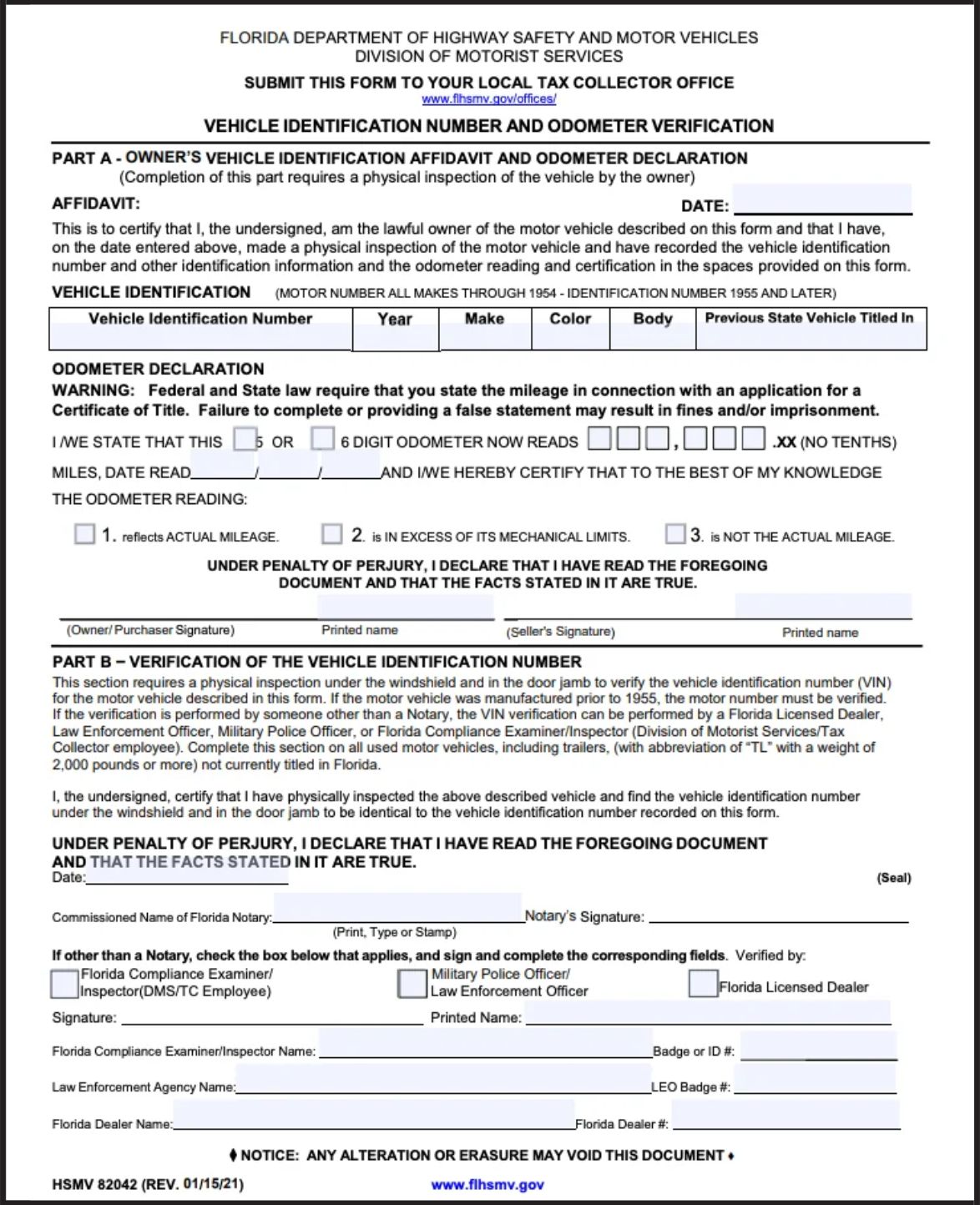
The official government form is titled Vehicle Identification Number and Odometer Verification. You can also access the agency-hosted version here: Official FLHSMV Form HSMV 82042 (PDF)
The form has two main sections:
- Part A – Owner’s Vehicle Identification Affidavit and Odometer Declaration: Records the vehicle’s identification details, the owner’s inspection, and the odometer reading and mileage certification.
- Part B – Verification of the Vehicle Identification Number: Records the physical VIN inspection performed by an authorized verifier, such as a law enforcement officer, licensed Florida dealer, qualifying FLHSMV employee, or Florida-commissioned notary.
The form is intended for applicable Florida title and registration transactions involving used vehicles, including vehicles that have not previously been titled in Florida.
You may not need the separate HSMV 82042 form in every title application. FLHSMV also permits Section 8 of Form HSMV 82040 MV to be used in place of the separate VIN verification form for the relevant transactions.
The form is a government-prescribed document, not a private vehicle sale agreement. Completing it does not independently transfer ownership or issue a Florida title.
Form revision: The government-hosted HSMV 82042 PDF currently displays Revision 01/15/21. Check the agency’s current version before completing your application, particularly if you are using an older copy. The revision date should not be confused with an expiration date.
When Do You Need a Florida VIN Verification?
Florida requires VIN verification in certain situations involving vehicles entering the state’s title or registration system.
The purpose is to establish that the identification number physically displayed on the vehicle matches the number provided in the supporting ownership and title documents. This helps identify the vehicle being presented for titling or registration.
Two principal situations can trigger the requirement.
1. Applying for a Florida title for a used vehicle that has never been titled in Florida
Under Florida Statutes § 319.23(3), an application for a certificate of title for a vehicle not previously titled in Florida must include the prescribed VIN verification documentation, unless an applicable exemption applies.
For example, someone purchasing a used car in Georgia and bringing it to Florida for its first Florida title may need to complete HSMV 82042.
Having a valid Georgia certificate of title does not automatically eliminate the Florida VIN verification requirement.
The title application must also contain acceptable evidence of ownership, such as the properly assigned out-of-state title or other qualifying ownership documentation.
2. Registering a vehicle previously registered outside Florida
Florida Statutes § 320.02(3) separately addresses VIN verification before registering a vehicle that was registered outside the state.
The application must include either a qualifying seller-and-purchaser VIN affidavit or an appropriate departmental form showing that the required physical examination was completed.
A new Florida resident bringing an existing vehicle from another state may encounter both title and registration requirements as part of the transaction.
These two statutory provisions address related but distinct requirements:
- Section 319.23(3) concerns the supporting documents for a Florida title application when a vehicle has not previously been titled in Florida.
- Section 320.02(3) concerns VIN verification before Florida registration of a vehicle registered outside the state.
The requirements should not be treated as interchangeable. The applicable process depends on the vehicle’s previous title and registration history.
Legal references:
Vehicles That Are Exempt From Florida VIN Verification
Not every vehicle requires a Florida VIN inspection. The exemptions depend partly on whether the applicant is pursuing a title or a registration.
For the Florida title process, § 319.23(3) exempts VIN verification for:
- New motor vehicles, regardless of whether purchased in Florida or out of state.
- Mobile homes.
- Trailers and semitrailers with a net weight of less than 2,000 pounds.
- Travel trailers.
- Camping trailers.
- Truck campers.
- Fifth-wheel recreation trailers.
FLHSMV Procedure TL-10 and the official HSMV 82042 instructions also identify off-highway vehicles as exempt from the relevant title VIN verification procedure.
The registration exemptions under § 320.02(3) have a somewhat different scope.
| Vehicle category | Title exemption under § 319.23(3) | Registration exemption under § 320.02(3) |
|---|---|---|
| New motor vehicle | Yes, regardless of purchase location | Only a new vehicle sold in Florida by a licensed dealer |
| Mobile home | Yes | Yes |
| Trailer or semitrailer under 2,000 pounds | Yes | Yes |
| Travel trailer | Yes | Yes |
| Camping trailer | Yes | Yes |
| Truck camper | Yes | Not expressly listed |
| Fifth-wheel recreation trailer | Yes | Not expressly listed |
Off-highway vehicles are also identified in FLHSMV’s title procedure, but should not automatically be treated as exempt under every separate registration requirement.
If your vehicle falls into an unusual classification, confirm the applicable exemption with your county tax collector before arranging an inspection. The title and registration exemption lists are not identical.
Relevant authorities:
Who Can Perform a Florida VIN Verification?
The person completing Part B of Form HSMV 82042 must be an authorized verifier. The inspection is not simply a paperwork review.
For the physical-inspection method, the vehicle must be examined so the verifier can compare its actual identifying number with the number recorded in Part A.
The owner completes the owner’s section, and the authorized verifier completes the appropriate portion of Part B.
Authorized VIN Verification Officials
For a Florida title application, the recognized verifier categories include:
- Law enforcement officers: A duly constituted law enforcement officer from any state may conduct the physical inspection.
- Military police officers: FLHSMV expressly recognizes military police officers in its title procedure and the HSMV 82042 form instructions.
- Licensed Florida motor vehicle dealers: A properly licensed Florida dealer may inspect and verify the vehicle.
- FLHSMV compliance examiners and qualifying tax collector employees or agents: Authorized Division of Motorist Services and tax collector personnel may perform the inspection.
- Florida-commissioned notaries public: A Florida notary may conduct the physical VIN verification for a Florida title application.
The verifier must physically inspect the vehicle and certify that the identification number is identical to the number recorded on the form.
Part B contains corresponding identification fields. Depending on who performs the verification, the required information may include:
- Law enforcement agency name and badge number.
- Military police or law enforcement identification.
- Florida dealer name and dealer license number.
- Compliance examiner or tax collector employee name and badge or ID number.
- Florida notary’s commissioned name, signature, and seal.
For the title-verification procedure, an out-of-state law enforcement officer is recognized under § 319.23(3)(a)2. However, an out-of-state notary should not automatically be treated as acceptable for the same title transaction.
FLHSMV’s Procedure TL-10 provides additional operational instructions concerning the authorized verification methods.
Official procedure: FLHSMV Procedure TL-10 – Original Certificate of Title
Can the Buyer and Seller Verify the VIN Without a Notary?
Yes. Florida law recognizes an alternative seller-and-purchaser affidavit method.
Under § 319.23(3)(a)1, the seller and purchaser may provide a sworn affidavit confirming that the VIN written on the affidavit is identical to the number displayed on the actual vehicle.
This is a separate method from having an authorized official complete Part B of HSMV 82042.
FLHSMV Procedure TL-10 also explains that the purchaser and seller may sign Part A of Form HSMV 82042 to verify the VIN and odometer reading instead of preparing a separate affidavit.
There is an important distinction between these methods:
- Seller-and-purchaser affidavit method: Both the seller and purchaser provide the required verification.
- Physical-inspection method: The purchaser/owner completes the form and an authorized verifier completes Part B. FLHSMV Procedure TL-10 states that only one purchaser/owner signature is required on HSMV 82042 when this method is used.
Therefore, the seller’s signature is not automatically required in every transaction involving HSMV 82042.
An ordinary informal statement or a VIN copied from the previous title is not a substitute for the required affidavit or physical verification.
Does Florida Require a Notary for VIN Verification?
No. Florida does not require notarization in every VIN verification transaction.
The available methods include physical verification by an authorized official or the qualifying seller-and-purchaser affidavit procedure.
For example, a law enforcement officer or licensed Florida dealer can complete the physical verification without requiring a separate notary to notarize the owner’s signature.
Florida Statutes § 92.525 also permits a written declaration under penalties of perjury as a method of verifying a document when verification is authorized or required by law.
The statute’s prescribed declaration begins:
Under penalties of perjury, I declare that I have read the foregoing document and that the facts stated in it are true.
The declaration must appear at the end of or immediately below the document being verified and above the signer’s signature.
A different situation arises when a Florida notary performs the physical verification in Part B. The notary must actually inspect the vehicle, complete the relevant verification fields, sign, print or stamp their commissioned name, and affix the required Florida notary seal.
Simply notarizing the owner’s signature without performing the required physical inspection does not accomplish the Part B verification.
Florida Statutes § 117.05 also establishes a $10 maximum fee for a standard notarial act, subject to the statutory exceptions. A separate vehicle inspection or service charge should not automatically be treated as a notarial fee.
Legal references:
- Florida Statutes § 92.525 – Verification of Documents
- Florida Statutes § 117.05 – Notary Requirements and Fees
- Florida Statutes § 117.107 – Prohibited Notarial Acts
How to Complete Florida Form HSMV 82042
Form HSMV 82042 has two parts, and each serves a different purpose.
Part A records the owner’s vehicle identification information and odometer declaration. Part B establishes that an authorized verifier has physically inspected the vehicle and confirmed its VIN.
Read the form before filling it out. The VIN, vehicle description, odometer information, and verifier details should be checked against the actual vehicle and supporting documents.
Part A – Owner’s Vehicle Identification Affidavit and Odometer Declaration
Part A is completed by the vehicle owner or purchaser as applicable. The owner must physically inspect the vehicle and enter the requested information.
Work through the fields in the order shown on the form.
1. Date of physical inspection
Enter the date on which the owner personally inspected the vehicle and recorded its identification information.
Make sure the date is accurate and consistent with the inspection.
2. Owner’s certification
Part A begins with a statement confirming that the undersigned is the lawful owner of the vehicle and has physically inspected it.
The person signing should understand this certification before signing.
3. Vehicle Identification Number
Enter the VIN exactly as displayed on the vehicle.
Do not rely exclusively on the number printed on an old registration card, insurance document, or out-of-state title. Compare it with the actual vehicle.
4. Vehicle year and make
Provide the manufacturer’s model year and vehicle make.
Check that these details agree with the supporting vehicle documents.
5. Color and body type
Enter the vehicle’s color and body description in the appropriate spaces.
6. Previous state vehicle titled in
Identify the state in which the vehicle was previously titled.
For example, a vehicle previously titled in Georgia should have Georgia entered in this field.
7. Odometer declaration
Enter the current odometer reading, the date it was read, and the applicable mileage certification. The next section explains this in more detail.
8. Owner and seller signatures
Complete the applicable signature fields based on the verification method.
If using the seller-and-purchaser affidavit method, both parties provide the required signatures. When the purchaser/owner uses the physical-inspection method with an authorized verifier completing Part B, FLHSMV Procedure TL-10 states that only one purchaser/owner signature is required.
Print the names clearly wherever requested.
How to Complete the Odometer Declaration
The odometer declaration records the mileage displayed by the vehicle when inspected. It is a separate but important part of the Florida VIN verification form.
The form provides the following instructions:
Odometer reading
Enter the current reading using the five- or six-digit option provided on the form.
The designated mileage reading does not include tenths of a mile. Do not include decimal mileage in the odometer entry.
For example, if the odometer displays 84,526.7 miles, the reported reading in the designated whole-mile field is 84,526.
Date mileage was read
Enter the date on which the odometer was checked.
This should correspond to the actual inspection rather than the date on which the form is later submitted.
Mileage certification
Select the one statement that accurately reflects the vehicle’s mileage:
- Reflects ACTUAL MILEAGE: Select this when the displayed reading accurately represents the vehicle’s actual mileage.
- Is IN EXCESS OF ITS MECHANICAL LIMITS: Select this when the odometer has reached its mechanical display limit and rolled over.
- Is NOT THE ACTUAL MILEAGE: Select this when the displayed reading does not represent the vehicle’s actual mileage.
These are different certifications. Do not select the option that seems most convenient or favorable to the transaction.
The form also contains this warning:
WARNING: Federal and State law require that you state the mileage in connection with an application for a Certificate of Title. Failure to complete or providing a false statement may result in fines and/or imprisonment.
Certain vehicles are exempt from federal and Florida odometer disclosure requirements. Under § 319.225(4), the exemptions include vehicles with a gross vehicle rating of more than 16,000 pounds, vehicles that are not self-propelled, and vehicles qualifying for the applicable age-based exemptions.
For age-based exemptions:
- Model year 2011 and newer vehicles are exempt after 20 years.
- Model year 2010 and older vehicles are exempt after 10 years.
These exemptions concern odometer disclosure, not the general VIN verification requirement. A vehicle can be exempt from odometer disclosure but still require VIN verification.
Legal reference: Florida Statutes § 319.225 – Odometer Disclosure Statements
Part B – Verification of the Vehicle Identification Number
Part B is completed by the authorized verifier when the physical-inspection method is used.
Unlike Part A, this section is not simply completed by copying information from ownership paperwork. It requires an actual inspection of the vehicle.
The form identifies two inspection locations:
- Under the windshield.
- Inside the door jamb.
The verifier checks the vehicle’s identifying number at the specified locations and confirms that it matches the VIN recorded in Part A.
The verifier then completes the applicable information, including:
- Date of physical inspection.
- Verification certification.
- Signature.
- Printed name.
- Official agency, dealer, or examiner identification, as applicable.
- Notary commission information and seal, where a Florida notary performs the verification.
For example, if a Florida licensed dealer performs the inspection, the dealer must provide the required dealer name and dealer number.
A law enforcement officer must provide the agency and badge information requested by the form.
A Florida notary completing Part B must provide their commissioned name, signature, and seal.
The verifier should not sign the form without physically examining the vehicle.
VIN Verification for Vehicles Manufactured Before 1955
Older vehicles may not have a modern 17-character VIN.
Form HSMV 82042 specifically distinguishes between:
- Motor numbers: For vehicles manufactured through 1954.
- Identification numbers: For vehicles manufactured in 1955 and later.
For a vehicle manufactured before 1955, the applicable motor number should be entered and verified instead of attempting to enter a modern VIN format.
Part B also instructs the verifier to confirm the motor number when the vehicle was manufactured before 1955.
This distinction is particularly relevant for antique and older vehicles whose identification systems differ from those used on modern vehicles. Use the identifying number required by the official form and applicable FLHSMV procedure.
Signatures and Perjury Declaration
Both the owner and the authorized verifier make declarations concerning the information they provide.
The official HSMV 82042 form contains the following printed statement:
UNDER PENALTY OF PERJURY, I DECLARE THAT I HAVE READ THE FOREGOING DOCUMENT AND THAT THE FACTS STATED IN IT ARE TRUE.
The declaration appears in Part A and Part B. However, the wording printed on HSMV 82042 is not identical to the written declaration prescribed by § 92.525(2), which begins “Under penalties of perjury.” Therefore, do not alter the government-issued form to change this wording. Florida counsel should confirm the intended legal effect before the form’s declaration is described as legally equivalent to the statutory wording.
By signing, each person certifies the truthfulness of the relevant information and their own inspection or verification.
False information should never be entered to complete a transaction more quickly. Florida Statutes § 92.525 makes a knowingly false written declaration a third-degree felony.
The form also carries an administrative warning:
NOTICE: ANY ALTERATION OR ERASURE MAY VOID THIS DOCUMENT.
If you enter an incorrect VIN, odometer reading, date, or other important information, it is safer to prepare a fresh form rather than make questionable handwritten alterations.
Do not ask a notary or authorized verifier to sign an incomplete form.
Legal reference: Florida Statutes § 92.525 – Perjury by False Written Declaration
Where to Submit the Completed Florida VIN Verification Form
The completed Florida VIN Verification Form is submitted as part of the applicable vehicle title or registration transaction.
The official HSMV 82042 instructions direct applicants to submit the form to their local county tax collector office.
Depending on the transaction, an authorized license plate agency may also process the application on behalf of FLHSMV.
The completed verification should accompany the relevant title or registration paperwork.
Submitting Form HSMV 82042 by itself does not issue a Florida certificate of title or vehicle registration. The agency must review the complete application and supporting documents.
You can locate an appropriate office using the official agency directory: Florida County Tax Collector and FLHSMV Office Locator
Documents to Prepare Along With Form HSMV 82042
The supporting documents depend on whether you are applying for a Florida title, registration, or both.
Commonly requested documents include:
- Completed Form HSMV 82042: The vehicle identification and odometer verification form, when applicable.
- Florida Application for Certificate of Motor Vehicle Title (HSMV 82040 MV): Required for the applicable title transaction. Section 8 may be used instead of a separate HSMV 82042.
- Out-of-state certificate of title: The existing title or other acceptable proof of ownership.
- Previous vehicle registration: Where applicable to the transaction.
- Government-issued identification: Additionally, effective October 1, 2026, an individual applying for Florida vehicle registration must provide proof of address satisfactory to the department, along with one of the following: a valid REAL ID driver license or identification card issued by Florida or another state; a valid, unexpired U.S. passport; or a valid, unexpired foreign passport accompanied by an unexpired Form I-94. However, Florida title applications have separate identification requirements under § 319.23(9).
- Proof of Florida insurance: When required for the particular registration transaction.
- Applicable title and registration fees: The amount depends on the vehicle and transaction.
Effective October 1, 2026, a business applicant for vehicle registration must provide a federal employer identification number, if applicable, or verification that the business is authorized to conduct business in Florida, or a Florida municipal or county business license or number.
Not every applicant needs every document on this list. For example, someone completing a title transfer may have different supporting-document requirements from someone handling registration for a vehicle already titled in another state.
The official Florida title application is available here: Florida Form HSMV 82040 MV – Application for Certificate of Motor Vehicle Title
Review the requirements with the county tax collector before attending an appointment, particularly if the original out-of-state title is unavailable or a lienholder is involved.
Can You Complete VIN Verification at a Florida Tax Collector Office?
Some Florida tax collector offices provide VIN verification services at their locations.
This can be convenient for applicants who have not already arranged an inspection with an authorized verifier.
However, inspection availability and appointment procedures vary by county. Do not assume that every tax collector office provides the service or accepts walk-in inspections.
Before visiting, contact the specific office and ask:
- Whether it performs physical VIN inspections.
- Whether the vehicle must be brought to the office.
- Whether an appointment is necessary.
- Whether you need to complete Part A before arriving.
- Which supporting documents should accompany the form.
If you already have a properly completed HSMV 82042, you may be able to submit the verification with the rest of your application without arranging another inspection, subject to the agency’s review.
What If a Bank or Lienholder Holds the Out-of-State Title?
A vehicle financed through a bank or other lender may have an out-of-state electronic or paper title held by the lienholder. Leased vehicles can also involve a similar arrangement with the lessor.
This can change how the Florida application is processed.
For certain transactions, FLHSMV permits a registration-only transaction while an out-of-state lienholder or lessor holds the title. However, this is not a blanket exemption from Florida’s title requirements.
FLHSMV’s guidance for people moving into Florida explains that new residents generally need both Florida title and registration. A temporary registration-only arrangement may be available while the agency waits for the out-of-state title from the lienholder or lessor.
Accordingly, a person should not assume that having a lender hold the title removes the need to obtain a Florida title.
The applicable process and supporting documentation should be confirmed with the county tax collector.
Relevant official procedures:
- FLHSMV Procedure RS-04 – Registration Only Registration
- FLHSMV Information Notice INFO23-026 – Titling and Registering Vehicles for Persons Moving into Florida
Florida VIN Verification Deadlines and Form Validity
Florida has statutory deadlines for certain vehicle title and registration transactions. However, these deadlines should not be confused with the validity period of the VIN verification form itself.
No standalone statutory expiration period for a completed HSMV 82042 was identified in the reviewed Florida authorities.
That does not mean an older form will necessarily be accepted indefinitely. An agency may have transaction-specific documentation requirements, so applicants should complete the verification as part of the applicable title or registration process.
Florida’s 30-Day Vehicle Title Transfer Deadline
Under Florida Statutes § 319.23(6)(a), an application for a vehicle title following a transfer must generally be filed within 30 days after delivery of the vehicle to the purchaser.
Failure to file within this period results in an additional statutory fee of $20, in addition to other applicable fees and penalties.
For example, if you purchase and take delivery of a used vehicle on November 1, you should not postpone the title application while assuming that the VIN verification can be completed whenever convenient.
The 30-day deadline concerns filing the title application. It does not establish a 30-day expiration period for a completed HSMV 82042.
Legal reference: Florida Statutes § 319.23(6)(a) – Title Transfer Deadline
Florida’s 10-Day Registration Requirement for Certain Nonresidents
Florida Statutes § 320.38 establishes a 10-day registration requirement for certain nonresidents.
The rule applies when a nonresident, other than an exempt nonresident migrant or seasonal farm worker:
- Accepts employment in Florida.
- Engages in a trade, profession, or occupation in Florida.
- Enters their children in Florida public schools.
The nonresident must register the motor vehicle within 10 days after the commencement of the qualifying employment or education, provided the vehicle is intended to be operated on Florida roads.
Section 320.38 also exempts certain nonresident college or university students. A student in Florida for up to six months in a work-study program is exempt if academic credits are earned from a college whose credits or degrees are accepted by at least three accredited institutions of higher learning and the vehicle is properly registered in another jurisdiction. A nonresident enrolled full-time in such an institution is also exempt while enrolled.
This is not a universal 10-day registration deadline for every person who moves to Florida.
The specific circumstances covered by the statute matter. A person should not apply this deadline without checking whether the nonresident requirements apply to their situation.
Legal reference: Florida Statutes § 320.38 – When Nonresident Exemption Is Not Allowed
Common Mistakes When Completing Florida Form 82042
A completed form can still cause problems if the vehicle information, inspection details, or supporting documents are incorrect.
The following mistakes are worth checking before submitting the application.
1. Entering an incorrect VIN
A single transposed character can create a mismatch between the form and the actual vehicle.
Compare the VIN displayed on the vehicle with the ownership documents before signing.
2. Copying the VIN only from the out-of-state title
The purpose of verification is to establish that the number on the vehicle matches the number on the paperwork.
Copying the number from an old title without inspecting the vehicle defeats that purpose.
3. Failing to inspect the required VIN locations
Part B requires examination under the windshield and in the door jamb.
A verifier should not complete the certification based only on a photograph or document supplied by the owner.
4. Entering an incorrect odometer reading
Recording the wrong mileage can create inconsistencies in the title application.
Check the displayed reading and enter the appropriate five- or six-digit whole-mile figure without tenths.
5. Selecting the wrong mileage certification
The actual mileage, excess of mechanical limits, and not-actual-mileage options represent different situations.
Choose the option that accurately reflects the vehicle’s circumstances.
6. Leaving required information incomplete
Missing dates, signatures, printed names, or verifier identification details may prevent the agency from processing the form.
Review both Part A and Part B before submitting.
7. Using an unauthorized verifier
Not everyone who can inspect or handle vehicle paperwork is authorized to complete Part B.
Confirm the verifier’s eligibility under the applicable Florida title or registration procedure.
8. Assuming an out-of-state notary is acceptable for a Florida title application
Florida’s title statute specifies a notary commissioned by Florida for this physical-verification method.
The separate registration statute uses different wording and recognizes a notary commissioned by any state. Do not assume the two requirements are identical.
9. Assuming the seller must always sign Part A
FLHSMV Procedure TL-10 states that only one purchaser/owner signature is required when the physical verification is completed by an authorized official.
Both parties are required for the alternative seller-and-purchaser affidavit method.
10. Assuming HSMV 82042 is always the only acceptable form
Section 8 of HSMV 82040 MV may be used in lieu of the separate VIN verification form for the applicable title transaction.
Check which document the tax collector expects.
11. Failing to check for exemptions
Some vehicle categories are exempt from VIN verification.
Check the title and registration exemption lists separately rather than relying on a general exemption description.
12. Treating VIN verification as proof of ownership
The form verifies the vehicle’s identity. It does not replace an assigned certificate of title, an ownership transfer, or other required proof of ownership.
13. Altering or erasing information
The official form warns that alterations or erasures may void the document.
Use a fresh form when necessary rather than making uncertain changes after signing.
Special Situations That May Require a Different VIN Verification Process
Not every vehicle follows the ordinary out-of-state title and registration procedure. Some transactions involve additional ownership, identification, or federal documentation requirements.
Vehicles Imported From Outside the United States
A vehicle imported from another country may require additional documentation beyond an ordinary out-of-state title transfer.
The FLHSMV Motor Vehicle Procedures Manual, Procedure TL-10, identifies additional import-related documentation, including:
- U.S. Customs and Border Protection Form 7501, Entry Summary.
- Department of Transportation Form HS-7, Declaration of Importation of Motor Vehicles and Motor Vehicle Equipment Subject to Federal Motor Vehicle Safety, Bumper and Theft Prevention Standards.
The VIN verification must still be completed through an appropriate authorized verifier when required.
A standard Florida VIN verification form does not replace federal import documentation or establish that the vehicle has satisfied all applicable import requirements.
Applicants should check the current FLHSMV procedure and applicable federal import requirements before submitting the Florida title application.
Official source: FLHSMV Procedure TL-10 – Original Certificate of Title
Vehicles With Missing, Altered or Defaced VINs
Form HSMV 82042 is designed to verify an existing vehicle identification number. It is not a replacement procedure for a VIN that has been destroyed, removed, altered, or made impossible to identify.
If the identifying numbers are missing or damaged, the vehicle may require a separate FLHSMV and law enforcement process.
Florida Statutes § 319.33 addresses unlawful conduct involving altered or defaced vehicle identification numbers, false statements in title applications, and related vehicle forfeiture provisions.
Under § 319.33(7), a vehicle whose identifying numbers do not exist or have been destroyed, removed, covered, altered, or defaced, or whose real identity cannot be determined, may be treated as contraband and become subject to forfeiture.
There is also a specific FLHSMV procedure for a Certificate of Destruction application when no current Florida vehicle record exists. In that situation, Procedure TL-10 requires VIN verification by a Florida law enforcement officer only.
Do not attempt to repair, replace, or alter an identifying number yourself. Contact FLHSMV or the appropriate Florida law enforcement agency about the proper identification process.
Legal and administrative references:
- Florida Statutes § 319.33 – Vehicle Identification Numbers and Related Offenses
- FLHSMV Procedure TL-10 – Original Certificate of Title
Vehicles Without an Assignable Previous Title
A VIN verification does not establish ownership by itself.
If an applicant cannot provide a certificate of title properly assigning the previous owner’s interest in the vehicle, an ordinary HSMV 82042 may not resolve the ownership problem.
Florida provides a bonded-title procedure under § 319.23(7).
Under this procedure, the department may accept a prescribed surety bond, an affidavit in the required form, and a title application when the applicant cannot provide the properly assigned prior title.
The statutory bond requirement is generally twice the vehicle’s value as determined by the department.
The prescribed affidavit must address how the applicant acquired the vehicle, disclose known liens or security interests, and state that the applicant has the right to receive a certificate of title.
This is a separate application process involving additional documentation and financial requirements. A completed VIN verification form does not guarantee approval of a bonded title.
Legal reference: Florida Statutes § 319.23(7) – Bonded Title Applications
FAQs
1. Does Florida require a notary for VIN verification?
No. A notary is only one of the permitted physical-verification options.
Florida law also recognizes qualifying law enforcement officers, licensed motor vehicle dealers, and authorized FLHSMV personnel. The seller-and-purchaser affidavit method is another alternative.
However, when a Florida notary completes Part B of HSMV 82042, the notary must physically inspect the vehicle and complete the required verification fields. Merely notarizing the owner’s signature is not enough.
2. Can an out-of-state police officer complete Florida Form HSMV 82042?
Yes. For a Florida title application, § 319.23(3)(a)2 recognizes a duly constituted law enforcement officer in any state as an authorized physical verifier.
FLHSMV Procedure TL-10 also expressly identifies law enforcement officers from any state and military police officers.
The officer must physically inspect the vehicle, confirm that the VIN matches the number recorded on the form, and provide the required agency and badge information.
An out-of-state notary is a different issue because the Florida title provision specifies a notary commissioned by Florida.
3. Does my vehicle need to be physically present for VIN verification?
Yes, when using the physical-inspection method through Part B of HSMV 82042.
The verifier must inspect the VIN under the windshield and in the door jamb, then certify that it matches the number recorded on the form.
Florida also permits an alternative sworn seller-and-purchaser affidavit method under § 319.23(3)(a)1. That method is legally distinct from having an authorized official complete Part B.
The vehicle’s actual identifying number must still be accurately verified; paperwork or a photograph alone should not be substituted for the required certification.
4. Does Florida VIN verification transfer ownership of a vehicle?
No. A Florida VIN verification confirms the identity of a vehicle. It does not independently transfer ownership.
Ownership transfer generally requires the appropriate assignment of the certificate of title and completion of the applicable title application process.
Form HSMV 82042 should not be confused with a vehicle bill of sale or title transfer document.
5. How long is a Florida VIN verification form valid?
The reviewed Florida statutes and FLHSMV procedures do not establish a separate statutory expiration period for a completed HSMV 82042.
However, this does not guarantee that every tax collector or license plate agency will accept an old verification regardless of the circumstances.
The 30-day requirement under § 319.23(6)(a) applies to the vehicle title application following a transfer. It is not a 30-day expiration period for the VIN verification form.
Complete the verification as part of the applicable title or registration process and confirm acceptance requirements with the local tax collector.
Disclaimer: This article is for general informational purposes only and is not legal advice. Requirements can depend on the vehicle and transaction; confirm the current requirements with FLHSMV or your county tax collector before submitting an application.