
Florida Medical Power of Attorney [Free PDF Template]
A Florida medical power of attorney is not what Florida law actually calls this document and that terminology gap causes more problems than most people expect when a healthcare decision needs to be made quickly. Florida law calls this document a Designation of Health Care Surrogate under F.S. §765.202, and while the function is the same as a medical power of attorney in other states, A generic medical power of attorney form is not automatically valid simply because it is labeled for medical use; its execution and contents must comply with applicable law. Florida also recognizes an advance directive executed in another state when it complies with that state’s law or Florida law.
I’ve worked with families who brought what they believed was a complete health care power of attorney florida to a hospital only to have staff decline to act on it because the document didn’t meet Florida’s specific execution requirements — leaving them scrambling for legal authority during a medical crisis. The florida designation of health care surrogate template below is built around what F.S. §765.202 actually requires — including the two-witness requirements and witness restrictions that a generic form may not address — so the document your family needs is ready before the moment they need it.
Candice Hayden, Legal Writer
Maria Rosso, Florida Probate, Guardianship and Estate Planning Attorney
Free Florida Medical Power of Attorney Form
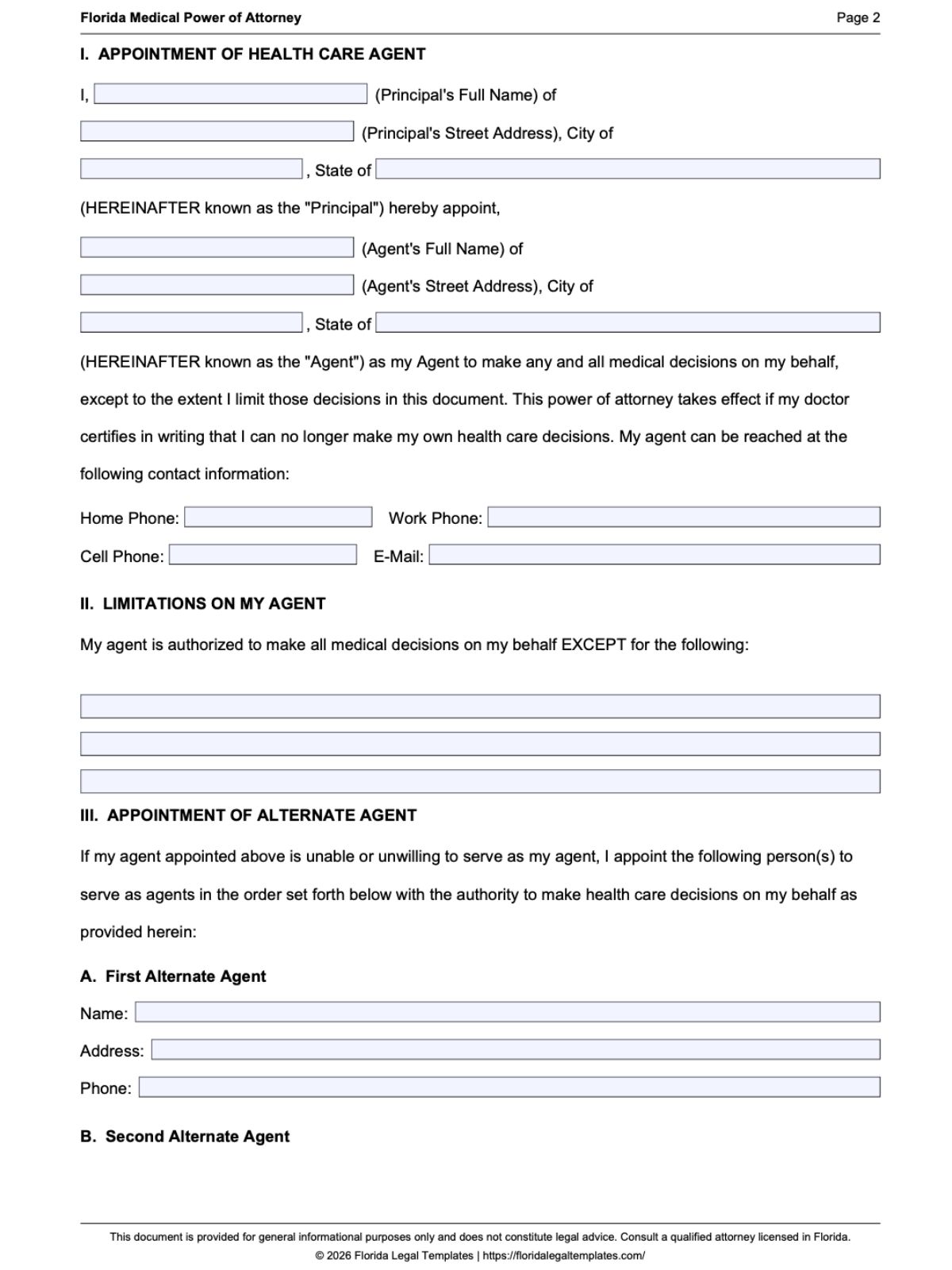
Florida’s version of a medical power of attorney is commonly referred to as a Designation of Health Care Surrogate. The form is typically available in:
- PDF format
- Printable format
- Fillable digital format
A properly drafted form generally includes:
- The principal’s legal information
- Primary health care surrogate designation
- Alternate surrogate designation
- Scope of medical authority
- HIPAA medical records authorization
- Effective date selection
- Witness signatures
This document is commonly used by:
- Adults creating advance directives
- Elderly individuals planning for incapacity
- Individuals undergoing surgery or ongoing treatment
- Parents organizing long-term healthcare planning
- Unmarried couples wanting decision-making authority
A standard template may not fully address more complex situations, including:
- Blended family conflicts
- Detailed end-of-life care instructions
- Mental health treatment authority
- High-value estate planning strategies
- Situations involving multiple physicians or facilities
Under Florida law, hospitals and physicians rely heavily on statutory compliance before recognizing a surrogate’s authority. Even minor execution mistakes can delay treatment decisions during emergencies.
Many Florida residents preparing healthcare directives also create broader incapacity planning documents at the same time. If you want someone to manage financial matters in addition to medical decisions, reviewing a durable financial authority form alongside your health care surrogate designation can help avoid gaps in authority during a medical emergency.
What Is a Florida Medical Power of Attorney?
A Florida medical power of attorney is a legal document that authorizes another person to make healthcare decisions for the principal. Florida law formally uses the term “Designation of Health Care Surrogate” under Chapter 765 of the Florida Statutes.
The document differs from a living will. A health care surrogate designation appoints a person to make decisions, while a living will states the principal’s treatment preferences regarding life-prolonging procedures.
Under Florida law, the surrogate’s authority is limited to legally permitted healthcare decisions. The principal retains full control while mentally competent. Pursuant to Florida Statutes § 765.204, the principal’s decisions always override contrary decisions made by the surrogate.
A health care surrogate designation is often paired with written end-of-life treatment instructions. Florida residents who want to document life-support preferences separately should also consider creating a Florida advance directive for life-prolonging treatment decisions, since the two documents serve different legal functions under Chapter 765.
Florida also allows two different activation structures:
- Immediate authority: The surrogate may assist with healthcare administration while the principal remains competent.
- Springing authority: The surrogate’s authority begins only after a formal determination of incapacity.
The legal framework governing these directives appears in Florida’s Health Care Advance Directives statutes under Chapter 765.
Key Florida Laws That Affect This Document
| Topic / Issue | Florida Legal Rule | Governing Statute |
|---|---|---|
| Execution Requirements | Must be signed before two adult witnesses | § 765.202(1) |
| Witness Restrictions | The designated surrogate cannot act as a witness, and at least one witness must be neither the principal’s spouse nor blood relative | § 765.202(2) |
| Alternate Surrogate | An expressly designated alternate surrogate may assume the surrogate’s duties if the primary surrogate is not willing, able, or reasonably available | § 765.202(3) |
| Effective Date | The designation may state that the surrogate’s authority is effective immediately; otherwise, the surrogate’s authority generally begins when the principal is determined to be incapacitated | §§ 765.202(6), 765.204 |
| Principal Control | Principal decisions override surrogate decisions while competent | § 765.204 |
| Health Information Authorization | The designation may authorize the surrogate to receive the principal’s health information and obtain medical records as necessary to carry out the surrogate’s authority | § 765.2035 |
| Divorce Revocation | Unless the advance directive or dissolution or annulment order provides otherwise, dissolution or annulment of the principal’s marriage revokes the designation of the former spouse as surrogate | § 765.104(2) |
| Proxy Fallback System | Providers may use statutory proxy hierarchy if no valid surrogate exists | § 765.401 |
| Restricted Medical Procedures | Certain procedures require specific authorization or court involvement | § 765.113 |
Florida law establishes specific requirements for advance directives and imposes duties on health care facilities and providers when implementing them. Proper execution can help avoid disputes over whether a designation should be recognized.
The HIPAA authorization language is especially important in practice. If the principal wants the surrogate to have express authority to receive health information, the designation should include the health-information authorization provided in §765.203.
Florida also has strict fallback procedures when no valid surrogate exists. Under the statutory proxy system, healthcare providers may bypass informal family preferences and follow Florida’s legal hierarchy for decision-making authority.
For the governing statutes, see:
Practical Impact & Document Clauses
Proper witnessing is critical because Florida does not require notarization for this document. Instead, validity depends entirely on compliance with the two-witness rules under Florida Statutes § 765.202.
The document should also contain several operational clauses that healthcare providers routinely expect to see, including:
- HIPAA release authorization
- Effective date selection
- Alternate surrogate designation
- Capacity acknowledgment language
- Medical authority limitations
Naming an alternate surrogate can prevent delays if the primary surrogate becomes unavailable during a medical emergency.
A common real-world issue occurs after divorce. Under Florida Statutes § 765.104(2), naming a spouse as surrogate may automatically become ineffective after divorce unless the document specifically states otherwise.
When to Use a Florida Medical Power of Attorney
This document is commonly used:
- Before surgery or hospitalization
- During retirement planning
- For elderly parents
- Before extended travel
- During chronic medical treatment
- As part of comprehensive estate planning
It is also especially important for unmarried couples. Without a valid surrogate designation, an unmarried partner may have no legal authority to make healthcare decisions.
A Florida medical power of attorney may not fully address every healthcare planning issue. Additional documents may still be necessary for:
- End-of-life treatment instructions
- Financial decision-making
- Guardianship disputes
- Mental health admission authority
This document is commonly included within a broader estate planning strategy, especially for older adults or individuals managing long-term medical concerns. Families organizing incapacity and inheritance planning together may also benefit from preparing a Florida estate distribution document to address property transfers and final wishes separately from healthcare authority.
How to Create or Fill Out a Florida Medical Power of Attorney
Choose Your Health Care Surrogate
Your surrogate should be someone who is:
- Trustworthy
- Available during emergencies
- Comfortable communicating with doctors
- Capable of handling stressful medical decisions
Florida law also allows naming an alternate surrogate who automatically assumes authority if the primary surrogate is unavailable.
Choosing a surrogate is only one part of incapacity planning. If the same trusted person may also need authority over banking, contracts, or property matters, many individuals create a broader Florida delegated authority document so financial decisions can continue smoothly during hospitalization or incapacity.
Decide When Authority Begins
Florida permits two activation structures:
- Immediate authority
- Incapacity-triggered authority
Immediate authority allows the surrogate to assist with healthcare administration even while the principal remains competent.
Springing authority delays decision-making power until a physician formally determines incapacity.
Include HIPAA Authorization Language
The document should include the health-information authorization described in Florida Statutes § 765.203 if the principal wants the surrogate to receive the principal’s health information.
Including this authorization can make the surrogate’s authority to receive the principal’s health information clearer to health care providers.
Crucially, if you select an “Incapacity-Triggered” structure but wish for your loved one to be able to talk to doctors or handle health insurance billing while you are well, you must explicitly initial the statutory box allowing immediate access to health information under Fla. Stat. § 765.203.
Sign the Form Properly
Under Florida law, the form must be signed in the presence of two adult witnesses.
Important restrictions apply:
- The surrogate cannot act as a witness
- At least one witness must be an independent party who is neither the principal’s spouse nor a blood relative. Additionally, to avoid automatic invalidation under § 765.202(2), neither the primary surrogate nor the alternate surrogate may act as a witness.
Florida does not require notarization for a valid health care surrogate designation.
Distribute Copies Correctly
The document works best when copies are distributed to:
- Primary physicians
- Specialists
- Hospitals
- Primary surrogate
- Alternate surrogate
Copies should also be added directly into medical charts whenever possible.
Medical Decisions a Florida Health Care Surrogate Can and Cannot Make
Decisions a Surrogate May Generally Make
A surrogate may generally:
- Consent to medical treatment
- Access medical records
- Communicate with physicians
- Coordinate healthcare decisions
- Review treatment options
The scope of authority depends on the language included in the document.
Restricted Decisions Under Florida Law
Under Florida Statutes § 765.113, a surrogate or proxy generally may not consent to certain specified procedures unless the statute’s applicable requirements are satisfied, which may include an express delegation of authority in the advance directive or court approval, including:
- Abortion
- Sterilization
- Electroshock therapy
- Psychosurgery
- Voluntary admission to a mental health facility
These powers typically require specific authorization within the directive or court involvement.
What Happens If You Do Not Have a Valid Health Care Surrogate Form?
If no valid designation exists, Florida healthcare providers may rely on the statutory health care proxy system under Florida Statutes § 765.401.
Under Florida Statutes § 765.401, the following persons may be authorized to make health care decisions in the order of priority established by the statute:
- Court-appointed guardian or guardian advocate
- Spouse
- Adult children, or a majority of adult children who are reasonably available for consultation
- Parents
-
Adult siblings, or a majority of adult siblings who are reasonably available for consultation
-
An adult relative who has exhibited special care and concern for the patient and maintained regular contact with the patient
-
A close friend
-
A qualifying clinical social worker selected through the provider’s bioethics process
When families cannot immediately establish legal authority, disputes sometimes escalate into probate or affidavit-related proceedings after a medical crisis or death. In smaller estates, surviving relatives may later need a simplified Florida probate affidavit to handle limited estate assets without full probate administration.
This process can create disputes among family members, especially when relatives disagree about treatment decisions.
Hospitals may also delay non-emergency decisions while determining who has legal authority to act.
Informal verbal wishes alone may not be sufficient for providers to recognize decision-making authority.
Florida Medical Power of Attorney vs Living Will
These documents serve different purposes.
A Florida medical power of attorney appoints a decision-maker. A living will states the principal’s preferences regarding life-prolonging treatment.
For example:
- A living will may state whether artificial life support should continue.
- A health care surrogate designation determines who communicates those decisions with physicians.
Using both can make the plan clearer: the surrogate designation identifies the person who can make health-care decisions, while a living will addresses the principal’s instructions concerning life-prolonging procedures.
What If Your Living Will and Health Care Surrogate Disagree?
One issue that surprises families is that appointing a health care surrogate does not give that person unlimited authority to disregard your written treatment instructions. If you have both a Designation of Health Care Surrogate and a Living Will, physicians are expected to read them together. The surrogate’s role is to interpret and carry out your wishes, not replace them with personal preferences.
A common example is a principal who signs a Living Will declining life-prolonging procedures in qualifying circumstances, but years later verbally tells the surrogate something different without updating the written documents. That can leave the medical team trying to determine whether the later statements actually revoked or modified the earlier directive. Florida law allows a competent principal to amend or revoke an advance directive at any time, but relying only on verbal conversations often creates uncertainty when family members remember those conversations differently. See Fla. Stat. § 765.104.
For that reason, whenever you substantially change your wishes, update both documents at the same time, destroy outdated copies when appropriate, and provide the revised versions to every physician, hospital, and surrogate who previously received the originals. Doing so greatly reduces the risk that providers will pause treatment decisions while determining which instructions accurately reflect your current intent.
Limitations and Legal Considerations
A surrogate’s authority generally ends upon the principal’s death, except for limited post-death matters authorized by law.
Healthcare providers may reject forms that:
- Lack proper witnesses
- Omit required authority language
- Contain conflicting instructions
- Appear incomplete
The “Health Care Surrogate for Minors” Trap (§ 765.2035)
A widespread misunderstanding among parents traveling without their children or organizing family emergency plans is assuming that an adult Designation of Health Care Surrogate covers medical care for minor children. A health care surrogate designation for an adult is different from the separate designation authorized for a minor under Fla. Stat. § 765.2035.
If parents leave children with grandparents, relatives, or other caregivers, a separate Designation of Health Care Surrogate for a Minor can give a designated caregiver authority to consent to medical care when the statutory requirements are met. Florida law also provides other circumstances in which persons such as stepparents, grandparents, adult siblings, or adult aunts and uncles may consent to a minor’s medical care when the statutory conditions are satisfied. Fla. Stat. §§ 765.2035, 743.0645.
A medical power of attorney only governs healthcare decisions and does not transfer ownership rights or control over personal property. For example, if a family member later needs to sell or transfer a vehicle after death, separate ownership documentation such as a Florida vehicle transfer form may still be required depending on the transaction.
Florida law also limits a surrogate’s ability to override a competent patient’s decisions.
The document remains private and is not filed with Florida courts, Sunbiz, or a statewide registry.
Common Mistakes to Avoid
Common execution and planning mistakes include:
- Using only one witness
- Allowing the surrogate to act as witness
- Omitting HIPAA authorization language
- Failing to name an alternate surrogate
- Not updating the form after divorce
- Failing to distribute copies to physicians
- Confusing a living will with a surrogate designation
- Leaving conflicting medical directives
These mistakes can lead to:
- Hospital refusal
- Delayed treatment decisions
- Family disputes
- Court involvement
- Loss of intended decision-making authority
Frequently Asked Questions
Is a Florida medical power of attorney the same as a health care surrogate designation?
Yes. In Florida, the legal term is “Designation of Health Care Surrogate,” although many people still use the phrase “medical power of attorney.”
Does a Florida medical power of attorney need to be notarized?
No. Under Florida law, notarization is not required for validity. The document is fully effective when signed before two qualified adult witnesses. Notarization is not required by §765.202. If you expect to use an advance directive outside Florida, keep in mind that Florida recognizes an out-of-state advance directive when it complies with the law of that state or Florida under §765.112.”
Can a spouse automatically make medical decisions in Florida?
Not always. If no valid surrogate designation exists, providers may follow Florida’s statutory proxy hierarchy under § 765.401. However, disputes or unavailable spouses can complicate the process.
When does a Florida health care surrogate become effective?
The principal may choose either immediate authority or incapacity-triggered authority under Florida Statutes § 765.202(6).
Legal Disclaimer: This article provides general information about Florida health care surrogate designations and is not legal advice. Laws may change, and individual circumstances can affect your rights and options. Consider consulting a qualified Florida attorney for advice about your specific situation.