Florida Do Not Resuscitate (DNR) Form | DH 1896 PDF
Planning for emergency care can bring up difficult questions, whether you’re thinking ahead for yourself or helping someone close to you. If the patient has decided against CPR during cardiac or respiratory arrest, Florida uses a specific form—the Do Not Resuscitate Order (DNRO), DH Form 1896—to communicate that choice to EMTs and paramedics.
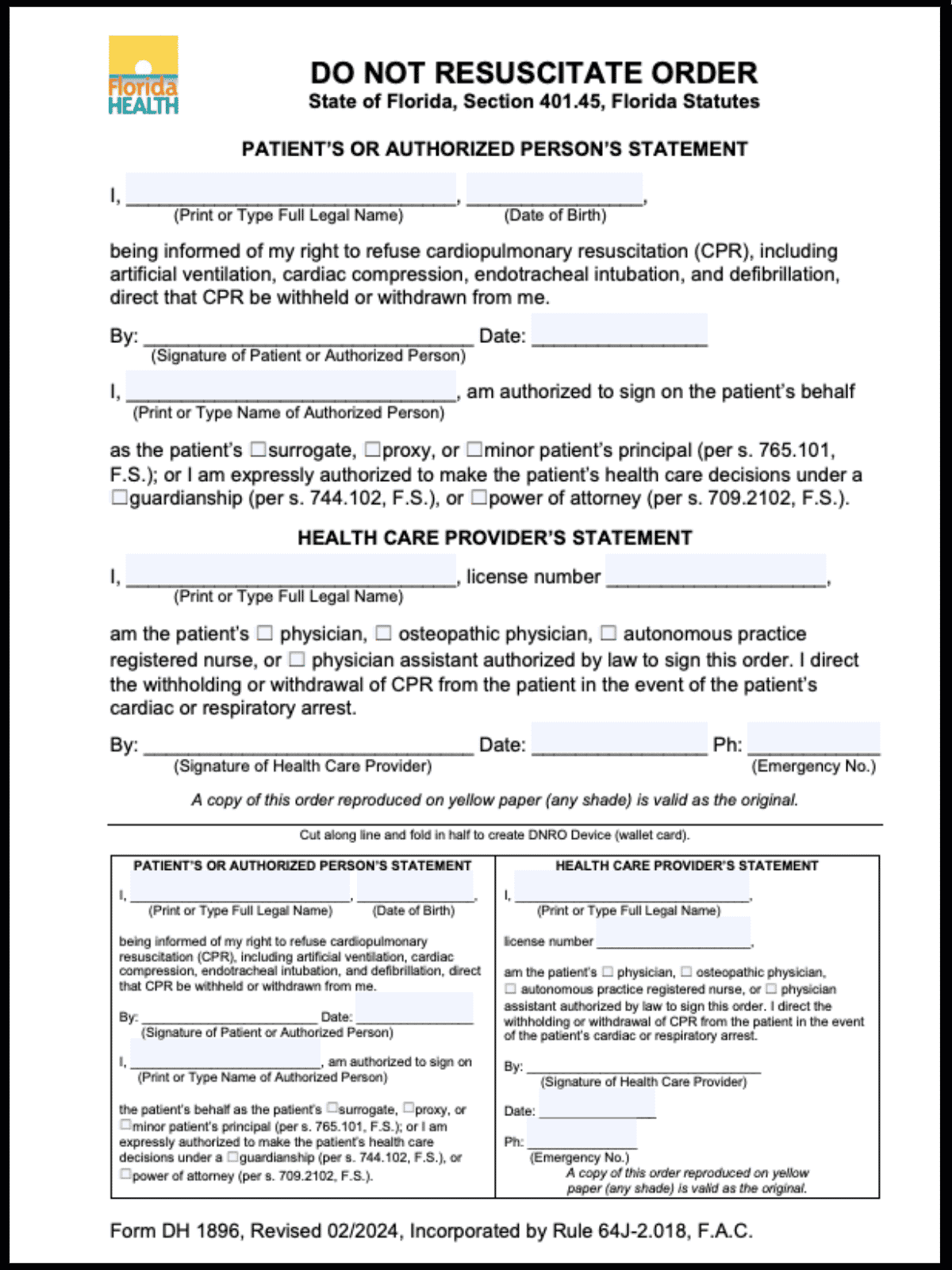
The official form is provided on this article. The patient, or someone with legal authority to sign for them, and an authorized health care provider must sign it. Print the form on yellow paper; copies must also be on yellow paper or have a full-page yellow background so responders can recognize them.
A DNRO applies to resuscitation. It does not rule out comfort care, pain relief, other indicated treatment, or transport. Call 911 in an emergency, even when a DNRO is in place.
Candice Hayden, Legal Writer
Maria Rosso, Florida Probate, Guardianship and Estate Planning Attorney
Florida Do Not Resuscitate (DNR) Form PDF
Get PDF
Use the official DH Form 1896 provided on this page. It is the Florida Department of Health’s fillable form, identified as Revised 02/2024 and incorporated by Rule 64J-2.018, Florida Administrative Code. You can also open the official Florida Department of Health DH Form 1896 PDF.
The Department of Health instructs users to print the form on yellow paper before completing it. The Department also recognizes copies reproduced on yellow paper or with a full-page yellow background. Any shade of yellow is acceptable. Check every copy—including the detachable wallet-sized DNRO Device—to make sure the text is legible and the signatures are accurately reproduced.
The Florida Do Not Resuscitate Order form is for a person who wants Florida EMTs and paramedics to withhold or withdraw CPR in the event of cardiac or respiratory arrest. A commercial or custom template cannot replace DH Form 1896 for prehospital EMS use.
What Do Not Resuscitate Form 1896 Does—and What It Does Not Do
The Florida Do Not Resuscitate is a specific direction for EMTs and paramedics. It applies to cardiopulmonary resuscitation during cardiac or respiratory arrest, including artificial ventilation, cardiac compression, endotracheal intubation, and defibrillation. Under Fla. Stat. § 401.45, a valid prehospital order must use the form adopted by rule.
A DNRO does not tell responders to stop all treatment. EMTs and paramedics may provide comfort measures, pain relief, and other medically indicated care. They can also transport the patient. Call 911 even when the patient has a DNRO. The Florida Department of Health says EMS can support the patient and caregivers, help keep the patient comfortable, and transport the patient to a hospital without starting resuscitation.
DH Form 1896 is distinct from a living will, health care surrogate designation, or broader advance-care document. Those documents can address other health care decisions. EMTs and paramedics are not required to interpret them instead of a valid yellow DH Form 1896.
Who Must Sign the Florida Do Not Resuscitate
Patient and health care provider
The Florida do not resuscitate form requires signatures from both the patient or authorized representative and an authorized health care provider.
- A competent patient signs for themself.
- If the patient is incapacitated or is a minor, an authorized representative may sign.
- The provider must be authorized to sign and must complete the provider statement.
DH Form 1896 identifies a physician, osteopathic physician, autonomous practice registered nurse, or physician assistant authorized by law. Florida law also authorizes an autonomous APRN to provide certain signatures otherwise required from a physician under § 464.0123(3)(a)5., Florida Statutes.
The form itself does not require a notary or subscribing witnesses. That applies to the DNRO; a separate document used to establish the representative’s authority may have its own signing requirements.
Complete the form with the provider, and check that all required fields, dates, and signatures are present before making copies. Missing information can leave responders without a usable order at the scene.
When someone signs for the patient
The form identifies these representative roles: a health care surrogate, statutory proxy, principal for a minor patient, court-appointed guardian, or attorney-in-fact under a power of attorney. The signer must have the applicable legal authority. Being a relative, caregiver, or general agent does not by itself establish authority to sign.
For a guardian or attorney-in-fact, check the underlying court order or power of attorney for express health care decision authority. A professional guardian should get legal review before signing. Court approval is generally required under Fla.Stat. § 744.4431, subject to statutory exceptions. One narrow exception concerns a ward in a hospital who meets specified medical conditions; a guardian acting under that exception must notify the court in writing within two business days.
A separate restriction may apply when a surrogate or proxy is making the decision for a pregnant patient before viability. Under Fla. Stat. § 765.113, the surrogate or proxy generally cannot consent to withholding or withdrawing life-prolonging procedures in that situation unless the principal expressly delegated the authority in writing or a court approved it. Seek legal or clinical guidance if this restriction may apply.
How to Complete and Put the Form Into Use
Use the official Florida Do Not Resuscitate Form 1896 provided on this page and complete it with the patient’s health care provider.
- Enter the patient’s information. Print or type the patient’s full legal name and date of birth as requested.
- Confirm who is signing. The competent patient signs for themself. If someone signs for the patient, enter that person’s name and identify their authority on the form.
- Complete the provider statement. The authorized provider enters their name and license number, selects the applicable provider role, and signs and dates the order. Add the emergency phone number requested on the form.
- Keep the official wording intact. The patient’s statement directs that CPR “be withheld or withdrawn.” Do not edit the form or substitute custom language.
- Print and copy in the required yellow format. The Department instructs users to print the form on yellow paper before completing it. For copies, use yellow paper or preserve a full-page yellow background. Check that signatures and wording reproduce accurately and remain legible.
- Make it easy to find. Keep the full form somewhere visible and accessible to emergency responders. The patient may carry the detachable DNRO Device with photo identification.
- Pass it along during transport. If EMS transports the patient, the DNRO or DNRO Device should accompany them to the receiving facility.
When a patient who lives in a nursing home, assisted living facility, or adult family-care home is on the premises, Rule 64J-2.018, effective October 10, 2024, allows an employee or contract employee to identify the resident to EMS by an oral statement made in the patient’s presence.
The yellow format makes the order identifiable when responders need to locate and assess it quickly. A black-and-white copy, an altered form, or a faint reproduction can prevent the order from working as intended. Keep one clear yellow copy with the patient’s care information and give additional copies to relevant caregivers and providers.
There is no routine public filing step for an ordinary patient’s DNRO. Professional guardians may have a separate court process under § 744.4431, Florida Statutes. Hospitals, nursing homes, assisted living facilities, and hospices may use additional documents or procedures. Ask the facility how it records and follows the patient’s wishes.
Florida Legal Requirements at a Glance
Statutory and rule matrix
| Topic / Issue | Florida Legal Rule | Governing Statute |
|---|---|---|
| Official form and EMS use | Use DH Form 1896; the original or copy must retain the yellow format and be legible and unaltered. | Rule 64J-2.018; § 401.45(3)(a), (5), F.S. |
| Provider signature and APRN authority | The patient or authorized representative and an authorized provider sign; autonomous APRNs have statutory signing authority. | Rule 64J-2.018; § 464.0123(3)(a)5., F.S. |
| Patient or representative authority | The signer must be the patient or a representative with the applicable decision-making authority. | Rule 64J-2.018 and DH Form 1896; §§ 765.205(1)(c), 765.401, 709.2201(2)(c), and 744.4431, F.S. |
| Revocation and decision changes | A properly completed DNRO does not expire; a competent patient may revoke it. Notify people and providers holding copies. | Rule 64J-2.018(9) (effective October 10, 2024); Florida DOH DNRO guidance |
| Pain relief and palliative care | A DNRO addresses CPR; it does not cancel comfort care, pain relief, or palliative-care requests. | Rule 64J-2.018(8)(b) (effective October 10, 2024); Florida DOH DNRO guidance |
For EMS, the state form, signatures, yellow reproduction, and legibility are practical requirements. EMTs and paramedics are not required to withhold CPR when the form is altered, illegible, or not properly reproduced in the required yellow format.
A correctly signed form can still be difficult to use if no one can locate it. Keep it visible or carry the DNRO Device, and make sure it travels with the patient during EMS transport.
A completed DNRO does not expire. Florida Department of Health guidance says a competent patient can revoke it orally or in writing, by physically destroying it, by choosing not to present it to EMTs or paramedics, or by signing a superseding order. Notify providers, facilities, caregivers, and others who have copies when the patient’s decision changes.
Situations Where DH Form 1896 May Not Be Enough
Hospital or residential care: The DNRO is specifically intended for EMTs and paramedics in prehospital settings. Since September 17, 2026, assisted living facilities must honor a properly executed DH Form 1896, document it in the resident’s record, and keep a yellow copy readily available for emergencies under Rule 59A-36.009; hospitals, nursing homes, and hospices may use additional documents or procedures. Confirm the process with the facility’s care team.
Travel outside Florida: The Florida Do Not Resuscitate is directed to EMTs and paramedics certified in Florida. The Department of Health cannot direct responders in other locations to honor it. Check the requirements where the patient will be.
Broader treatment choices: If the patient wants to address treatment decisions beyond CPR during cardiac or respiratory arrest, discuss complementary advance directives or a health care surrogate designation with the provider.
Authority or court exceptions: Get legal or clinical guidance when a representative’s authority is disputed, a professional guardian is involved, or the pregnancy restriction may apply.
Mistakes That Can Keep the DNRO From Working as Intended
- Using a commercial or custom form: It does not replace the state form required for prehospital EMS use.
- Printing on white paper without a full-page yellow background: EMS personnel are not required to honor a form or copy that lacks the required yellow format.
- Altering the form or leaving wording or signatures illegible: Responders may be unable to verify the order. The rule does not require them to withhold CPR from an altered or illegible form.
- Missing a signature or relying on a family relationship alone: The form requires the patient or an authorized representative and an authorized provider. A relative without the appropriate authority may not be able to sign for the patient.
- Keeping the form out of sight or failing to send it with the patient: Responders need to be able to locate or receive the order. Keep it accessible and pass it along during transport.
- Assuming the DNRO replaces a living will or facility process: The DNRO covers CPR for EMS. Other health care decisions and facility procedures may need separate documents.
- Assuming it prevents comfort care or means 911 should not be called: The DNRO does not prohibit comfort measures, other indicated care, or transport.
- Changing the patient’s wishes without notifying people who hold copies: Old copies can cause confusion during an emergency. Notify providers, caregivers, and others who received the form when it is revoked or replaced.
Frequently Asked Questions
Does the Florida DNRO need witnesses or notarization to be valid?
No. DH Form 1896 itself requires the patient’s or authorized representative’s signature and the provider’s signature, but it does not require witnesses or notarization. A separate document that establishes representative authority, such as a durable power of attorney, may have its own signing requirements.
Who can sign DH Form 1896 if the patient can no longer make the decision?
An authorized health care surrogate or proxy, a guardian delegated authority to make health care decisions, or an attorney-in-fact expressly authorized to make those decisions may be able to sign. Additionally, for a minor, the form provides for the minor patient’s principal. Still, a family relationship alone does not establish signing authority.
Does a Florida DNRO expire, and how can a competent patient revoke it?
A properly completed Florida Do Not Resuscitate Order does not expire. Florida Department of Health guidance says a competent patient may revoke it orally or in writing, destroy it, choose not to present it to EMS, or sign a superseding order. Notify providers, facilities, caregivers, and others who hold copies when the patient’s decision changes.
Does a DNRO stop EMS from giving comfort care or transporting the patient?
No. It directs EMS about CPR during cardiac or respiratory arrest. EMTs and paramedics may provide comfort measures and other medically indicated care, and they can transport the patient. Call 911 when help is needed.
This article provides general educational information and document guidance, not legal advice. Discuss a patient’s medical choices with the treating provider; consult an attorney about disputed authority or court processes.