
Florida DMV Power of Attorney [Free HSMV 82053 Fillable PDF]
A Florida DMV power of attorney is a narrow transaction-specific document not a general power of attorney and the most common mistake people make is showing up at the tax collector’s office with a standard Chapter 709 POA thinking it will work for a vehicle title transfer.
Florida’s DMV uses its own specific form HSMV 82053 for authorizing someone else to handle motor vehicle, mobile home, or vessel title and registration transactions on your behalf, and a general dmv power of attorney florida drafted under Chapter 709 is not always accepted as a substitute at the tax collector’s window.
I’ve seen straightforward title transfers stall because the person handling it brought a perfectly valid general POA that simply was not the right document for that specific transaction. The florida motor vehicle power of attorney template below is built around HSMV 82053 and covers what the form authorizes, what it cannot be used for, and the specific restrictions on who can serve as your agent depending on the nature of the transaction.
Candice Hayden, Legal Writer
Maria Rosso, Florida Probate, Guardianship and Estate Planning Attorney
Download Florida DMV Power of Attorney Form
Florida uses Official Form HSMV 82053 for standard vehicle and vessel power of attorney transactions. The form is generally available in printable PDF and fillable formats and is intended for limited DMV-related authority only.
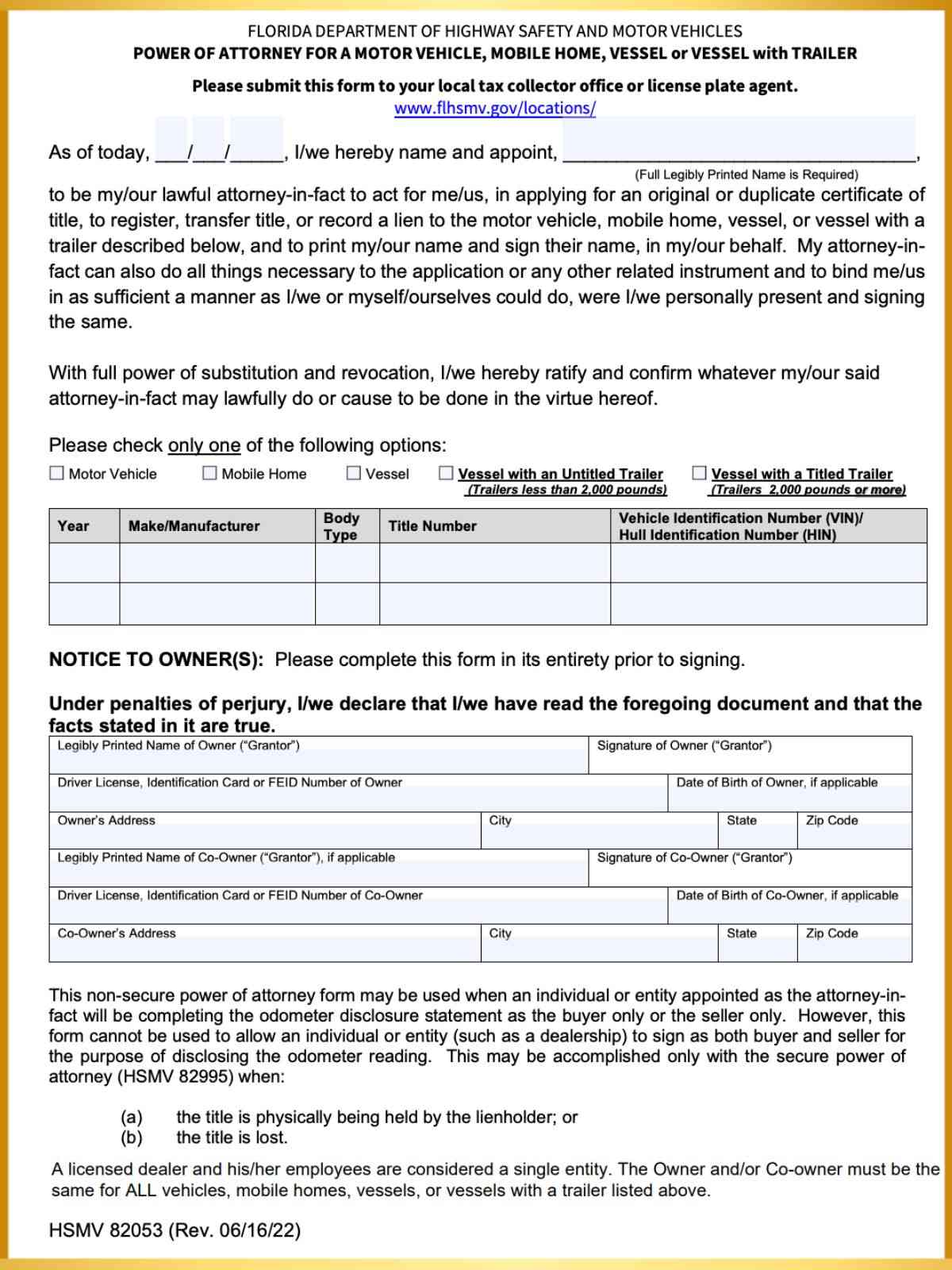
Get HSMV 82053 PDF
A florida motor vehicle power of attorney can authorize an agent to:
- Transfer a vehicle title
- Apply for registration
- Request a duplicate title
- Complete odometer disclosure paperwork
- Process vessel title transactions
This form is commonly used by:
- Individual vehicle owners
- Car dealerships
- Family members assisting elderly owners
- Business entities managing company vehicles
- Out-of-state owners handling Florida title matters
However, a standard power of attorney form florida dmv document does not work in every situation. If the transaction involves a missing title, electronic title, or federally required odometer disclosure issue, Florida may require a Secure Power of Attorney instead of Form HSMV 82053.
Unlike a durable estate-planning POA, this form is transaction-specific and does not grant broad financial or healthcare authority.
What Is a Florida DMV Power of Attorney?
A Florida DMV Power of Attorney is a limited legal authorization that allows one person, called the principal or vehicle owner, to appoint another person or business entity as their attorney-in-fact for motor vehicle or vessel transactions.
Under Florida law, this form is treated differently from a general durable power of attorney created under Chapter 709. A standard florida vehicle power of attorney is designed specifically for FLHSMV processing and follows separate execution rules under Florida motor vehicle statutes.
The owner authorizes the agent to act only within the scope stated on the form. That authority may include:
- Signing title paperwork
- Completing registration applications
- Handling odometer disclosures
- Applying for replacement titles
Many vehicle owners mistakenly believe a general durable power of attorney automatically satisfies DMV requirements. In practice, FLHSMV offices often require the state-approved vehicle POA form because it contains mandatory vehicle information, statutory disclosures, and anti-fraud language required for title processing.
Because this document is narrowly limited to DMV transactions, many vehicle owners later realize they also need broader estate-planning authority for financial or personal matters. In those situations, a durable financial authorization form or a more general Florida power of attorney document may be more appropriate depending on the scope of authority needed.
Key Florida Laws That Affect This Document
Under Florida law, vehicle and vessel powers of attorney are governed primarily by Chapter 319 and Chapter 328 of the Florida Statutes, along with administrative procedures issued by FLHSMV.
| Topic / Issue | Florida Legal Rule | Governing Statute |
|---|---|---|
| Execution Formalities | Form must be completed before signing and include VIN/HIN, title number, make, and year. | § 319.225, § 328.01, & FLHSMV TL-02 |
| Notary Requirements | Standard DMV POA does not require notarization if statutory perjury clause is included. | § 319.225(6)(a) |
| Durable vs. Limited POA | Durable POAs require witnesses and notary; DMV POA follows separate motor vehicle rules.¹ | § 709.2102(2) & § 709.2105 vs. § 319.225 |
| Identification Rules | Grantor must provide DL number, ID number, or FEID. | FLHSMV Form 82053 |
| Odometer Disclosure | One person generally cannot sign as both buyer and seller for mileage disclosures. | Federal & State Anti-Fraud Rules |
[¹] Scope Note: Under Fla. Stat. § 709.2102(2), agency-prescribed forms are explicitly exempted from Chapter 709 scope requirements. This statutory exemption provides the FLHSMV with the clear legal authority to reject general estate-planning POAs in favor of its mandatory Form HSMV 82053.
The Fast Title Prohibition & Photocopy Certification Rule (FLHSMV TL-02)
Two operational rules under FLHSMV Procedure TL-02 routinely cause transactions to fail at the tax collector counter:
-
Fast Title Absolute Bar: Under FLHSMV rules, a Power of Attorney (whether Form HSMV 82053 or a Chapter 709 durable POA)cannot be used to obtain a “Fast Title” (same-day printed title certificate). Fast Title applications must be signed directly by the titled owner in person or submitted through a licensed motor vehicle dealer.
-
Photocopy Certification Requirement: While a photocopy of an original general POA is valid under § 709.2106(5), Tax Collector clerks reviewing Form HSMV 82053 will reject an uncertified photocopy. If submitting a copy of Form HSMV 82053 instead of the original wet-ink document, the copy must be formally certified as a true and
Florida’s motor vehicle POA rules are highly procedural. A missing VIN, incomplete title number, or omitted identification field can cause the county tax collector or license plate agency to reject the transaction entirely.
The rules also serve an anti-fraud function. Florida requires detailed identification and statutory perjury language because title transfers and odometer disclosures carry significant financial and criminal liability. Improper signatures or false mileage disclosures can expose both the owner and agent to fraud investigations and transaction delays.
Pursuant to Fla. Stat. § 319.225, vehicle title documentation must comply with specific execution and disclosure standards. Durable power of attorney execution requirements are separately addressed under Fla. Stat. § 709.2105.
Execution Requirements Under Florida Law
Florida requires the DMV power of attorney form to be fully completed before the owner signs it. The document must clearly identify the vehicle or vessel involved in the transaction.
Required information typically includes:
- Vehicle Identification Number (VIN)
- Hull Identification Number (HIN) for vessels
- Title number
- Vehicle make and year
- Ownership information
If critical information is missing, FLHSMV offices may reject the title or registration application during processing.
Perjury Clause Instead of Notarization
One unusual aspect of Florida’s DMV POA system is that the standard state form generally does not require notarization.
Instead, Florida law allows the document to rely on a mandatory statutory affirmation directly above the signature block. The form must contain the following wording:
“Under penalties of perjury, I/we declare that I/we have read the foregoing document and that the facts stated in it are true.”
This language is required under Fla. Stat. § 319.225(6)(a).
That rule differs significantly from a durable power of attorney under Chapter 709, which generally requires two witnesses and notarization.
Identification and Signature Rules
Florida requires the grantor to provide identification directly on the form. Depending on the owner type, this may include:
- Florida driver license number
- State identification card number
- Federal Employer Identification Number (FEID). Note: When an agent is signing on behalf of a business entity owner, tax collectors require the FEID number of the business *plus* a copy of the signing officer’s driver’s license to verify corporate authority.
The appointed attorney-in-fact must also sign correctly during the transaction process. Under Florida DMV rules, the agent signs their own legal name while acting on behalf of the owner.
Signing the principal’s name instead of the agent’s own name can constitute criminal perjury under Florida law.
When the Vehicle Is Titled to a Business, the POA Is Only Part of the File
A completed Form HSMV 82053 does not, by itself, prove that the person signing for a company has authority to bind that business. This catches a lot of fleet owners and small LLCs by surprise.
If the vehicle is owned by a corporation, LLC, or partnership, the county tax collector may ask for documentation showing the signer’s authority, especially if the officer’s title is not obvious from the paperwork. Depending on the circumstances, that can include corporate records, an operating agreement, partnership documentation, or other evidence identifying the authorized representative. FLHSMV procedures allow tax collectors to verify the capacity of the individual signing on behalf of a business before processing a title transaction.FLHSMV TL-02 Title and Registration Procedures Manual (business ownership verification guidance).
In practice, bringing a copy of the business’s formation records and a government-issued photo ID for the signing officer often prevents an otherwise complete title transfer from being rejected at the counter. The POA authorizes the transaction, but the tax collector still has to confirm that the person granting or exercising that authority is legitimately acting for the titled owner.
Odometer Disclosure Restrictions
Federal and Florida anti-fraud laws place additional restrictions on odometer disclosure transactions.
In many vehicle sales, the same individual cannot sign as both the buyer and seller for mileage disclosure purposes. This restriction exists to reduce fraud involving inaccurate odometer reporting.
Dealership employees and third-party representatives must follow these rules carefully during title processing.
Practical Impact & Document Clauses
These statutory requirements directly affect how county tax collectors process title applications and registrations.
Failure to follow the rules may result in:
- Rejected title transfers
- Delayed registrations
- Invalid odometer disclosures
- Fraud investigations
- Additional DMV processing requirements
Several clauses on the form are mandatory under Florida law, including:
- The statutory perjury affirmation
- Vehicle identification details
- Signature authorization language
- Odometer disclosure sections
When to Use a Florida Vehicle Power of Attorney
A DMV power of attorney florida document is commonly used when the vehicle owner cannot personally complete title or registration paperwork.
Typical situations include:
- Selling a vehicle while traveling or living out of state
- Allowing a dealership to finalize title transfer documents
- Authorizing a family member to register a vehicle
- Managing business fleet paperwork
- Applying for duplicate titles
- Processing boat or vessel title transactions
The form may also help during interstate transactions involving Florida-titled vehicles.
Vehicle transfers in Florida are often completed alongside supporting ownership paperwork. If the transaction includes a private-party sale, many owners also prepare a vehicle purchase record to document the transfer terms and odometer details. Boat owners handling vessel title transactions may similarly need a Florida vessel sale document during registration processing.
Situations Where This Form May Not Work
A standard Florida DMV POA is not appropriate in every situation.
It may not work for:
- Fast Title transactions
- Lost title situations involving odometer disclosures
- Electronic title transfers requiring secure processing
- Healthcare or financial authority
- General estate planning needs
Under FLHSMV rules, a power of attorney generally cannot be used for Fast Title processing.
How to Fill Out the Florida DMV Power of Attorney Form
Step 1 — Identify the Vehicle or Vessel
Enter complete vehicle or vessel information, including:
- VIN or HIN
- Title number
- Year
- Make and model
- Ownership details
Double-check every number carefully because title processing errors often begin with incomplete identification fields.
Step 2 — Name the Attorney-in-Fact
Provide the full legal name of the person or business authorized to act on your behalf.
Choose someone trustworthy because the form allows them to complete legally binding title and registration actions.
Step 3 — Define the Authorized DMV Actions
Specify what the agent may do, such as:
- Transfer ownership
- Register the vehicle
- Apply for duplicate titles
- Complete odometer disclosures
Limiting authority to necessary tasks helps reduce misuse risk.
Step 4 — Enter Required Identification Information
Florida requires identifying information directly on the form.
Depending on the situation, this may include:
- Driver license number
- State ID number
- FEID for business owners
Missing identification fields can delay processing.
Step 5 — Review the Perjury Statement Carefully
The statutory perjury affirmation replaces traditional notarization requirements on the standard DMV form.
Before signing, confirm all information is accurate because false statements may create civil or criminal liability.
Step 6 — Submit the Form Properly
The completed form must generally be submitted directly to:
- A county tax collector office
- An authorized license plate agency
The form is submitted at the time of the title or registration transaction. It is not filed with county land records and is not submitted to Sunbiz.
Before submitting title paperwork, it helps to verify that the ownership information and transfer details match the supporting sale documents exactly. Florida buyers frequently pair DMV paperwork with a general proof of ownership form to reduce title disputes and document the transaction history more clearly.
Secure Power of Attorney vs. Standard DMV Power of Attorney
What Is Form HSMV 82995?
Florida uses Form HSMV 82995 as a Secure Power of Attorney for certain odometer disclosure situations.
This specialized form helps comply with federal mileage disclosure requirements when the original title is unavailable.
When a Secure POA Is Legally Required
A Secure Power of Attorney may be required when:
- The physical title is lost
- The title is destroyed
- The title is electronic and held by a lienholder
- The transaction requires odometer disclosure compliance
In these situations, a standard florida motor vehicle power of attorney may be legally insufficient.
Important Limitation for Online Templates
Unlike standard DMV forms, the Secure Power of Attorney form is state-controlled.
It generally cannot be downloaded or printed from ordinary websites because the form must be serialized and obtained through approved channels.
Limitations and Legal Considerations
A Florida DMV Power of Attorney does not create durable authority over the owner’s finances, estate planning, or healthcare decisions.
Its authority is usually limited to:
- Vehicle title matters
- Registration processing
- Odometer disclosures
- DMV transactions
Other important limitations include:
- Fast Title restrictions
- Strict completion requirements
- Potential rejection for incomplete forms
- Electronic title complications
- Fraud exposure for inaccurate disclosures
Business-owned vehicles may also require additional verification or FEID documentation.
A DMV power of attorney only covers vehicle and registration matters and does not replace broader incapacity or end-of-life planning documents. People organizing a more complete Florida estate plan often combine these vehicle-specific forms with a Florida living will declaration to address medical treatment preferences and healthcare decisions separately.
Common Mistakes to Avoid
One of the most common mistakes is leaving critical vehicle information incomplete. Even a single incorrect VIN digit can delay title processing.
Other frequent errors include:
- Using a generic POA instead of Form HSMV 82053
- Forgetting identification numbers
- Assuming notarization alone satisfies DMV rules
- Attempting Fast Title processing with a POA
- Using the wrong form for secure odometer situations
- Allowing improper dual-signing during mileage disclosures
- Signing the owner’s name instead of the agent’s own name
- Submitting outdated or partially completed forms
These mistakes can lead to rejected applications, delayed sales, additional DMV fees, or potential fraud investigations.
Frequently Asked Questions
Does a Florida DMV Power of Attorney need to be notarized?
Not necessarily. Under Florida law, the standard DMV power of attorney form can rely on a statutory perjury affirmation instead of notarization if it complies with Fla. Stat. § 319.225(6)(a).
This differs from a durable power of attorney under Chapter 709, which generally requires witnesses and notarization.
Can I use a general durable power of attorney for Florida vehicle transfers?
Sometimes, but FLHSMV offices often require the state-approved vehicle POA form because it contains specific disclosures and vehicle identification fields necessary for title processing.
What happens if the vehicle title is lost during the sale?
If the transaction also requires odometer disclosure compliance, Florida may require Form HSMV 82995, the Secure Power of Attorney, rather than the standard DMV POA form.
Can a dealership employee sign for both the buyer and seller?
Generally, no. Federal and Florida anti-fraud rules restrict dual-signing in odometer disclosure transactions to help prevent mileage fraud.
Questions about vehicle authority often overlap with larger probate and family estate-planning concerns, especially when someone is handling affairs for an elderly relative. In situations involving inherited property or simplified probate administration, a small estate transfer affidavit may also become relevant depending on the assets involved.