
Florida Sales Agreement (Free Printable PDF, Guide)
A Florida sales agreement is the document that determines whether a deal you thought was done is actually enforceable, and the threshold that triggers the written requirement is lower than most sellers expect. Under current Fla. Stat. § 672.201, a sale of goods priced at $500 or more generally requires a record sufficient to indicate a contract and signed by the party against whom enforcement is sought; Florida’s 2025 UCC amendments making this terminology effective took effect July 1, 2025, which means a significant portion of everyday business transactions — A verbal agreement or an unsigned document may create an enforcement problem for a $500-or-more goods sale, but the result depends on the record, the parties’ conduct, applicable UCC exceptions, and whether an electronic signature or merchant-confirmation rule satisfies § 672.201.
The practical problem is often not whether the parties reached a deal, but whether the available records satisfy § 672.201 when enforcement is disputed. That matters once the price reaches $500, particularly because Florida’s current statute focuses on a qualifying record and the signature of the party against whom enforcement is sought. The purchase agreement florida template below is built around what Florida courts actually require to find an enforceable sales agreement, including a note on the custom goods exception that catches manufacturers on both sides of a verbal order more often than you’d expect.
Candice Hayden, Legal Writer
Carly Johansson, Florida Contract Attorney Last updated: September 28, 2026
Florida Sales Agreement (PDF, Printable, Fillable)
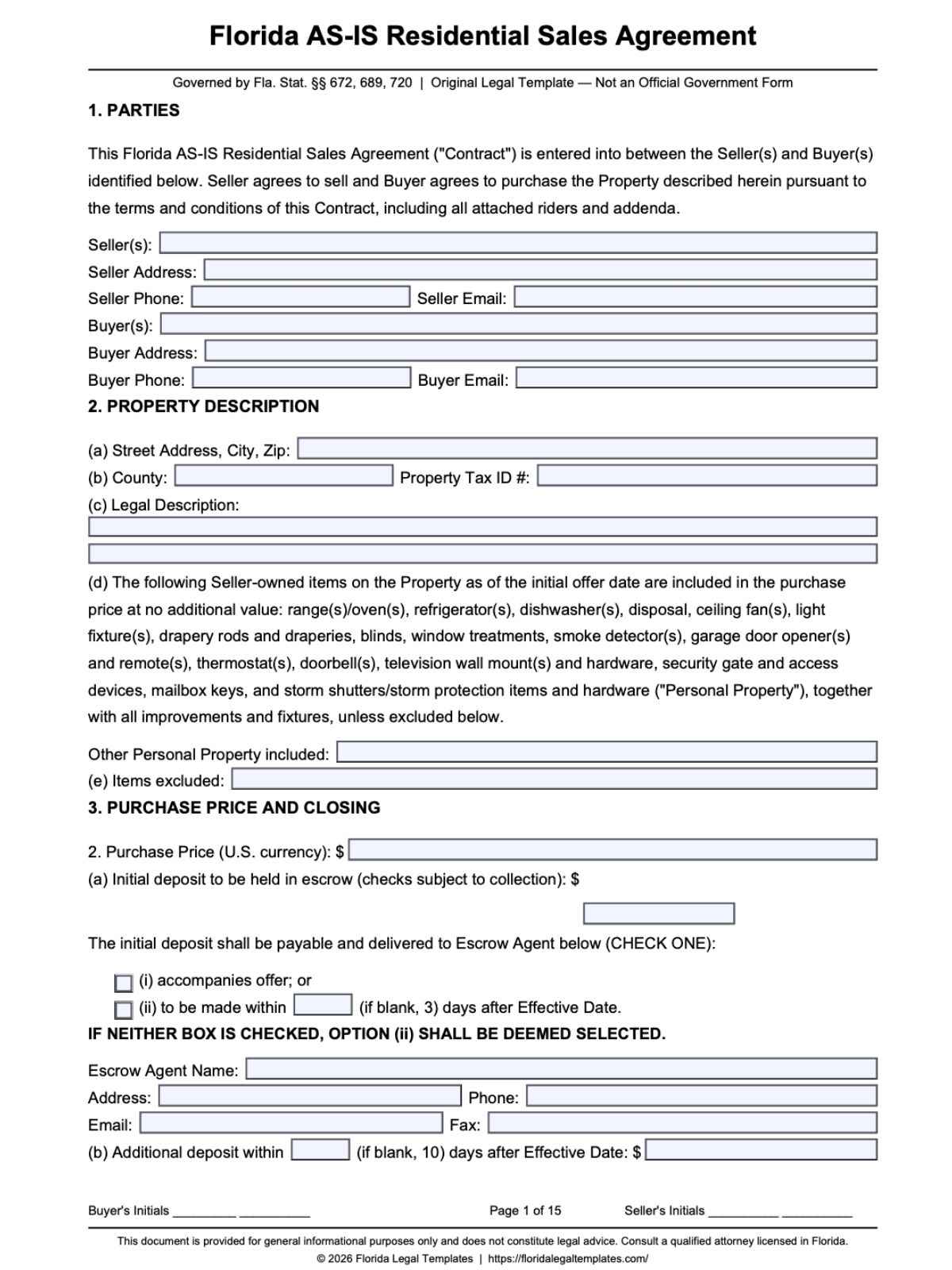
A Florida purchase agreement template gives the parties a place to identify the goods, price, payment schedule, delivery terms, warranties, and remedies before the transaction is completed.
What the document includes:
- Buyer and seller identification
- Description of goods being sold
- Purchase price and payment terms
- Delivery terms and timeline
- Risk of loss allocation (FOB or delivery-based)
- Warranty terms or disclaimers (“AS IS”)
- Default and remedies provisions
- Governing law (Florida)
Who should use this:
- Individuals buying or selling goods
- Small businesses conducting product sales
- Online or offline commercial transactions
- Private party sales (equipment, inventory, etc.)
When this template may NOT be sufficient:
- Real estate transactions, which are subject to separate Florida statutes governing contracts and conveyances, including Fla. Stat. §§ 725.01 and 689.01.
- Complex commercial supply agreements
- Secured transactions requiring separate Article 9 analysis and, depending on the collateral and perfection method, potentially a UCC financing statement
- Multi-state or international sales
- Mixed goods-and-services transactions require a hybrid-transaction analysis under Fla. Stat. § 672.102; the UCC may still apply to provisions relating primarily to the sale-of-goods aspects even when services are part of the transaction.
A goods sale agreement Florida works best for clearly defined, single-transaction sales of personal property.
What Is a Florida Sales Agreement?
A Florida sales agreement is a contract for the sale of goods (tangible personal property) governed by the Florida Uniform Commercial Code (UCC), specifically Fla. Stat. §§ 672.101–672.724.
Legal framework:
- Governed by UCC Article 2 (Sales of Goods)
- Applies only to goods—not services or real estate
- Overrides general contract law in key areas
Legal nuance:
An informal sale can still form a contract under Chapter 672, but § 672.201 imposes a special enforceability rule once the price reaches $500. The current statute requires a qualifying record and the signature of the party against whom enforcement is sought, subject to statutory exceptions.
Critical distinction:
- Sales Agreement / Purchase Agreement: Broad contract terms
- Bill of Sale: Proof of transfer (not full contract)
- Service Agreement: Does not involve goods
Execution validity:
- No notarization required
- No witnesses required
- Must be signed in certain situations (explained below)
If these distinctions are ignored, parties often end up using the wrong document—leading to disputes over ownership, delivery, or defective goods.
Sales agreements are frequently confused with simpler ownership transfer documents, especially in private transactions involving vehicles, equipment, or inventory. Parties handling one-time transfers may also want to review when a proof of ownership transfer document is appropriate versus when a full sales contract is legally necessary under Florida’s UCC rules.
Key Florida Laws That Affect Florida Sales Agreement
Summary of Applicable Laws
| Topic / Issue | Florida Legal Rule | Governing Statute |
|---|---|---|
| Statute of Frauds | Writing required for goods ≥ $500 | Fla. Stat. § 672.201(1) |
| Statute of Limitations | 5 years for a contract founded on a written instrument; 4 years for a contract not founded on a written instrument, including sale and delivery of goods | Fla. Stat. § 95.11 |
| Age / Capacity | Florida generally removes the disability of nonage at age 18, subject to statutory exceptions and rules governing minors’ contracts | Fla. Stat. § 743.07 |
| Warranty Disclaimer | Must comply with Fla. Stat. § 672.316, including the rules for “merchantability” exclusions and “AS IS” or similar language | Fla. Stat. § 672.316 |
| Risk of Loss | Passes based on merchant status or delivery terms | Fla. Stat. § 672.509 |
If the buyer is paying over time, separate the sale terms from any financing arrangement so the agreement clearly states the purchase price, payment schedule, and any security interest. A secured transaction may also require separate analysis under Chapter 679. In those situations, parties sometimes combine the purchase terms with a separate private lending agreement to clearly distinguish repayment obligations from the underlying sale of goods.
Practical Impact & Document Clauses
For a $500-or-more sale of goods, the practical starting point is Fla. Stat. § 672.201: keep a qualifying record of the contract and make sure the signature requirement is satisfied before relying on the agreement in a dispute.
Under current Fla. Stat. § 672.201, a contract for goods priced at $500 or more generally requires a record sufficient to indicate a contract and signed by the party against whom enforcement is sought.
Warranty disclaimers must follow strict statutory wording. Under Fla. Stat. § 672.316:
Warranty exclusions depend on the type of implied warranty being excluded: § 672.316 generally requires a written, conspicuous reference to ‘merchantability’ for excluding the implied warranty of merchantability, while § 672.316(3)(a) recognizes ‘AS IS,’ ‘WITH ALL FAULTS,’ and similar language for excluding implied warranties when its conditions are met.
If this requirement is not met, implied warranties may still apply—even if the seller intended to exclude them.
Risk of loss is another critical area. Under Fla. Stat. § 672.509, if the agreement does not specify when risk transfers:
- When § 672.509(1) or (2) does not apply, risk passes to the buyer on receipt if the seller is a merchant and on tender of delivery if the seller is not a merchant; carrier-shipment and destination terms can produce different results.
- Non-merchants → Risk passes to the buyer upon “tender of delivery” (when the goods are made available for pickup).
Florida no longer has a separate UCC sales limitations period in Fla. Stat. § 672.725. Under current Fla. Stat. § 95.11, the limitations period is generally five years for a contract founded on a written instrument and four years for a contract not founded on a written instrument, including an action for the sale and delivery of goods.
For a Florida seller, the practical checklist is straightforward: preserve the record supporting the sale, make any warranty exclusion comply with § 672.316, and state clearly when risk of loss transfers rather than leaving the parties to § 672.509’s default rules.
Merchant-to-Merchant Orders Can Become Binding Even Without Both Signatures
One Florida UCC rule surprises businesses that regularly buy or sell inventory. Between merchants, a confirmation record received within a reasonable time can satisfy § 672.201 against the receiving party if the statutory requirements are met and the recipient does not send a record objecting to its contents within 10 days after receipt. Under Fla. Stat. § 672.201(2), the receiving merchant has 10 days after receipt to object in a record to the confirmation’s contents. If no written objection is sent within that period, the confirmation can become enforceable against the recipient despite the absence of their signature.
The rule matters whenever two parties qualify as merchants and one sends a confirmation record after an oral agreement. A supplier quotes pricing over the phone, emails an order confirmation, and immediately begins sourcing inventory. The buyer later claims, “We never signed anything.” If the buyer is also a merchant and failed to object within ten days, that defense may not succeed.
This exception does not apply to ordinary consumer purchases. It is limited to transactions between merchants who routinely deal in goods of that kind or otherwise meet the UCC definition of a merchant under Fla. Stat. § 672.104. For Florida businesses that qualify as merchants under Fla. Stat. § 672.104, including many wholesalers, manufacturers, distributors, and retailers, keeping copies of order confirmations and documenting when they were received can be just as important as obtaining a traditional signed agreement.
When to Use Florida Sales Agreement
A Florida sales agreement is most useful when the parties need the deal terms in one place—especially the goods, quantity, price, delivery terms, warranties, and remedies. For goods priced at $500 or more, the record should also be checked against Fla. Stat. § 672.201.
Common use cases:
Use a Florida sales agreement when the transaction involves identified goods and the parties need a clear record of the quantity, price, delivery terms, payment obligations, warranties, and remedies. For transactions at $500 or more, the record should also be reviewed against Fla. Stat. § 672.201.
Practical scenarios:
- A business selling inventory to another company
- A private seller transferring ownership of equipment
- A buyer purchasing goods with structured payment terms
When NOT to use:
- Real estate transactions
- Service-only agreements
- Employment or contractor relationships
Choosing the right document matters because a sales contract can establish payment, delivery, warranty, and default terms that a simple transfer document may not address.
Written sales agreements are especially important in business transactions involving inventory, equipment, or custom goods delivered over time. Companies outsourcing product-related work or bundled deliverables may also use separate service performance terms when labor or ongoing support is part of the overall arrangement.
How to Create or Fill Out the Florida Sales Agreement
Before filling out a Florida sales contract, get the basic deal terms settled first: what is being sold, how much is being sold, what the buyer will pay, when delivery occurs, and which warranty terms apply. For a $500-or-more goods sale, also check the record and signature requirements in § 672.201.
Step-by-step process:
- Identify buyer and seller
- Include full legal names and contact details
- Describe the goods
- Include quantity, condition, and specifications
- Set purchase price and payment terms
- Define due dates and payment methods
- Define delivery method and timeline
- Specify shipping, pickup, or delivery
- Specify risk of loss transfer
- Use clear language (e.g., FOB shipping point)
- Include warranty terms or disclaimers
- Use required statutory wording (“AS IS” or merchantability reference)
- Add default and remedy provisions
- Define consequences for non-payment or breach
- Ensure compliance with Statute of Frauds
- Put agreement in writing if ≥ $500
- Execute agreement
- Ensure the record is signed by the party against whom enforcement may be sought, as required by Fla. Stat. § 672.201, while retaining a signed copy for both parties’ records.
- Retain copies
- Keep signed copies for records
If the transaction involves confidential pricing structures, proprietary product specifications, or customer information, businesses may also require a separate business confidentiality agreement to protect sensitive information exchanged during negotiations or fulfillment.
Practical tips:
- Always document high-value transactions
- Avoid vague descriptions of goods
- Make warranty disclaimers clearly visible
Limitations and Legal Considerations
A Florida sales agreement is a private contract, but the parties still need to account for the UCC rules that apply to the sale, including the good-faith obligation under Fla. Stat. § 671.203 and the enforceability requirements in § 672.201.
Key limitations:
- Cannot waive the obligation of good faith under Fla. Stat. § 671.203
- Must comply with statutory requirements for enforceability
Florida-specific constraints:
- A qualifying record is generally required for goods priced at $500 or more under Fla. Stat. § 672.201.
- Warranty disclaimers must follow strict wording rules
High-risk scenarios:
- Selling defective goods without proper disclaimers
- Failing to define risk of loss
- Relying on oral agreements
Edge cases:
- Mixed contracts involving goods and services
- Conditional or installment sales
- Seller financing requiring UCC filing
Checking the record, warranty language, and delivery terms before performance can make a later dispute much easier to resolve, particularly when § 672.201, § 672.316, or § 672.509 controls the issue.
The Specially Manufactured (Custom) Goods Exception
While the $500 threshold under Fla. Stat. § 672.201(1) generally makes an unwritten sales contract unenforceable, specially manufactured goods may fall within the exception in § 672.201(3)(a) when the goods are not suitable for sale to others and, before notice of repudiation, the seller has made a substantial beginning of manufacture or commitments for their procurement under circumstances indicating the goods are for the buyer.
This exception creates a high-stakes operational risk for both parties. A buyer who verbally authorizes a custom $10,000 equipment modification or tailored inventory run cannot simply walk away citing the lack of a signed contract once the manufacturer purchases raw materials or begins production. Conversely, manufacturers who rely on verbal orders without a signed sales agreement forfeit the ability to enforce pre-payment terms, milestone schedules, or explicit quality inspection thresholds. Executing a formal written agreement before custom production begins remains essential for establishing clear specifications and limiting liability.
For regulated assets such as vehicles or boats, the sales contract does not by itself complete every title or registration requirement; the parties should also complete the transfer documents required for the particular asset. For vehicle or recreational equipment transactions, parties may still need separate motor vehicle ownership transfer paperwork or similar state-specific transfer documentation.
Common Mistakes to Avoid
Not documenting a $500-or-more sale with a qualifying record
Consequence: The seller may face an enforceability problem under Fla. Stat. § 672.201 unless a statutory exception applies.
Using invalid warranty disclaimers
Consequence: Seller may still be liable for implied warranties.
Failing to define delivery and risk of loss
Consequence: Unexpected liability if goods are damaged.
Vague product descriptions
Consequence: Disputes over what was actually sold.
Ignoring statutory limitations period
Consequence: Loss of the right to bring a claim after the applicable limitations period under Fla. Stat. § 95.11.
Frequently Asked Questions (FAQ)
Does a Florida sales agreement need to be in writing?
For goods priced at $500 or more, Fla. Stat. § 672.201 generally requires a record sufficient to indicate a contract and signed by the party against whom enforcement is sought, subject to statutory exceptions.
Can a seller exclude all warranties in Florida?
A seller may exclude or modify implied warranties only if the disclaimer complies with Fla. Stat. § 672.316, which includes specific rules for merchantability exclusions and recognizes “AS IS,” “WITH ALL FAULTS,” and similar language in appropriate circumstances.
When does risk of loss transfer to the buyer?
Under Fla. Stat. § 672.509, it depends on whether the seller is a merchant and the delivery terms.
How long do I have to sue for breach of a sales contract in Florida?
The applicable period generally depends on the contract and the applicable provision of Fla. Stat. § 95.11: five years for a contract founded on a written instrument and four years for a contract not founded on a written instrument, including sale and delivery of goods.
A well-drafted Florida sales agreement gives the parties a clearer record of the transaction, but the details matter: for a $500-or-more goods sale, the record should satisfy Fla. Stat. § 672.201, while warranty and risk-of-loss provisions should be drafted with §§ 672.316 and 672.509 in mind.
Legal Disclaimer: This article provides general legal information about Florida sales agreements and is not legal advice. Laws and individual circumstances vary, so consult a qualified Florida attorney for advice about your specific transaction.