
Florida Consulting Agreement [Free Printable, Fillable PDF]
A Florida consulting agreement that includes a non-solicitation or confidentiality clause isn’t just a service contract anymore — under Florida law it becomes a restrictive covenant, and that reclassification changes everything about how a court will read it if a dispute comes up after the engagement ends. Under F.S. §542.335, any provision that restricts what a consultant can do or disclose after the relationship ends must be supported by a legitimate business interest, and if the language is broader than necessary to protect that interest a Florida court is required to modify it rather than void it — which means the scope of protection you thought you had gets rewritten by a judge instead of negotiated by you.
I’ve reviewed consultant agreement florida language that included what looked like a routine non-solicitation clause, only to find it covered every client the consultant had ever worked with rather than the specific relationships the client actually had a protectable interest in. The consulting contract florida template below is drafted with §542.335 in mind from the start, so the restrictions it includes are specific enough to survive a challenge and narrow enough that a court doesn’t rewrite them into something neither side intended.
Candice Hayden, Legal Writer
Carly Johansson, Florida Contract Attorney
Florida Consulting Agreement (PDF, Printable, Fillable)
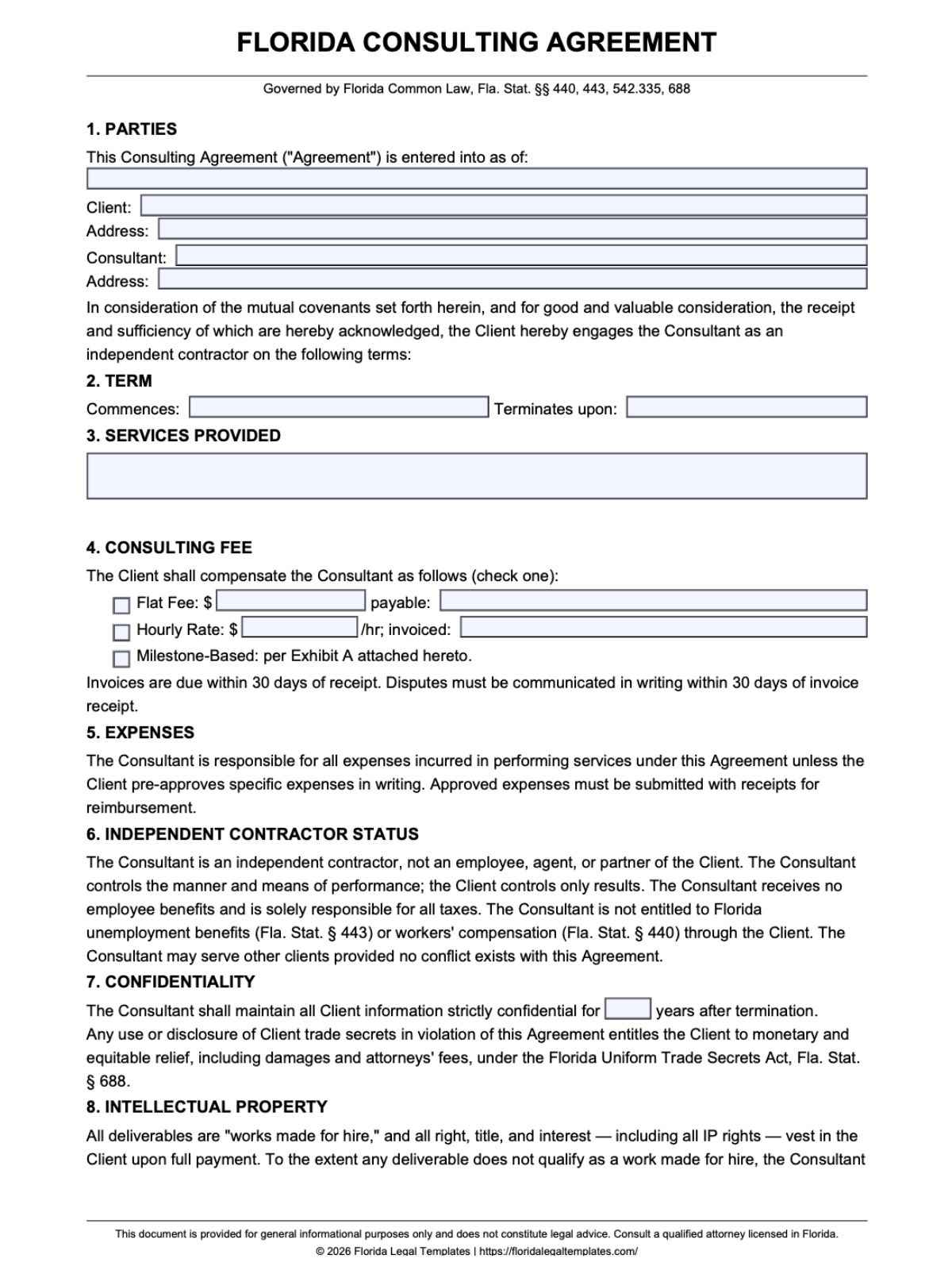
A business consulting agreement Florida template provides a structured, ready-to-use format for formalizing consulting relationships.
What the document includes:
- Identification of client and consultant
- Scope of services and deliverables
- Compensation structure (hourly, fixed, or milestone-based)
- Term and termination provisions
- Independent contractor clause
- Intellectual property ownership (“work made for hire”)
- Confidentiality obligations
- Indemnification and liability provisions
- Dispute resolution and governing law
- Reciprocal Attorneys’ Fees clause (pursuant to Fla. Stat. § 57.105(7))
- Venue and Forum Selection (specifying the Florida county for disputes)
Who should use this:
- Businesses hiring consultants for specialized services
- Freelancers offering professional expertise
- Agencies working with external clients
- Startups outsourcing technical or strategic roles
When this template may NOT be sufficient:
- Construction-related consulting (subject to strict indemnity rules)
- Agreements involving complex non-compete clauses
- Multi-party or long-term consulting arrangements
- Situations with high risk of employee misclassification
A consulting agreement Florida template is most effective when the scope is clearly defined and the relationship remains truly independent.
What Is a Florida Consulting Agreement?
A Florida consulting agreement is a private contract governing professional services performed by an independent contractor rather than an employee.
Legal framework:
- Governed by Florida common law (contract and agency principles)
- Subject to Fla. Stat. § 725.01 (unenforceable contracts)
- Influenced by Fla. Stat. Ch. 672 when deliverables involve goods
Legal nuance:
This is not an employment agreement. Under Florida law, classification depends on the “right to control” test, not simply what the contract calls the relationship.
Critical distinction:
- Consulting agreement: Independent contractor relationship
- Employment agreement: Employer-employee relationship with control and benefits
Execution validity:
- No notarization required
- No witnesses required
- Must be signed to ensure enforceability, especially for long-term engagements
If the agreement is poorly drafted or does not reflect the actual working relationship, courts may reclassify the consultant as an employee—triggering legal and financial consequences.
Consulting agreements are frequently confused with employment or standard contractor arrangements, especially when businesses maintain significant control over how the work is performed. Companies evaluating classification risks may also want to compare how a contractor services agreement differs from a formal employee hiring contract under Florida law.
Key Florida Laws That Affect Florida Consulting Agreement
Summary of Applicable Laws
| Topic / Issue | Florida Legal Rule | Governing Statute |
|---|---|---|
| Statute of Frauds | Contracts that cannot be performed within one year must be in writing and signed by the party to be charged. | Fla. Stat. § 725.01 |
| Independent Contractor Status | Parties must meet specific “right to control” criteria to avoid being reclassified as an employment relationship. | Fla. Stat. § 440.02(15)(d) |
| Age / Capacity | Parties must be at least 18 years of age to enter into a binding, non-voidable agreement. | Fla. Stat. § 743.07 |
| Restrictive Covenants | Must protect legitimate business interests | Fla. Stat. § 542.335 |
| Indemnification Limits | Certain clauses void without monetary cap (construction context) | Fla. Stat. § 725.06 |
Florida consulting relationships often involve access to sensitive business information, proprietary systems, or strategic planning data. Businesses sharing confidential operational details during consulting engagements frequently strengthen protections with a separate confidential business information agreement to support enforceability and trade secret protection.
Practical Impact & Document Clauses
These laws directly shape how a Florida consulting agreement must be written to remain enforceable.
Under Fla. Stat. § 725.01, any agreement that cannot be performed within one year must be in writing and signed. Oral consulting agreements for long-term projects are not enforceable.
Independent contractor classification is governed by Fla. Stat. § 440.02(15)(d). If the client exercises too much control over how work is performed, the consultant may be legally treated as an employee—regardless of contract language.
Restrictive covenants, such as non-compete clauses, must comply with Fla. Stat. § 542.335. These clauses must protect a legitimate business interest and be reasonable in scope and duration, or they will be unenforceable.
Additionally, under Fla. Stat. § 725.06, certain indemnification provisions—particularly in construction consulting—are void unless they include a specific monetary limitation.
In practical terms:
- Misclassification can trigger tax and liability exposure
- Invalid non-compete clauses offer no protection
- Improper indemnity clauses may be struck down entirely
- Oral agreements may be unenforceable
When to Use Florida Consulting Agreement
A Florida consulting agreement should be used whenever a business hires an independent professional to provide services.
Common use cases:
- Hiring consultants for specialized expertise
- Outsourcing business functions or advisory roles
- Structuring project-based or ongoing consulting work
Practical scenarios:
- Marketing or branding consultants
- IT or software consulting services
- Financial, legal, or strategic advisory roles
When NOT to use:
- Employer-employee relationships
- Informal or minor one-time engagements
- Situations requiring partnership or joint venture agreements
Using the correct document ensures the relationship is clearly defined and legally enforceable.
Consulting agreements are commonly used for specialized advisory work where businesses need outside expertise without creating a long-term employment relationship. In collaborative ventures involving shared management responsibilities or profit participation, parties may also require a separate business partnership framework to properly define ownership and operational authority.
How to Create or Fill Out the Florida Consulting Agreement
Creating a consulting contract Florida requires both clarity and legal precision.
Step-by-step process:
- Identify the parties
- Include full legal names of client and consultant
- Define scope of services
- Clearly describe tasks, deliverables, and expectations
- Set compensation structure
- Hourly, fixed fee, or milestone-based
- Define term and termination
- Include duration and termination rights
- Insert independent contractor clause
- Reflect actual working relationship
- Add intellectual property clause
- Use “Work Made for Hire” language combined with an “Express Assignment” clause. Because consultants are not employees, “Work Made for Hire” alone may not cover all deliverables under Federal and Florida law.
- Include confidentiality provisions
- Protect sensitive business information
- Define indemnification and liability limits
- Ensure compliance with Florida law
- Add dispute resolution and governing law
- Specify Florida jurisdiction
- Execute agreement
- Both parties sign
If consulting services involve milestone-based compensation, deferred payments, or product-related deliverables, the parties may also need separate written structured repayment terms or transaction documents to clearly separate consulting obligations from financing arrangements.
Practical tips:
- Avoid vague or overly broad service descriptions
- Ensure intellectual property ownership is clearly assigned
- Align the agreement with how the work will actually be performed
Limitations and Legal Considerations
A Florida consulting agreement is a private contract but must operate within strict legal boundaries.
Key limitations:
- Cannot override employee classification laws
- Cannot enforce invalid non-compete clauses
Florida-specific constraints:
- Must comply with Statute of Frauds requirements
- Must meet restrictive covenant standards
High-risk scenarios:
- Misclassifying consultants as independent contractors
- Failing to include IP ownership provisions
- Using overly broad indemnification clauses
Edge cases:
- Sub-consulting arrangements
- Multi-party consulting contracts
- Long-term or ongoing engagements
Understanding these limits helps prevent disputes and regulatory issues.
A consulting agreement cannot transfer unlimited authority over a business’s legal or financial affairs. Where broader operational authority is intended, businesses may require a separate Florida authorization document rather than relying solely on consulting contract language.
Common Mistakes to Avoid
Misclassifying employees as consultants
Consequence: Legal liability, tax penalties, and potential reclassification under Florida law.
Using vague scope of services
Consequence: Disputes over deliverables and expectations.
Omitting “work made for hire” clause
Consequence: Consultant may retain ownership of intellectual property.
Including unenforceable non-compete clauses
Consequence: Clause becomes invalid under Florida law.
Ignoring indemnification limits
Consequence: In construction or design-related consulting, an indemnity clause without a monetary cap is void under Fla. Stat. § 725.06. Additionally, ensure the clause does not require the consultant to indemnify the client for the client’s own negligence.
Frequently Asked Questions (FAQ)
Is a Florida consulting agreement valid without notarization?
Yes. Florida law does not require notarization for a consulting agreement to be legally binding.
How does Florida determine if a consultant is an employee or contractor?
Under Fla. Stat. § 440.02(15)(d), classification depends on the level of control the client exercises over the consultant.
When must a consulting agreement be in writing in Florida?
Under Fla. Stat. § 725.01, agreements exceeding one year must be written and signed.
Can a Florida consulting agreement include a non-compete clause?
Yes, but only if it complies with Fla. Stat. § 542.335 and protects a legitimate business interest.
A well-drafted Florida consulting agreement does more than define services—it protects intellectual property, clarifies responsibilities, and ensures compliance with Florida law.