What Happens If You Don’t Notarize a Florida Power Of Attorney?
A power of attorney (POA) can appear perfectly complete signed, dated, and even neatly formatted yet still fail when it matters most. In Florida, missing a required signature, missing the required acknowledgment, or overlooking the witness requirements can render the document legally ineffective from the moment it is signed.
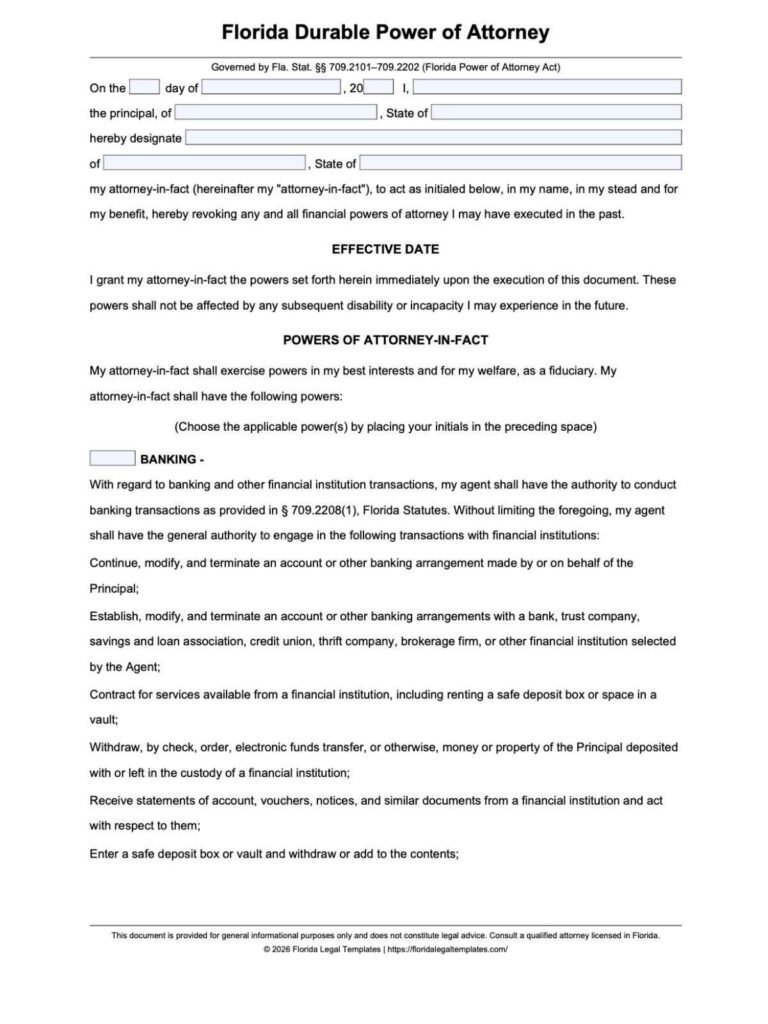
If you’re wondering what happens if you don’t notarize a power of attorney in Florida, the short answer is straightforward: under Florida law, a financial power of attorney generally must be signed by the principal, witnessed by two subscribing witnesses, and properly acknowledged. Missing any of these execution formalities can prevent banks, title companies, and other institutions from recognizing the document.
Many people assume notarization alone is enough because that’s the rule in some states. Florida is different. Here, the two-witness requirement and the required acknowledgment are separate statutory requirements, and neither replaces the other.
Understanding these rules before signing a POA is far easier than trying to fix problems after the principal becomes incapacitated. Below, we’ll examine Florida’s execution requirements, explain what makes a power of attorney defective, discuss how banks and title companies respond to improperly executed documents, and outline the practical options for correcting mistakes before they become costly.
Candice Hayden, Legal Writer
Maria Rosso, Florida Probate, Guardianship and Estate Planning Attorney
The Exact Statutory Requirement (Florida Statutes § 709.2105)

Florida’s execution requirements are not merely recommended best practices—they are statutory conditions for creating a valid Florida power of attorney.
Under Florida Statutes § 709.2105, a principal executing a power of attorney must:
- Sign the document.
- Sign in the presence of two subscribing witnesses.
-
Acknowledge the principal’s signature before a notary public or, where applicable, use an acknowledgment or proof method authorized in § 695.03.
Statutory Reference Matrix
| Topic / Issue | Precise Legal Rule | Governing Statute / Code |
| Execution Formalities |
Requires the principal’s signature, two subscribing witnesses, and acknowledgment before a notary public or, where applicable, by another method authorized by § 695.03. |
Fla. Stat. § 709.2105(2) |
| Agent Qualifications |
Requires the agent to be a natural person age 18 or older, or a financial institution with trust powers, a Florida place of business, and authority to conduct trust business in Florida. |
Fla. Stat. § 709.2105(1) |
| Notary Signing for Principal |
Allows a notary public to sign the principal’s name when the principal is physically unable to sign, subject to under § 117.05(14). |
Fla. Stat. § 709.2105(3) |
| Out-of-State Reciprocity | Validates out-of-state POAs in Florida if executed in compliance with the origin state’s laws. | Fla. Stat. § 709.2106(3) |
| Military Preemption | Recognizes military powers of attorney executed in accordance with 10 U.S.C. § 1044b. | Fla. Stat. § 709.2106(4) |
| Agent Affidavit Reliance |
Allows a third person to request and rely on an agent’s affidavit about the principal’s status and whether the POA or the agent’s authority has been revoked, terminated, or suspended. |
Fla. Stat. § 709.2119(2) |
| 4-Day Rejection Rules |
Presumes four days, excluding Saturdays, Sundays, and legal holidays, is a reasonable response time only for a financial institution or broker-dealer handling a banking or investment transaction expressly authorized by the POA under § 709.2120(1). |
Fla. Stat. § 709.2120(1) |
| Real Estate Recording | When a POA is used in a real-property transaction, recording requirements may apply; § 695.01 provides that an instrument executed by POA is not effective against certain creditors or subsequent purchasers without notice unless the POA is recorded as required, and § 709.2106 addresses recording the original POA. | Fla. Stat. § 695.01 |
For the complete statutory language, see Fla. Stat. § 709.2105 and Fla. Stat. § 117.05.
Section 695.03 is also relevant because § 709.2105(2) incorporates its acknowledgment and proof methods where applicable to instruments concerning real property to be recorded. Since July 1, 2024, commissioners of deeds under subsections (2) and (3) are appointed by Florida’s Secretary of State rather than the Governor.
These requirements work together. A document that satisfies only one or two of them does not automatically become partially enforceable. Instead, execution defects can deprive the document of the legal authority that third parties rely upon when accepting a POA.
Witnesses and the Notary Serve Different Functions
One of the most common misunderstandings involves the roles of witnesses and the notary.
The notary public verifies the principal’s identity and formally acknowledges the execution of the document. The subscribing witnesses, on the other hand, confirm that they witnessed the principal sign the instrument.
Neither role replaces the other.
For example:
-
Two subscribing witnesses without the required acknowledgment or proof under § 695.03 do not satisfy Florida’s ordinary execution rule.
- A notarized document without two witnesses also fails the statutory execution requirements.
-
A witness’s signature alone does not substitute for the required acknowledgment or proof under § 695.03.
The safest approach is ensuring that the principal, both witnesses, and the notary all participate during execution so there is no question about compliance.
When the Principal Cannot Physically Sign
Florida law also addresses an uncommon but important situation.
If a principal is physically unable to sign, § 709.2105(3) permits the notary public to sign the principal’s name under specific statutory conditions.
Although rarely needed, this provision allows individuals with physical limitations—but who still possess legal capacity—to execute a valid power of attorney without losing access to estate-planning tools.
The principal must direct the notary to sign in the principal’s presence by verbal, written, or other means. Two disinterested persons must witness the signing, and the notary must add the statement required by Fla. Stat. § 117.05(14)(d), describe the circumstances and means of the direction, and keep proof of the authorization for 10 years.
The October 1, 2011 Dividing Line
Not every Florida power of attorney is evaluated under today’s rules.
Florida law draws an important distinction based on when the document was executed.
Under Florida Statutes § 709.2106, powers of attorney signed on or after October 1, 2011 must comply with the current execution requirements contained in § 709.2105.
Older documents are treated differently. A power of attorney executed before October 1, 2011 is generally evaluated under the law that existed at the time it was signed rather than today’s statutory requirements.
That distinction surprises many families. Someone may discover an older POA that appears to lack modern execution formalities and assume it is automatically invalid. In reality, its validity depends on the legal standards that existed when it was originally executed.
Why Banks Sometimes Reject Older Powers of Attorney
Even when an older POA remains legally valid, financial institutions often proceed cautiously.
A bank employee reviewing an unfamiliar document may not immediately know which version of Florida law applies. Rather than risk accepting an invalid authorization, the institution may request additional documentation or legal review before honoring the POA.
This is one reason estate-planning attorneys frequently recommend updating older powers of attorney instead of relying on documents signed decades earlier.
A current, properly executed document usually creates fewer practical obstacles when the agent needs to act.
What Happens If Execution Was Defective — The Real-World Consequences
Execution mistakes rarely become apparent on the day the document is signed.
Problems usually surface months or years later—often during a medical emergency, real estate transaction, or financial crisis—when the agent attempts to use the power of attorney.
Missing One Witness
Florida requires two subscribing witnesses.
If only one witness signed the document, the execution requirements under § 709.2105(2) are not satisfied.
As a result:
- banks may refuse account access,
- title companies may halt closings,
- financial institutions may reject transactions,
- the agent may be unable to act on the principal’s behalf.
Notarized but Not Witnessed
Some people mistakenly believe notarization alone validates a power of attorney.
It does not.
An otherwise perfectly notarized POA that lacks two witness signatures still fails Florida’s statutory execution requirements.
Witnessed but Never Notarized
The opposite mistake produces the same outcome.
ven if two witnesses observed the signing, a durable power of attorney in Florida governed by Chapter 709 generally does not satisfy the execution requirements without the required acknowledgment.
The missing acknowledgment is not merely a technical oversight—it is one of the required legal elements for creating a valid Florida statutory power of attorney.
What “Invalid” Means in Practice
Many people hear the word “invalid” and assume the document instantly becomes meaningless paper.
The practical reality is slightly different.
A defective POA loses the legal reliability that third parties depend upon when allowing someone else to control another person’s finances.
That is why Florida law allows a third person to refuse a POA when the person believes in good faith that the document is invalid or that the agent lacks authority for the requested act.
The rejection is not simply institutional caution—it is expressly contemplated by Florida law.
This explains why families often report that:
“The bank wouldn’t accept my mother’s power of attorney.”
In many situations, the issue isn’t the authority granted inside the document.
It’s the way the document was executed.
Out-of-State Powers of Attorney
Florida also recognizes an important exception.
Under § 709.2106(3), a power of attorney executed in another state may still be valid in Florida if it complied with that state’s execution requirements when it was signed.
This provision frequently benefits:
- retirees relocating to Florida,
- seasonal residents (“snowbirds”),
- individuals moving from another state after completing their estate planning elsewhere.
That does not mean every out-of-state POA will automatically be accepted by every institution.
Banks and title companies may still examine whether the document satisfies the law of the jurisdiction where it was executed before relying on it.
When a POA is valid in Florida solely because it complied with another state’s law, § 709.2106(3) separately permits a third person to request an opinion of counsel about its validity, including due execution. The opinion is provided at the principal’s expense, and the third person may reject the POA if the agent does not provide the requested opinion.
How This Plays Out With Specific Institutions
Execution defects often become practical business problems rather than courtroom disputes.
Different institutions evaluate powers of attorney differently, but all tend to scrutinize documents that appear incomplete or improperly executed.
Banks and Financial Institutions
Banks bear significant financial risk when allowing one person to control another person’s accounts.
If employees notice missing witness signatures, incomplete acknowledgments, altered pages, or other execution defects, they may refuse to honor the document.
Florida law also provides an additional safeguard.
Under Florida Statutes § 709.2119(3), a third person asked to accept a power of attorney that appears to have been executed in accordance with § 709.2105 may request an opinion of counsel about a legal matter concerning the document, provided the reason for the request is stated in writing or another record.
This allows institutions to seek legal confirmation when a document raises legitimate concerns, with the opinion provided at the principal’s expense unless the request is made after the time specified in § 709.2120(1) for accepting or rejecting the POA.
Rather than processing questionable transactions immediately, many financial institutions prefer to resolve uncertainty first, especially when substantial assets are involved.
Title Companies and Real Estate Closings
Real estate transactions often involve stricter document review than ordinary banking transactions.
If an agent signs a deed, mortgage, or other instrument using a defective power of attorney, the closing may stop until the issue is resolved.
Where a power of attorney is used to affect title to Florida real property, an original power of attorney may be required for recording in the official records. For recording requirements, see Fla. Stat. § 695.01.
A defect discovered shortly before closing can delay the transaction, increase legal costs, or even cause the sale to collapse if the principal is no longer able to execute a replacement POA.
Hospitals and Healthcare Providers
People often confuse a financial power of attorney with Florida’s healthcare surrogate designation.
They serve different legal purposes and are governed by different statutory frameworks.
A financial POA generally authorizes financial and property-related decisions, while healthcare decision-making relies on separate advance directive documents.
For that reason, presenting a financial POA to a hospital may not accomplish what families expect, even if the document was properly executed.
Special Cases Worth Flagging
Two exceptions are especially important under Chapter 709: military powers of attorney and powers of attorney executed in another state. Florida treats both differently from an ordinary Florida POA, so the execution date and place of execution can change the analysis.
Military Powers of Attorney
One of the most significant exceptions involves military personnel.
Under Florida Statutes § 709.2106(4), Florida recognizes a military power of attorney if it is executed in accordance with 10 U.S.C. § 1044b. These federally authorized documents are governed by the federal execution requirements rather than Florida’s ordinary POA execution formalities.
A military power of attorney may also be signed in advance and made effective upon the principal’s deployment, as provided in § 709.2106(4).
For civilian estate planning, however, Florida’s ordinary execution requirements still apply.
Photocopies and Electronic Copies
Many people assume they must always present the original signed power of attorney.
In practice, that’s not always true.
Unless the power of attorney provides otherwise, Florida law gives a photocopy or electronically transmitted copy of an original power of attorney the same effect as the original. An original may still be required for recording when the power of attorney is relied upon to affect title to real property.
If the POA will be used to sign:
- deeds,
- mortgages,
- satisfactions of mortgage,
- or other documents affecting title,
the original document—or a certified copy—may be required for recording with the county clerk.
The practical takeaway is simple: keep the original in a secure location, even though Florida law generally gives qualifying copies the same effect as the original.
How to Fix a Defective Power of Attorney
If an execution problem is discovered, the first question is whether the principal still has capacity to sign a new POA. If so, using a new document that satisfies § 709.2105 is generally the cleaner way to avoid continued reliance on an improperly executed instrument.
In most situations, the answer is no.
If an execution defect is discovered while the principal still has capacity, the safest practical course is generally to have the principal execute a new power of attorney that complies with Florida’s current execution requirements rather than rely on a defective document.
Step 1: Determine the Defect
Before preparing a replacement document, identify exactly what went wrong.
Common defects include:
- missing notary acknowledgment,
- only one witness instead of two,
- incomplete acknowledgment language,
- witness signatures obtained without the required witnessing of the principal’s signature,
- missing principal initials beside statutory “superpowers.”
Each defect may affect enforceability differently, but all should be corrected before relying on the document.
Step 2: Re-Execute the POA Properly
If the principal still has legal capacity, the most effective solution is to execute a completely new power of attorney.
During signing, ensure that:
- the principal signs the document;
- two subscribing witnesses are present;
- the notary completes the acknowledgment;
- any statutory “superpowers” requiring separate initials or signatures under § 709.2202 are properly completed.
If the principal is physically unable to sign or initial one of these powers, § 709.2202(2) permits the notary to sign or initial at the principal’s direction, in the principal’s presence, with two disinterested subscribing witnesses and the required notation.
A separate limit applies when a Florida-domiciled principal uses remote witnesses: a POA executed under those circumstances is not effective to grant the special powers listed in § 709.2202(1) if the witnesses are remote under § 117.285 or other applicable law.
The acknowledgment should also contain the statutory elements required under Florida law, including:
- venue,
- date,
- principal’s identity,
- whether acknowledgment occurred by physical presence or online notarization,
- identification method.
The certificate must also identify the notarial act as an acknowledgment and include the notary’s official signature, printed or stamped name, and official seal.
Skipping any portion of the acknowledgment creates unnecessary risk that another institution may later question the document.
Step 3: Act Before Capacity Is Lost
This is where execution mistakes become especially serious.
If the principal loses legal capacity before a defective power of attorney is replaced, they may no longer have the legal ability to execute a valid new one.
A nondurable POA does not solve that problem: under § 709.2109(1)(b), it terminates when the principal becomes incapacitated. Under § 709.2104, a POA is durable only if it contains the statutory language or similar wording showing the principal’s intent that the authority continue despite subsequent incapacity.
At that point, the family may need to consider court-supervised options, including a guardianship because the principal may no longer be able to execute a new power of attorney.
Guardianship is generally far more expensive, time-consuming, and restrictive than properly executing a valid power of attorney while the principal still has capacity.
That is why correcting execution defects promptly is far easier than trying to solve them during a crisis.
Frequently Asked Questions
Does Florida require a POA to be notarized?
Yes. Under Florida Statutes § 709.2105(2), a financial power of attorney governed by Chapter 709 generally must be signed by the principal and two subscribing witnesses and acknowledged before a notary public or, where applicable, by another method authorized under § 695.03. Missing the required acknowledgment can leave the document defective.
Can one person be both a witness and the notary on a Florida POA?
Yes. A Florida notary may also serve as one of the two subscribing witnesses if the notary actually witnesses the principal sign the POA and separately signs in the witness capacity. The notary must not notarize the notary’s own signature; the acknowledgment certificate should identify the principal as the person whose signature is being acknowledged. A second subscribing witness is still required, so there must be two subscribing witness signatures under § 709.2105(2).
Is a power of attorney from another state valid in Florida?
Often, yes. Under Florida Statutes § 709.2106(3), Florida generally recognizes a power of attorney that complied with the law of the state where it was executed. Even so, banks or title companies may request additional documentation if questions arise about its validity.
What happens if my POA is missing a witness signature?
A Florida statutory power of attorney requires two subscribing witnesses.
If one witness signature is missing, the document generally does not satisfy Florida’s execution requirements. Financial institutions and other third parties may lawfully refuse to accept it until a properly executed replacement is provided.
Attorney Review Callout
Practice Insight Before an agent needs to use a POA, ask the receiving bank or title company to review it. Early review gives the principal time to address questions and execute a replacement while still able to do so. The receiving institution’s statutory request options are described in § 709.2119.
My Final Thoughts
For a Florida POA executed under Chapter 709, careful execution matters as much as the language inside the document. Section 709.2105 requires the principal’s signature, two subscribing witnesses, and the required acknowledgment before a notary or through the statutory alternative.
If you’re preparing a new POA, take the time to complete the execution ceremony correctly the first time. Ensure the principal signs in the presence of two subscribing witnesses, obtain a proper notarial acknowledgment, and carefully complete any required initials for statutory “superpowers.”
Those few extra minutes can determine whether your agent has immediate authority to act—or whether your family faces rejected transactions, delayed real estate closings, frozen financial accounts, or even guardianship proceedings when help is needed most.
Legal Disclaimer: This article provides general information about Florida powers of attorney and is not legal advice. Florida laws may change, and individual circumstances can affect how the law applies. Consult a qualified Florida attorney for advice about your specific situation.