
Florida Affidavit Of Service | Free PDF Template
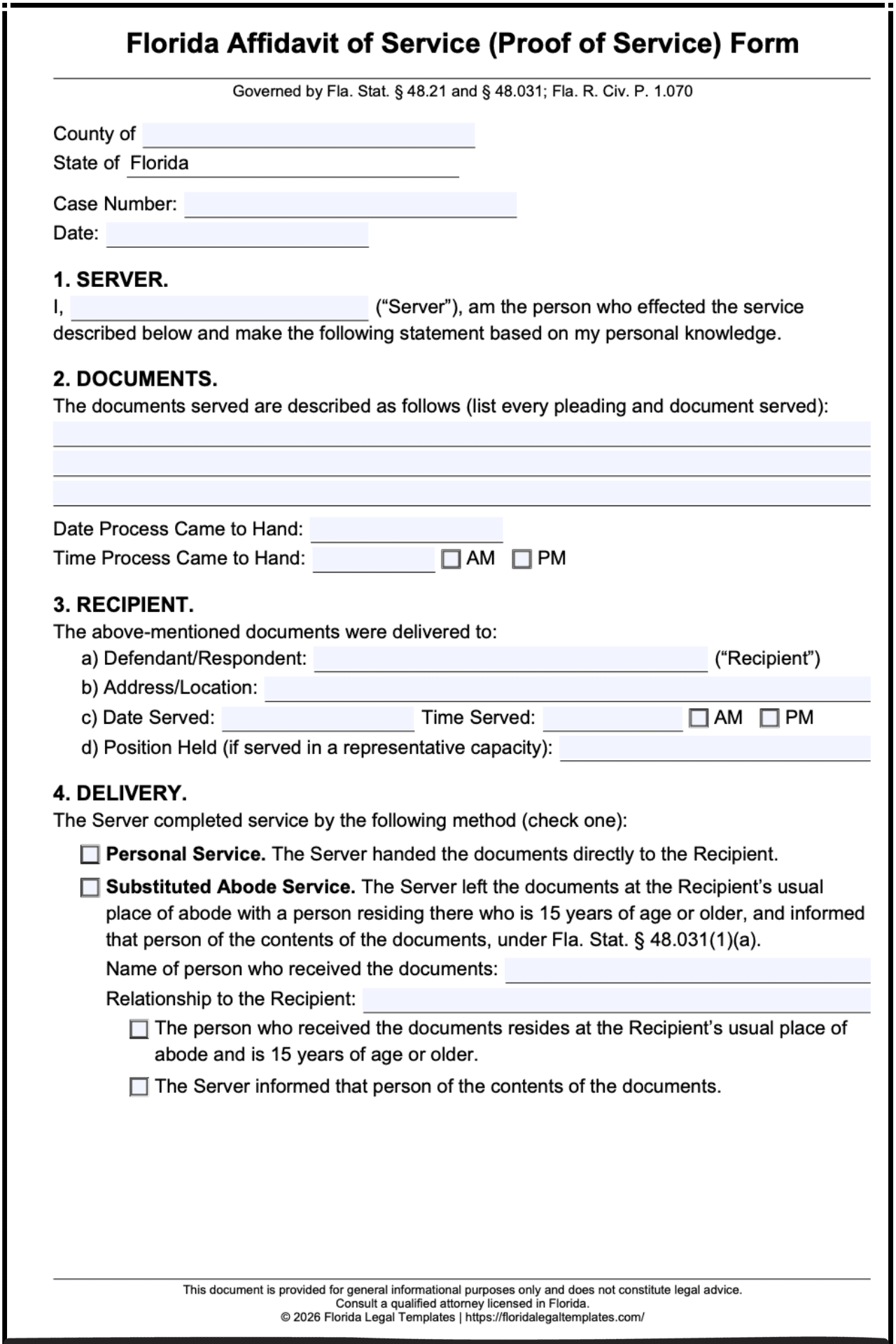
A Florida affidavit of service provides proof that legal papers were served. Florida’s ordinary statutory record of the service is called a return-of-service form. Under Florida Statutes § 48.21, the person who effects service must complete and sign that form, recording when process came to hand, when it was served, how service occurred, who received it, and which pleadings and documents were served.
Separately, Florida Rule of Civil Procedure 1.070(b) requires the person serving process to make proof of service by affidavit promptly and within the time allowed for the recipient to respond. These requirements are related but should not be assumed to be interchangeable; the applicable court form and procedure determine how they must be documented.
Candice Hayden, Legal Writer
Maria Rosso, Florida Probate, Guardianship and Estate Planning Attorney
Florida Affidavit of Service Form (Free PDF)
Get PDF
The person who actually served the legal papers must complete and sign the return of service. The party who requested service should not sign as the process server unless that person was legally authorized to perform the service and actually did so.
A general template may not be appropriate for every situation. For example, certified process servers must use a return-of-service form reviewed and approved by the applicable court under Florida Statutes § 48.29(6).
What a Florida affidavit of service does
A Florida affidavit of service creates a sworn record of the steps taken to deliver legal papers to another person. It helps establish when service occurred, which documents were delivered, who received them, and which method the server used.
In a Florida civil case, the affidavit provides proof of service for the court record. It can be relevant when the court considers whether a defendant received proper notice, whether a response deadline has started, or whether the case can proceed to the next stage.
Return of service, affidavit of service, and certificate of service
In Florida, a return of service and an affidavit of service serve related but distinct purposes. Florida Statutes § 48.21 requires the person who serves process to complete and sign a return-of-service form documenting the service details, including when the papers were received, when they were delivered, how service occurred, who received them, and which documents were served.
Florida Rule of Civil Procedure 1.070(b) separately requires the person serving process to make proof of service by affidavit promptly and within the recipient’s response period. Although both requirements relate to documenting the same service event, they should not automatically be treated as interchangeable. The applicable court form and filing procedure should determine whether the required information and affidavit verification can be provided in one document or require separate documentation.
Return of service: Florida Statutes § 48.21 calls the ordinary statutory record a return-of-service form. The person who effects service completes and signs it, recording the required facts about delivery. It is filed with the court under the applicable requirements of Chapter 48.
Affidavit of service: Florida Rule of Civil Procedure 1.070(b) requires the person serving process to make proof of service by affidavit promptly and within the time allowed for the recipient to respond. An affidavit is a written statement sworn before an officer authorized to administer oaths.
Certificate of service: This concerns the service of later pleadings and other documents in an existing case, rather than the original delivery of a summons and initial pleading. Florida Rule of General Practice and Judicial Administration 2.516 governs service of filed documents and provides for a certificate identifying the date, people served, service addresses, and method of service.
A return of service, therefore, should not automatically be treated as interchangeable with every affidavit or certificate of service. The document submitted must satisfy the requirements applicable to the particular type of service.
A defendant may waive service under Rule 1.070(i); after the plaintiff files the waiver, no further proof of service is required. Effective April 1, 2026, a request for waiver may be sent by U.S. certified mail, return receipt requested, or by registered mail as defined in § 1.01, including qualifying private delivery services.
Official authority: Florida Statutes § 48.21 and Florida Rule of General Practice and Judicial Administration 2.516.
Who completes the Florida affidavit of service form
The person who actually effects service must record the service details and sign the return-of-service form. A plaintiff, petitioner, or other party requesting service should not certify that service occurred based on information they did not personally establish.
Florida recognizes several routes for serving process:
-
Sheriff or deputy sheriff: Under Chapter 48, the sheriff is the primary authorized person responsible for serving process, subject to statutory exceptions.
-
Special process server: A sheriff may appoint qualified special process servers to serve process as permitted by Florida law.
-
Certified process server: A person approved and placed on the applicable circuit’s list of certified process servers may serve process within the authority provided by law.
-
Court-appointed server: Under Rule 1.070(b), the court may appoint a competent person who is not interested in the action to serve process.
Special and certified process servers must satisfy applicable statutory qualifications. These include being at least 18 years old, having no mental or legal disability, being a permanent Florida resident, and being disinterested in the process they serve.
A person receiving papers through substituted service at another person’s usual place of abode must also meet the statutory conditions. Under § 48.031(1)(a), the person accepting the copies must reside there and be at least 15 years old.
The distinction matters because completing a form does not authorize someone to serve process. The person effecting service must be legally authorized to do so.
Official authority: Florida Statutes § 48.021, Florida Statutes § 48.29 and Florida Rule of Civil Procedure 1.070(b).
What Florida law requires the return to say
Florida Statutes § 48.21 establishes the main information that must appear on a return-of-service form. These are factual details about what the process server received and what happened during delivery.
| Topic | Florida legal requirement | Governing authority |
|---|---|---|
| Date received | Record the date and time the process came into the server’s hands. | § 48.21(1) |
| Date served | Record the date and time the papers were delivered. | § 48.21(1) |
| Method of service | Identify how service was completed. | § 48.21(1) |
| Recipient information | State the name of the person served and, if served in a representative capacity, their position. | § 48.21(1) |
| Documents delivered | List all pleadings and documents served. | § 48.21(1) |
| Server’s signature | The person who effected service must sign the return. An authorized server may use an electronic signature. | § 48.21(1) |
| Filing and endorsements | Complete the required endorsements on the process and file the return with the court. | § 48.031(5); Rule 1.070(e) |
The return should give the court enough information to understand the actual service event. A vague statement that the papers were delivered is not a substitute for the individual facts required by the statute.
The required service details
Under Florida Statutes § 48.21(1), the return-of-service form must contain the following information.
1. Date and time the process came to hand
This identifies when the process server received the legal papers for service. It is separate from the date and time of actual delivery.
For example, a server might receive a summons and complaint on Monday but complete service on Wednesday. The return should accurately record both events rather than using the delivery date for both entries.
2. Date and time of service
The return must identify when the person was served. This information is particularly important because the recipient’s response obligations are connected to service.
The server should record the actual date and time rather than estimating or reconstructing them later.
3. Manner of service
The form must describe the method used to serve the papers. For example, it should distinguish personal delivery from substituted service at the recipient’s usual place of abode.
This information allows the court to understand how service was attempted and completed.
4. Name of the person served
The return must identify the person who received the documents.
When process is served on someone in a representative capacity, the return must also identify the position that person occupied. Omitting this information can make it difficult to establish who received the papers and in what capacity.
5. List of all pleadings and documents served
The return must identify every pleading and document delivered during the service event.
A server should not list only the summons if the complaint and other required documents were also served. The record should accurately reflect the complete set of papers delivered.
6. Signature of the person who served process
The person who effected service must sign the return. Florida law also permits a person authorized under Chapter 48 to serve process to use an electronic signature.
The signature requirement is not merely administrative. Section 48.21(2) specifically addresses the consequences of an omitted signature or required factual detail.
There is no subscribing-witness requirement under § 48.21.
Official authority: Florida Statutes § 48.21 – Return of execution of process.
Endorsements on the papers served
Completing the return-of-service form is not the only documentation step. Florida law and the civil procedure rules also address endorsements placed directly on the papers being served.
Under Florida Statutes § 48.031(5), the person serving process must place the following information on the first page only of at least one of the processes served:
-
Date and time of service.
-
The server’s initials or signature.
-
The server’s identification number, if applicable.
The same subsection requires the person requesting service or the person authorized to serve process to file the return-of-service form with the court.
There is also a separate requirement under Florida Rule of Civil Procedure 1.070(e). At the time of personal service, the date and hour of service must be endorsed on the original process and all copies of it by the person making service.
The rule also requires delivery of a copy of the initial pleading to the person being served.
These provisions address related but distinct documentation requirements. A server should not assume that completing the return form eliminates the need to make the required endorsements on the original process and copies.
Official authority: Florida Statutes § 48.031 and Florida Rule of Civil Procedure 1.070(e).
Facts that depend on the service method
The information recorded on a return can depend on how the legal papers were delivered. The server should describe the actual circumstances rather than using a generic statement that does not identify the service method.
One important example is substituted abode service.
Under Florida Statutes § 48.031(1)(a), original process may be served by:
-
Delivering a copy directly to the person being served, together with a copy of the complaint, petition, or other initial pleading or paper; or
-
Leaving the copies at the person’s usual place of abode with someone who resides there, is at least 15 years old, and is informed of their contents.
For substituted abode service, the recipient does not necessarily have to be the person’s spouse or another family member. The statutory requirement is that the person resides at the usual place of abode and meets the age requirement.
A useful return should identify the actual person who received the copies and clearly record that substituted service was used. The server should not describe the event as personal delivery to the named defendant when another resident accepted the papers.
The distinction is important because a return that inaccurately describes the recipient or method may create questions about whether the statutory service requirements were followed.
Official authority: Florida Statutes § 48.031(1)(a).
Does the Florida proof of service need a notarized signature?
Not every return-of-service form needs to be notarized, but Florida’s affidavit requirement must be considered separately.
Florida Statutes § 48.21 requires the person who effected service to sign the return-of-service form. That statute does not itself prescribe notarization as an additional formality for the standard return.
However, Florida Rule of Civil Procedure 1.070(b) requires the person serving process to make proof of service by affidavit promptly and, in any event, within the time during which the person served must respond.
This distinction is particularly important because the wording of Rule 1.070(b) changed in 2025.
The earlier wording limited the affidavit requirement to a person appointed by the court. The Florida Supreme Court removed the words “When so appointed,” making the requirement apply to the person serving process generally. The amendment took effect on April 1, 2025, and remains reflected in the current November 12, 2026 edition of the Florida Rules of Civil Procedure.
Official authorities: Florida Rules of Civil Procedure, Rule 1.070(b) and Florida Supreme Court opinion, SC2024-0774.
Florida Statutes § 92.525 provides a method for verifying a document through a written declaration under penalties of perjury when verification is required by law. This can be an alternative to a notarized oath when the applicable procedure permits it.
The declaration must contain the following exact statutory wording:
Under penalties of perjury, I declare that I have read the foregoing [document] and that the facts stated in it are true
The statement must appear at the end of or immediately below the document being verified and above the signer’s signature.
The words “to the best of my knowledge and belief” may be added only when verification on information or belief is permitted by law.
This is not simply an optional sentence to include anywhere in the document. It is the statutory language for the written-declaration method of verification.
Official authority: Florida Statutes § 92.525.
What happens if the affidavit is notarized?
When the person making the affidavit swears to the statement before a Florida notary, the notarial act must comply with Florida Statutes § 117.05.
The jurat must contain the required information, including:
-
State and county where the notarization takes place.
-
Whether the act is an oath or affirmation.
-
Whether the signer appeared physically or through authorized online notarization.
-
Exact date of the notarial act.
-
Name of the person making the statement.
-
Identification method used by the notary, such as personal knowledge or satisfactory evidence.
-
Notary’s official signature.
-
Notary’s printed, typed, or stamped commissioned name.
-
Official notary seal.
Florida law provides a standard jurat for an oath or affirmation. A notarized document should not contain an incomplete or incorrect notarial certificate.
An affidavit may also be sworn before an officer authorized to administer oaths under Florida Statutes § 92.50, subject to applicable requirements. Since July 1, 2025, a Florida judge may also authenticate a jurat or certificate of proof or acknowledgment by signing it and printing the judge’s name, title, and court.
In short, do not assume that every return must be notarized, but do not assume that an ordinary signature alone satisfies the separate affidavit requirement. Check the applicable court form and procedure to ensure the proof is properly executed.
Official authorities: Florida Statutes § 117.05 and Florida Statutes § 92.50.
How and when to file the return of service
After service is completed, the return-of-service form must be filed with the court handling the case.
Florida Statutes § 48.031(5) provides that the person requesting service or the person authorized to serve process shall file the return-of-service form with the court.
For a pending civil case, this ordinarily means filing it with the Clerk of Court in the county where the action is pending. Follow the applicable clerk’s filing instructions and confirm that the return appears in the case record.
A return of service is a court filing, not a private contract or an instrument that must be recorded with the Florida Division of Corporations, the Florida Department of Revenue, or the Florida Department of Highway Safety and Motor Vehicles.
The timing requirements
Two separate timing requirements are relevant under Florida Rule of Civil Procedure 1.070.
1. The deadline to serve initial process
Under Rule 1.070(j), the initial process and initial pleading must be served within 120 days after the initial pleading is filed for the defendant.
When service is not completed within that period, the court must direct that service be completed within a specified time or dismiss the action without prejudice or drop the defendant from the case, subject to the rule’s provisions.
If the plaintiff establishes good cause or excusable neglect, the court must extend the service period for an appropriate time.
2. The deadline to make proof of service
Rule 1.070(b) separately requires the person serving process to make proof of service by affidavit promptly and within the period during which the person served must respond.
These deadlines serve different purposes. The 120-day period concerns completing service of the initial process and initial pleading. The prompt-proof requirement concerns documenting that service afterward.
Do not assume that having 120 days to serve also gives the server 120 days to prepare and file the proof.
Rule 1.070(i) also provides a separate procedure for requesting a waiver of service. Effective April 1, 2026, the request may be sent by U.S. certified mail, return receipt requested, or registered mail. When the signed waiver is filed with the court, no further proof of service is required.
Official authority: Florida Rule of Civil Procedure 1.070(b), (j).
Use the correct form for certified process servers
A certified process server must use a return-of-service form that has been reviewed and approved by the applicable court under Florida Statutes § 48.29(6).
This requirement is particularly relevant when considering a general Florida service form. A document that contains the basic statutory fields should not automatically be treated as an approved substitute for a circuit’s required form.
Before filing, the server should check the applicable court’s requirements, confirm that all mandatory information is present, and verify that the return has been placed in the correct case record.
Official authority: Florida Statutes § 48.29(6).
When a general Florida service form may not be enough
A standard Florida return-of-service form is useful for documenting ordinary service, but it should not be used as a universal replacement for specialized affidavits or court-approved forms.
Several business-entity service provisions also changed effective October 1, 2025. Section 48.091 now addresses registered-office hours and service on an employee in specified circumstances when the registered agent is absent. Also, Section 48.101(5) permits personal service on the receiver of a domestic business entity, business trust, or sole proprietorship while the receivership is pending. Section 48.181(5) also addresses substituted service through the Secretary of State in qualifying actions involving a former Florida resident who later becomes a nonresident. These methods have their own statutory conditions and should be checked before using a general return-of-service form.
Some service methods have additional requirements concerning due diligence, notice, supporting documents, and filing deadlines.
A Chapter 48 transition rule that took effect April 29, 2025, treats service occurring between January 2, 2023, and October 1, 2025, as valid if a court has not invalidated it and the service complied either with the 2022 Chapter 48 amendments or with the law in effect before January 2, 2023. The amendments apply to service made or effectuated on or after October 1, 2025, regardless of when the claim accrued. The transition rule does not extend the time to challenge service or revive a challenge already waived.
Service through the Secretary of State
Florida Statutes § 48.161 addresses substituted service on certain parties through the Florida Secretary of State.
This method may apply in qualifying circumstances involving nonresidents, parties concealing their whereabouts, or business entities for which substituted service is authorized by law.
It is not simply another way to deliver ordinary process when personal service is inconvenient.
Due diligence must come first.
When a party seeks substituted service because an individual or business entity is a nonresident or conceals its whereabouts, that party must exercise due diligence to locate the person and attempt personal service before using the statutory method. Effective October 1, 2025, § 48.161(5) requires the party to make a diligent inquiry and an honest and conscientious effort appropriate to the circumstances, reasonably use the knowledge available to the party, and make an appropriate number of attempts at times and places where the person is reasonably likely to be found.
The affidavit of compliance must include facts establishing the basis for substituted service. These include:
-
The due diligence exercised in attempting to locate and personally serve the party.
-
The party’s nonresidence or concealment, where applicable.
-
The qualifying business-entity basis for substituted service, where applicable.
Notice and supporting proof are also required.
Under § 48.161(3), notice of service and a copy of the process must be sent forthwith to the party being served. The statute provides for registered mail, certified mail with return receipt requested, or an eligible commercial delivery firm.
When the parties have recently and regularly communicated through email or other electronic means, the server must also send the notice and process using those electronic means. The server must direct the notice to the last known physical address and, where applicable, the last known electronic address.
The party effectuating service must also file the required proof of delivery or return receipts, subject to the statutory exceptions for active refusal, rejection, or concealment.
The 40-day affidavit deadline
The party effectuating service or that party’s attorney must file an affidavit of compliance within 40 days after service on the Secretary of State. The court may allow additional time.
This affidavit is different from an ordinary process server’s return. It must establish the facts justifying the substituted-service method, including the required due-diligence information.
There is also an important effective-date rule. Under § 48.161(8), service is effectuated on the later of:
-
The date the affidavit of compliance is filed; or
-
The date the notice-of-service requirements under subsection (3) are completed.
Therefore, sending process to the Secretary of State does not necessarily mean that service has been fully effectuated on that date.
Official authority: Florida Statutes § 48.161 – Method of substituted service on certain parties in care of the Secretary of State.
Out-of-state service
Service performed outside Florida has its own statutory framework under Florida Statutes § 48.194.
For ordinary personal service in another state, territory, or commonwealth of the United States, subsection (1) generally requires service in the same manner as service within Florida, using a person authorized to serve process in the state where service takes place.
The person seeking to establish out-of-state service must file a return-of-service form described in § 48.21 or other competent evidence stating the time, manner, and place of service.
This is different from the specialized mail procedure available in certain foreclosure proceedings.
Special registered-mail and first-class-mail affidavits in foreclosure cases
Under § 48.194(2), when in rem or quasi in rem relief is sought in a foreclosure proceeding as defined in § 702.09 and the person’s address is known, original process may be served by registered mail on a person in another state, territory, or commonwealth.
If registered mail is returned with an endorsement or stamp showing “refused,” subsection (3) provides a first-class-mail procedure. Merely failing to claim the registered mail is not treated as a refusal under this provision.
When service is obtained through these procedures, the party’s attorney, or the party if unrepresented, must file the affidavit setting forth the return of service required by subsection (4).
Depending on the method used, the affidavit must include details such as:
-
The nature of the process.
-
The date the process was mailed.
-
The name and address appearing on the envelope.
-
Confirmation that registered mail was sent with return receipt requested.
-
Who signed the return receipt, if known, and the basis for that knowledge.
-
The relationship between the person signing the receipt and the person being served, if known, and the basis for that knowledge.
-
For the refused-mail procedure, the relevant refusal and first-class-mail dates and mailing details.
The required supporting material must also be attached. This includes the registered-mail return receipt or the applicable returned envelopes, depending on the service method.
A general return-of-service template that does not capture these specialized mailing facts and attachments should not be used as a substitute for the affidavit required under § 48.194(4).
Official authority: Florida Statutes § 48.194.
Circuit-specific forms
Florida has statutory requirements that apply statewide, but certified process servers must also comply with the court-approved-form requirement.
Under § 48.29(6), a certified process server must prepare the return on a form reviewed and approved by the court.
This means a general Florida affidavit of service template may not be appropriate for every certified process server or every circuit.
Before using a form, check:
-
Whether the server is using the correct form for the applicable circuit.
-
Whether the court has an approved return-of-service format.
-
Whether the form captures all the details required by § 48.21.
-
Whether an affidavit or statutory declaration is also needed to satisfy Rule 1.070(b).
-
Whether the particular service method requires additional affidavits or supporting documents.
Using a generic form without checking these requirements can leave important information out of the court record.
Mistakes that can affect proof of service
A return-of-service form is only useful when it accurately records what happened and satisfies the applicable legal requirements. Several mistakes can create problems when a party later relies on the court record to establish service.
1. Leaving out a required fact or the server’s signature
Florida Statutes § 48.21(2) expressly addresses an incomplete return.
If the return omits any fact required under subsection (1) or does not contain the server’s signature, the statute treats the service as invalid unless the return is amended on application to the court from which the process issued.
The court may permit the return to be amended to supply the missing facts or signature. Once amended, service is treated as effective as though the return had originally included the omitted information.
The statute also allows the court, in its discretion, to impose a fine not exceeding $10 on the person who effected service.
How to avoid this: Review each required field before filing. Confirm that the date and time received, service date and time, manner of service, recipient information, documents served, and server’s signature are present.
2. Confusing failure to file proof with an incomplete return
These are separate issues under Florida law.
Rule 1.070(b) states that failure to make proof of service will not affect the validity of the service. However, § 48.21(2) expressly addresses missing statutory facts or the server’s signature on the return-of-service form.
The two provisions should not be treated as though they say the same thing. One addresses failure to make proof; the other addresses defects in the statutory return itself.
How to avoid this: Do not rely on the general statement that failure to file proof does not affect validity as a reason to submit an incomplete or unsigned return.
3. Recording the wrong recipient or service method
The server must accurately identify the individual who received the documents and explain the manner in which service occurred.
For example, if copies were left at the defendant’s usual place of abode with another resident, the return should not describe the event as though the defendant personally accepted the papers.
How to avoid this: Record the actual recipient’s name, the recipient’s position if applicable, and the precise service method. Do not substitute assumptions for facts observed during service.
4. Recording an incorrect service time or incomplete document list
A return with an inaccurate service date or time can create confusion about when the person was served and when the response period begins.
Similarly, listing only the summons while omitting other documents actually delivered can leave an incomplete record of the service event.
How to avoid this: Prepare the return using the process server’s actual service information. Check the document list against the papers delivered and verify that all required endorsements are completed.
5. Assuming a generic form establishes that service was legally proper
A completed return does not automatically establish that the underlying service method complied with Florida law.
For example, substituted abode service must meet the statutory conditions concerning the usual place of abode, the resident receiving the papers, the recipient’s age, and notification of the documents’ contents.
A form cannot correct an improper delivery method merely because someone completed and signed it.
How to avoid this: Review both the documentation requirements and the requirements governing the actual method of service. For specialized service, use the applicable affidavit or court-approved form.
6. Knowingly making a false return or written declaration
A return of service must accurately reflect what happened. A person should never invent a delivery date, claim to have served someone they did not serve, or sign a statement containing facts they know are false.
Florida imposes serious penalties for false returns by certain authorized process servers.
Under § 48.021(4), a special process server who willfully and knowingly executes a false return of service commits a third-degree felony and is permanently barred from serving process in Florida.
Under § 48.31(2), the same third-degree felony classification and permanent bar apply to a certified process server who willfully and knowingly executes a false return.
Knowingly making a false written declaration under § 92.525(3) is also a third-degree felony.
These are criminal consequences, not merely administrative corrections to a court filing.
Official authorities: Florida Statutes § 48.021(4), Florida Statutes § 48.31(2) and Florida Statutes § 92.525(3).
7. Allowing an interested person to serve process
Special process servers and certified process servers must be disinterested in the process they serve.
Similarly, a person appointed by the court under Rule 1.070(b) must be competent and not interested in the action.
A person with a direct interest in the case should not assume they can serve process simply because they are willing to deliver the documents.
How to avoid this: Use a sheriff, an appropriately authorized process server, or a competent and disinterested person appointed by the court, as applicable.
8. Serving process on Sunday
Florida Statutes § 48.20 generally makes service or execution on Sunday of a writ, process, warrant, order, or judgment void. The statute also provides for damages liability against the person serving or causing the service.
There is a narrow exception. The person requesting service must make an affidavit explaining that there is good reason to believe the person to be served intends to escape from Florida under the protection of Sunday. An officer may then perform Sunday service if furnished with an order authorizing it by the trial court judge.
A server should not treat Sunday as an ordinary service day simply because the papers are ready.
Official authority: Florida Statutes § 48.20.
Frequently asked questions
Is a Florida affidavit of service the same as a return-of-service form?
Not exactly. Florida Statutes § 48.21 uses the term return-of-service form for the ordinary statutory record documenting how process was served.
Florida Rule of Civil Procedure 1.070(b) separately requires the person serving process to make proof of service by affidavit.
People often use “Florida affidavit of service” and “Florida return of service” interchangeably when searching for a form. However, the documents have distinct legal functions. The form used must meet the applicable statutory and procedural requirements, including the affidavit requirement.
Does a Florida return of service have to be notarized?
Not necessarily. Florida Statutes § 48.21 requires the server to sign the return-of-service form but does not independently prescribe notarization for that standard return.
However, Rule 1.070(b) requires proof of service by affidavit. When verification is required, Florida Statutes § 92.525 permits a written declaration under penalties of perjury where that method is applicable.
A notarized oath is another available verification method. The appropriate approach depends on the applicable court requirements and the document being filed.
Can I use one Florida proof-of-service template in every county and for every service method?
No. A general Florida proof-of-service template may cover ordinary service information, but it cannot automatically satisfy every specialized service procedure.
For example, certified process servers must use a form reviewed and approved by the applicable court under § 48.29(6).
Service through the Secretary of State may require a separate affidavit of compliance under § 48.161. Certain out-of-state foreclosure mail procedures require a specific affidavit and supporting mailing documents under § 48.194(4).
Check the applicable court’s requirements before using a general return-of-service form.
If no return is filed—or a required detail is missing—was service invalid?
The answer depends on what happened.
Florida Rule of Civil Procedure 1.070(b) states that failure to make proof of service does not, by itself, affect the validity of service.
However, Florida Statutes § 48.21(2) addresses a different situation: when the return-of-service form omits a required statutory fact or the server’s signature. The statute states that such an omission invalidates service unless the return is amended on application to the issuing court.
Therefore, failure to file proof and filing an incomplete return should not be treated as identical problems. The actual service method and the specific defect must be examined separately.
This article provides general educational information about Florida Affidavit Of Service requirements. It is not individualized legal advice and does not guarantee that a particular service attempt or court filing is valid. Consult a Florida attorney when the proper service method or applicable court requirements are uncertain.