
Florida Residential Lease Agreement [Free Printable, Fillable PDF]
A Florida residential lease agreement can look thorough on paper and still have clauses in it that Florida law treated as void the moment both parties signed. Under F.S. §83.47, a rental-agreement provision is void and unenforceable to the extent it purports to waive or preclude rights, remedies, or requirements under Part II of Chapter 83 or limit liability arising under law, so landlords who copy broad maintenance waivers or liability disclaimers from out-of-state templates may be creating protections that Florida law will not enforce.
A Florida residential lease agreement can look polished and still contain a clause that does not fit Florida’s landlord-tenant rules. If you’re starting from a Florida residential lease agreement PDF, the useful question is not how long the form is or how professional it looks, but whether its rent, deposit, maintenance, entry, and termination provisions match the requirements that actually apply in Florida.
Candice Hayden, Legal Writer
Ross Bridger, Real Estate Attorney
Florida Residential Lease Agreement (PDF, Printable, Fillable)
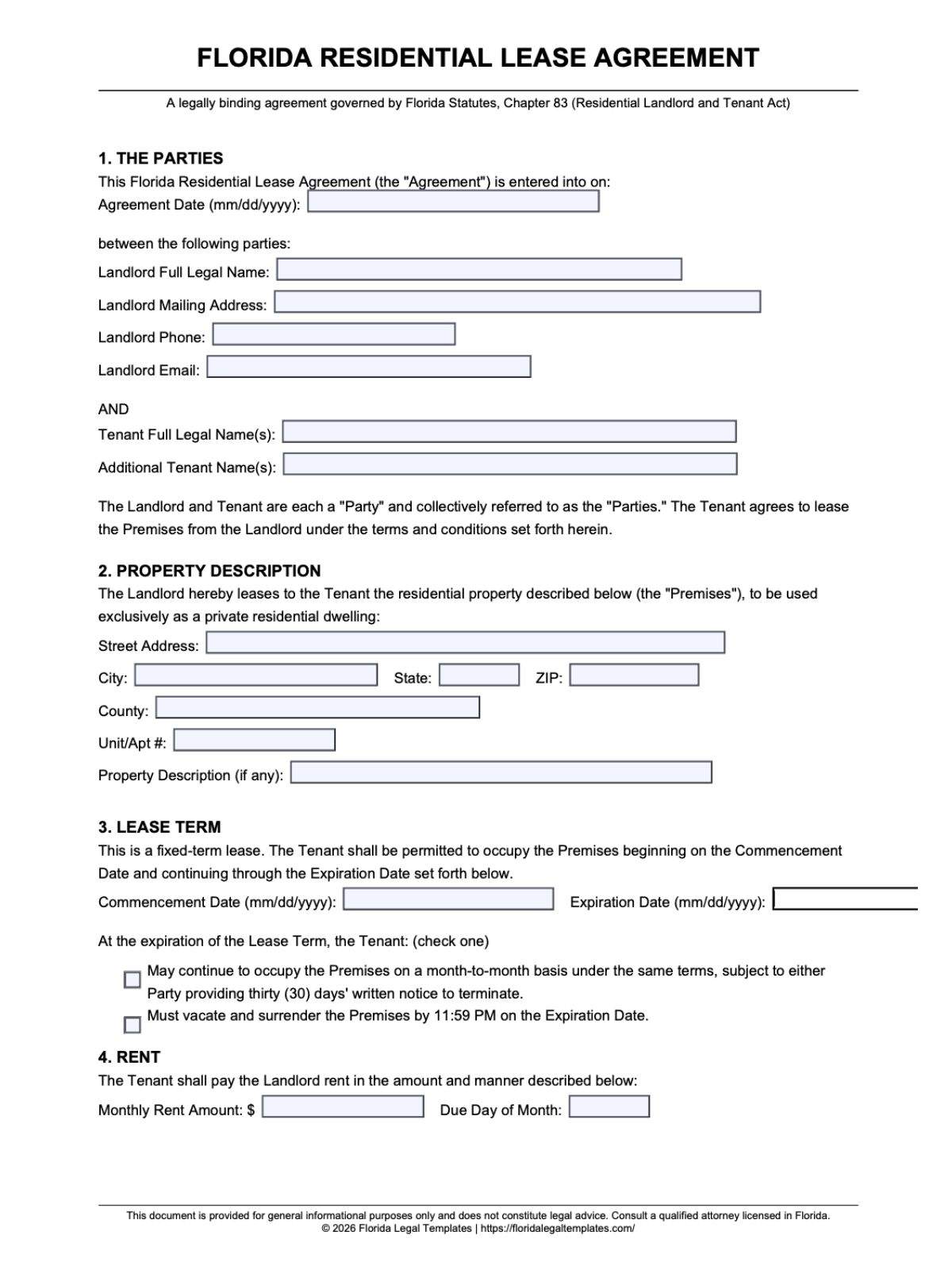
A Florida residential lease agreement PDF or printable template allows landlords and tenants to quickly create a structured rental contract while maintaining legal compliance.
What the document includes:
- Lease term (fixed duration such as 6 or 12 months)
- Monthly rent, due dates, and late fee terms
- Security deposit amount and handling terms
- Maintenance and repair responsibilities
- Required Florida disclosures:
- Radon gas warning (Fla. Stat. § 404.056)
- Security deposit handling, holding method, and required disclosures (Fla. Stat. § 83.49)
- Landlord or authorized agent contact information (Fla. Stat. § 83.50)
- Mandatory standalone Flood Risk Disclosure form (Required under Fla. Stat. § 83.512 for all residential leases with a term of one year or longer)
Who should use this:
- Residential landlords renting houses, apartments, or condos
- Property managers handling leasing operations
- Tenants reviewing contractual obligations before signing
When this template may NOT be sufficient:
- Commercial or mixed-use properties
- Multi-party ownership or corporate leasing structures
- Situations requiring customized legal provisions
A residential rental agreement Florida template works best for standard residential use but must be reviewed carefully to ensure it reflects current Florida statutory requirements.
While residential leases are typically fixed-term, some arrangements require more flexibility. In such cases, a monthly tenancy structure may be more suitable, particularly when either party prefers shorter commitment periods.
What Is a Florida Residential Lease Agreement?
A Florida residential lease agreement is a written contract that establishes the terms of a residential tenancy between a landlord and tenant, which may be for a specific duration or, depending on the agreement and rent-payment period, operate as a periodic tenancy. It is governed specifically by Florida’s statutory framework for residential rentals.
Under Florida law, these agreements are regulated by the Florida Residential Landlord and Tenant Act (Fla. Stat. §§ 83.40–83.683), which defines the rights, obligations, and legal protections of both parties.
Key distinctions:
- Residential lease: May establish a specific duration or other agreed tenancy terms
- Rental agreement: A written or oral agreement for a duration of less than 1 year providing for use and occupancy of the premises
Execution and validity:
- No notarization required for enforceability
- No witness requirement due to the 2020 amendment to Fla. Stat. § 689.01
- Becomes binding once signed by both landlord and tenant
This makes a Florida residential lease agreement a private but legally enforceable contract, provided it complies with statutory rules and includes all required disclosures.
Key Florida Laws That Affect This Florida Residential Lease Agreement
Summary of Applicable Laws
| Topic / Issue | Florida Legal Rule | Governing Statute |
|---|---|---|
| Governing Law | Residential leases governed by Florida Residential Landlord and Tenant Act | Fla. Stat. §§ 83.40–83.683 |
| Landlord Entry | Minimum 24 hours’ advance notice required for non-emergency repairs; entry must occur between 7:30 a.m. and 8:00 p.m. | Fla. Stat. § 83.53(2) |
| Security Deposit Return |
15 days to return the deposit if no claim is made, or 30 days to give written notice of a claim |
Fla. Stat. § 83.49(3)(a) |
| Month-to-Month Termination | Minimum 30 days’ written notice before the end of the monthly period under Fla. Stat. § 83.57(3) | Fla. Stat. § 83.57(3) |
| Prohibited Clauses | Cannot waive tenant rights or limit landlord liability | Fla. Stat. § 83.47 |
| Self-Help Eviction | Lockouts or utility shutoffs strictly prohibited | Fla. Stat. § 83.67 |
Practical Impact & Document Clauses
These statutory rules directly control how a Florida residential lease agreement must be drafted.
For example:
- The lease must include an entry clause aligned with the 24-hour notice rule under Fla. Stat. § 83.53
- The security deposit clause must reflect the strict 15-day return or 30-day notice requirement under Fla. Stat. § 83.49
- The termination clause must follow the updated 30-day notice period
- If rent remains unpaid when due, the landlord must deliver a written demand for payment of the rent or possession of the premises. If the default continues for 3 days, excluding Saturday, Sunday, and court-observed legal holidays, the landlord may terminate the rental agreement under Fla. Stat. § 83.56(3).
Florida law also requires specific disclosures:
- Radon gas notification on at least one document, form, or application executed at or before the rental agreement, using the statutory language required by Fla. Stat. § 404.056
- Security deposit holding notice issued within 30 days of fund receipt specifying bank details (Fla. Stat. § 83.49(2))
- Landlord or authorized agent’s name and address for receiving notices and demands, as required by Fla. Stat. § 83.50
- A separate, standalone written Flood Risk Disclosure form addressing the landlord’s knowledge of flooding during the landlord’s ownership, related insurance claims, and flood-damage assistance, as required by Fla. Stat. § 83.512 for rental agreements with a term of 1 year or longer
- Federal lead-based paint disclosure materials required for most pre-1978 housing, including the required lead-warning statement, known lead-hazard information, available records, and EPA pamphlet
If these elements are missing or incorrect:
- Lease provisions may become void or unenforceable
- Landlords may lose rights to claim deposits
- Tenants may pursue legal remedies
Additionally, any attempt to waive tenant protections is invalid under Fla. Stat. § 83.47, and illegal eviction practices can trigger significant financial liability.
A Lease Cannot Take Away the Tenant’s Right to Send a 7-Day Notice Before Withholding Rent
One clause that regularly causes problems is language stating that a tenant may never withhold rent if repairs are not made. In Florida, that provision is unenforceable if it conflicts with the tenant’s rights under Fla. Stat. § 83.60(1).
The catch is that tenants cannot simply stop paying because something is broken. Before a tenant may raise material noncompliance with the landlord’s maintenance obligations as a defense based on nonpayment of rent, § 83.60(1)(b) generally requires 7 days to elapse after the tenant gives written notice specifying the noncompliance and indicating the intention not to pay rent because of it. If the issue is fixed within that period, the tenant must continue paying rent under the lease. If it is not corrected, the statute provides a potential defense in a later eviction action, but only if the required procedure was followed.
This is why many experienced Florida landlords include a clause reminding tenants of the statutory notice process instead of trying to prohibit rent withholding altogether. It does not create new rights, but it reduces disputes by directing both parties to the procedure already required under Florida law. A lease that accurately references the statute is far more useful than one that promises protections the law will not enforce.
When to Use This Florida Residential Lease Agreement
A residential lease agreement Florida is appropriate in structured, fixed-term rental situations.
Common use cases:
- Renting a property for 6 or 12 months
- Establishing a formal landlord-tenant relationship
- Replacing outdated or non-compliant lease agreements
Applicable property types:
- Single-family homes
- Apartments
- Condominiums (with HOA considerations)
When NOT to use:
- Short-term or vacation rentals
- Commercial leasing arrangements
- Informal occupancy without contractual structure
Using the wrong type of agreement can create enforcement issues, particularly when statutory protections are not properly addressed.
If occupancy involves shared living arrangements, using a shared responsibility agreement between tenants can help clearly define obligations and avoid conflicts that a standard lease may not address in detail.
How to Create or Fill Out the Florida Residential Lease Agreement
Creating a Florida residential lease agreement PDF using a rental application first requires attention to both structure and legal compliance.
Step-by-step process:
- Identify the parties
- Include landlord’s legal name
- Provide authorized agent details (required under Fla. Stat. § 83.50)
- Describe the property
- Full address and unit details
- Define lease term
- Fixed duration with clear start and end dates
- Set rent terms
- Monthly rent, due date, and late fee policy
- Include security deposit terms
- Amount collected
- Location of funds
- Required statutory disclosure language
- Insert mandatory disclosures (“magic words”)
- Radon gas consumer notification verbatim paragraph embedded in the lease agreement text (under Fla. Stat. § 404.056)
- Security deposit bank account notification generated within a strict 30-day window (Fla. Stat. § 83.49(2))
- A separate, standalone written Flood Risk Disclosure document under Fla. Stat. § 83.512 for any residential tenancy spanning 1 year or longer
- Federal Lead-Based Paint disclosure form and EPA booklet for pre-1978 housing stock
- Define entry and maintenance rules
- Reflect statutory notice requirements
- Clarify responsibilities
- Execute the agreement
- Signatures of both parties
- No notarization required
Practical tips:
- Align rent due dates with lease start date
- Avoid including unenforceable clauses
- Maintain signed copies for documentation
Selecting the correct agreement type during drafting is critical. For example, if lease rights may be transferred or delegated, a tenant-to-tenant transfer document should be considered to ensure proper legal structure and liability coverage.
Limitations and Legal Considerations
A Florida residential lease agreement generally does not need to be filed with a government agency, but the parties still need to follow Florida’s statutory rules on tenancy terms, disclosures, deposits, notices, and landlord obligations.
Key limitations:
- Cannot override statutory tenant protections
- Must include all mandatory disclosures
- Must follow deposit handling requirements
Important edge cases:
- Multi-year leases no longer require witnesses
- Verbal agreements may exist but are harder to enforce
Legal risks:
- Invalid clauses may be struck from the contract
- Non-compliance may lead to financial penalties
- Increased exposure to disputes and litigation
Common Mistakes to Avoid
1. Missing required disclosures
Failure to provide the mandatory radon warning, security deposit banking disclosure, landlord contact details, or the separate written flood history disclosure under Fla. Stat. § 83.512.
Consequence: If a landlord violates the flood-disclosure requirement and a tenant later suffers substantial loss or damage to personal property from flooding, the tenant may terminate the rental agreement by written notice and surrendering possession within 30 days after the damage or loss, with prepaid rent or other amounts refunded for periods after termination under Fla. Stat. § 83.512.
2. Using outdated templates
Templates that do not reflect updated laws such as the 30-day termination requirement.
Consequence: Legal non-compliance and disputes.
3. Including prohibited clauses
Attempting to waive tenant rights or limit landlord liability.
Consequence: Clauses are void under Fla. Stat. § 83.47.
4. Mishandling security deposits
- Not returning within 15 days
- Failing to notify within 30 days
Consequence: Loss of claim rights and potential liability.
5. Violating entry rules
Entering property without notice or outside permitted hours.
Consequence: Breach of tenant rights under Florida law.
6. Attempting self-help eviction
Lockouts or utility shutoffs to force vacancy.
Consequence: Liability for actual and consequential damages or three months’ rent, whichever is greater, plus costs and attorney’s fees under Fla. Stat. § 83.67(6).
A residential lease governs possession—not ownership or financial structuring. In situations involving financial obligations or secured arrangements, a formal lending agreement may be required to clearly document repayment terms and legal responsibilities beyond tenancy.
Frequently Asked Questions (FAQ)
Is a Florida residential lease agreement legally valid without notarization?
Yes. Florida law does not require notarization. A signed agreement is legally binding as long as it meets contract requirements.
What is the updated notice period for terminating a month-to-month lease in Florida?
Under Fla. Stat. § 83.57(3), the required notice period is 30 days, reflecting recent legislative updates.
What happens if required disclosures are missing from the lease?
Missing disclosures—such as radon warnings or deposit notices—can:
- Make portions of the lease unenforceable
- Expose the landlord to legal claims
- Reduce enforceability in disputes
How should a landlord handle a security deposit under Florida law?
A landlord must:
- Store the deposit in a Florida institution or approved method
- Provide written notice within 30 days
- Return the deposit within 15 days (if no claim) or send notice within 30 days if deductions are made
Failure to follow these rules can result in loss of deposit rights and legal liability.
A properly prepared Florida residential lease agreement should match the parties’ actual arrangement and the Florida rules that apply to it. Checking the deposit, entry, maintenance, notice, and disclosure provisions before signing can help both landlords and tenants avoid preventable disputes.
Legal Disclaimer:This article provides general information about Florida residential lease agreements and is not legal advice. Laws and requirements may change, and individual circumstances can affect how the law applies. Consider consulting a qualified Florida attorney for advice about a specific situation.