
Florida Room Rental Agreement [Free Printable PDF, Guide]
A Florida room rental agreement is something most homeowners don’t think they need until they’re already in a situation where not having one has become a real problem. What starts as an informal arrangement with a friend, a relative, or someone from a listing site can cross into full landlord-tenant territory faster than most people expect, because Florida courts look at the substance of the arrangement rather than what the parties called it.
I’ve seen homeowners try to remove a room occupant with a simple conversation or a text message, not realizing that when an occupant is legally a tenant under Chapter 83, a landlord generally must use the statutory process to recover possession rather than resorting to self-help. The room lease agreement florida template below is built for exactly this situation, covering the terms that establish the arrangement clearly from the start and give the homeowner a legal foundation if things don’t go as planned.
Candice Hayden, Legal Writer
Ross Bridger, Real Estate Attorney
Florida Room Rental Agreement (PDF, Printable, Fillable)
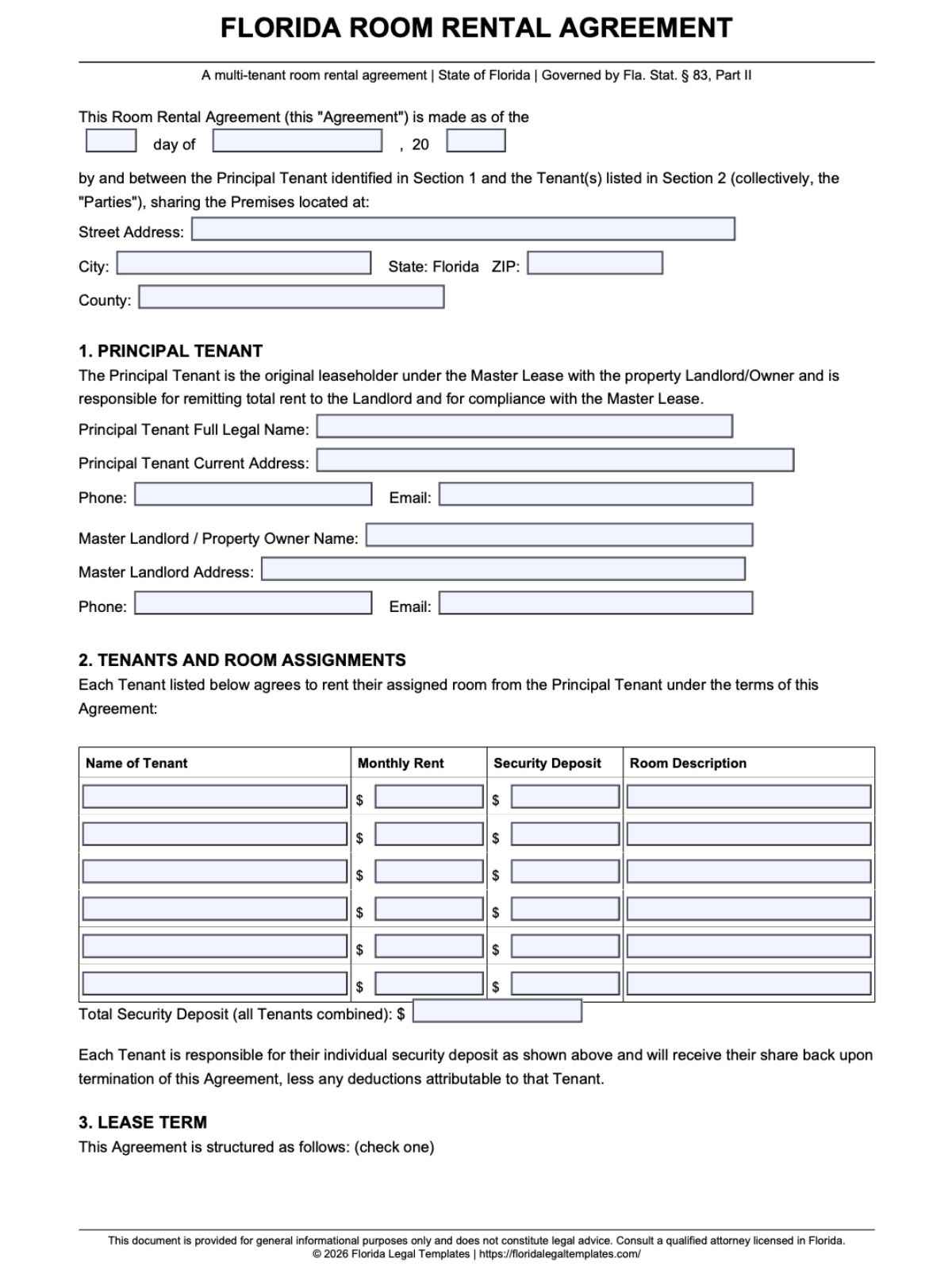
A Florida room rental agreement puts the practical details of a room tenancy in writing, including the rent, lease term, private bedroom, shared areas, deposit terms, and rules for using the rest of the home.
What the document includes:
- Lease term (fixed-term or month-to-month tenancy)
- Monthly rent amount, due date, and payment terms
- Security deposit provisions aligned with Florida law
- Definition of exclusive room vs shared/common areas
- Landlord entry rights and tenant privacy protections
- Required Florida disclosures
Who should use this:
- Homeowners renting out a spare bedroom
- Tenants subleasing a room with landlord permission
- Property managers handling shared housing setups
When this template may NOT be sufficient:
- Full-property lease agreements
- Informal roommate arrangements (use a roommate agreement instead)
- Short-term or vacation rental setups
When the arrangement creates a residential tenancy under Chapter 83, the fact that the tenant is renting only one bedroom does not make the arrangement informal; the agreement should still identify the rented space, rent, term, and rights to use the shared areas.
What Is a Florida Room Rental Agreement?
A Florida room rental agreement is a residential lease for a specific room within a larger dwelling. The tenant has “exclusive possession” of the specific room. For repairs, Florida law generally requires at least 24 hours’ notice and entry between 7:30 a.m. and 8:00 p.m., although § 83.53 also allows entry in specified circumstances such as consent or an emergency.
Legal framework:
- A rented room can fall within the Florida Residential Landlord and Tenant Act when it is rented as a home, residence, or sleeping place, subject to the exclusions that apply under Fla. Stat. § 83.42.
- Creates a landlord-tenant relationship, even if the landlord lives in the same property
Key distinctions:
- Room rental agreement: landlord-tenant relationship
- Roommate agreement: private contract between co-tenants
- Sublease: tenant rents to another tenant
Execution validity:
- A typical residential lease does not require notarization merely to be valid.
- No subscribing witnesses are required merely for a lease of real property under Fla. Stat. § 689.01.
Practical implication:
Even when renting a single room, landlords must comply with all statutory obligations—including notice rules, deposit handling, and required disclosures.
Because a room rental still creates a formal landlord-tenant relationship, it’s helpful to understand how it compares to broader lease structures. For example, a standard residential lease format used across Florida outlines similar rights and obligations, while a roommate agreement for shared living situations applies when there is no direct landlord-tenant relationship. This distinction ensures the correct legal framework is used.
Key Florida Laws That Affect Florida Room Rental Agreement
Summary of Applicable Laws
| Topic / Issue | Florida Legal Rule | Governing Statute |
|---|---|---|
| Governing Law | Residential lease law applies to room rentals | Fla. Stat. §§ 83.40–83.684 |
| Security Deposit | If no claim is made, the deposit generally must be returned within 15 days; if the landlord intends to claim against it, written notice generally must be provided within 30 days, by certified mail or by e-mail when § 83.505’s electronic-notice requirements are satisfied. | Fla. Stat. § 83.49(3)(a) |
| Month-to-Month Termination | At least 30 days’ written notice before the end of the monthly rental period. | Fla. Stat. § 83.57(3) |
| Landlord Entry | 24-hour notice; entry between 7:30 a.m.–8:00 p.m. | Fla. Stat. § 83.53(2) |
| Execution Formalities | No witness requirement for validity | Fla. Stat. § 689.01 |
Practical Impact & Document Clauses
These rules matter when the agreement is drafted because the document needs to match the actual tenancy. A month-to-month room rental, for example, should not contain a termination provision that conflicts with the 30-day notice rule in Fla. Stat. § 83.57(3).
For example, the lease must include a termination clause that aligns with the 30-day notice requirement under Fla. Stat. § 83.57(3). If this is omitted or misstated, termination may be legally invalid. Similarly, the landlord’s right to enter the rented room must reflect the 24-hour notice rule and restricted time window defined under Fla. Stat. § 83.53.
Security deposits are another high-risk area. Under Fla. Stat. § 83.49, landlords must follow strict timelines: 15 days to return the deposit if no deductions are made, or 30 days to provide written notice of a claim. Missing these deadlines, or failing to provide the required 30-day notice in the manner authorized by Fla. Stat. § 83.49(3)(a), can result in the landlord losing the right to impose the claim against the deposit, subject to the statute’s other provisions. While Fla. Stat. § 83.505 permits required Chapter 83 notices to be delivered by e-mail, the parties must first sign the statutory electronic-delivery addendum and provide valid e-mail addresses for that purpose. If the landlord does not satisfy the statutory notice requirements, the landlord forfeits the right to impose the claim against the deposit, although § 83.49(3)(a) permits a later action for damages after the deposit is returned.
Florida law also requires specific disclosures to be included:
- Radon gas notification containing the statutory language required by Fla. Stat. § 404.056(5).
- Security deposit holding disclosure with verbatim statutory language
- Written disclosure, at or before commencement of the tenancy, of the landlord’s name and address or the name and address of the person authorized to receive notices and demands on the landlord’s behalf.
- Federal lead-based paint disclosure for most pre-1978 housing, when applicable.
The disclosures that apply to a particular tenancy should be provided at the time and in the manner required by the applicable Florida or federal law.
Since room rentals are governed by the same statutory framework as full leases, reviewing a broader Florida residential lease document structure can help ensure all required disclosures and clauses are properly included. Many of these compliance requirements also overlap with month-to-month tenancy rules and notice obligations, especially when no fixed term is defined.
When to Use Florida Room Rental Agreement
A Florida room rental agreement is most useful when the tenant has a defined bedroom or other portion of a dwelling for residential use while also sharing parts of the property, such as a kitchen, bathroom, laundry area, or living space. Florida’s definition of a dwelling unit expressly includes a part of a structure rented as a home, residence, or sleeping place under Fla. Stat. § 83.43(5).
That makes the agreement particularly useful for homeowners renting a spare bedroom, landlords renting individual bedrooms, and authorized subleases where the occupant’s rights and shared spaces need to be clearly defined.
When NOT to use:
- Informal roommate agreements
- Vacation or short-term rentals
- Commercial property leasing
Choosing the correct agreement type is critical. Using a roommate agreement where a lease is required can leave both parties unprotected.
In situations where the occupant is not directly renting from the property owner, a different agreement type may be more appropriate. For instance, if an existing tenant rents out their space, a subleasing arrangement under Florida law is typically required. Additionally, landlords often screen applicants beforehand using a tenant screening and rental application form to reduce risk in shared housing setups.
Renting Multiple Rooms? Treat Each Bedroom as a Separate Tenancy
If you rent bedrooms individually instead of leasing the entire home to one group, Each separately rented room can create its own rental agreement and corresponding landlord-tenant rights and obligations. One tenant moving out, defaulting on rent, or being evicted does not automatically affect the legal status of the other occuants.
This becomes especially important when serving notices under Chapter 83. Notices should identify and be served on the tenant or tenants whose tenancy is being terminated, in accordance with the applicable Chapter 83 notice and service requirements. Likewise, returning one tenant’s security deposit does not allow the landlord to apply those funds toward damage allegedly caused by another room tenant. Florida’s Residential Landlord and Tenant Act treats each lease according to its own terms, even when the occupants share common areas. See Fla. Stat. §§ 83.56 and 83.49.
From a drafting standpoint, the agreement should identify the tenant’s exclusive bedroom, list every shared area the tenant may use, and state whether rent includes utilities or other shared household expenses. Those details become critical if a dispute later reaches county court, because they help define exactly what the tenant rented and what obligations belonged to each individual occupant.
How to Create or Fill Out the Florida Room Rental Agreement
Creating a room lease agreement Florida requires both clarity and strict compliance with legal requirements.
Step-by-step process:
- Identify the parties
- Landlord (owner or authorized person)
- Tenant renting the room
- Describe the property
- Full address
- Specific room
- Shared/common areas
- Define the lease term
- Fixed term or month-to-month
- Set rent terms
- Amount, due date, payment method, late fees
- Include security deposit terms
- Amount collected
- Storage method
- Required statutory disclosure language
- Insert mandatory disclosures (“magic words”)
- Radon gas notification containing the statutory language required by Fla. Stat. § 404.056(5), except where the statutory transient-occupancy exception applies.
- Security deposit notice
- Landlord identification
- Lead-based paint disclosure (if applicable)
- A separate flood-risk disclosure must be provided at or before execution of a residential rental agreement with a term of 1 year or longer, as required by Fla. Stat. § 83.512.
- Define landlord entry rights
- Must comply with 24-hour notice rule
- Execute the agreement
- Signatures required
- No notarization required
Practical tips:
- Clearly distinguish private room vs shared spaces
- Align notice periods with rent cycle
- Avoid clauses that attempt to waive tenant rights (they are void under Fla. Stat. § 83.47)
Limitations and Legal Considerations
A Florida room rental agreement is a private contract, but the parties cannot use the document to waive rights or obligations imposed by Part II of Chapter 83. Fla. Stat. § 83.47 makes provisions that purport to waive or preclude statutory rights, remedies, or requirements void and unenforceable.
The agreement should therefore set out the parties’ expectations clearly without attempting to contract around Florida’s mandatory landlord-tenant rules.
Legal constraints:
- Florida prohibits specified self-help practices, including utility shutoffs and preventing a tenant from gaining reasonable access to the dwelling unit, under Fla. Stat. § 83.67
- Landlords cannot lock tenants out or shut off utilities, and a violation of Fla. Stat. § 83.67 can expose the landlord to actual and consequential damages or 3 months’ rent, whichever is greater, plus costs and attorney’s fees.
High-risk scenarios:
- Landlord lives in the same home but ignores tenant rights
- Informal agreements lacking required disclosures
Edge cases:
- Shared kitchen or bathroom disputes
- Multiple tenants renting different rooms
Even in shared living situations, Florida law treats the tenant’s room as a protected space.
The Silent Trap of Waiving Transient Removal Rights
Homeowners frequently utilize room rentals for short-term boarders or temporary house guests who contribute to expenses, thinking a formal document protects them. However, executing this agreement triggers a severe procedural trap under Florida law. Under Fla. Stat. § 82.035, a homeowner has the right to request immediate law enforcement intervention to remove an unwanted guest without a court order by executing a transient occupant affidavit. To qualify for summary police removal, the occupant must not hold a leasehold interest in the property.
A written room rental agreement can change the removal analysis because § 82.035 applies only to a statutory transient occupant whose occupancy is not pursuant to a lease. Whether Chapter 82 or Chapter 83 applies depends on the nature of the occupancy, the agreement between the parties, and the statutory requirements; the length of the stay alone does not decide the issue. If the occupant has a leasehold interest, the landlord generally must use the applicable Chapter 83 procedures to recover possession rather than treating the person as a transient occupant.
Room rental agreements apply only to residential use. For business purposes, a commercial lease for business occupancy must be used, as it follows a different legal framework.
Common Mistakes to Avoid
Treating room rental as informal arrangement
Some landlords assume renting a room is less regulated.
Consequence: Full legal liability still applies under Florida law.
Missing required disclosures
Radon, deposit notice, and landlord identity are mandatory.
Consequence: Lease provisions may become unenforceable.
Using outdated termination rules
For a month-to-month tenancy, Florida law requires at least 30 days’ written notice before the end of the monthly rental period under Fla. Stat. § 83.57(3).
Consequence: Invalid termination and legal disputes.
Entering the room without notice
Ignoring the 24-hour rule.
Consequence: Violation of tenant rights and potential claims.
Mishandling security deposits
Missing 15-day or 30-day deadlines.
Consequence: Loss of right to retain deposit funds.
Attempting self-help eviction
Lockouts or utility shutoffs.
Consequence: The landlord may be liable for actual and consequential damages or three months’ rent, whichever is greater, plus costs and attorney’s fees.
Lumping fees into the 3-day notice
Consequence: A three-day notice for nonpayment should accurately state the rent demanded under Fla. Stat. § 83.56(3). Amounts other than rent should not be included unless they qualify as rent under the written rental agreement.
Frequently Asked Questions (FAQ)
Do tenants renting a single room have full rights under Florida law?
Generally, yes. When the room rental falls within Part II of Chapter 83, the tenant receives the protections and obligations that apply to residential tenants, although statutory exclusions and the specific facts of the occupancy can affect which rules apply.
How much notice is required to terminate a room rental agreement in Florida?
It depends on the type of tenancy. For a month-to-month tenancy, Fla. Stat. § 83.57(3) requires at least 30 days’ notice before the end of the monthly rental period. Other periodic tenancies have different statutory notice periods, so the rental period should be identified before preparing a termination notice.
Can a landlord enter a rented room without notice?
Not always. For repairs, § 83.53 generally requires at least 24 hours’ notice and entry between 7:30 a.m. and 8:00 p.m., but the statute also permits entry in specified circumstances such as consent or an emergency.
What happens if required disclosures are missing from a room rental agreement?
Missing disclosures can make parts of the agreement unenforceable and expose the landlord to legal liability.
For a Florida room rental, the details matter: identify the rented room and shared areas, state the rent and deposit terms, use the correct Chapter 83 notices, and include disclosures that apply to the particular tenancy, including the separate flood disclosure required for rental agreements of 1 year or longer.