
Free Florida Quitclaim Deed Form | PDF & WORD Format
If you need a Florida quitclaim deed, your first priority is using a form that satisfies Florida’s execution and recording requirements—not just filling in names and signing it. A quitclaim deed is commonly used to transfer property between people who already know and trust each other, such as divorcing spouses, family members, or a property owner transferring real estate into a revocable living trust. It transfers only the interest the grantor currently owns and makes no promise that the title is clear or even exists.
Two mistakes regularly derail these transfers in Florida. First, a quitclaim deed that is not signed in the presence of two subscribing witnesses fails to satisfy Florida’s statutory conveyance requirements. Second, if the property is a married owner’s homestead, a transfer made without the required spousal joinder is void from the beginning—even if the deed is later recorded. These are not minor paperwork issues; they can prevent a valid transfer of ownership and create expensive title problems later.
Candice Hayden, Legal Writer
Maria Rosso, Florida Probate, Guardianship and Estate Planning Attorney
Get Your Florida Quitclaim Deed (Free PDF & Fillable Form)
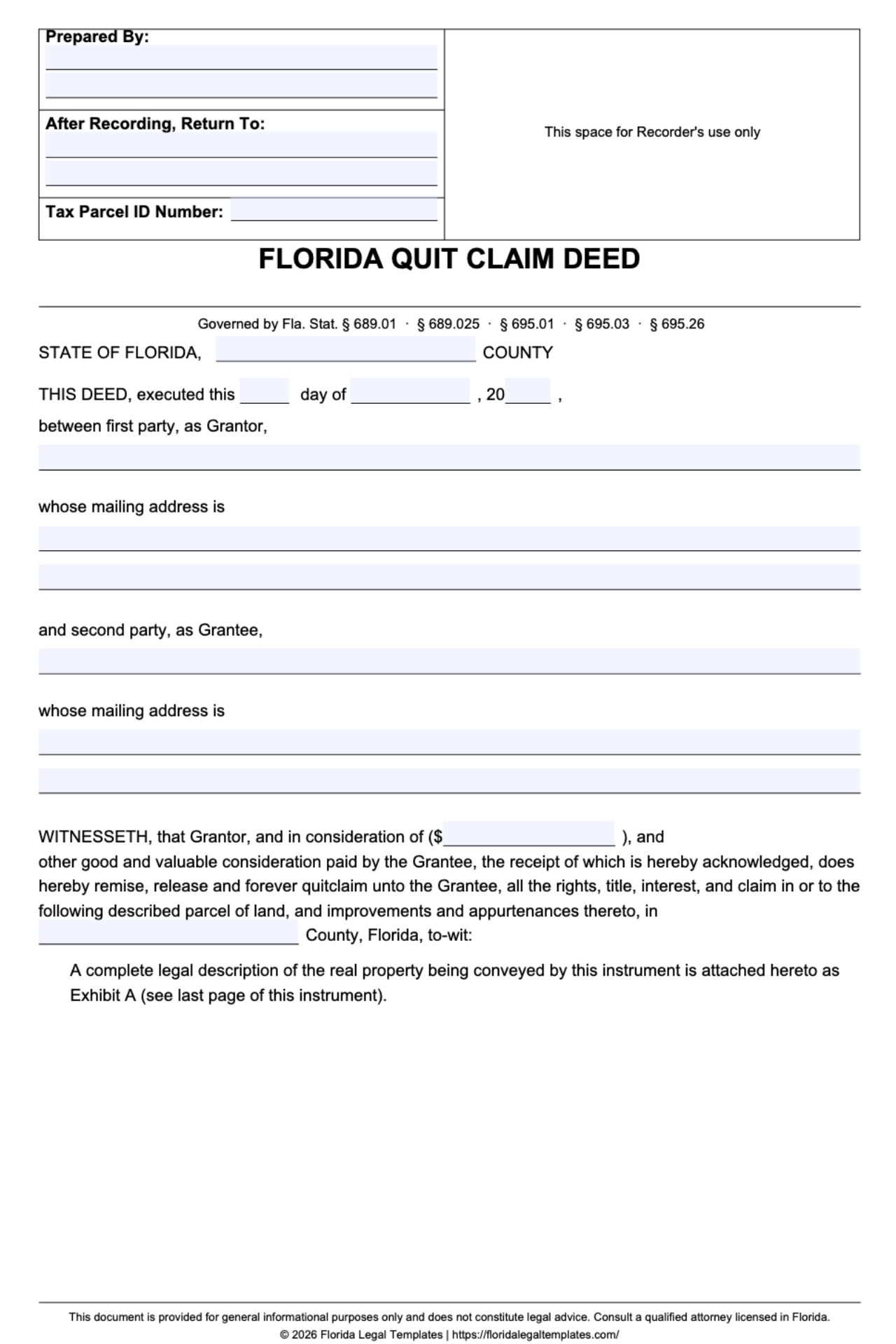
A properly prepared Florida quitclaim deed PDF should do more than provide blank spaces to complete. It should already include the formatting and information Florida recording offices expect so the document is less likely to be rejected during recording.
A quality free quitclaim deed Florida template should include:
- A blank, printable PDF version
- A fillable and editable version for electronic completion
- Space for the complete legal description of the property
- Signature blocks for the grantor and two subscribing witnesses
- A Florida notary acknowledgment section
- Preparer name and mailing address section
- Grantee name and mailing address section
- Printed-name fields beneath every required signature
- The mandatory Florida Radon Gas Disclosure
- Recording margins and document formatting suitable for county recording requirements
Unlike generic deed templates found online, a properly formatted quit claim deed Florida form should already account for Florida’s document formatting requirements, including preparer information and printed names beneath signatures. These details often determine whether the Clerk accepts the document for recording.
Who Should Use This Template?
A Florida quit claim deed is most often used when ownership is changing between parties who already understand the property’s ownership history and are not relying on title warranties.
Common situations include:
- One spouse transferring ownership after a divorce settlement.
- Parents adding an adult child to the property’s title.
- Siblings distributing inherited real estate.
- A homeowner transferring property into a revocable living trust.
- Correcting minor title issues between family members.
- Adding or removing a spouse from title after marriage or separation.
In each of these situations, the parties generally already know the property’s history and simply need a legal instrument to transfer whatever ownership interest currently exists.
When This Template Is Not the Right Choice
Even the best blank quitclaim deed Florida template cannot solve problems involving disputed ownership or uncertain title.
You should not rely on a quitclaim deed when:
- The buyer expects guaranteed ownership.
- The property’s title history is unknown.
- There is an active ownership or boundary dispute.
- The property is a married owner’s Florida homestead and the non-owner spouse refuses to sign.
- You need protection against undisclosed liens or competing ownership claims.
For those transactions, another type of deed—or additional legal action—may be necessary because a quitclaim deed offers no title warranties and cannot resolve underlying ownership disputes.
What Does a Quitclaim Deed Actually Transfer in Florida?
A Florida quitclaim deed transfers only the ownership interest the grantor actually possesses at the moment the deed is signed. It does not promise that the grantor owns the property outright, owns any particular percentage, or even owns anything at all.
That means the legal effect depends entirely on what interest the grantor currently holds.
For example:
- If the grantor owns 100% of the property, the entire ownership interest can pass to the grantee.
- If the grantor owns only a one-half interest, only that half transfers.
- If the grantor owns no legal interest, the deed still exists—but it transfers nothing.
The document itself does not determine ownership. It simply conveys whatever rights currently exist.
This is why quitclaim deeds are frequently used among family members and trusted parties. Everyone involved usually already understands the property’s ownership status and is not asking the grantor to guarantee the title.
By contrast, a warranty deed is generally used when a buyer expects assurances that the seller has good title and can legally transfer the property. A quitclaim deed intentionally avoids those promises.
Another practical limitation often surprises property owners. A Florida quitclaim deed transfers only a present ownership interest. If someone signs a quitclaim deed today but does not actually acquire legal ownership until later, that later-acquired interest does not automatically pass to the grantee. The deed speaks only as of the time it is executed, making it unsuitable for transferring future or expected ownership rights.
Understanding this distinction helps explain why quitclaim deeds are excellent tools for straightforward family transfers but poor choices for arm’s-length real estate sales where title protection is expected.
Florida Laws That Govern Execution and Recording
Florida has two separate sets of rules that apply to a quitclaim deed. The first determines whether the deed legally transfers ownership. The second determines whether the county clerk will accept it for recording.
Meeting one requirement doesn’t automatically satisfy the other. For example, a deed may be legally effective between the parties but still be rejected by the Clerk because required formatting information is missing. On the other hand, failing to meet Florida’s mandatory execution requirements—such as the witness requirement—can prevent a valid transfer of legal title altogether.
The Statutory Requirements Table
| Topic / Issue | Florida Legal Rule | Governing Statute |
|---|---|---|
| Execution Formalities | Grantor must sign in the presence of two subscribing witnesses, who must also sign the deed. | Fla. Stat. § 689.01(1) |
| Notary Requirement | A formal notary acknowledgment or jurat is required before the deed can be recorded. | Fla. Stat. § 695.03 |
| Preparer Information | The first page must contain the preparer’s name and post-office address. | Fla. Stat. § 695.26(1)(b) |
| Printed Names | The name of the grantor, notary, and each witness must be legibly printed, typed, or stamped beneath their signatures. Crucially, the document must also display the post-office address of each of the two subscribing witnesses next to or under their signatures. | Fla. Stat. § 695.26(1)(c) & (e) |
| Grantee Information | Each grantee’s printed name and post-office address must appear on the deed. | Fla. Stat. § 695.26(1)(f) |
Florida’s recording rules are designed to protect both property owners and the public record. County Clerks rely on standardized formatting so every recorded deed clearly identifies who prepared the document, who transferred the property, who received it, and whose signatures were witnessed and notarized.
Following these statutory requirements also helps reduce title disputes. Years after a property transfer, title companies, lenders, or future purchasers often review recorded deeds. Missing signatures, incomplete acknowledgments, or omitted identifying information can delay refinancing, prevent a sale, or require corrective legal action before closing.
For the complete statutory language governing deed execution and conveyances, see Fla. Stat. § 689.01. Recording requirements are contained in Fla. Stat. § 695.03 and Fla. Stat. § 695.26.
What Happens If a Clause Is Missing
Not every omission has the same legal consequence. Some defects affect the validity of the transfer itself, while others primarily affect recordation.
Missing Witnesses
Florida’s two-witness requirement is mandatory for conveying real property. If the grantor does not execute the deed before two subscribing witnesses, the deed fails to satisfy Florida’s conveyance requirements under Fla. Stat. § 689.01(1). This is more serious than a recording defect—it creates a title problem because the legal transfer itself is defective.
A common mistake occurs when someone signs the deed at home and later asks two people to sign as witnesses. Those individuals did not actually witness the execution, which can undermine the deed’s validity.
Missing Preparer Information or Printed Names
Other defects usually arise during recording.
Examples include:
- Missing the preparer’s name or complete mailing address.
- Omission of legibly printed names directly beneath all signatures.
- Missing or incomplete mailing addresses for the grantees.
- Failure to provide the physical post-office addresses for both subscribing witnesses.
- Submitting the deed without meeting the standard 3-inch top margin requirement on the first page.
In these situations, the Clerk may reject the document for recording until the deficiencies are corrected. Although the deed may still be enforceable between the parties depending on the circumstances, failing to record promptly creates its own risks.
Why Recording Matters
Recording a quitclaim deed places the public on notice that ownership has changed. Until the deed is properly recorded, a later purchaser or creditor who records first may gain priority over the grantee’s interest under Florida’s recording laws.
That means a perfectly intended family transfer can become a much larger title problem if the deed sits unrecorded for months while liens, judgments, or competing transfers occur.
When defects are discovered after signing, the solution is often a corrective deed executed with the missing information. In more complicated situations—particularly where ownership has already become disputed—a quiet title action may be necessary to resolve competing claims.
The Homestead Trap: Why a Married Owner Can’t Quitclaim Alone
Florida’s homestead protections create one of the most misunderstood rules affecting quitclaim deeds.
If the property is the married owner’s primary homestead, the owner generally cannot transfer any interest without the other spouse joining in the conveyance. A quitclaim deed signed by only the titled spouse is void from its inception, not merely voidable.
This protection comes from Article X, Section 4(c) of the Florida Constitution together with Fla. Stat. § 708.08, and it applies regardless of whose name appears on the existing deed.
Many homeowners mistakenly assume that because only one spouse purchased the home or appears on the title, that spouse may freely transfer it. Florida law says otherwise when the property qualifies as the family’s homestead.
A Common Real-World Example
Suppose a husband owns the family home in his name alone. Without telling his wife, he signs a quit claim deed Florida form transferring the property to his adult son.
Even if:
- the deed is signed,
- properly witnessed,
- notarized,
- and recorded,
the transfer has no legal effect if the property is protected homestead and the wife did not join in the conveyance.
Recording the deed does not cure this defect because the constitutional protection exists independently of the recording process.
What You Should Verify Before Completing the Form
Before filling out any quitclaim deed Florida PDF, ask these questions:
- Is this the owner’s primary residence?
- Is the owner legally married?
- Does the non-titled spouse have homestead rights?
- Should both spouses sign as grantors or execute the required joinder?
Answering these questions before execution is far easier—and far less expensive—than trying to repair an invalid conveyance after the deed has already been recorded.
For the statutory framework governing homestead transfers, review Fla. Stat. § 708.08.
When People Actually Use a Florida Quitclaim Deed
A Florida quitclaim deed is designed for situations where the parties already know each other and are comfortable with the property’s ownership history. Its purpose is to transfer whatever ownership interest currently exists—not to guarantee that the title is free of defects or claims.
Below are the situations where a quitclaim deed is commonly used and where it makes practical sense.
Divorce Property Settlements
One of the most common uses is after a divorce. If a marital settlement agreement awards the home to one spouse, the other spouse may sign a quitclaim deed transferring their ownership interest.
Keep in mind that signing the deed only changes the title. If both spouses remain on the mortgage, the lender can still hold both borrowers responsible for the loan until it is refinanced or otherwise satisfied.
Adding a Spouse or Family Member to Title
Many homeowners use a quit claim deed Florida form after marriage to add a spouse to the property’s title. Others add an adult child or another close family member for estate planning or ownership purposes.
Since everyone involved already understands the property’s history, the absence of title warranties is usually not a concern.
Removing Someone From Title
A quitclaim deed is also commonly used to remove a co-owner after:
- Divorce
- Buyout of a joint owner
- Family property settlements
- Certain probate-related distributions
Removing someone’s name from the deed changes ownership, but it does not release that person from mortgage obligations unless the lender separately agrees.
Transferring Property Into a Revocable Living Trust
Many Florida homeowners fund their revocable living trusts by transferring real estate into the trust using a quitclaim deed.
This allows the property to become part of the trust while the owner generally continues using and controlling the property during their lifetime.
The “Lady Bird Deed” (Enhanced Life Estate) vs. Standard Quitclaim Trap
A major estate planning mistake occurs when a parent attempts to gift a home to an adult child using a standard quitclaim deed to avoid probate. Executing a standard quitclaim deed instantly transfers present legal title to the child. This creates three immediate legal and tax hazards:
-
Loss of Control: The parent cannot sell, mortgage, or alter the deed without the child’s written consent.
-
Creditor Exposure: The property becomes immediately vulnerable to the child’s judgment creditors, divorcing spouses, or bankruptcy claims.
-
Homestead Tax Penalty: Transferring present title revokes the parent’s Save Our Homes statutory assessment cap and Florida homestead property tax exemption under Fla. Stat. § 196.031.
To avoid probate while preserving total control, Florida homeowners frequently utilize an Enhanced Life Estate Deed (Lady Bird Deed) instead of a standard quitclaim deed. A Lady Bird Deed reserves a life estate for the parent with the explicit right to sell, mortgage, or gift the property during their lifetime without the joinder of the named remainder beneficiaries, maintaining full homestead tax protections and Medicaid eligibility while passing title automatically upon death.
Clearing Minor Title Issues
Sometimes a quitclaim deed resolves small title defects between parties who trust each other.
Examples include:
- Correcting an ownership percentage.
- Fixing a mistaken name on an earlier deed.
- Confirming ownership among siblings after inheritance.
- Resolving minor family title discrepancies.
Because no warranties are involved, this approach works best when ownership itself is not disputed.
Parent-to-Child Gift Transfers
Parents sometimes gift Florida property to children using a quitclaim deed. Even when no purchase price is paid, recording taxes may still apply if the property carries an outstanding mortgage that effectively transfers to the child. Under Florida law, documentary stamp tax can be based on the debt secured by the property rather than cash consideration alone.
When You Should Not Use One
A quitclaim deed is generally a poor choice when:
-
- Selling property to an unrelated buyer.
- The purchaser expects guaranteed title.
- Ownership is actively disputed.
- Boundary lines are uncertain.
- There are unknown liens or competing ownership claims.
-
- The property’s title history has not been investigated.
In these situations, a deed providing title warranties is usually more appropriate.
How to Fill Out and File a Florida Quitclaim Deed
Preparing the document correctly is only half the process. The execution and recording steps are equally important because mistakes often create title problems that are much more expensive to fix later.
Step 1: Identify the Grantor and Grantee
List every grantor exactly as their name appears on the current recorded deed.
Likewise, identify every grantee using their complete legal name.
Avoid nicknames, abbreviations, or inconsistent spellings that could create confusion in future title examinations.
Step 2: Insert the Complete Legal Description
Do not rely solely on the property’s street address.
Florida deeds should contain the complete legal description exactly as it appears on:
- the current recorded deed, or
- the county Property Appraiser’s records.
An incomplete legal description can create uncertainty about what property was actually transferred.
Step 3: Include the Required Radon Gas Disclosure
Florida law requires instruments transferring an interest in real property to include the following statutory notice exactly as written:
“RADON GAS: Radon is a naturally occurring radioactive gas that, when it has accumulated in a building in sufficient quantities, may present health risks to persons who are exposed to it over time. Levels of radon that exceed federal and state guidelines have been found in buildings in Florida. Additional information regarding radon and radon testing may be obtained from your county health department.”
The wording should not be shortened or rewritten because it is prescribed by statute.
Step 4: Sign Before Two Witnesses and a Notary
Florida requires the grantor to sign in the presence of:
- two subscribing witnesses, and
- a notary public.
Completing the execution during a single signing session helps eliminate disputes over whether the witnesses actually observed the signature.
Step 5: Confirm All Required Information Appears on the First Page
Before recording, verify that the deed includes:
- preparer’s name,
- preparer’s mailing address,
- grantee’s mailing address,
- printed names beneath every signature.
These seemingly minor details frequently determine whether the Clerk accepts the document for recording.
Step 6: Calculate Documentary Stamp Tax
Most recorded quitclaim deeds require documentary stamp tax.
In most Florida counties, the tax rate is $0.70 per $100 (and $0.60 per $100 in Miami-Dade) of the underlying consideration. If the property is a gift but carries an outstanding mortgage, the remaining loan balance triggers tax liability. However, transfers between spouses or former spouses that are executed incident to a divorce are entirely exempt from documentary stamp taxes on the marital home under Fla. Stat. § 201.02(7).
Step 7: Bring Government-Issued Identification
Under Florida’s identity verification measures, county clerks may require the individual presenting the deed for recording to provide a government-issued photo identification or a copy of one to help prevent deed fraud.
This requirement applies whether documents are submitted in person or through approved electronic recording services.
Step 8: Record the Deed
Once properly executed, submit the original deed to the Clerk of the Circuit Court (or County Comptroller, where applicable) in the county where the property is located.
Recording protects the grantee against later purchasers and creditors by placing the transfer into Florida’s public records.
Do not delay recording unnecessarily. An otherwise valid transfer may become significantly more complicated if another party records a conflicting interest first.
Practical Tip
If there is any uncertainty about:
- existing liens,
- competing ownership claims,
- unreleased mortgages,
- or boundary issues,
order a title search before signing the deed.
A quitclaim deed transfers whatever interest the grantor has—but it does not eliminate existing title defects or reveal hidden ownership problems.
Limitations of a Quitclaim Deed in Florida
A Florida quitclaim deed is intentionally limited in what it accomplishes. It transfers only the ownership interest the grantor currently has and does not provide the legal protections that accompany a warranty deed. Understanding these limitations before signing helps prevent disputes and unrealistic expectations after the transfer is complete.
No After-Acquired Title
A quitclaim deed transfers only the grantor’s present interest at the moment the deed is executed. If the grantor later acquires a greater ownership interest, that newly acquired interest does not automatically pass to the grantee.
For example, suppose someone mistakenly believes they own a property and signs a quitclaim deed today. Months later, they inherit legal title through a probate proceeding. That newly acquired ownership remains with the grantor because the earlier quitclaim deed transferred only the interest they held when they signed it—not property acquired later.
This differs from certain other deed types that may transfer after-acquired title under specific legal doctrines.
No Right to Sue for Title Defects
A quitclaim deed contains no promises about ownership.
If someone later proves they own the property, or a superior ownership claim surfaces, the grantee generally cannot sue the grantor for breach of title because the grantor never guaranteed ownership in the first place.
This is why quitclaim deeds work best between family members, spouses, or trusted parties who already understand the property’s history.
Existing Liens and Mortgages Stay With the Property
A quitclaim deed changes ownership—it does not erase financial obligations attached to the property.
Existing obligations such as:
- Mortgages
- Judgment liens
- Tax liens
- Certain recorded encumbrances
generally remain attached to the property after the transfer.
Receiving property through a quitclaim deed should never be viewed as receiving “clean title.”
A Quitclaim Deed Does Not Override a Due-on-Sale Clause
Many property owners assume that as long as mortgage payments continue on time, the lender won’t care if title changes hands. That is a dangerous assumption.
Most residential mortgages contain a standarddue-on-sale clause allowing the lender to demand immediate payment of the remaining loan balance if the borrower transfers any interest in the property without prior consent. Executing and recording a quitclaim deed successfully transfers title, but it does not supersede the bank’s underlying mortgage rights.
However, federal law provides vital safe harbors. Under the Garn-St. Germain Depository Institutions Act (12 U.S.C. § 1701j-3(d)), lenders are legally prohibited from triggering a due-on-sale clause for specific exempt transfers, including:
-
Living Trusts (§ 1701j-3(d)(8)): Transfers into the borrower’s revocable inter vivos trust, provided the borrower remains a beneficiary and occupancy rights are unaffected.
-
Immediate Family (§ 1701j-3(d)(6)): Lifetime transfers directly to aspouse or children.
-
Divorce & Death: Transfers resulting from a divorce decree, marital property settlement, or inheritance by a relative upon a co-owner’s death.
Where the Trap Lies: Federal statutory protection doesnot extend to lifetime transfers made to siblings, parents, unmarried partners, or investment entities (such as deeding a property into a personally owned LLC).
Before executing a quitclaim deed on mortgaged property—especially for business asset protection or non-child transfers—review your loan agreements or secure written consent from your lender. Deeding the property changes title instantly, but doing so outside statutory exemptions can leave you facing an unexpected loan acceleration.
Homestead Restrictions Still Apply
A properly completed deed cannot override Florida’s constitutional homestead protections.
If the property is protected homestead and the required spouse does not join in the transfer, recording the deed will not make the transfer valid. Constitutional requirements always take precedence over the form itself.
Documentary Stamp Tax May Still Apply
Many people assume that transferring property to a child or another family member is automatically tax-free because no money changes hands.
That is not always true.
If the transfer includes an existing mortgage that effectively shifts to the new owner, documentary stamp tax may still be calculated on the outstanding debt, even though the property was gifted.
Understanding this distinction before recording helps avoid unexpected recording costs.
Common Mistakes That Invalidate a Florida Quitclaim Deed
Most title problems involving quitclaim deeds are not caused by complicated legal issues. They result from simple execution mistakes that could have been prevented before the document was signed.
Using a Generic or Out-of-State Form
Many online deed templates are designed for states that require only notarization.
Florida is different.
A generic form that omits the required two subscribing witnesses may produce a deed that fails to satisfy Florida’s conveyance requirements, creating a significant title defect.
Always verify that the form was prepared specifically for Florida real estate transfers.
Forgetting the Non-Owner Spouse on Homestead Property
This is one of the costliest mistakes property owners make.
If the property qualifies as Florida homestead, a married owner generally cannot transfer it without the required spousal joinder—even if only one spouse appears on the current deed.
Because the transfer is void from the beginning, recording the document does not fix the problem.
Omitting the Preparer Statement
Many self-prepared deeds are flatly rejected by county recording clerks because they omit the preparer’s statement, lack the mandatory physical addresses of the subscribing witnesses, or fail to provide a matching printed name under every signature.
Although this may seem like a technical formatting issue, it delays recording and often requires the deed to be corrected before the Clerk will accept it.
Confusing a Quitclaim Deed With a Warranty Deed
A quitclaim deed is not simply a cheaper version of a warranty deed.
The legal difference is substantial.
Someone accepting property through a quitclaim deed assumes the risk that ownership may be incomplete or disputed because the grantor makes no promise about title quality.
Using the wrong deed for the transaction often leads to disputes that could have been avoided by selecting the appropriate conveyance document from the outset.
Using Only the Property Address
A street address is not a substitute for the property’s legal description.
Mailing addresses can change, multiple parcels may share similar addresses, and some legal boundaries cannot be identified from an address alone.
Always copy the complete legal description from the existing recorded deed or county property records.
Waiting Too Long to Record
A signed deed sitting in a desk drawer provides far less protection than one recorded in the county’s public records.
If another purchaser, judgment creditor, or lienholder records an interest before the grantee records the quitclaim deed, the delay may create unnecessary legal complications or priority disputes.
Prompt recording is one of the simplest ways to protect the transfer.
Frequently Asked Questions (FAQ)
Can a Florida quitclaim deed be reversed or canceled after it’s recorded?
Generally, no. Once a properly executed and recorded quitclaim deed transfers ownership, it cannot simply be canceled because one party changes their mind. Reversing the transfer typically requires a new deed from the current owner or a court order if fraud, forgery, incapacity, or another legal defect is involved.
Does a quitclaim deed remove an ex-spouse from the mortgage?
No, A quitclaim deed transfers ownership of the property, not responsibility for the mortgage loan.
If both spouses signed the mortgage, the lender may continue holding both borrowers responsible until the loan is refinanced, paid off, or otherwise modified with the lender’s approval.
Is a quitclaim deed valid if it wasn’t notarized when signed but was acknowledged later?
Florida requires a proper notary acknowledgment or jurat before the deed is eligible for recording. Even if the parties intended to transfer ownership, failing to satisfy the notarization requirements can prevent the deed from being recorded and may create practical title problems.
What happens if only one of the two required witnesses actually watched the grantor sign?
Florida law requires two subscribing witnesses for the execution of a quitclaim deed.
If only one witness actually observed the grantor sign, the deed may fail to satisfy Florida’s mandatory execution requirements, creating a defect in the transfer of legal title. Correcting the problem often requires executing and recording a properly witnessed corrective deed. If ownership has already become disputed, additional legal proceedings, such as a quiet title action, may be necessary.