
Florida ATV Bill of Sale Template [Free Fillable PDF]
A Florida ATV bill of sale documents the transaction between you and the seller, but it won’t fix a broken ownership chain if the title history behind that machine has a gap in it — and ATV sales in Florida have that problem more often than most buyers expect. Under F.S. §317.0007(3), transferring an ATV title requires the seller to surrender the last title document with proper execution, including certification that the vehicle is debt-free or disclosure of any existing liens, and when a previous owner somewhere in that chain never completed their transfer, the current seller may not even know the title isn’t clean.
I’ve watched ATV buyers pay cash, load the machine on a trailer, and feel good about the deal — then show up at the tax collector’s office and find out the title was never transferred from an owner two or three transactions back, leaving them with a utv bill of sale florida that proves they bought it but no clear path to getting it titled in their name. The template and checklist below cover what to verify before the money changes hands, not after.
Candice Hayden, Legal Writer
Carly Johansson, Florida Contract Attorney
Florida ATV Bill of Sale (PDF, Printable, Fillable)
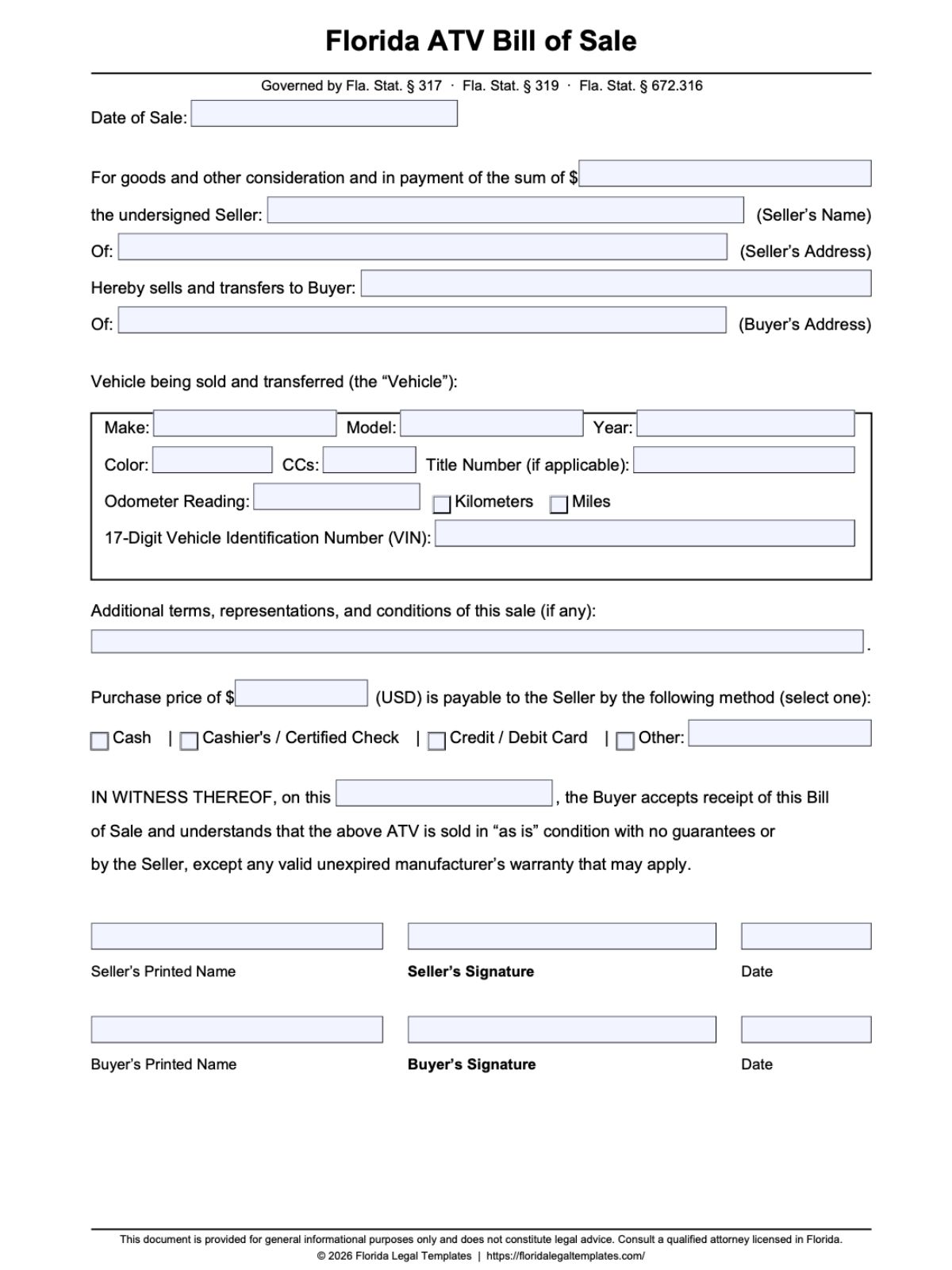
A Florida ATV bill of sale template provides a structured format that includes all required information for a compliant transaction.
What the document includes:
- Buyer and seller full legal names and addresses
- ATV details:
- Vehicle Identification Number (VIN)
- Year, make, and body type (ATV or ROV)
- Purchase price and payment terms
- Hour meter reading (Best practice for valuation, though Off-Highway Vehicles are exempt from statutory odometer disclosure per Fla. Stat. § 319.225).
- Perjury clause (mandatory for title use)
- Signatures of both buyer and seller
Who should use this:
- Private sellers of ATVs or UTVs
- Buyers purchasing used off-highway vehicles
- Individuals needing proof of ownership for title application
When this template may NOT be sufficient:
- If the ATV has an active lien that has not been satisfied
- If the VIN is missing or altered (illegal transaction)
- If a valid title exists but is not properly transferred
- If a minor (under 18) is the sole purchaser. (Note: Under Fla. Stat. § 743.07, minors lack full capacity to contract. While Florida doesn’t have a specific “Titling Affidavit,” Tax Collectors typically require a parent or guardian to co-sign the title application to ensure the contract is not voidable.)
Even a complete bill of sale cannot replace the legal requirement of obtaining a title.
What Is a Florida ATV Bill of Sale?
A Florida ATV bill of sale is a supporting ownership document used in the transfer of off-highway vehicles.
Because Florida treats ATVs as titled off-highway vehicles rather than standard passenger vehicles, buyers often review the broader Florida ownership transfer documentation process to better understand how private sale records support title applications. Transactions involving side-by-sides or towable off-road equipment may also overlap with Florida’s trailer transfer paperwork requirements when the ATV is sold together with a hauling trailer.
Legal framework:
- Governed by Chapter 317 of the Florida Statutes (Off-Highway Vehicle Titling)
- Supplemented by general motor vehicle procedures under Chapter 319
Legal nuance:
This document is not a standalone ownership record. It must be used alongside a title application submitted to the County Tax Collector.
Critical distinction:
- Bill of sale: Evidence that a transaction occurred
- Title: Official proof of ownership issued by FLHSMV
Don’t Accept an “Open Title” Just Because the Seller Says It’s Normal
One of the easiest ways to end up with an ATV you can’t title is by accepting an “open title” from the seller. This happens when the seller hands you a Florida title that has already been signed by the previous owner, but the seller’s own name never appears as the purchaser. In a private sale, the person selling the ATV should already be the titled owner or have completed the transfer into their own name. Otherwise, the tax collector may reject your title application even if your bill of sale is properly completed.
The confusion often comes from licensed motor vehicle dealers, who can legally transfer vehicles using dealer reassignment procedures instead of titling every unit in the dealership’s name. Private individuals do not receive that exception. If someone claims they are “selling it for a friend” or “never got around to transferring the title,” ask them to complete the title transfer into their own name first before you pay. That extra step can prevent weeks of delay, additional paperwork, or a rejected title application when you submit Form HSMV 82040. Dealer reassignment procedures are governed under Florida title laws and FLHSMV procedures. Fla. Stat. §§ 319.22 and 320.27, together with applicable FLHSMV title processing guidance.
Execution validity:
- Must be signed by both the seller and purchaser under Fla. Stat. § 317.0007
- No witnesses are required
- Notarization is generally not required, except when used with a sworn ownership statement
Practical implication:
Without filing the required paperwork and obtaining a title, the buyer does not have legally recognized ownership—even with a signed bill of sale.
Key Florida Laws That Affect Florida ATV Bill of Sale
Summary of Applicable Laws
| Topic | Rule | Statute |
| Execution Formalities | Must be signed by both the Seller and the Purchaser. No witnesses are legally required for the document to be valid. | § 317.0007 |
| Notary Requirements | No statutory requirement; governed by general contract law. However, FLHSMV recommends notarization if a title is unavailable and a “Sworn Statement of Ownership” is used. | § 317.0007(2) |
| Filing Deadlines | The Purchaser must apply for a transfer of title within 30 days of the date of sale to avoid a late fee (typically $20). | § 319.23(6) |
| Notice of Sale | The Seller must submit a “Notice of Sale” (Form HSMV 82050) to the Tax Collector within 30 days to be shielded from liability for the vehicle’s future use. | § 317.0017 |
| Age of Capacity | Parties must be at least 18 years of age to enter a binding contract. Minor ownership is permitted only with a supplemental parental/guardian affidavit. | § 743.07 |
The title verification and transfer rules discussed here are similar to other Florida recreational vehicle transactions where ownership records and lien disclosures are critical. Buyers comparing different off-road vehicle transactions may also benefit from reviewing Florida’s motorhome and recreational vehicle sale requirements, especially when dealing with titled recreational property and private-party transfers.
Practical Impact & Document Clauses
These statutes directly determine whether a Florida ATV bill of sale will be accepted for title transfer.
First, the document must include a valid perjury clause. For the bill of sale to be accepted as primary proof of ownership, it must contain certification language such as: “Under penalties of perjury, I declare that I have read the foregoing document and that the facts stated in it are true.” Without this clause, the Tax Collector may reject the document during title processing.
Second, the ATV must be properly identified. The bill of sale must include the VIN, year, make, and body type. Missing or incorrect details will result in a rejected application.
Third, timing is critical. The buyer must apply for title transfer within 30 days under Fla. Stat. § 319.23. Missing this deadline typically results in a late fee.
At the same time, the seller should file a Notice of Sale within 30 days under Fla. Stat. § 317.0017. This step protects the seller from liability for accidents, misuse, or damages after the sale.
Florida also follows a title-only system for ATVs. Once processed, the title will clearly state that the vehicle is “NOT SUITABLE FOR HIGHWAY USE.” A bill of sale does not grant any right to operate the ATV on public roads.
Failure to comply with these requirements can result in:
- Rejected title applications
- Continued liability for the seller
- Legal penalties for fraudulent or incomplete documentation
When to Use Florida ATV Bill of Sale
A Florida ATV bill of sale should be used whenever an off-highway vehicle is sold or transferred between private parties.
Common use cases:
- Private sale of an ATV or UTV
- Transfer of ownership between individuals
- Supporting documentation for title application
Practical scenarios:
- Cash transactions
- Proof of ownership for FLHSMV submission
- Recording purchase price for tax purposes
When NOT to use:
- As a substitute for title transfer
- When the VIN is missing or altered
- When a lien is active and unresolved
- For vehicles intended for highway use
Using the document correctly ensures the transaction is properly recorded and legally supported.
How to Create or Fill Out the Florida ATV Bill of Sale
Completing a Florida ATV bill of sale requires careful attention to statutory requirements.
Step-by-step process:
- Identify the parties
- Include full legal names and addresses
- Describe the ATV
- VIN (mandatory)
- Year, make, and body type
- State the purchase price
- Include payment method and terms
- Insert odometer/hour meter disclosure
- Example: “The odometer/hour meter reading is [number] and to the best of my knowledge reflects the actual usage unless otherwise stated.”
- Include the perjury clause
- Must use statutory language under Fla. Stat. § 92.525
- Sign the document
- Both buyer and seller must sign
- Submit title application
- File Form HSMV 82040 with the County Tax Collector
- File Notice of Sale (seller)
- Submit Form HSMV 82050 within 30 days
If the ATV purchase includes installment payments, deferred financing, or a private payment arrangement between the parties, documenting those obligations separately through a Florida repayment agreement template can help reduce disputes over missed payments, repossession rights, or ownership obligations after the sale.
Practical tips:
- Double-check VIN accuracy to avoid rejection
- Do not modify required legal wording
- Keep signed copies for both parties
Limitations and Legal Considerations
A Florida ATV bill of sale is not a standalone ownership document.
Key limitations:
- Cannot replace a valid certificate of title
- Not valid without required disclosures and identification
Legal constraints:
- Must comply with Chapter 317 requirements
- Must include a valid perjury clause
High-risk scenarios:
- Selling an ATV with an altered VIN
- Attempting to bypass an existing lien
- Using a bill of sale without filing for title
Under Florida law, altering or removing a VIN is a third-degree felony, and any bill of sale involving such a vehicle is legally void.
Edge cases:
- Minor ownership requires a parental or guardian affidavit under Fla. Stat. § 743.07
- ATVs from non-titling states may require additional documentation
- No-title scenarios may require a sworn statement of ownership
Operational restriction:
Operational restriction:
A bill of sale does not grant the right to operate an ATV on public roads. These vehicles are limited to private property or designated off-road areas.
The Out-of-State Non-Titling Origin Trap
Florida residents frequently purchase used ATVs or side-by-sides from neighboring states like Georgia or Alabama where off-highway vehicles are not legally titled. When these machines cross the border into Florida, buyers assume a standard private bill of sale is all they need to secure a new title. This assumption triggers an administrative dead-end under Florida Highway Safety and Motor Vehicles (FLHSMV) Procedure TL-44. Because Florida enforces a strict title-only system for off-highway vehicles under Chapter 317, a private bill of sale from a non-titling state is completely insufficient on its own.
To successfully title the vehicle in Florida, the purchaser must present the private bill of sale combined with either the seller’s official out-of-state registration card or the original out-of-state retail dealer invoice. These secondary documents are mandatory to establish the baseline chain of ownership before the state will generate a fresh Florida title. If you hand over cash to an out-of-state seller who lacks a title and cannot produce a matching state registration card or the original dealership receipt, the local County Tax Collector will reject your title application. You will be left with an off-road machine that cannot be legally operated on Florida public lands under Fla. Stat. § 316.2074, as you cannot obtain the compulsory validation decal without a processed title. Always demand the out-of-state registration or original dealer invoice before signing the bill of sale.
Certain no-title or inherited ATV situations may require additional sworn ownership documentation before FLHSMV will process the transfer. In those cases, sellers and buyers sometimes need supporting Florida affidavit forms for ownership verification to address missing records, title defects, or correction requests during the application process.
Common Mistakes to Avoid
Omitting the perjury clause
Required for title processing.
Consequence: Title application may be rejected.
Missing or incorrect VIN
Improper vehicle identification.
Consequence: Registration and title denial.
Not filing title application within 30 days
Missed statutory deadline.
Consequence: Late fees and delays.
Failing to submit Notice of Sale
Seller does not notify the state.
Consequence: Severe civil liability. Under Florida’s Dangerous Instrumentality Doctrine, if the buyer crashes and you haven’t filed HSMV 82050, you can be held financially responsible for any resulting injuries as the “owner of record.”
Attempting to sell ATV with altered VIN
Illegal activity.
Consequence: Criminal penalties and void transaction.
Using bill of sale to bypass lien
Ignoring lienholder rights.
Consequence: Title transfer denied.
Improper VIN disclosures and undocumented recreational vehicle transfers can create many of the same liability and ownership problems seen in other private powersports sales. Buyers handling personal watercraft or similar recreational equipment transactions may also want to review Florida’s watercraft transfer documentation standards for additional guidance on recreational title transfers and seller liability protection.
Frequently Asked Questions (FAQ)
Is a bill of sale enough to transfer ATV ownership in Florida?
No. Ownership is only transferred when a title is issued by FLHSMV after proper filing.
Do I need a title for an ATV in Florida?
Yes. Florida uses a title-only system for ATVs under Chapter 317.
What happens if I don’t include the perjury clause?
The bill of sale may not be accepted as valid proof of ownership during the title process.
Can I use an ATV bill of sale if the vehicle has no title?
In some cases, but additional documentation such as a sworn statement of ownership may be required, and acceptance depends on FLHSMV review.
A properly completed Florida ATV bill of sale ensures the transaction is documented, compliant with state law, and ready for title processing.