
Florida Affidavit of Correction (Free PDF & Word Template)
A Florida affidavit of correction is used to fix errors on legal documents — most commonly vehicle titles, but also real property records and other official instruments — and the procedure for doing it correctly is more specific than most people expect when they discover a mistake.
For vehicle titles Florida requires that errors be identified by drawing a line through the incorrect information rather than erasing or covering it, and the affidavit of correction florida must be signed by whoever made the original error — if the seller wrote the wrong date, only the seller can sign the correction, not the buyer. I’ve seen title transfers stall at the tax collector’s window because a seller used white-out on what seemed like a minor typo, invalidating the title entirely and requiring both a correction affidavit and a HSMV 82101 application for a duplicate title before the transaction could move forward.
The title correction affidavit florida template below covers the procedure for both vehicle titles and other document corrections, including the signature requirement and line-through rule that determine whether the correction holds up.
Candice Hayden, Legal Writer
Maria Rosso, Florida Probate, Guardianship and Estate Planning Attorney
Florida Affidavit of Correction (PDF, Printable, Fillable)
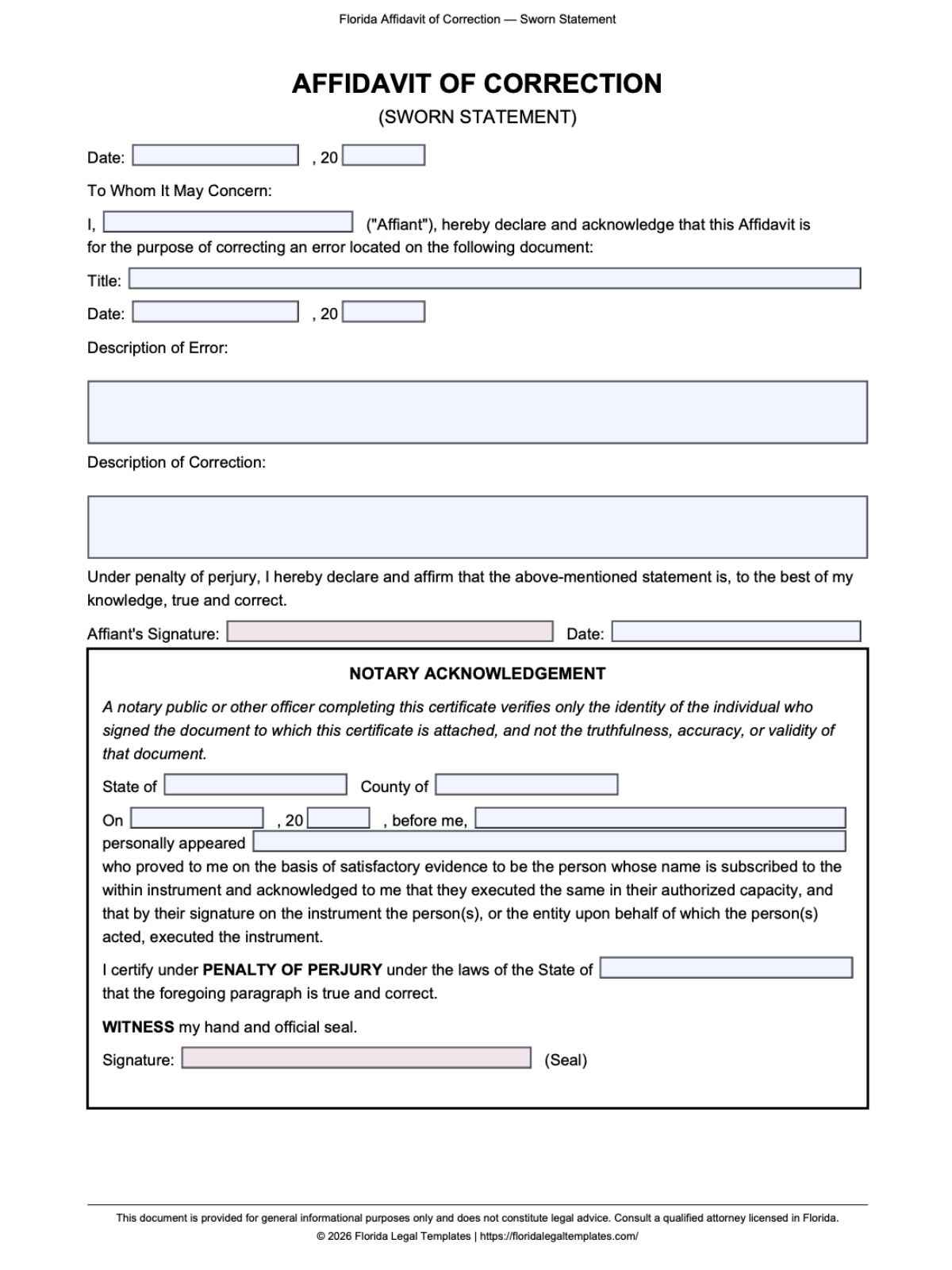
A affidavit of correction Florida template provides a structured way to formally correct errors while preserving the original intent of a document.
What the document includes:
- Affiant identification (person correcting the error)
- Description of the original document (including date and details)
- Specific error being corrected
- Corrected information
- Statement confirming no change in intent
- Notary jurat section
Who should use this:
- Individuals correcting minor clerical errors in:
- Property records
- Vehicle titles
- Legal or business documents
When this template may NOT be sufficient:
- Changing ownership (adding/removing parties)
- Modifying legal property descriptions materially
- Altering purchase price or contractual terms
- Fixing major title defects
Key insight: An affidavit of correction fixes errors—not decisions.
What Is an Affidavit of Correction in Florida?
A Florida affidavit of correction is a sworn statement used to correct non-material errors in an already executed document.
Legal framework:
- Florida Statutes Chapter 117 (Notaries Public)
- Florida Statutes Chapter 92 (Sworn declarations)
- Florida Statutes § 689.041 (real estate corrections)
- Florida Statutes Chapter 319 (vehicle titles)
Legal nuance:
In real estate, for errors in deeds, this is specifically known as a Curative Notice of Scrivener’s Error under Fla. Stat. § 689.041. When properly recorded, it creates a “rebuttable presumption” that the facts stated in the notice are true, making it the gold standard for fixing deed typos.
Critical distinction
Permitted corrections:
- Misspelled names
- Incorrect middle initials
- Typographical errors
- Minor digit mistakes (e.g., lot number typo)
NOT permitted:
- Adding or removing owners
- Changing ownership structure
- Altering legal intent
- Modifying property boundaries or parcels
Key implication:
If the correction affects ownership or intent, Florida law requires a new document, such as a corrective deed not an affidavit. Furthermore, under Fla. Stat. § 689.041(2)(c), the statutory Curative Notice framework is strictly prohibited if the intended real property is described exclusively by a metes and bounds legal description. Typographical errors in metes and bounds boundary text require a fully executed Corrective Deed signed by the original grantor, or a judicial reformation action.
Because Florida uses different affidavit types for different legal purposes, readers dealing with sworn corrections involving estates, ownership history, or probate filings may also want to review other commonly used Florida affidavit formats and legal declarations. In inheritance-related title issues, a probate-related heirship affidavit may be required instead of a simple correction document.
Key Florida Laws That Affect Florida Affidavit of Correction
Summary of Applicable Laws
| Topic / Issue | Florida Legal Rule | Governing Statute |
|---|---|---|
| Notary Requirement (Jurat) | Must be sworn before notary | Fla. Stat. § 117.05(13) |
| Identity Verification | Notary must verify ID | Fla. Stat. § 117.05(5) |
| Scope of Correction (Real Estate) | Only non-material errors allowed | Fla. Stat. § 689.041(1) |
| Reference to Original Document | Must include book/page for recorded docs | Fla. Stat. § 695.26 |
| Unsworn Declaration Option | Allowed with perjury wording | Fla. Stat. § 92.525(2) |
Practical Impact & Document Clauses
Florida law imposes strict execution rules. Under Fla. Stat. § 117.05, the affidavit must include a jurat, meaning the affiant must swear or affirm the contents before a notary. A simple acknowledgment is not sufficient.
For real estate corrections, Fla. Stat. § 689.041 limits the scope strictly to non-material errors. Attempting to use this document for substantive changes—such as ownership—can invalidate the correction and disrupt the chain of title.
Additionally, under Fla. Stat. § 92.525, false statements in an affidavit constitute a third-degree felony.
In practice:
- Missing jurat → document invalid
- Incorrect scope → rejection by clerk or agency
- Missing reference to original document → recording failure
- False correction → criminal liability
When to Use Florida Affidavit of Correction
A title correction affidavit Florida or general affidavit of correction is used to fix clerical errors without changing legal meaning.
Common use cases:
- Real estate document corrections
- Vehicle title corrections
- Contract or agreement corrections
Practical scenarios:
- Misspelled name on a deed
- Minor typo in legal description
- Incorrect VIN digit on a title
- Data entry errors in contracts
When NOT to use:
- Ownership changes
- Boundary or parcel adjustments
- Financial term changes
- Any substantive modification
For those cases, a new legal document is required.
Vehicle title mistakes often surface during ownership transfers, especially when seller information, VIN details, or sale dates are entered incorrectly. In those situations, it helps to review the Florida vehicle sale documentation process, since inconsistencies between the title and supporting sale records can delay registration or tax collector approval.
How to Create or Fill Out the Florida Affidavit of Correction
Creating a valid affidavit of correction Florida requires precision and compliance with statutory requirements.
Step-by-step process:
- Identify the affiant
- Must be someone with knowledge of the error
- Reference the original document
- Include title, date, and recording details
- For real estate: Official Records Book and Page
- Describe the error clearly
- Be specific and factual
- Provide corrected information
- State exactly what the correct data should be
- Confirm no change in intent
- Include statement preserving original transaction
- Insert sworn statement
- Add a Notary Jurat with 2026 Compliance
- he block must explicitly state: “The foregoing instrument was acknowledged before me by means of [ ] physical presence or [ ] online notarization.” Without this “method of presence” check-off, Florida clerks will reject the filing.
- Verify identity
- Present valid government-issued ID
- Sign in presence of notary
- File or record (if required):
- Real estate → County Clerk
- Vehicle title → Tax collector or FLHSMV
- Private contract → No filing required
Note: For real estate, you must pay the standard recording fees (typically $10.00 for the first page and $8.50 for each additional page in most Florida counties). If you are correcting a document that was previously recorded, you must also pay a “cross-indexing” fee to link the correction to the original.
When correcting recorded real estate documents, the affidavit should match the original transaction records exactly, including names, dates, and property references. If the original filing involved a rental or occupancy arrangement, reviewing the standard Florida lease documentation requirements can help ensure supporting records remain consistent with the correction being filed.
Practical tips:
- Match correction exactly to original document
- Avoid broad or ambiguous wording
- Double-check all identifiers (names, numbers, dates)
Limitations and Legal Considerations
A Florida affidavit of correction is strictly limited in scope.
Key limitations:
- Cannot alter legal rights or ownership
- Cannot replace a corrective deed when required
Florida-specific constraints:
- Must comply with Fla. Stat. § 689.041 for real estate corrections
- Must be properly notarized under Fla. Stat. § 117.05
High-risk scenarios:
- Using affidavit for major corrections
- Failing to reference original document
- Attempting to fix invalid notarization
Edge cases:
- County recording rules may vary
- Vehicle corrections require agency approval
- Private contracts remain internal documents
An affidavit of correction cannot be used to recover property rights, transfer collateral, or repossess assets after default. For situations involving recovery of secured property or lender possession rights, a repossession-related sworn statement is typically the more appropriate legal instrument under Florida procedures.
Common Mistakes to Avoid
Using affidavit for material changes
Consequence: Invalid correction and possible legal disputes.
Not referencing original document
Consequence: Recording rejection or ineffective correction.
Missing notary jurat
Consequence: Document is legally invalid.
Incorrect or vague correction description
Consequence: Rejection or confusion in legal records.
Attempting to fix ownership issues
Consequence: Requires corrective deed—affidavit will not work.
Providing false information
Consequence: Criminal liability under Fla. Stat. § 92.525(3), including felony charges.
Frequently Asked Questions (FAQ)
Can an affidavit of correction change ownership on a Florida deed?
No. Under Fla. Stat. § 689.041, it can only correct non-material errors—not ownership.
Do I need to record an affidavit of correction in Florida?
Yes, for real estate documents it must be recorded with the county clerk to be legally effective.
Can I use an affidavit of correction for a car title in Florida?
Yes. A affidavit of correction car title Florida is commonly used to fix minor errors and must be submitted to the tax collector or FLHSMV with the original title.
What happens if the correction is more than a minor error?
A new legal document—such as a corrective deed or amended contract—must be executed instead of using an affidavit.
People correcting ownership records after a death sometimes assume a correction affidavit alone can resolve probate-related title problems. In many cases, additional estate documentation such as an estate tax clearance affidavit for Florida probate matters may also be required before property transfers can move forward cleanly.
A properly prepared Florida affidavit of correction is a precise legal tool. When used correctly, it resolves minor errors efficiently. When misused, it can create serious legal complications.