
Florida Affidavit of Heirship (Free Fillable PDF Template)
A Florida affidavit of heirship identifies who is entitled to inherit from someone who died without a will, but it does not transfer anything on its own — and the gap between what the document establishes and what institutions will actually do with it is where most families run into trouble.
Under Florida’s intestate succession laws at F.S. §732.101, the affidavit of heirs florida establishes the family pedigree and heir relationships, but whether a bank, title company, or county recorder acts on it is entirely their decision — there is no legal obligation for any institution to accept it in lieu of a court order.
I’ve watched families spend weeks preparing a thorough, properly notarized florida affidavit of heirs only to have a title company decline it because their underwriting standards required a probate court order regardless of how clear the heirship was. The template and breakdown below cover what the affidavit must contain under F.S. §735.304 to give it the best chance of acceptance, which institutions are most likely to honor it and which typically won’t, and when a Summary Administration petition is the more reliable path forward.
Candice Hayden, Legal Writer
Maria Rosso, Florida Probate, Guardianship and Estate Planning Attorney
Florida Affidavit of Heirship (PDF, Printable, Fillable)
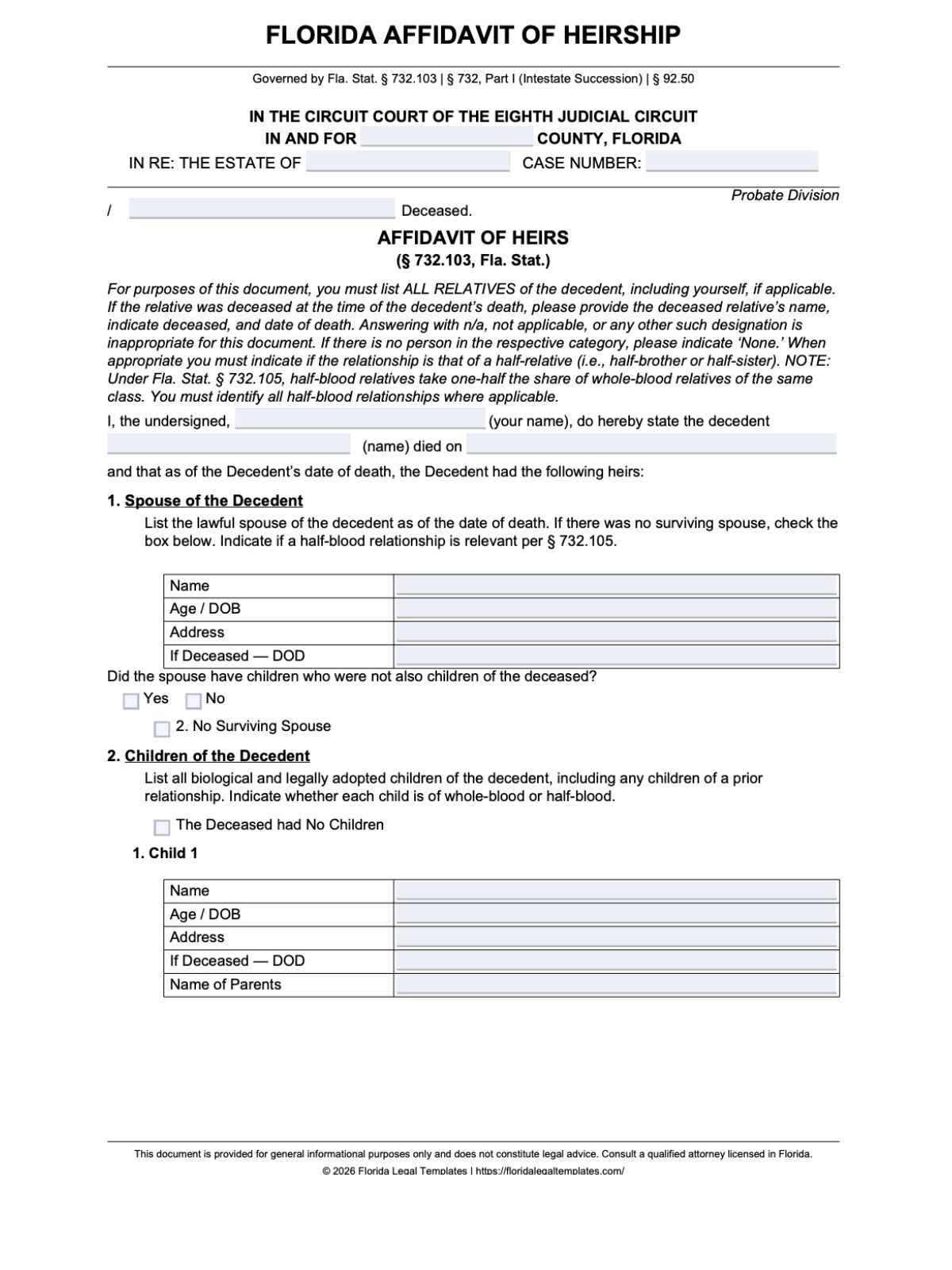
A Florida affidavit of heirs template provides a structured format to document family relationships and identify heirs under Florida law. These forms are typically available as printable or fillable documents.
What the document includes:
- Decedent’s full name and date of death
- Statement confirming no valid will exists (if applicable)
- Detailed family history (spouse, children, prior marriages)
- Identification of all legal heirs and their relationships
- Declaration regarding estate debts (if required for specific use cases)
- Notary jurat or statutory perjury declaration
Who should use this:
- Heirs of a deceased person without a will
- Individuals handling small estates or personal property
- Persons transferring vehicles or claiming limited assets
When this template may NOT be sufficient:
- Transferring real estate title (requires probate court order)
- Estates with disputes among heirs
- Estates with significant debts
- Complex or multi-state estates
Key insight:An affidavit of heirs Florida document helps identify heirs—but it does not legally transfer ownership of real estate.
What Is an Affidavit of Heirship in Florida?
An affidavit of heirship in Florida is a sworn statement used to establish the legal heirs of a deceased person when no will exists. It is based on Florida’s intestate succession laws, which determine how property is distributed.
Under Florida law, heirship is governed by Title XLII, Chapter 732, which defines who qualifies as a legal heir when someone dies intestate (without a will).
Florida probate law uses several different sworn estate documents depending on the asset involved, readers handling inheritance matters may also want to review other Florida affidavit formats commonly used in probate and property matters. For estates that qualify for simplified administration, a small estate transfer affidavit for limited probate situations may sometimes provide a more reliable procedural path.
Legal nuance:
This document is typically used in limited situations where:
- The estate qualifies for simplified handling
- No formal probate administration is necessary for certain assets
Critical distinction:
- Affidavit of heirship → Identifies heirs
- Probate court order → Transfers legal ownership
Key implication:
Relying solely on an affidavit to transfer real estate can result in invalid title and rejection by title insurers, because Florida requires court involvement for real property transfers.
Key Florida Laws That Affect Florida Affidavit of Heirship
Summary of Applicable Laws
| Topic / Issue | Florida Legal Rule | Governing Statute |
|---|---|---|
| Intestate Heir Determination | Defines who qualifies as legal heirs | Fla. Stat. Ch. 732 |
| Small Estate Affidavit Use | Allows transfer of nonexempt personal property up to $20,000 (if deceased >1 year) or up to funeral/medical expenses (if deceased <1 year). | Fla. Stat. Ch. 735 |
| Notary Requirement (Jurat) | Must be sworn under oath; acknowledgment alone is insufficient | Fla. Stat. § 117.05(13) |
| Unsworn Declaration Option | Allowed only with statutory perjury wording | Fla. Stat. § 92.525 |
| Vehicle Title Transfer | Allows heir-based transfer without probate if conditions met | Fla. Stat. § 319.28 |
| Creditor Liability (2 Years) | Heirs remain liable for estate debts for 2 years unless a formal Notice to Creditors was published. | Fla. Stat. § 733.710 | Fla. Stat. § 735.304 |
In Florida, “Heirship” is a strict pyramid. If a decedent had a spouse and children from that same marriage, the spouse takes 100%. If there are “lineal descendants” from a different marriage, the split is 50/50.
Florida’s heirship rules become especially important when inherited property must be cleared for sale or transfer after death. In situations involving estate tax liens or probate-related title issues, an estate tax lien release affidavit used in Florida probate administration may also be required before title companies will approve a closing.
Practical Impact & Document Clauses
Florida law strictly controls how an affidavit of heirs Florida can be used. Under Fla. Stat. Chapter 732, heirs must be identified according to intestate succession rules. Any mistake in listing heirs—such as excluding a child—can invalidate the affidavit.
For execution, the affidavit must include a jurat under Fla. Stat. § 117.05. If no notary is used, the document must include the exact statutory wording required under Fla. Stat. § 92.525:
“Under penalties of perjury, I declare that I have read the foregoing document and that the facts stated in it are true.”
For vehicle transfers, the affidavit must also include a specific declaration under Fla. Stat. § 319.28, confirming the estate has no debts and that heirs have agreed on distribution.
Real-world risks if rules are violated:
- Missing heirs → invalid inheritance claims
- Incorrect wording → document rejection
- False statements → third-degree felony for perjury
- Improper use → title defects or legal disputes
When to Use Florida Affidavit of Heirship
A Florida affidavit of heirship is appropriate in limited, specific situations.
Common use cases:
- Establishing heirs when no will exists
- Claiming small personal property assets
- Transferring vehicle ownership without probate
Practical scenarios:
- Collecting funds from small bank accounts
- Transferring a car title through FLHSMV
- Supporting simplified probate filings
When NOT to use:
- Transferring real estate title
- Resolving disputes among heirs
- Estates with significant creditor claims
Using this document in the wrong context can delay asset transfer or create legal issues.
One of the most common practical uses for a Florida heirship affidavit is transferring vehicles owned by a deceased family member when the estate qualifies for simplified handling. In those cases, supporting ownership records such as a Florida motor vehicle transfer document can help verify title history and reduce delays during FLHSMV processing.
How to Create or Fill Out the Florida Affidavit of Heirship
Completing a Florida affidavit of heirs requires accuracy and strict compliance with Florida law.
Step-by-step process:
- Identify the decedent (name and date of death)
- Confirm that no valid will exists
- Determine heirs under Florida intestate succession law
- List all heirs and their relationships
- Provide a clear family history (marriages, children, etc.)
- Confirm estate status (debts and agreements among heirs)
- Include required statements:
- Vehicle transfer clause (if applicable)
- Perjury statement (if not notarized)
- Add signature block
- Complete notary jurat or include unsworn declaration
- Submit based on asset type:
- Bank → directly to institution
- Vehicle → FLHSMV or tax collector
- Probate → court filing
Accuracy is critical when documenting family relationships, prior marriages, and legal heirs. If errors are discovered later in recorded probate or title documents, a Florida correction affidavit for clerical or recording mistakes may be needed to resolve inconsistencies before financial institutions or title companies will accept the paperwork.
Practical tips:
- Double-check all heir information carefully
- Include children from all relationships
- Use exact statutory wording—small errors can invalidate the document
Limitations and Legal Considerations
A Florida affidavit of heirship has strict limitations.
Key limitations:
- Cannot transfer real property title independently
- Does not override Florida intestate succession laws
Florida-specific constraints:
- Must comply with Fla. Stat. Chapters 732 and 735
- Must include oath or statutory perjury language
High-risk scenarios:
- Omitting heirs
- Misidentifying family relationships
- Attempting to bypass probate
Edge cases:
- Blended families
- Unknown or missing heirs
- Multiple marriages
Florida law is particularly strict about real estate. Under probate rules, a court order—such as summary administration—is required to transfer property.
Court-Authorized Disposition (§ 735.304) vs. Unofficial Private Affidavits
A frequent source of confusion for grieving families is confusing a self-prepared, private “Affidavit of Heirship” with a statutory Disposition Without Administration of Intestate Property under Fla. Stat. § 735.304. While an informal private affidavit may be accepted by the FLHSMV for vehicle title transfers under Fla. Stat. § 319.28, banks and financial institutions are under no legal obligation to release bank accounts or securities based solely on an un-filed private document.
To compel third parties to release intestate personal property without full probate, an heir at law must file a formal affidavit petition under Fla. Stat. § 735.304 with the clerk of the probate court. This process is available if the intestate estate consists only of exempt personal property under § 732.402, constitutionally exempt personal property, and nonexempt personal property not exceeding $20,000 (pursuant to CS/HB 1337) plus preferred funeral and last 60 days’ medical expenses. Once the probate judge reviews the affidavit and issues an official authorization letter under the seal of the court, third-party institutions are statutorily discharged from liability and legally mandated to release the funds.
An affidavit of heirship does not replace broader estate planning documents or probate authority when ownership rights are disputed. In estates involving incapacity planning, delegated authority, or management of financial affairs before death, a durable financial authority document under Florida law serves a completely different legal purpose and should not be confused with heirship documentation.
Common Mistakes to Avoid
Omitting a legal heir
Consequence: Invalid affidavit and potential inheritance disputes
Using affidavit to transfer real estate
Consequence: Title defects and rejection by title insurers
Missing jurat or perjury clause
Consequence: Document becomes legally invalid
Incorrect family history
Consequence: Misdistribution of assets and legal challenges
Ignoring creditor liability
Consequence: Personal financial liability for estate debts
Under Fla. Stat. § 92.525, false statements in the affidavit can result in criminal penalties for perjury.
Frequently Asked Questions (FAQ)
Can a Florida affidavit of heirship transfer real estate?
No. Florida law requires probate court involvement to transfer real estate. An affidavit alone is not sufficient.
Do I need a notary for an affidavit of heirs in Florida?
Yes, unless you use a valid unsworn declaration with the required statutory perjury wording under Fla. Stat. § 92.525.
How long are heirs liable for estate debts in Florida?
Under Fla. Stat. § 735.304, heirs may be liable for estate debts for up to 2 years after death.
Can I transfer a car title using an affidavit of heirship in Florida?
Yes. Under Fla. Stat. § 319.28, a vehicle title can be transferred using an affidavit if the estate has no debts and heirs agree on distribution.
A properly prepared Florida affidavit of heirship can simplify the handling of certain assets after death. However, because it does not replace probate for real estate and carries legal risks if used incorrectly, it must be completed carefully and in full compliance with Florida law.