
Florida Contract Amendment (Free PDF & WORD Form)
A Florida contract amendment allows the parties to change specific terms of an existing agreement without replacing the entire contract. Whether you’re updating payment terms, extending deadlines, revising the scope of work, or changing other contractual obligations, a properly drafted amendment preserves the original agreement while modifying only the provisions the parties intend to change.
One of the most common mistakes is assuming every amendment follows the same legal rules. In Florida, the governing requirements depend on the underlying contract. An amendment to a consulting agreement is treated differently from one involving the sale of goods under the Uniform Commercial Code (UCC), while amendments affecting mortgages, deeds, or long-term leases may require recording and additional execution formalities. Before completing your template, make sure your amendment follows the legal framework that applies to the original contract.
Candice Hayden, Legal Writer
Carly Johansson, Florida Contract Attorney
Free Florida Contract Amendment Template (PDF & WORD)
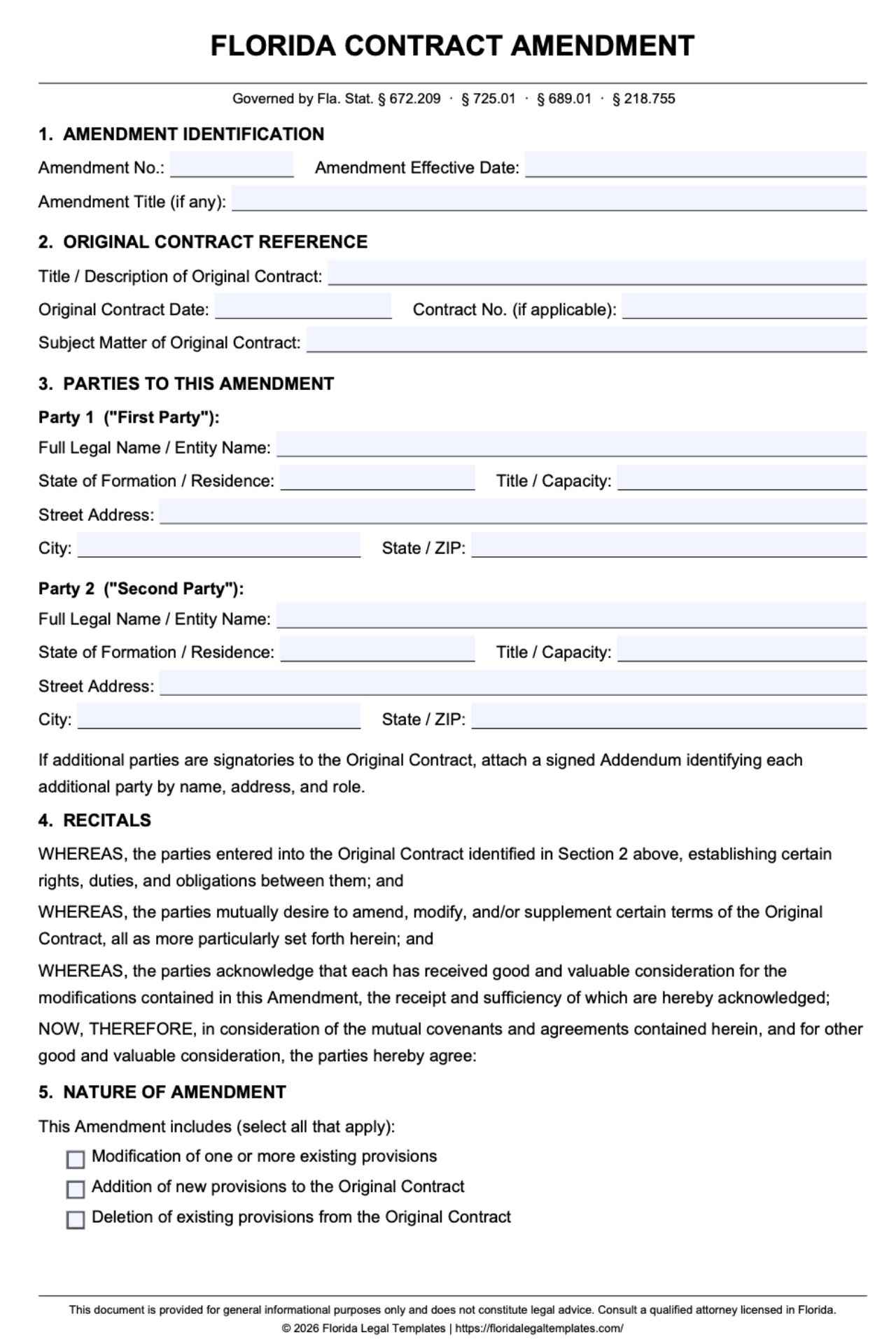
Our Florida Contract Amendment template is available in printable PDF and fillable Word formats, making it easy to modify an existing agreement without drafting a completely new contract.
The template includes dedicated fields for:
- Names of all parties to the original agreement
- Title of the original contract
- Original execution date
- Description of each clause being modified
- New contractual language replacing or supplementing existing provisions
- Consideration recital (when applicable)
- Integration clause confirming all remaining terms stay in effect
- Signature blocks for every original contracting party
Each section is designed to reduce ambiguity by identifying exactly which provisions are being changed. Rather than rewriting an entire agreement, the amendment pinpoints the specific language being revised while leaving unaffected provisions intact.
What the Florida Contract Amendment Includes
A properly drafted Florida contract amendment typically contains:
- Identification of the original agreement
- Introductory recitals explaining the purpose of the amendment
- Clearly numbered modifications
- Effective date of the amendment
- Consideration language where legally required
- Integration and survival language
- Signature blocks for all required parties
One drafting practice experienced contract professionals consistently follow is referencing the exact section numbers from the original agreement. Instead of saying “Payment terms are changed,” the amendment should identify the precise contractual provision being modified, such as:
“Section 4.2 of the Original Agreement is hereby amended and replaced with the following…”
This greatly reduces future disputes over what the parties intended to change.
Who Should Use Florida Contract Amendment?
This template is appropriate when parties already have a legally binding Florida contract and want to modify selected terms without terminating or replacing the agreement.
Common situations include:
- Extending project deadlines
- Revising payment schedules
- Updating pricing
- Expanding or reducing services
- Changing delivery timelines
- Correcting drafting errors
- Adding new contractual obligations while preserving the existing agreement
Businesses, independent contractors, employers, consultants, landlords, vendors, and service providers frequently use amendment agreements instead of drafting entirely new contracts because they preserve the contractual history while documenting later changes.
When This Template Is Not Enough
Some situations require more than a standard amendment.
For example, this template should not be used as the sole document when:
- The amendment modifies a recorded mortgage, deed, or another recordable real-property instrument.
- The amendment changes a long-term lease that must itself satisfy Florida’s real-property execution requirements.
- The modification relates to local government construction contracts subject to statutory change-order procedures.
- A merchant uses a consumer form contract containing a “no oral modification” provision that requires separate consumer acknowledgment under Florida’s Uniform Commercial Code.
Attempting to use a standard amendment in these situations may create enforceability problems or additional statutory compliance obligations.
Amendment vs. Addendum vs. Novation: Which One You Actually Need
Choosing the wrong document often creates more problems than the wording inside it. Many disputes arise because parties use the term “amendment” when they actually intended to create an addendum, replace the contract entirely, or substitute one party for another.
Understanding the distinction before drafting avoids unnecessary legal uncertainty.
Contract Amendment
A contract amendment changes one or more existing provisions of an already enforceable agreement.
Instead of replacing the contract, it sits on top of the original document and modifies only the identified sections.
For example:
- extending a completion deadline;
- increasing the purchase price;
- changing payment milestones;
- revising confidentiality obligations.
Everything else remains unchanged unless specifically modified.
This is the correct document when the parties still want the original contract to govern their relationship.
Addendum
An addendum supplements an agreement by adding new provisions without altering existing ones.
For example, if parties wish to add an additional service package or include a new reporting requirement while leaving every existing clause untouched, an addendum is usually the better choice.
Unlike an amendment, an addendum generally expands the agreement rather than changing previously negotiated language.
Amended and Restated Agreement
Sometimes so many provisions have changed that repeatedly layering amendments becomes impractical.
Instead of preparing a fifth or sixth amendment, parties often execute an Amended and Restated Agreement.
This document replaces the earlier contract with a single consolidated version containing all previous modifications.
Operationally, this makes contract administration much easier because future readers no longer need to compare multiple amendments to determine the governing terms.
Novation
A novation accomplishes something entirely different.
Rather than merely changing contract language, it extinguishes the original contract and substitutes either:
- a new agreement,
- a new party,
- or both.
A valid novation releases obligations under the previous contract and creates an entirely new contractual relationship.
Businesses commonly encounter novations during asset purchases, mergers, or transfers of contractual obligations where every affected party agrees to substitute a new contracting party.
Why Mislabeling Matters
Courts focus on what the document actually does rather than the title printed at the top.
If an amendment is drafted broadly enough to appear as though it replaces the entire agreement, it can unintentionally supersede provisions the parties expected to survive.
That risk increases when the amendment fails to specify:
- which sections are changing,
- which remain unchanged,
- and whether the original agreement continues in force.
Clear drafting prevents expensive disputes years later when one party argues that the amendment replaced the entire contract instead of modifying only selected provisions.
What Counts as a Valid Contract Amendment in Florida
A valid Florida contract amendment begins with one fundamental requirement: every party bound by the original agreement must agree to the modification.
An amendment is not a unilateral announcement. It represents a new meeting of the minds regarding identified contractual terms.
This becomes especially important when one party attempts to revise compensation, deadlines, responsibilities, or other material obligations after performance has already begun. Even where an original agreement contains language giving one party authority to make administrative changes, Florida common-law principles do not permit unilateral material modifications that fundamentally alter the parties’ rights or obligations.
Another practical drafting requirement is identifying the original agreement with precision.
A well-prepared amendment should reference:
- full title of the contract;
- execution date;
- names of all original parties; and
- the specific sections being amended.
Without these details, multiple agreements between the same parties can create uncertainty regarding which contract the amendment actually modifies.
Equally important is recognizing that an amendment does not stand on its own.
It derives its legal effect from the underlying contract. If the original agreement is invalid or unenforceable, the amendment generally cannot create an enforceable contract independently.
Why the Integration Clause Matters
One drafting point deserves special attention: the amendment should clearly state that provisions not expressly changed continue in effect.
Florida common-law drafting practice favors language confirming that every provision not expressly modified remains effective.
Typical wording follows this approach:
“All other terms, conditions, and provisions of the Original Contract dated [Date] not explicitly modified by this Amendment shall remain unamended, in full force, and legally binding upon the parties.”
This language prevents later arguments that the amendment unintentionally replaced unrelated provisions.
Without an integration clause, parties sometimes dispute whether modified language affects neighboring clauses, payment obligations, indemnification provisions, dispute-resolution procedures, or termination rights.
A single paragraph confirming the continued effectiveness of the original agreement often eliminates those uncertainties before they become litigation issues.
The Common-Law “NOM Clause” Oral Waiver Trap (Okun v. Lippold)
A major litigation trap in Florida common-law contracts (such as consulting, employment, or service agreements) involves the enforceability of a “No Oral Modification” (NOM) clause. Many business owners assume that if their original contract contains a clause stating “This Agreement may only be amended in a writing signed by both parties,” any subsequent verbal agreement or text thread is automatically void. Under Florida law, that assumption is dangerously incomplete.
In landmark rulings such as Okun v. Lippold and Gunderson v. School District of Hillsborough County, Florida courts established that parties to a common-law contract can orally waive the NOM clause itself through their subsequent words, mutual performance, or course of dealing. If one party requests a verbal change, the other party performs in reliance on that request, and both sides accept the new arrangement, Florida judges will enforce the oral modification despite the written NOM clause.
In stark contrast, under Fla. Stat. § 672.209(2), contracts for the sale of goods strictly enforce written NOM clauses between merchants. To prevent an accidental common-law oral waiver on service or business contracts, the amendment should explicitly state that the NOM clause remains in full force and that no past or future course of conduct shall constitute an oral waiver of the written amendment requirement.
The Consideration Problem — Why Many Florida Amendments Are Void
Not every signed amendment creates an enforceable obligation.
One of the most misunderstood issues under Florida contract law is consideration—the legal exchange of value supporting a contractual promise. Whether additional consideration is required depends largely on the type of contract being amended.
This distinction frequently surprises businesses because the rules differ for service contracts and contracts involving the sale of goods.
Common-Law Contracts and the Pre-Existing Duty Rule
For most consulting agreements, employment contracts, professional service agreements, and other non-UCC contracts, Florida follows the common-law pre-existing duty rule.
In practical terms, this means a party generally cannot demand additional payment for doing exactly what they were already legally obligated to do under the original agreement.
Consider a consultant hired to complete a software implementation for $40,000. Halfway through the project, the consultant refuses to continue unless the client agrees to pay an additional $10,000, even though the scope of work remains unchanged.
Simply signing an amendment increasing compensation may not make that promise enforceable because the consultant has offered nothing new in exchange.
To create a valid amendment, the parties typically need a new mutual exchange of value, such as:
- expanding the project scope;
- extending the performance period;
- adding deliverables;
- resolving a genuine dispute over contractual obligations; or
- agreeing to another legally recognized exchange.
Florida case law, including landmark rulings like Blair v. Howard and Koretzky v. Singer, strictly enforces this principle. The courts require a fresh, independent exchange of value to validate a contract modification; merely repeating a pre-existing legal duty is insufficient.
From a drafting perspective, this is why many professionally prepared amendments include a consideration recital. While the recital itself does not create consideration where none exists, it documents the parties’ intended exchange and helps demonstrate why the amendment was executed.
The UCC Exception for Goods
The rule changes when the contract involves the sale of goods.
Under Florida’s Uniform Commercial Code, an agreement modifying a sales contract does not require new consideration to be legally binding, provided the modification is made in good faith.
This exception recognizes the commercial reality that supply shortages, manufacturing delays, market price fluctuations, and changing business conditions often require parties to adjust purchase agreements after execution.
For example, if a manufacturer and distributor agree to revise delivery schedules because of unexpected production delays, the amendment may remain enforceable without either party providing additional consideration, so long as the modification is negotiated honestly and not obtained through coercion or bad faith.
Because the governing rules differ so significantly, correctly classifying the underlying agreement is one of the first steps in drafting a Florida contract amendment. A service agreement and a contract for the sale of goods may appear similar on the surface, yet the legal requirements supporting an enforceable modification are materially different.
Key Florida Laws That Affect Your Amendment
The enforceability of a Florida contract amendment depends on more than obtaining signatures. The underlying contract, the subject matter of the amendment, and the type of transaction all determine which legal requirements apply. A modification that works perfectly for a consulting agreement may not satisfy the requirements for a real estate transaction, a sales contract governed by the Uniform Commercial Code (UCC), or a public construction contract.
Before signing an amendment, verify whether Florida law requires additional formalities, a written agreement, recording, or compliance with specific statutory provisions. Overlooking these requirements can leave an otherwise well-drafted amendment difficult—or even impossible—to enforce.
Statutory Matrix
| Topic / Issue | Florida Legal Rule | Governing Statute |
|---|---|---|
| Execution Formalities (Witnesses) | No witnesses are required for standard business or lease amendments. Under Florida law, the historic two-witness rule applies strictly to instruments conveying real estate title (deeds); residential and commercial lease modifications of any duration require zero witnesses. | Fla. Stat. § 689.01 |
| Notary Requirements | A notary is generally unnecessary for private contract amendments unless the amended document is a recordable real-property instrument. | Fla. Stat. § 695.03 |
| Consideration Exemption (Sale of Goods) | Amendments to contracts for the sale of goods require no new consideration if made in good faith. | Fla. Stat. § 672.209(1) |
| Statute of Frauds | Amendments must be in writing if the original contract—or the contract as modified—falls within the Statute of Frauds, including agreements incapable of being performed within one year or sales of goods valued at $500 or more. | Fla. Stat. § 725.01Fla. Stat. § 672.201 |
| Public Works Change Orders | For construction contracts entered into on or after July 1, 2025, local governmental entities generally must approve or deny a conforming change-order price quote and provide written notice of the decision within 35 days after receiving the quote. | Fla. Stat. § 218.735(7) |
Florida’s rules demonstrate why contract amendments should never be treated as one-size-fits-all documents. The governing law changes depending on what the original agreement covers. For example, a consulting agreement may require additional consideration to support a modification, while a sales contract for goods follows a different standard under the UCC. Likewise, a routine service agreement typically requires no witnesses or notarization, but the same is not true for amendments involving certain real-property interests.
Ignoring these distinctions creates practical risks beyond courtroom disputes. A lender may refuse to recognize an improperly executed mortgage amendment, a title company may reject an incorrectly recorded document, or a public contractor may lose significant leverage by failing to understand statutory change-order deadlines. Matching the amendment’s execution requirements to the underlying transaction is often just as important as drafting the revised contract language itself.
Practical Impact & Required Clauses
A Florida contract amendment should do more than state what is changing. It should also explain how the modification fits within the existing agreement and why it remains enforceable.
One of the most important drafting decisions involves determining whether the amendment must be in writing. Even if the original agreement was made orally, a later modification may independently trigger the Statute of Frauds. For example, if the parties agree to extend performance beyond one year or modify a sales contract involving goods valued at $500 or more, Florida law requires the amendment itself to be reduced to writing. Failing to document the modification can create serious evidentiary problems if one party later disputes its existence or terms.
Another provision experienced contract drafters rarely omit is the consideration recital. Although a recital does not replace legally sufficient consideration where it is required, it documents the parties’ intent and explains the exchange supporting the amendment. When disputes arise years later, this language often helps establish the commercial purpose behind the modification rather than leaving a court to reconstruct the parties’ negotiations.
The integration or survival clause is equally important. Without it, parties sometimes argue that changing one section of the agreement implicitly altered unrelated provisions as well. To avoid that uncertainty, Florida contract amendments commonly include language confirming that every provision not expressly modified continues in full force and effect.
If the amendment affects a real-property conveyance or a lease requiring statutory execution formalities, overlooking the witness requirement can have far-reaching consequences. A carefully negotiated amendment may fail to accomplish its intended legal effect simply because it was executed like an ordinary business contract instead of following Florida’s real-property requirements.
The Merchant-to-Consumer Trap: Separately Signed NOM Clauses
Businesses that use preprinted contracts often include a No Oral Modification (NOM) clause stating that the agreement may only be changed through a signed written amendment. While these clauses are common, Florida’s Uniform Commercial Code imposes an additional consumer-protection requirement in a specific situation.
When a merchant supplies a standard form contract to a non-merchant consumer, a clause requiring future modifications to be made only through signed writings is not automatically enforceable against the consumer. Under Florida law, that restriction must be separately signed or initialed by the consumer to become effective.
In practice, this rule primarily affects businesses such as:
- Retailers
- Vehicle dealerships
- Equipment suppliers
- Merchants selling goods using standardized purchase agreements
- Businesses relying on preprinted customer contracts
A common drafting mistake is burying the no-oral-modification clause within several pages of boilerplate language and assuming it automatically binds the consumer. If the separate-signature requirement is overlooked where the UCC applies, the business may later find that the restriction cannot be enforced as intended.
Practical Drafting Tip
Rather than relying on a standard paragraph buried near the end of the agreement, many experienced contract professionals place a dedicated initials line immediately beside the clause, for example:
Customer Initials: ________
followed immediately by the no-oral-modification language.
This simple drafting step creates a clear record that the consumer specifically acknowledged the restriction instead of merely signing the agreement as a whole. While this requirement is limited to the circumstances described under Florida’s UCC, businesses using standardized sales contracts should review their forms carefully before assuming every boilerplate amendment restriction will withstand scrutiny.
How to Fill Out a Florida Contract Amendment
A well-drafted amendment should leave no doubt about what is changing, when the changes become effective, and which provisions of the original contract remain unchanged. Most contract disputes involving amendments arise because the document is vague—not because the parties disagreed about making changes.
Following a structured drafting process helps ensure the amendment accurately reflects the parties’ intentions while minimizing future interpretation disputes.
Step 1 — Identify the Original Contract
Begin by identifying the agreement being modified with enough detail that there is no uncertainty about which contract the amendment applies to.
Include:
- Full title of the original agreement
- Date the original contract was executed
- Legal names of every original contracting party
If the parties have entered into multiple agreements over the years, referencing only “the Agreement” can create confusion. A precise description establishes exactly which contract is being amended.
Step 2 — Clearly Describe Every Modification
Each modification should reference the specific section being changed.
Rather than stating:
“Payment terms are revised.”
Use language such as:
“Section 5.1 of the Original Agreement is hereby amended and replaced with the following…”
If an entirely new provision is being added, specify where it will appear.
For example:
“A new Section 8.4 is hereby added to read as follows…”
This drafting style prevents disputes over whether the amendment replaces an existing clause or merely supplements it.
Step 3 — Include a Consideration Recital (When Required)
If the amendment modifies a common-law contract—such as a consulting, employment, or service agreement—confirm that legally sufficient consideration supports the modification.
Examples include:
- Expanded services
- Additional deliverables
- Extended performance deadlines
- Settlement of a genuine contractual dispute
- Other mutual exchanges of value
Although the recital itself does not create consideration, documenting the exchange strengthens the amendment and helps explain why the parties agreed to modify the original contract.
If the amendment instead relates to a contract for the sale of goods governed by Florida’s Uniform Commercial Code, remember that the consideration rules differ. The parties should still act in good faith even though additional consideration is generally unnecessary.
Step 4 — Add the Integration (Survival) Clause
Every amendment should confirm that the remaining provisions of the original agreement continue unchanged.
A commonly used provision states:
“All other terms, conditions, and provisions of the Original Contract dated [Date] not explicitly modified by this Amendment shall remain unamended, in full force, and legally binding upon the parties.”
Stating that all other provisions remain unchanged helps prevent a later dispute over whether the amendment altered terms that the parties did not identify for revision.
The integration clause protects both parties by making it clear that only the identified modifications take effect.
Step 5 — Match the Execution Requirements to the Type of Contract
Most Florida business contracts do not require witnesses or notarization simply because they are being amended.
However, amendments involving recordable real-property interests should follow the execution requirements applicable to those underlying documents.
Before signing, determine whether your amendment involves:
- A deed
- A mortgage
- A long-term lease
- Another recordable real-property instrument
Using ordinary contract signatures for documents requiring additional formalities may prevent the amendment from achieving its intended legal effect.
Step 6 — Obtain Signatures from Every Required Party
An amendment cannot be imposed by one party acting alone.
Every original party whose contractual rights or obligations are affected should sign and date the amendment.
Businesses should also verify that the individual signing possesses authority to bind the company, such as an officer, manager, member, or other authorized representative.
Unsigned drafts, email negotiations, or partially executed amendments frequently become the source of litigation because one side believes a modification was finalized while the other disagrees.
Don’t Assume Every Amendment Can Be Signed Electronically
Many Florida contract amendments are finalized by email using e-signature platforms, and that is often perfectly valid. Under Florida’s Uniform Electronic Transaction Act (UETA), an electronic signature generally has the same legal effect as a handwritten signature when both parties have agreed to conduct the transaction electronically. See Fla. Stat. § 668.50. That agreement can be express or inferred from the parties’ conduct, such as consistently exchanging signed documents through an approved e-signature platform.
The catch is that UETA does not eliminate execution or recording requirements that apply because of the underlying document. If the amendment modifies a mortgage, deed, or another instrument that must be acknowledged and recorded in the county’s official records, the parties should confirm that the chosen signing method satisfies Florida’s recording requirements and the county recorder’s electronic recording procedures before relying on a standard e-signature workflow. A document that is enforceable between the parties is not automatically recordable.
For ordinary business contracts, keeping the final signed amendment together with the original agreement and every prior amendment creates a complete contract file. That simple practice prevents confusion years later when someone needs to determine which version of a particular clause actually governs.
Practical Tip: Number Amendments Sequentially
If a contract has been modified more than once, identify each amendment chronologically.
Examples include:
- First Amendment to Agreement
- Second Amendment to Agreement
- Third Amendment to Agreement
This simple organizational practice creates a clear contractual history and makes future reviews significantly easier, particularly for long-term commercial relationships.
When an Amendment Must Be Recorded or Triggers Tax
Most Florida contract amendments remain private agreements between the parties.
If you are modifying a consulting agreement, employment contract, vendor agreement, purchase agreement, or other ordinary commercial contract, there is generally no requirement to file or record the amendment with the Florida Division of Corporations (Sunbiz) or a county recording office.
The analysis changes when the amendment affects a recordable interest in real property.
For example, amendments modifying:
- Mortgage terms
- Interest rates
- Loan maturity dates
- Certain long-term commercial leases
- Other recordable real-property interests
should generally be recorded with the County Clerk of Court where the property is located to preserve priority against future purchasers, lenders, and other third parties.
Recording is not simply an administrative step. An unrecorded amendment may still bind the original parties while failing to protect their interests against later competing claims involving the same property.
Mortgage Amendments That Increase Principal
Another frequently overlooked issue involves taxes.
If a mortgage amendment increases the principal amount of debt secured by Florida real property, additional documentary stamp or intangible tax may apply depending on the transaction and the amount on which tax was previously paid.
These include:
- Documentary Stamp Tax of $0.35 per $100 of the incremental increase under Fla. Stat. § 201.08.
- Intangible Tax of 2 mills on the additional secured debt pursuant to Fla. Stat. § 199.133.
These taxes apply only in specific circumstances involving increased secured indebtedness—not every mortgage amendment automatically creates a tax obligation.
Parties modifying commercial financing arrangements should evaluate whether the amendment changes the amount of secured debt before execution and recording.
Costly Mistakes That Void Florida Amendments
Many amendment disputes do not arise because the revised language was poorly written. They occur because the parties overlooked a legal requirement that affects enforceability.
Understanding these common mistakes helps avoid unnecessary litigation and protects the validity of the amended agreement.
Attempting a Unilateral Modification
A material contract change generally requires the affected parties’ agreement, so businesses should not treat an amendment as effective merely because one side drafted or signed it.
Examples include:
- Retroactively reducing compensation
- Extending contractual obligations without consent
- Eliminating negotiated benefits
- Expanding responsibilities after execution
Even if the original agreement contains broad management or administrative discretion, material contractual modifications still require mutual assent.
Paying More for Exactly the Same Performance
Under Florida common-law contract principles, increasing payment while requiring identical performance already owed under the original agreement may fail for lack of legally sufficient consideration.
Businesses often encounter this issue during ongoing service projects where additional compensation is requested despite no corresponding expansion of work.
Whenever compensation changes, ask what new value each party is exchanging.
If the answer is “nothing,” the amendment deserves closer legal review before execution.
Omitting the Integration Clause
Before signing, make sure the amendment states that every provision not expressly changed remains in effect, particularly when several earlier amendments already exist.
Years later, parties may disagree over whether unrelated sections survived the modification.
A short integration clause often eliminates this uncertainty before it develops into a contractual dispute.
Ignoring the Separate Signature Requirement for Consumer NOM Clauses
Merchants using standardized consumer contracts sometimes assume every boilerplate provision automatically becomes enforceable.
Where Florida’s Uniform Commercial Code requires separate consumer acknowledgment for a no-oral-modification clause, overlooking that additional signature or initials may undermine the effectiveness of the restriction.
Review standardized sales agreements periodically to ensure amendment provisions continue to satisfy applicable legal requirements.
Attempting to Waive Public Change-Order Requirements
Local government construction contracts involve statutory obligations that private parties cannot simply remove through contract language.
Any contractual attempt to waive or ignore the prompt payment and statutory change-order timelines outlined in the Local Government Prompt Payment Act is legally ineffective, as Florida treats these public infrastructure procedures as non-negotiable protections.
Understanding where contractual freedom ends—and statutory requirements begin—is one of the most effective ways to avoid costly compliance mistakes.
Frequently Asked Questions
Does a Florida contract amendment need to be notarized to be enforceable?
Usually, no.
For most private commercial contracts, Florida law does not require notarization simply to make an amendment legally binding between the parties.
The primary exception involves amendments affecting recordable real-property instruments, where notarization or acknowledgment requirements may apply because of the nature of the underlying document rather than the amendment itself.
I agreed to pay my contractor more for the same work. Is that amendment enforceable?
It depends on the type of contract.
For many service contracts governed by Florida common-law principles, promising additional payment for identical performance already required under the original agreement may be unenforceable because no new consideration supports the modification.
If the amendment instead involves a contract for the sale of goods governed by Florida’s Uniform Commercial Code, different rules apply.
Can my employer amend my employment contract to reduce my pay without my signature?
A material reduction in contractual compensation generally cannot be imposed through a unilateral amendment.
Because a valid amendment requires mutual assent, one party cannot simply rewrite core contractual obligations without the agreement of the other contracting party.
Whether later conduct creates a separate legal issue depends on the surrounding facts, but an unsigned amendment itself does not automatically become enforceable simply because one party drafted it.
Our original contract was oral. Can we amend it in writing?
Yes, but the modification itself may trigger legal requirements that did not previously apply.
For example, if the amendment places the agreement within Florida’s Statute of Frauds—such as extending performance beyond one year or modifying a qualifying sale-of-goods transaction—the amendment should be reduced to writing to satisfy the applicable legal requirements.
Using a written amendment in these situations provides clearer evidence of the parties’ agreement and reduces the likelihood of future disputes over what was actually modified.
Legal Disclaimer:This article provides general information about Florida contract amendments and is not legal advice. Contract requirements can vary depending on the type of agreement, transaction, and parties involved. For a specific amendment, consider consulting a Florida attorney.