
Florida UCCJEA Affidavit: Requirements & Free PDF Form
When you file a Florida family law case involving child custody, parental responsibility, or time-sharing, the Florida UCCJEA Affidavit is not optional paperwork. It is a mandatory jurisdictional filing that allows the court to determine whether it has legal authority to hear the case. Unlike documents that explain why one parent should receive custody, this affidavit answers a different question: Does Florida have the legal authority to decide the custody dispute at all?
Each party in a qualifying child custody proceeding must provide the required UCCJEA information under oath in the first pleading or in an attached affidavit. Even if both parents fully agree on custody arrangements, the filing requirement still applies. The court relies on the information you provide—particularly the child’s five-year residence history and any existing custody proceedings—to determine whether Florida qualifies as the proper jurisdiction under the Uniform Child Custody Jurisdiction and Enforcement Act (UCCJEA).
Candice Hayden, Legal Writer
Maria Rosso, Florida Probate, Guardianship and Estate Planning Attorney
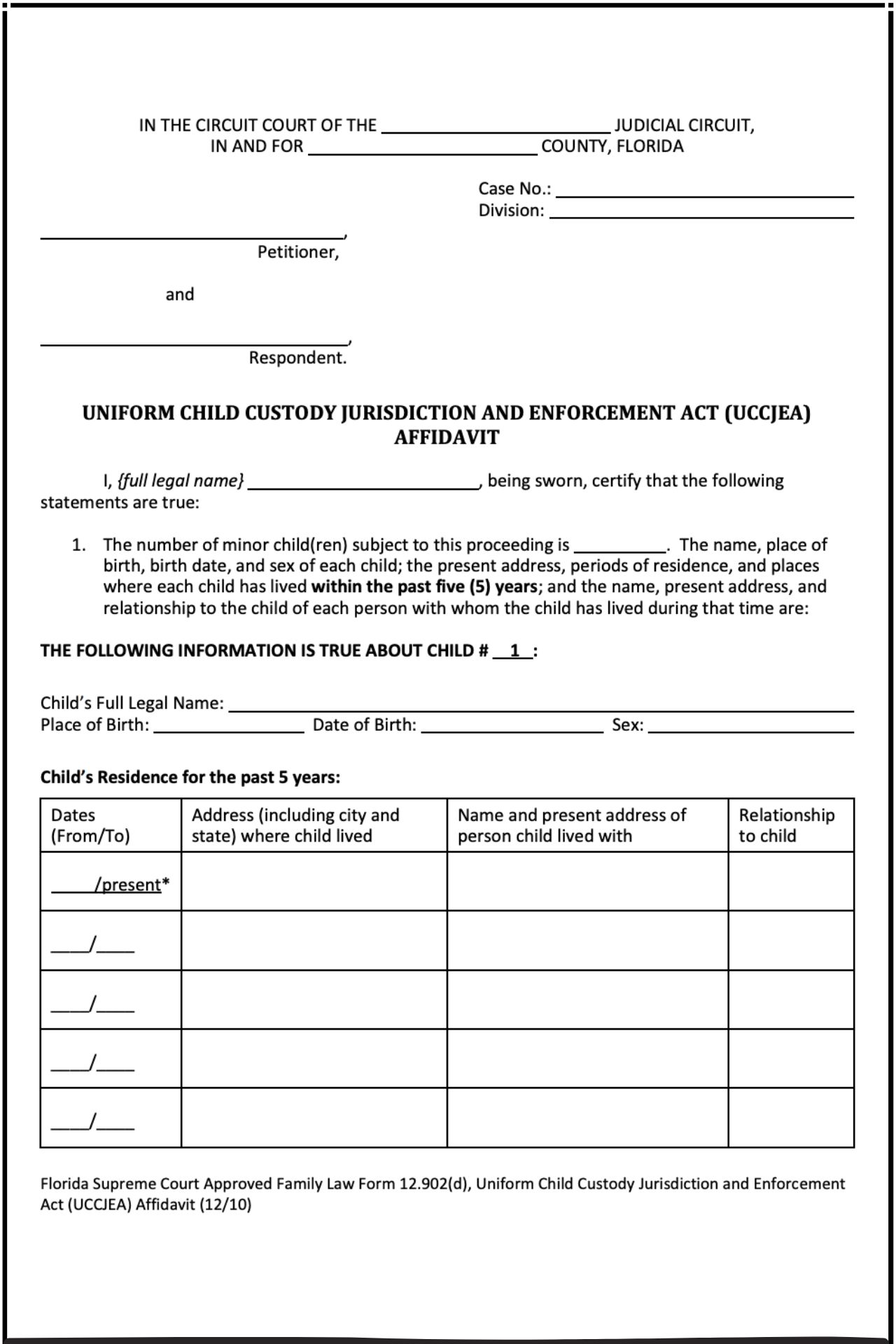
Florida UCCJEA Affidavit Form (Free PDF)
Get PDF
Florida requires parties to use the Florida Supreme Court Approved Family Law Form 12.902(d) for the UCCJEA affidavit. Because this is an official court pleading, it is not a document that can be freely customized like a standard legal template.
Our prepared version is designed to help users:
- Complete the official form correctly
- Understand each required disclosure
- Avoid common filing mistakes
- Generate a clean, court-ready document before printing
You may:
- Complete a fillable PDF electronically
- Print and sign the completed form
- Sign before a Notary Public, Deputy Clerk, or use Florida’s permitted unsworn verification when applicable
This affidavit must accompany:
- Divorce cases involving minor children
- Paternity actions
- Parenting plan disputes
- Time-sharing modifications
- Any proceeding involving parental responsibility or child custody
Even agreed custody cases require the affidavit
One of the most common misconceptions is that parents with a fully agreed Parenting Plan can skip the UCCJEA affidavit.
They cannot.
Under Fla. Stat. § 61.522(1), each party must provide the required UCCJEA information in the first pleading or an attached affidavit, even when the parents agree on custody terms.
When this form should not be used
Despite the similar terminology used in Florida family law, this affidavit does not apply to:
- Adult guardianship proceedings
- Property disputes
- Financial affidavits
- Child support disclosures unrelated to custody jurisdiction
- Other non-custody family law filings
Its sole purpose is establishing child custody jurisdiction.
What Is a UCCJEA Affidavit in Florida?
A Florida UCCJEA Affidavit is a jurisdictional pleading, not a factual statement arguing who should receive custody.
The distinction matters because the UCCJEA affidavit is about jurisdiction, not the merits of the parenting dispute: under Fla. Stat. § 61.522, the court uses the information about the child’s residence and other proceedings to determine what court may properly hear the custody case.
Many parents mistakenly believe the affidavit is where they explain why they are the better parent. It is not.
Instead, the affidavit gives the court enough information to determine:
- where the child has lived,
- who has cared for the child,
- whether another state already has jurisdiction,
- whether another custody case already exists,
- and whether Florida may legally issue or modify a custody order.
This requirement comes from Part II of Chapter 61, Florida Statutes, and Florida provides the Supreme Court-approved Family Law Form 12.902(d) for the UCCJEA affidavit.
The judge generally reviews the affidavit before reaching any substantive custody questions. If jurisdiction is lacking, the court may never reach the merits of the custody dispute regardless of how compelling either parent’s position may be.
Think of the affidavit as answering “Which court may decide?” rather than “Who should receive custody?”
That distinction prevents parents from filing custody cases in states that have little or no legal connection to the child.
Florida Laws Governing the UCCJEA Affidavit
Statutory Requirements at a Glance
| Topic / Issue | Florida Legal Rule | Governing Statute |
|---|---|---|
| Mandatory filing | Filed under oath with each party’s initial pleading in qualifying custody cases | Fla. Stat. § 61.522(1) |
| Five-year residence history | Child’s residence history, dates, addresses, and caregivers for the previous five years | Fla. Stat. § 61.522(1) |
| Execution requirements | Signed before a notary, Deputy Clerk, or verified through an approved unsworn declaration | Fla. Stat. §§ 61.522(1), 92.525 |
| Continuing disclosure obligation | Each party has a continuing duty to inform the court of any proceeding in Florida or another state that could affect the current proceeding. | Fla. Stat. § 61.522(4) |
| Non-compliance | The court may stay the proceeding until the required UCCJEA information is furnished. | Fla. Stat. § 61.522(2) |
Florida treats this affidavit as far more than administrative paperwork. Every disclosure helps the court determine whether another state already has jurisdiction or whether multiple courts could issue conflicting custody orders. That is why the affidavit must accompany the very first pleading rather than being submitted later in the case.
Filing the affidavit does not end the disclosure obligation. Under Fla. Stat. § 61.522(4), each party must continue to inform the court about proceedings in Florida or another state that could affect the current custody case, so a newly discovered proceeding should be brought to the court’s attention rather than left for the next hearing.
How These Laws Shape the Document’s Content
The largest section of the affidavit concerns the child’s residence history.
Florida requires the affiant to disclose the child’s residences during the previous five consecutive years, including:
- dates of residence,
- physical addresses,
- names of caregivers,
- current addresses of those caregivers,
- and each person’s relationship to the child.
This information helps determine the child’s “home state” and discourages parents from relocating immediately before filing in hopes of obtaining a more favourable forum.
The affidavit must also disclose whether the party:
- has participated in any previous custody or visitation proceeding,
- knows about any pending custody litigation,
- knows of domestic violence proceedings,
- protective order cases,
- dependency proceedings,
- termination of parental rights actions,
- or adoption proceedings involving the child.
These disclosures give the Florida court information about other proceedings that may affect jurisdiction, including another custody case or an enforcement, domestic-violence, protective-order, termination-of-parental-rights, or adoption proceeding covered by Fla. Stat. § 61.522(1)(b).
Another frequently overlooked requirement concerns unsworn verification.
When a party signs without appearing before a notary under the authority provided by Fla. Stat. § 61.522, the affidavit must contain the following statutory language immediately above the signature:
“Under penalties of perjury, I declare that I have read the foregoing document and that the facts stated in it are true.”
Omitting or modifying this wording can result in a defective verification, forcing the party to correct the filing before the case proceeds.
Florida law also gives the court a practical enforcement tool. If the required UCCJEA disclosures are missing, the judge may stay the proceedings until a compliant affidavit is filed. Rather than allowing a potentially defective custody case to move forward, the court can halt the litigation until jurisdictional information is complete.
Who Must Be Listed on the Affidavit (and Who Gets Missed)
Completing the Florida UCCJEA Affidavit isn’t just about listing the child’s current address. The affidavit must identify non-parties who have physical custody of the child or who claim rights of legal custody, physical custody, or visitation, as required by Fla. Stat. § 61.522(1)(c). Omitting someone—even unintentionally—can delay the case or raise questions about whether the court has all the information necessary to determine jurisdiction.
At a minimum, the affidavit should accurately identify:
- Every residence where the child has lived during the previous five consecutive years.
- The dates the child lived at each location.
- The person or people the child lived with.
- Each caregiver’s current address, if known.
- The caregiver’s relationship to the child.
Don’t overlook non-parent caregivers
Parents often focus only on themselves, but Fla. Stat. § 61.522(1)(c) also requires disclosure of certain non-parties who currently have physical custody of the child or claim custody or visitation rights.
Examples include:
- Grandparents providing long-term care
- An aunt or uncle with physical custody
- Foster parents
- Court-appointed guardians
- Extended relatives caring for the child
- Anyone asserting legal custody or visitation rights
These individuals may not be parties to the lawsuit, yet they can still affect the court’s jurisdiction. Leaving them off the affidavit can prevent the court from identifying everyone whose rights may be affected by the proceedings.
Prior proceedings matter—even if they happened years ago
The affidavit also requires disclosure of whether you have participated in any proceeding concerning the child as:
- a party,
- a witness,
- or in another capacity.
This includes knowledge of proceedings involving:
- child custody,
- visitation,
- domestic violence,
- injunctions for protection,
- dependency,
- termination of parental rights,
- adoption,
- enforcement proceedings in another state.
Many parents assume a closed case “doesn’t count anymore.” That assumption can create serious jurisdictional issues. Even an older proceeding may explain why another state has continuing jurisdiction.
If Another State Already Has a Custody Case, Expect the Judges to Communicate
Many parents assume that discovering a custody case in another state automatically ends their Florida case. That is not how the UCCJEA usually works.
If the affidavit reveals a qualifying custody proceeding already pending in another state, Florida law may require the Florida court to stay its proceeding and communicate with the other court before deciding whether the Florida case can proceed. This is an official part of the UCCJEA process, not an informal phone call between courts. Except for communications concerning schedules, calendars, court records, and similar administrative matters, the court must allow the parties to participate in the communication and, if they participate, give them an opportunity to present facts and legal arguments before jurisdiction is decided, and a record of the communication should be made. See Fla. Stat. § 61.511.
In practice, this means your affidavit can trigger an interstate jurisdiction review before the court ever considers temporary time-sharing or parental responsibility. If you know another case exists, include the court name, case number (if known), filing date, and the current status instead of writing only that “a case was filed.” Those details allow the Florida court to identify the correct tribunal quickly and can prevent weeks of delay while clerks and judges determine which state has authority to proceed.
Special situation: Parent fleeing domestic violence
Florida recognises that disclosing a residential address can create safety risks, similar to residency affidavits.
If a parent has filed a Request for Confidential Filing of Address under Florida Family Law Rule 12.980(h) because of domestic violence concerns, The current Form 12.902(d) instructions provide that a petitioner in a domestic-violence injunction case who has filed Form 12.980(h) should write confidential in spaces requiring the current address.
This exception protects safety while still allowing the court to receive the jurisdictional information necessary to decide the case.
When additional legal review is advisable
Some custody matters involve issues beyond a standard UCCJEA affidavit.
Examples include:
- international relocation,
- children who recently moved between several states,
- simultaneous custody cases in different jurisdictions,
- military families with frequent relocations,
- foreign custody orders.
Although the affidavit remains mandatory, these situations often require additional jurisdictional analysis because multiple courts—or even multiple countries—may potentially claim authority.
How to Complete and Sign the UCCJEA Affidavit
The affidavit is only effective if it is both complete and properly executed. Small procedural mistakes frequently result in rejected filings or court-ordered corrections, delaying custody decisions that families often need resolved quickly.
Step 1 – Gather the child’s five-year residential history
Before completing the form, collect:
- Every address where the child has lived during the previous five years.
- The exact dates at each residence.
- Names of everyone the child lived with.
- Their current addresses, if available.
- Their relationship to the child.
Parents frequently estimate dates from memory. If possible, verify them using school records, leases, medical records, or other reliable documents to minimise inconsistencies.
Step 2 – Identify every relevant proceeding
Next, check the information you already gathered against the UCCJEA form before signing. Make sure every prior or pending proceeding that could affect the case is identified, including its court, case number, and nature when known.
- custody litigation,
- visitation disputes,
- domestic violence injunctions,
- dependency proceedings,
- adoption matters,
- enforcement actions,
- termination of parental rights cases.
If another proceeding exists, disclose it rather than assuming the court will discover it independently.
Step 3 – Choose the correct verification method
Florida allows two primary methods of execution.
Option 1 – Sign before:
- a Notary Public; or
- a Deputy Clerk of Court.
Option 2 – Use an unsworn declaration permitted by Fla. Stat. § 92.525.
When using the second option, the affidavit must include the statutory declaration immediately above the signature:
“Under penalties of perjury, I declare that I have read the foregoing document and that the facts stated in it are true.”
Changing the wording or omitting the declaration may result in an invalid verification.
Step 4 – Sign only after reviewing every disclosure
Because the affidavit is made under oath or under penalty of perjury, review every answer carefully before signing.
Common errors include:
- forgetting temporary residences,
- listing incomplete dates,
- failing to disclose an older custody case,
- overlooking a caregiver who had physical custody,
- using outdated addresses.
Correcting these issues before filing is considerably easier than attempting to amend the affidavit after jurisdictional questions have already arisen.
Step 5 – File it with the initial pleading
The completed affidavit should be filed at the same time as:
- the initial petition; or
- the initial responsive pleading (Answer).
If you are filing electronically, follow the Florida Courts E-Filing Portal requirements and the filing procedures of the circuit and clerk handling your case.
Practical tips that prevent common filing problems
If the child moved frequently
The official form may not provide enough space for every residence. Rather than abbreviating information, attach additional pages using the same table format so the residence history remains complete and chronological.
Keep dates consistent
The residence timeline should not contain unexplained gaps or overlapping periods unless there is a legitimate reason. Inconsistent timelines often prompt additional questions from the court.
Don’t wait to disclose new proceedings
If another custody or related proceeding begins after filing, Florida law imposes a continuing obligation to notify the court. Updating the court promptly reduces the risk of conflicting jurisdictional decisions.
Jurisdiction Limits and When the Affidavit Isn’t Enough
Completing the affidavit correctly does not automatically give a Florida court authority to decide custody.
The affidavit provides the information the judge needs to determine whether jurisdiction exists—it does not create jurisdiction by itself.
Florida’s six-month “home state” rule
In many cases, Florida can exercise initial child custody jurisdiction when it qualifies as the child’s home state under Fla. Stat. § 61.514(1)(a). The residence history contained in the affidavit allows the judge to evaluate whether the child has lived in Florida with a parent or person acting as a parent for at least six consecutive months immediately before the commencement of the proceeding (or from birth for an infant under six months old).
The Temporary Absence and Interstate Retaliation Trap
A common misunderstanding among parents relocating to or from Florida involves temporary absences during the six-month qualification window. Under Fla. Stat. § 61.503(7), periods of temporary absence (such as summer vacations, temporary work assignments, or short visits to relatives) are legally counted as part of the six-month residency period in the originating state.
If a parent moves a child to Florida and immediately files a petition for time-sharing after only three months, the UCCJEA Affidavit will reveal on its face that Florida lacks “home state” jurisdiction. If the other parent files a competing custody action in the former state within six months of the move, Florida generally must stay its proceeding and communicate with the other court when a qualifying custody proceeding was previously commenced in another state under Fla. Stat. § 61.519. Furthermore, under Fla. Stat. § 61.521, if the Florida court determines that a parent engaged in “unjustifiable conduct” (such as wrongfully removing or retaining the child in Florida to manufacture jurisdiction), the court is statutorily mandated to decline jurisdiction and may require the party who invoked jurisdiction through unjustifiable conduct to pay necessary and reasonable expenses, which can include attorney’s fees and travel expenses, unless the assessment would be clearly inappropriate.
Emergency situations are different
One significant exception involves emergency jurisdiction under Fla. Stat. § 61.517.
Emergency jurisdiction exists only when the statutory requirements of Fla. Stat. § 61.517 are satisfied. It is not created simply because a parent believes Florida would be a more convenient forum.
Parents cannot create jurisdiction by agreement
Another common misunderstanding is that parents may simply agree to have their custody dispute decided in Florida.
They cannot.
Even if both parents agree, their agreement does not by itself create a jurisdictional basis that Florida lacks under the UCCJEA. If another state has continuing authority over the child, the Florida court must follow the governing jurisdictional rules rather than the parents’ preference.
This affidavit is not a Parenting Plan
Although both documents appear in custody cases, they serve completely different purposes.
| UCCJEA Affidavit | Parenting Plan |
|---|---|
| Establishes whether Florida has jurisdiction. | Establishes how parents will share responsibilities and time-sharing. |
| Focuses on residence history and jurisdictional facts. | Focuses on parenting arrangements. |
| Mandatory with the initial custody pleading. | Governs future parenting responsibilities after jurisdiction is established. |
| Does not decide who receives custody. | Addresses the terms of custody and time-sharing. |
Keeping the two documents separate is important: the UCCJEA affidavit supplies the jurisdictional information required by Fla. Stat. § 61.522, while the Parenting Plan addresses parenting responsibilities and time-sharing. Completing one does not substitute for the other.
Consequences of Errors, Omissions, or False Statements
Because the Florida UCCJEA Affidavit determines whether the court has jurisdiction, mistakes carry more weight than simple clerical errors. An incomplete or inaccurate affidavit can delay the case, require additional hearings, or even undermine custody orders entered by the court.
The most common problems arise from omitted disclosures, late filing, and improper verification. Many of these issues are preventable with careful preparation before the affidavit is signed.
Omitting a prior custody or domestic violence proceeding
One of the most serious mistakes is failing to disclose a previous or pending case involving the child.
For example, a parent may omit:
- an earlier custody case in another state,
- a domestic violence injunction,
- a dependency proceeding,
- an adoption matter,
- or a termination of parental rights case.
These proceedings directly affect the court’s jurisdictional analysis. If the omission is intentional or materially misleading, a custody order entered after a material jurisdictional omission may be subject to challenge if the omission affected the court’s authority to exercise jurisdiction.
Even when the omission is accidental, correcting the issue after orders have been entered is significantly more expensive and time-consuming than making a complete disclosure at the outset.
Filing the affidavit after the petition or answer
Florida requires each party to file the UCCJEA Affidavit with their initial pleading. Waiting until weeks later—even if no hearing has occurred—creates unnecessary procedural issues.
Under Florida law, the court may stay the proceedings until the required affidavit is filed. That means matters such as temporary parenting schedules, time-sharing requests, or other custody-related decisions may be delayed while the filing deficiency is corrected.
For families seeking immediate court intervention, even a short delay can have practical consequences.
Using the wrong verification method
Another recurring problem involves execution of the affidavit.
If you sign before a Notary Public or Deputy Clerk, the notarisation must be properly completed.
If you instead rely on Florida’s permitted unsworn verification, the affidavit must include the exact statutory declaration immediately above your signature:
“Under penalties of perjury, I declare that I have read the foregoing document and that the facts stated in it are true.”
Changing the wording, paraphrasing it, or leaving it out altogether may result in an invalid verification that must be corrected before the case can move forward.
Financial and legal consequences
Errors on the affidavit often create costs beyond simply filing an amended document.
Potential consequences include:
- delayed custody or time-sharing decisions,
- additional attorney’s fees to correct jurisdictional issues,
- repeat court hearings,
- postponed mediation,
- appellate challenges,
- increased litigation costs,
- uncertainty regarding previously entered custody orders.
Because jurisdiction is fundamental to every custody case, courts treat these disclosures far more seriously than routine filing defects.
Frequently Asked Questions (FAQ)
Can a UCCJEA affidavit be amended after filing if a new custody case surfaces in another state?
Yes. Florida law imposes a continuing duty to disclose new proceedings that could affect jurisdiction. If you learn about another custody, dependency, domestic violence, or similar proceeding after filing your affidavit, you should promptly notify the court in writing rather than waiting until a hearing. Timely disclosure helps the court determine whether jurisdiction remains appropriate.
Does signing electronically without a notary hold up in Florida family court?
An electronic signature alone does not replace Florida’s execution requirements.
The affidavit must either:
- be signed before a Notary Public or Deputy Clerk, or
- contain the authorised unsworn declaration under Fla. Stat. § 92.525, including the exact statutory perjury language.
Using an electronic signature without satisfying one of these verification methods may result in a defective filing.
What happens if it’s later discovered that the affidavit omitted a prior custody case?
The consequences depend on the circumstances, but the omission can be significant. If a prior custody proceeding or other required disclosure was intentionally concealed and that information affected the court’s jurisdiction, a custody order entered in reliance on the incomplete affidavit may later be challenged or declared void because the court lacked proper subject matter jurisdiction.
Even an unintentional omission may require amended filings and additional court proceedings to resolve the jurisdictional issue.
If both parents agree on custody terms, is the UCCJEA affidavit still legally required?
Yes. The filing requirement does not depend on whether the parents disagree. Each party must submit the required affidavit with their initial pleading in qualifying Florida custody, parental responsibility, or time-sharing cases. A mutually agreed Parenting Plan cannot replace or waive the court’s obligation to determine jurisdiction before issuing custody orders.
Legal Disclaimer: This article provides general educational information about the Florida UCCJEA Affidavit and Florida filing procedures. It is not legal advice and does not create an attorney-client relationship. If your case involves multiple states, international custody issues, emergency jurisdiction, or conflicting court orders, consider consulting a qualified Florida family law attorney before filing.