
Understanding the Florida Probate Process (Step by Step)
Losing a loved one is difficult enough without trying to navigate the legal process that follows. If the deceased owned assets in their sole name, those assets often cannot be transferred until the appropriate probate procedure is completed. Understanding the Florida probate process early can help families avoid unnecessary delays, unexpected costs, and procedural mistakes that may complicate estate administration.
Florida offers more than one probate pathway. Some estates qualify for a simplified procedure known as Summary Administration, while others require Formal Administration through the probate court. Which option applies depends on factors such as the value of the probate estate, the date of death, the nature of the assets, and whether ongoing estate management is necessary.
Recent legislative changes also make timing especially important. For individuals who pass away on or after July 1, 2026, Florida significantly increased the eligibility limit for Summary Administration. Families relying on outdated information may assume an estate requires formal probate when a simplified option is now available or choose the wrong procedure altogether.
This article explains how probate works in Florida, the steps involved, the updated 2026 eligibility rules, and the practical issues that commonly delay or derail probate proceedings.
Candice Hayden, Legal Writer
Maria Rosso, Florida Probate, Guardianship and Estate Planning Attorney
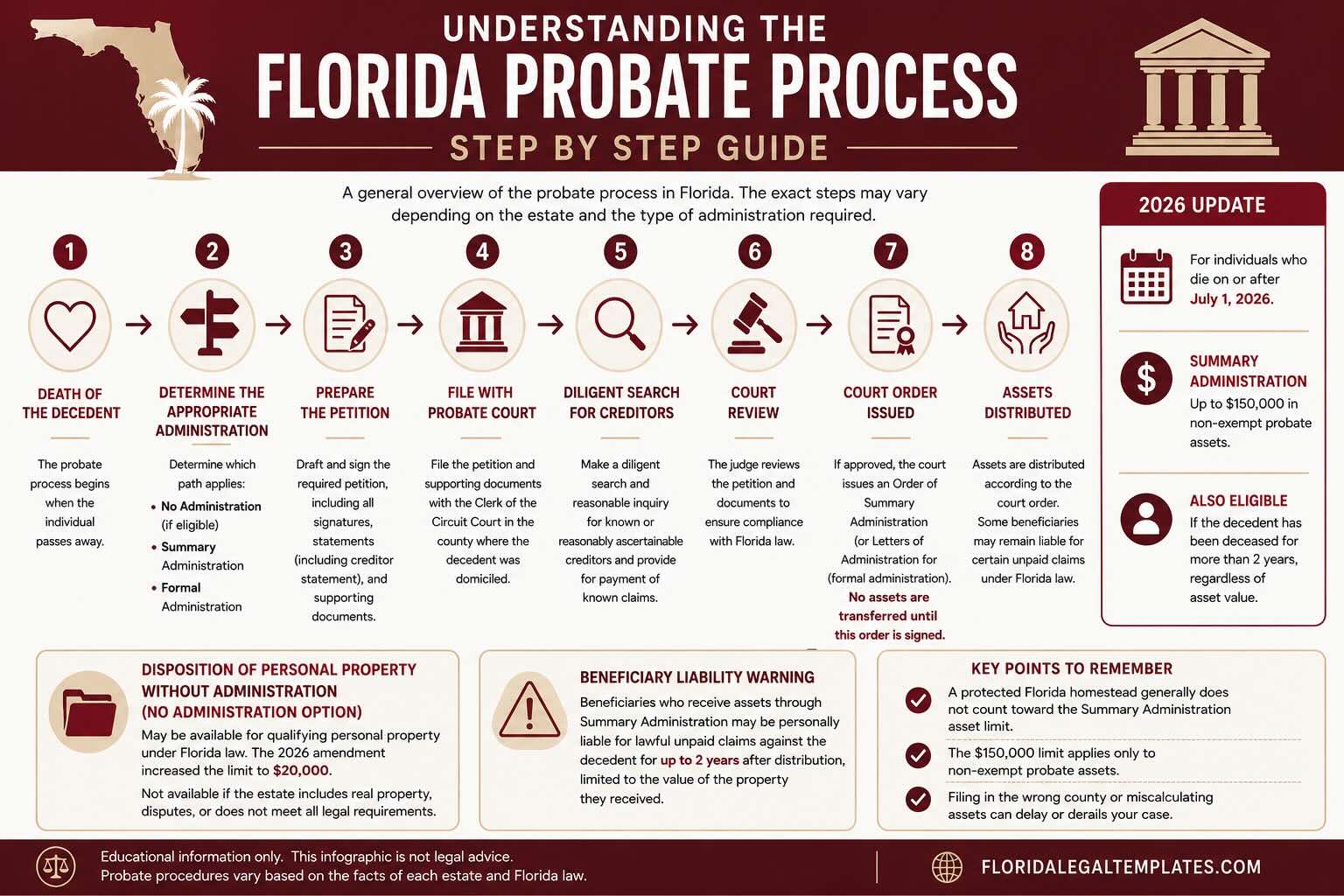
The Florida Probate Process at a Glance
Although every estate presents its own challenges, most follow the same overall sequence.
- Death of the property owner.
- Determine whether Summary Administration or Formal Administration applies.
- Prepare and verify the required probate petition.
- File the petition with the appropriate Florida probate court.
- Identify creditors and satisfy statutory notice requirements.
- Court reviews the filing.
- Judge signs the appropriate probate order.
- Assets are distributed to beneficiaries.
Many families first ask two questions:
- How long does probate take?
- Which probate procedure applies to my situation?
The answer depends largely on the type of administration.
| Administration Type | Generally Used When | Court Involvement |
|---|---|---|
| Summary Administration | Eligible estates meeting Florida’s statutory requirements | Simplified judicial proceeding |
| Formal Administration | Larger or more complex estates requiring ongoing administration | Full probate case supervised by the court |
Summary Administration usually involves fewer procedural steps because no ongoing estate administration occurs after the court issues its order. Formal Administration, by contrast, often requires appointment of a personal representative, continued court oversight, creditor administration, and additional filings before assets can be distributed.
The correct procedure should be identified before preparing any probate documents. Filing under the wrong process often results in delays, additional court costs, or conversion into Formal Administration.
Step 1 — Determine Which Type of Administration Applies
Selecting the correct probate procedure is the single most important decision at the beginning of estate administration. Florida law provides different requirements depending on the estate’s circumstances, and choosing the wrong path can delay distributions or require the entire filing to be redone.
Summary Administration Eligibility (Updated for 2026)
Florida law now permits Summary Administration in two primary situations.
First, for individuals who die on or after July 1, 2026, the total value of the decedent’s non-exempt Florida probate assets must not exceed $150,000. This threshold was increased from the previous $75,000 limit under CS/HB 1337, expanding access to the simplified probate process. Pursuant to Fla. Stat. § 735.201(1)-(2), the increased threshold applies only to qualifying deaths occurring on or after the law’s effective date.
Second, Summary Administration remains available regardless of estate value if the decedent has been deceased for more than two years.
One detail frequently causes confusion: not every asset is included when calculating the statutory limit.
For example, a properly protected Florida homestead generally qualifies as an exempt asset and does not count toward the $150,000 eligibility threshold. Non-exempt probate assets, however, are included when determining whether the estate qualifies.
Statutory Reference Matrix
| Topic / Issue | Florida Legal Rule | Governing Statute |
|---|---|---|
| Summary Administration eligibility | Available when non-exempt probate assets do not exceed $150,000 (deaths on or after July 1, 2026) or the decedent has been deceased for more than two years | Fla. Stat. § 735.201 |
| Petition execution | Petition must be signed and verified by the surviving spouse (if any) and all beneficiaries, subject to the statutory exception | Fla. Stat. § 735.203 |
| Unsworn verification | Petition may use an unsworn declaration containing the statutory verification language under penalty of perjury | Fla. Stat. § 92.525 |
The higher threshold means many estates that previously required Formal Administration may now qualify for Summary Administration. However, eligibility is determined by applying the statutory rules exactly as written. Incorrectly excluding assets or misunderstanding which property is exempt can cause the court to reject the petition.
Families should also remember that Summary Administration is still a formal court proceeding. The increased asset limit did not eliminate filing requirements or judicial review—it simply expanded who may use the simplified process.
Formal Administration Trigger Points
Not every estate can proceed through Summary Administration.
Formal Administration generally becomes necessary when the estate exceeds the statutory eligibility limits or when circumstances require active estate management.
Common situations include:
- Non-exempt probate assets exceeding the applicable statutory threshold.
- Litigation involving the estate.
- Ongoing business interests requiring management.
- Asset investigations or title issues.
- Circumstances requiring appointment of a personal representative to administer the estate.
Formal Administration provides the court with continuing oversight while estate affairs are resolved. Although it typically involves more filings and a longer administration period, it is designed for estates where simplified procedures would not adequately protect creditors, beneficiaries, or the estate itself.
In practice, families sometimes focus only on the estate’s approximate value without considering whether administration activities will continue after filing. Even an estate that appears straightforward can require Formal Administration if unresolved legal or financial issues demand ongoing management.
The Retroactivity Trap (Critical 2026 Nuance)
One of the most significant changes introduced in 2026 also creates one of the easiest mistakes to make.
The $150,000 Summary Administration limit is not retroactive.
According to the verified legislative changes reflected in CS/HB 1337, the increased threshold applies only to individuals who die on or after July 1, 2026.
Consider this example.
A Florida resident dies on June 30, 2026, leaving $120,000 in non-exempt probate assets. Although the probate petition may be filed months later, the estate cannot rely on the new $150,000 threshold because eligibility is determined by the date of death, not the filing date.
As a result, the estate remains subject to the previous statutory limit and may require Formal Administration despite falling below today’s higher threshold.
This distinction has practical consequences. Filing under the wrong administration type because the law was misunderstood can lead to dismissal of the petition, additional filing costs, and delays while the estate is converted into the proper probate proceeding.
Step 2 — Prepare the Petition and Required Statements
Once you’ve confirmed the correct type of probate administration, the next step is preparing the court filings. This stage is more than paperwork—it establishes the legal foundation for the probate case. Even a minor omission can delay court review or require amended filings.
For Summary Administration, the petition must contain specific information required by Florida law. It identifies the decedent, lists the beneficiaries, describes the probate assets, explains why the estate qualifies for Summary Administration, and tells the court how the assets should be distributed.
Unlike informal estate settlements, this is a verified court pleading. Every statement made to the court carries legal significance, so accuracy matters from the outset.
Statutory Reference Matrix
| Topic / Issue | Florida Legal Rule | Governing Statute |
|---|---|---|
| Petition requirements | Petition must include all statutory information required for Summary Administration | Fla. Stat. § 735.203 |
| Probate filing format | Summary Administration petitions must comply with Florida Probate Rules | Florida Probate Rules of Court Procedure (Rules 5.010–5.530) |
| Unsworn verification | Petition may be verified through an unsworn declaration under penalty of perjury | Fla. Stat. § 92.525 |
Preparing the petition is often where probate delays begin. Courts frequently require corrections when beneficiary information is incomplete, asset descriptions are inaccurate, or statutory language is omitted. Taking time to prepare a complete petition usually saves far more time than correcting deficiencies after filing.
The Mandatory Creditor Statement
One requirement is frequently overlooked because it is more than a general disclosure—it is mandatory statutory language.
Florida law requires every Summary Administration petition to include a statement confirming that the petitioner has investigated potential creditor claims.
The petition must include:
“…that the petitioner has made a diligent search and reasonable inquiry for any known or reasonably ascertainable creditors, and that the estate is either not indebted or that provision for the payment of all known debts has been made to the extent that assets are available.”
This language comes directly from Fla. Stat. § 735.203(1)(f) and serves an important purpose. Before the court authorizes distribution of estate assets, it expects petitioners to determine whether legitimate debts exist and explain how those obligations will be handled.
Skipping this requirement or replacing it with informal wording may result in the court requiring an amended petition before moving the case forward.
Who Must Sign the Petition?
Florida law also specifies who must join the petition.
For Summary Administration, the petition must generally be signed and verified by:
- the surviving spouse, if one exists; and
- all beneficiaries.
The only statutory exception applies when a beneficiary will receive their entire distributive share under the proposed order. In that limited circumstance, formal joinder may not be required.
This rule prevents disputes after the court has already entered an order. If beneficiaries disagree about distributions, those issues are far easier to resolve before the petition reaches the judge than afterward.
Notarization or an Unsworn Declaration
Many people assume every probate petition must be notarized.
Florida provides another option.
Instead of appearing before a Notary Public or Deputy Clerk, petitioners may use an unsworn written declaration, provided it contains the exact statutory verification language required by Fla. Stat. § 92.525(2).
The declaration must state in the required affidavit:
“Under penalties of perjury, I declare that I have read the foregoing document and that the facts stated in it are true.”
The wording should not be paraphrased. Courts expect the statutory language to appear exactly as required because it substitutes for a sworn oath.
Cross-Border Signatures via Remote Online Notarization (RON)
In many Florida probate matters, beneficiaries reside out of state or even out of the country, complicating the collection of physical signatures for joint petitions. If an estate chooses to use a traditional sworn notary acknowledgment instead of the § 92.525 unsworn declaration framework, Florida’s Remote Online Notarization (RON) law (Fla. Stat. § 117.201) allows out-of-state or international heirs to execute the petition digitally.
To be valid, the signing must occur via a live, two-way audio-video connection recorded by a certified Florida RON provider, utilizing credential analysis and identity proofing. While the unsworn declaration remains the standard shortcut, utilizing a formal RON framework is legally robust and fully accepted by Florida circuit courts when a traditional sworn oath is requested by a specific local judicial division.
Don’t Forget the Homestead Filing
If the estate includes Florida real property claimed as protected homestead, another filing is commonly required.
A Petition to Determine Homestead Status is typically filed alongside the probate petition so the court can determine the property’s legal status before distribution.
Failing to address homestead issues early often delays title transfers because financial institutions and title companies rely on the court’s determination before recognizing ownership changes.
Step 3 — File With the Correct Circuit Court
After the petition has been completed and properly verified, it must be filed in the correct Florida probate court.
Florida probate cases are filed with the Clerk of the Circuit Court (Probate Division) serving the county where the decedent was domiciled at the time of death. Venue is determined by residence—not where beneficiaries live or where most assets happen to be located.
Electronic filing is completed through the Florida Courts E-Filing Portal before the case is assigned to a circuit judge for review.
Practical Filing Workflow
The filing package commonly includes:
- Verified probate petition.
- Death certificate, where required.
- Petition to Determine Homestead Status, if applicable.
- Supporting schedules identifying estate assets.
- Any additional documents required by the local probate division.
Submitting complete documents together reduces the likelihood of clerk deficiency notices and avoids unnecessary processing delays.
Why Venue Matters
Choosing the wrong county may seem like a simple clerical mistake, but it can significantly slow estate administration.
If the probate proceeding is filed in an improper venue, the court may require the case to be transferred or dismissed before substantive review begins. That means additional filing costs, administrative delays, and extra work for everyone involved.
A quick review of domicile before filing often prevents weeks of avoidable delay.
Step 4 — Creditor Notice and Claims Handling
One of probate’s primary purposes is ensuring that legitimate creditors receive the protections provided by Florida law before estate assets are distributed.
That responsibility begins well before the judge signs a probate order.
What Does “Diligent Search” Actually Mean?
Florida requires petitioners to make a diligent search and reasonable inquiry for known or reasonably ascertainable creditors.
In practice, this involves reviewing the decedent’s financial records rather than relying solely on memory.
Common sources include:
- bank statements;
- credit card accounts;
- medical invoices;
- mortgage records;
- personal loan documents;
- tax records; and
- other financial correspondence.
The goal is not to discover every possible debt but to make a reasonable, good-faith effort to identify creditors who can be found through ordinary investigation.
Summary Administration vs. Formal Administration
Both probate procedures address creditor rights, but they do so differently.
Summary Administration is designed for qualifying estates and generally involves a streamlined process. Even so, creditors cannot simply be ignored. The petition must explain that provision has been made for payment of known debts to the extent estate assets are available.
Formal Administration typically involves a more extensive creditor administration process because estate management continues under court supervision.
The distinction matters because many families mistakenly believe Summary Administration eliminates creditor issues. It does not—it simply handles them under a different procedural framework.
Proposed Distribution Must Address Known Debts
Florida law also requires the proposed distribution plan to account for known obligations.
If creditors have been identified, the petition should explain how those claims will be satisfied before beneficiaries receive estate property.
Ignoring known debts may create problems long after probate appears complete. As discussed in the next section, beneficiaries who receive distributions may remain personally responsible for certain unpaid claims for a limited period under Florida law.
Step 5 — Court Review and the Order of Summary/Formal Administration
After the petition is filed, the probate case moves from document preparation to judicial review. At this stage, the court examines whether the filing complies with Florida law before authorizing any transfer of estate assets.
For many families, this is where a common misconception arises—they assume filing the petition gives them authority to access bank accounts, sell property, or distribute inheritances. It does not.
Until the court enters the appropriate probate order, estate assets generally remain subject to the probate process.
What the Judge Reviews
Whether the estate proceeds through Summary Administration or Formal Administration, the Circuit Judge reviews the filing to confirm that the statutory requirements have been satisfied.
Depending on the administration type, the court will evaluate matters such as:
- Whether the estate qualifies for the requested probate procedure.
- Whether required beneficiaries have properly joined the petition.
- Whether the petition contains the mandatory statutory statements.
- Whether creditor-related obligations have been addressed.
- Whether the proposed distribution complies with Florida law.
If the court identifies deficiencies, it may require amendments or additional documentation before entering an order.
This is why probate delays often stem from incomplete filings rather than court backlog. Missing signatures, omitted creditor disclosures, or incorrect asset valuations frequently result in avoidable requests for correction.
Why the Court Order Matters
Once the judge is satisfied that the statutory requirements have been met, the court issues the appropriate probate order.
For Summary Administration, this is the Order of Summary Administration.
Under Fla. Stat. § 735.206, the signed order serves as the legal authority directing financial institutions, title companies, custodians, and other asset holders to transfer estate property to the beneficiaries identified in the order.
Without that judicial order, third parties generally have no legal obligation to release probate assets.
This distinction is especially important for families attempting to close bank accounts or transfer real estate. Even if everyone agrees on who should inherit, institutions typically require the court order before recognizing the change in ownership.
Practical Example
Suppose an estate consists of a bank account, an investment account, and a vehicle titled solely in the decedent’s name.
Even if every beneficiary agrees on the distribution, the bank cannot simply divide the funds because a probate petition has been filed.
The legal authority arises only after the Circuit Judge signs the Order of Summary Administration. That order instructs the institution to release the assets according to the court-approved distribution.
Step 6 — Distribution and Lingering Heir Liability
After the probate order has been entered, estate assets can be distributed according to the court’s directions.
For beneficiaries, this often feels like the end of the probate process. Legally, however, one important risk may continue after the distributions have been made.
How Assets Are Distributed
Once the appropriate probate order is issued:
- Banks release account funds.
- Financial institutions transfer investment assets.
- Title companies process approved real estate transfers.
- Other custodians distribute property according to the court’s order.
Because the court has already approved the proposed distribution, beneficiaries generally receive assets directly rather than through prolonged estate administration.
Probate May End—Potential Liability May Not
Receiving an inheritance does not always eliminate future financial exposure.
Under Fla. Stat. § 735.206(4), beneficiaries who receive property through Summary Administration may remain personally liable for lawful unpaid claims against the decedent if the decedent died less than two years before the distribution.
That liability is limited in two important ways:
- It lasts for up to two years.
- A beneficiary’s responsibility generally cannot exceed the gross value of the property actually received.
This rule surprises many families because they assume the judge’s order permanently closes every issue relating to the estate.
Instead, Summary Administration balances efficiency with creditor protection. Qualified creditors may still pursue lawful claims within the statutory framework even after distributions have occurred.
Why This Matters in Practice
Imagine an estate is distributed shortly after probate because no outstanding debts are apparent.
Months later, a previously unknown medical provider establishes a lawful claim that should have been paid from estate assets.
If the statutory conditions are met, beneficiaries may be responsible up to the value of what they inherited.
That does not mean every late invoice creates liability, nor does it guarantee creditors will prevail. It does mean beneficiaries should avoid assuming that receiving inherited property automatically eliminates every potential estate obligation.
When Florida Probate Is Not Enough for Out-of-State Real Estate
A completed Florida probate case does not always mean every asset can be transferred. If the decedent owned real estate in another state, beneficiaries may discover that the Florida probate order is only part of the process.
For example, if the decedent lived in Florida but also owned a cabin in North Carolina or vacant land in Georgia titled solely in their name, the Florida Order of Summary Administration usually will not allow that county’s land records office to transfer ownership by itself. Instead, a separate probate proceeding, commonly called ancillary administration, may be required in the state where the real property is located. The exact procedure depends on that state’s probate laws.
This distinction matters when planning the estate timeline. Beneficiaries may receive Florida bank accounts and other assets quickly, only to discover months later that they still cannot sell or refinance the out-of-state property because an additional court process is required elsewhere. Florida probate can therefore be completed while title issues remain unresolved in another jurisdiction.
Florida law recognizes that administration of property located outside Florida may involve separate proceedings, but the requirements are governed primarily by the law of the state where the real estate sits
The No-Administration Alternative for Small Estates
Not every estate requires Summary Administration or Formal Administration.
Florida law provides another option for certain very small estates through the Disposition of Personal Property Without Administration procedure.
Unlike probate administration, this process is designed for limited circumstances where qualifying personal property can be transferred without opening a traditional probate case.
Updated $20,000 Limit
Under the 2026 amendments enacted through CS/HB 1337, the statutory limit for qualifying personal property increased from $10,000 to $20,000.
This change, reflected in Fla. Stat. § 735.301, allows more families with modest estates to use this simplified procedure instead of opening a probate administration.
When This Option May Apply
This alternative is intended for limited situations involving qualifying personal property rather than broader estate administration.
In the right circumstances, it can eliminate many of the procedural steps discussed earlier, including:
- filing a Summary Administration petition;
- obtaining a probate order; and
- completing a formal court administration.
When It Is Not Enough
Despite its convenience, this procedure has clear limits.
It generally is not appropriate when:
- the estate includes real property;
- heirs dispute ownership;
- significant probate assets are involved; or
- the estate exceeds the statutory requirements.
Families sometimes assume every “small estate” avoids probate, but that is not how Florida law operates. The availability of this alternative depends on satisfying the specific statutory requirements rather than the family’s preference for a simpler process.
Homestead and Asset-Counting Mistakes That Derail a Petition
One of the most common reasons Summary Administration petitions encounter problems is incorrect asset valuation.
The issue is rarely intentional. More often, families misunderstand which assets count toward the statutory eligibility limit.
Protected Homestead vs. Non-Exempt Real Estate
Florida’s protected homestead generally does not count toward the Summary Administration asset threshold.
However, not every property qualifies for that protection.
For example, a commercial building or a multi-unit property where portions of the property do not qualify as protected homestead may contain non-exempt value that must be included when determining eligibility.
Leaving those values out can dramatically change whether the estate qualifies for Summary Administration.
Consequences of Incorrect Asset Calculations
If non-exempt property is omitted from the asset calculation, the court may determine that the estate never qualified for Summary Administration.
That can result in:
- dismissal of the petition;
- additional filing expenses;
- delays in estate distribution; or
- conversion into Formal Administration.
Correct classification of estate assets before filing is usually far less expensive than correcting an improperly filed probate case later.
Other Common Filing Mistakes
Other issues that frequently delay probate include:
- relying on estimated asset values instead of documentation;
- overlooking partial ownership interests;
- failing to identify all probate assets;
- incomplete beneficiary information;
- missing required signatures; and
- omitting mandatory statutory statements from the petition.
Many of these problems are preventable through careful preparation before filing.
Frequently Asked Questions (FAQ)
If my loved one died in June 2026, can I still use the new $150,000 threshold now that it’s in effect?
No. Based on the 2026 statutory amendments reflected in your legal brief, the increased $150,000 Summary Administration threshold applies only to individuals who died on or after July 1, 2026. Eligibility is determined by the date of death, not the date the probate case is filed.
Can I use an unsworn declaration instead of a notary for the Summary Administration petition?
Yes, provided the declaration complies with Fla. Stat. § 92.525 and includes the exact statutory verification language required under Florida law:
“Under penalties of perjury, I declare that I have read the foregoing document and that the facts stated in it are true.”
Using different wording may not satisfy the statutory verification requirement.
If I already received my inheritance through Summary Administration, can a creditor still come after me later?
Potentially. Under Fla. Stat. § 735.206(4), beneficiaries who receive distributions may remain personally liable for lawful unpaid claims for up to two years, limited to the gross value of the property they received.
What happens if I forget to include a rental property or partial-interest asset when calculating the $150,000 limit?
If omitted property should have been included as a non-exempt probate asset, the estate may no longer qualify for Summary Administration. The court may require correction of the filing, dismiss the petition, or require the estate to proceed through Formal Administration instead.
This article is intended for educational purposes only and provides general information about the Florida probate process. It is not legal advice and does not create an attorney-client relationship.