
Florida Service Agreement [Free Printable, Fillable PDF]
A Florida service agreement doesn’t feel necessary until a client disputes what was agreed to, and by then the absence of one becomes the only thing either side is talking about. Under Fla. Stat. § 725.01, an agreement that cannot be performed within one year generally must be evidenced by a writing signed by the party to be charged before it can be enforced. Florida courts generally apply a possibility-of-performance rule: if the agreement could be fully performed within one year, § 725.01 may not apply, although the agreement’s terms and the parties’ intended performance still matter.
A detailed proposal and a long email trail can still leave important questions unanswered when the parties never put the final service terms into a clear written agreement. That matters most when the scope, payment trigger, or duration of the arrangement later becomes disputed. The service agreement florida template below is built around what Florida courts look for when determining whether an agreement actually existed and what its terms were, so the paperwork does the job before a dispute makes it necessary.
Candice Hayden, Legal Writer
Carly Johansson, Florida Contract Attorney Last updated: September 25, 2026
Florida Service Agreement (PDF, Printable, Fillable)
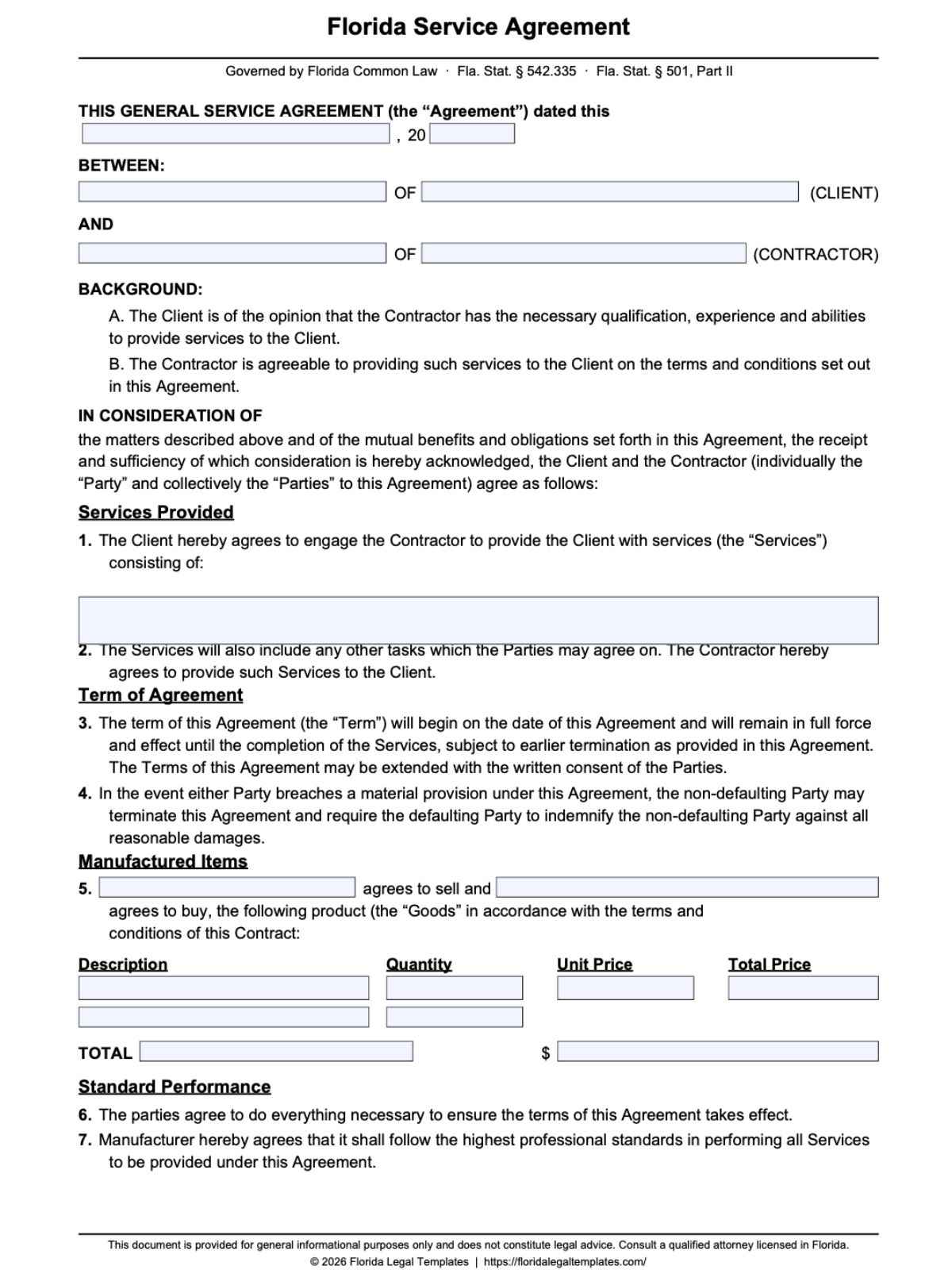
A service agreement florida template provides a structured format that ensures all essential legal terms are included and enforceable.
What the document includes:
- Identification of client and contractor
- Scope of services (clear, detailed work definition)
- Compensation and payment terms
- Term and termination provisions (including breach handling)
- Independent contractor clause
- Confidentiality obligations
- Intellectual property ownership clause
- Indemnification and liability provisions
- Dispute resolution process
- Governing law (Florida)
- Attorneys’ fees and legal costs, including the reciprocal effect that may arise under Fla. Stat. § 57.105(7) when a contract contains a prevailing-party enforcement fee provision
- Venue and Forum Selection (specifying the exact Florida county for disputes)
Who should use this:
- Freelancers and independent contractors
- Small businesses hiring service providers
- Agencies delivering client services
- Individuals entering paid service arrangements
When this template may NOT be sufficient:
- Agreements including enforceable non-compete or non-solicit clauses (must comply with Florida law)
- Construction-related services requiring statutory indemnity limits
- Situations where the client exercises high control (risk of misclassification)
- Agreements that cannot be performed within one year without proper written compliance
- Complex or multi-party agreements (including hybrid goods + services)
Even a strong general service agreement florida should be customized for high-risk or specialized use cases.
What Is a Florida Service Agreement?
A Florida service agreement sets the rules for a paid service relationship—what the provider will do, when payment is due, what happens if either side breaches the deal, and which Florida-law provisions control the dispute.
Legal framework:
- Governed by Florida common law for contracts
- Subject to the Statute of Frauds under Fla. Stat. § 725.01
- May involve restrictive covenant rules under Fla. Stat. § 542.335 (if included)
Legal nuance:
A service agreement is not the same as an employment agreement. Simply labeling a worker as an independent contractor does not determine legal status.
Florida applies a “right to control” test. If the client controls how the work is performed, the relationship may be treated as employment—regardless of contract wording.
Critical distinction:
- Independent contractor: Generally controls the means and manner of performing the agreed work
- Employee: The hiring party has the right to control material details of how the work is performed
- A contract label alone does not decide classification; the actual working relationship matters.
Execution validity:
- No notarization required
- No general witness requirement applies to an ordinary service agreement, although particular transactions or statutes may impose additional execution requirements
- Signature requirements depend on the agreement and any applicable statute; a signed writing is especially important when a writing requirement such as Fla. Stat. § 725.01 applies
Practical implication:
For a Florida service agreement, the details matter more than the label on the document. Spell out the scope, payment trigger, termination rights, ownership of work product, and allocation of risk instead of assuming an independent-contractor clause will resolve every issue.
Many Florida businesses use service agreements together with more specialized contractor documentation to clarify project scope, payment obligations, and ownership rights. When services are outsourced rather than handled through traditional employment, a dedicated contractor relationship agreement or detailed consulting services contract may provide additional protections depending on the nature of the work.
Key Florida Laws That Affect Florida Service Agreement
Summary of Applicable Laws
| Topic / Issue | Florida Legal Rule | Governing Statute |
|---|---|---|
| Statute of Frauds | Must be written if cannot be performed within 1 year | Fla. Stat. § 725.01 |
| Statute of Limitations | 5 years for written contracts | Fla. Stat. § 95.11(2)(b) |
| Age / Capacity | Persons 18 or older generally have the rights and obligations of adults; contracts involving minors can be subject to separate rules | Fla. Stat. § 743.07 |
| Restrictive Covenants | Must protect legitimate business interests | Fla. Stat. § 542.335 |
| Construction Indemnity | Certain construction indemnity provisions must contain the monetary limitation required by statute | Fla. Stat. § 725.06 |
Florida contract disputes often involve confidentiality obligations and restrictive covenant issues tied to service relationships. Businesses handling proprietary information during client engagements frequently pair service contracts with a separate confidential information protection agreement to strengthen trade secret and data protection measures under Florida law.
Practical Impact & Document Clauses
These laws directly shape how a florida service agreement must be drafted to remain enforceable.
Under Fla. Stat. § 725.01, any agreement that cannot be performed within one year from the date of making it must be in writing. Note: If the contract could potentially be completed within one year, even if the parties expect it to take longer, the Statute of Frauds might not apply, but a written contract is still the safest approach.
Fla. Stat. § 95.11(2)(b) generally provides a five-year limitations period for an action founded on a written contract, measured under Florida’s rules governing accrual and subject to applicable tolling and statutory exceptions.
If your agreement includes a restrictive covenant governed by Fla. Stat. § 542.335, the covenant must be in a signed writing, and the party seeking enforcement generally must plead and prove one or more legitimate business interests; qualifying covered agreements may instead be governed by the Florida CHOICE Act.
For specified construction-related contracts, Fla. Stat. § 725.06 can make an indemnification provision void unless it contains the monetary limitation required by the statute; the section also imposes additional limits and exceptions that should be reviewed before using a general service-agreement clause.
Finally, capacity matters. Under Fla. Stat. § 743.07, the disability of nonage is removed at 18, while contracts involving minors can be subject to separate rules governing their enforceability.
In real-world terms:
- A contract that is not properly written may be unenforceable
- Invalid clauses can be struck down by courts
- Poor compliance increases exposure to disputes and financial loss
When to Use Florida Service Agreement
Use a written Florida service agreement when the parties need a clear record of the service scope, price, payment trigger, term, and remedies—particularly when the arrangement involves recurring services or obligations that may continue beyond a single invoice.
Common use cases:
- Hiring freelancers or independent contractors
- Business-to-business service arrangements
- Project-based or ongoing services
Practical scenarios:
Florida service agreements are especially useful when the parties need the contract to control recurring or deliverable-based obligations—for example, an agency’s monthly marketing work, an IT provider’s support scope, or a consultant’s defined project milestones.
When NOT to use:
- Employment relationships requiring an employment contract
- Situations attempting to avoid labor law obligations
- Cases involving complex regulatory or licensing requirements
Using a written agreement gives the parties a clearer record of what they agreed to, but enforceability still depends on the agreement’s terms and any Florida law that applies to the particular transaction.
Service agreements are commonly used in long-term business collaborations where responsibilities and revenue expectations need to be clearly documented. In situations involving shared operations, profit distribution, or co-managed projects, parties may also benefit from formal business partnership terms that address ownership and management rights beyond day-to-day services.
How to Create or Fill Out the Florida Service Agreement
Creating a service agreement florida template requires careful drafting—not just filling blanks.
Step-by-step process:
- Identify parties
- Include full legal names and roles
- Define scope of services
- Clearly describe what work will be performed
- Set compensation terms
- Include payment amount, schedule, and method
- Define term and termination
- Include duration and breach handling provisions
- Include independent contractor clause
- Explicitly disclaim employment relationship
- Add confidentiality provisions
- Protect sensitive business information
- Include intellectual property clause
- Define ownership of work product
- Define indemnification and liability limits
- Allocate risk between parties
- Add dispute resolution + governing law
- Specify Florida as governing jurisdiction
- Execute agreement
- The parties should sign the agreement, and a signed writing is especially important when Fla. Stat. § 725.01 requires a writing signed by the party to be charged
If the arrangement involves staged deliverables, equipment purchases, or installment-based payments, parties may also need separate written transaction and payment terms to properly document obligations outside the core service relationship.
Practical tips:
Before signing, compare the scope section against the actual proposal or statement of work. In particular, make sure the payment trigger, deliverables, termination rights, and ownership provisions match what the parties actually agreed to.
If Your Client Is a Florida Government Agency, Your Payment Clause Should Match the Prompt Payment Rules
A standard payment clause may not be enough when your customer is a Florida state agency, county, municipality, school district, or other local governmental entity. Many public contracts are subject to Florida’s prompt payment requirements, which establish statutory deadlines for approving invoices and issuing payment. See Part VII of Fla. Stat. Chapter 218 (Local Government Prompt Payment Act) and Fla. Stat. § 215.422 for state agencies.
In practice, this means your agreement should do more than state “payment due within 30 days.” It should specify:
- when an invoice is considered properly submitted;
- what documentation must accompany each invoice;
- the project contact responsible for approving invoices; and
- the procedure for correcting a disputed or incomplete invoice.
Contractors should not assume that sending an invoice alone starts every government-payment deadline. For state agencies and local governmental entities, the applicable statute can tie the payment timeline to receipt of a proper invoice, inspection and approval, or other specified events. A missing purchase order number or required supporting documentation can delay payment even if the work was completed on time. Matching your invoicing clause to the public client’s payment procedures reduces avoidable disputes and makes it easier to determine when statutory interest or other remedies may become available.
Limitations and Legal Considerations
A florida services contract has enforceability limits under Florida law.
Key limitations:
- Liability waivers and exculpatory clauses are subject to Florida contract law, clear-drafting requirements, and public-policy limits; do not assume a clause waiving negligence, gross negligence, or intentional misconduct will be enforceable in every context.
- Cannot override employment classification laws
Florida-specific constraints:
For Florida agreements, pay particular attention to Fla. Stat. § 725.01 when the promised performance cannot be completed within one year and to Chapter 542 when the agreement contains restrictive covenants. The applicable restrictive-covenant rules can differ depending on whether the agreement falls under § 542.335 or the newer CHOICE Act.
High-risk scenarios:
- Misclassifying employees as independent contractors
- Including overly broad or invalid clauses
Edge cases:
Hybrid goods-and-services arrangements deserve separate review because Florida’s UCC rules may apply to the goods portion while ordinary contract principles govern the services portion. If the agreement combines several parties or obligations, spell out which party owes each performance obligation rather than relying on a single generic service clause.
Checking these limits before signing matters most when the agreement involves a construction project, restrictive covenant, mixed goods and services, or an independent-contractor relationship.
Restrictive Covenants and the Florida CHOICE Act
Independent contractor agreements sometimes place confidentiality, non-solicitation, or non-compete provisions alongside the service terms. When they are included, the applicable Florida restrictive-covenant rules should be checked rather than treating the provision as ordinary boilerplate. While these restrictive covenants have historically been scrutinized strictly against the service provider under general contract principles, the regulatory playing field changed with the enactment of the Florida CHOICE Act (codified as Part II of Chapter 542 under Fla. Stat. §§ 542.41–.45).
Florida’s CHOICE Act, enacted in 2025 and codified at Fla. Stat. §§ 542.41–542.45, created separate rules for qualifying covered garden-leave and noncompete agreements. The definition of a covered employee includes certain individual contractors who meet the statute’s compensation threshold, and covered noncompetes must satisfy specific writing, notice, acknowledgment, duration, and other statutory requirements. Agreements that do not meet the CHOICE Act’s definitions remain subject to the other applicable Florida restrictive-covenant rules.
A service agreement cannot be used to bypass employment laws or improperly delegate legal authority. Where one party needs authority to act on behalf of another in financial or operational matters, a separate durable authorization document may be required instead of relying solely on contractual language.
Common Mistakes to Avoid
Misclassifying contractors as employees
Consequence: Liability for taxes, benefits, and penalties under Florida law.
Using vague scope of services
Consequence: Disputes over deliverables and payment obligations.
Omitting intellectual property clause
Consequence: Contractor may retain ownership of work product.
Weak or missing confidentiality provisions
Consequence: Loss of sensitive business information protection.
Including unenforceable non-compete clauses
Consequence: A restrictive covenant governed by Fla. Stat. § 542.335 must be supported by a legitimate business interest, while qualifying covered noncompete agreements may instead be governed by the Florida CHOICE Act. In 2026, the enforceability of a non-compete depends on which Florida restrictive-covenant rules apply, including § 542.335 and, for qualifying covered agreements, the Florida CHOICE Act in Fla. Stat. §§ 542.41–542.45.
Ignoring termination structure
Consequence: Difficulty exiting the agreement or enforcing rights.
Frequently Asked Questions (FAQ)
Is a Florida service agreement valid without notarization?
Yes. An ordinary Florida service agreement generally does not require notarization to be binding, although a particular transaction or statute may impose additional formalities.
When must a service agreement be in writing in Florida?
Under Fla. Stat. § 725.01, agreements that cannot be performed within one year must be in writing.
Does an independent contractor clause prevent misclassification?
No. An independent-contractor clause does not by itself determine worker classification; the actual working relationship and the applicable classification rules must be considered.
Can a Florida service agreement include a non-compete clause?
Yes. A restrictive covenant may be enforceable under Fla. Stat. § 542.335, if its statutory requirements are satisfied; qualifying covered agreements may instead be governed by the Florida CHOICE Act in Fla. Stat. §§ 542.41–542.45.
A Florida service agreement can put the parties’ scope, payment terms, termination rights, ownership provisions, and dispute terms in one place. Before using a specialized clause, check the Florida law that applies to the particular relationship and services involved.
Legal Information Disclaimer: This Florida service agreement information is provided for general educational purposes and is not legal advice. Florida contract, employment-classification, restrictive-covenant, and licensing rules can vary based on the facts. Consider consulting a Florida attorney before relying on this template for a specific transaction.
Authors
-

Candice Hayden is a legal writer and copy editor at floridalegaltemplates.com, where she creates clear, accurate content focused on Florida legal forms, agreements, affidavits, and estate planning documents. With a background in English studies and nearly two decades of experience in legal content writing and SEO, she specializes in simplifying complex legal topics into trustworthy, reader-friendly guidance. Candice Hayden LinkedIn
-

Carly Johansson is a Florida contract attorney and legal reviewer at floridalegaltemplates.com, where she reviews business contracts, bills of sale, and transaction-related legal content for accuracy and compliance. She has extensive experience handling contract preparation, litigation matters, and commercial legal documentation across Florida. Carly earned her J.D. from Emory University School of Law and studied at the University of Florida. Connect with her on LinkedIn.
