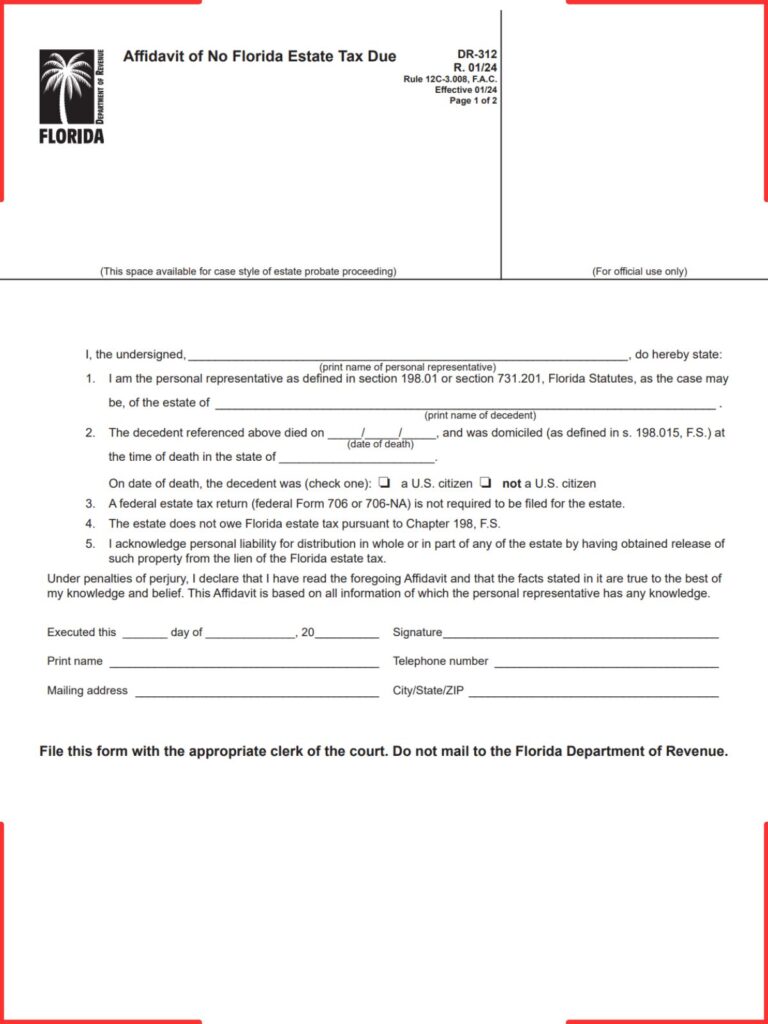
Florida Small Estate Affidavit [Free Printable PDF Template]
If you’ve been searching for a Florida small estate affidavit the way other states use them, Florida uses several small-estate procedures instead, including Disposition Without Administration under §735.301 and, for qualifying intestate estates, §735.304. What Florida calls Disposition Without Administration under F.S. §735.301 is a narrow procedure for obtaining court-authorized payment, transfer, or disposition of qualifying personal property without administration, not a general access tool, The qualifying estate must satisfy the statutory property and expense limits, but §735.301(2) allows an interested party to make the informal application; the statute does not limit filing to the person who paid the funeral or medical expenses.
The distinction matters when an estate contains only a small bank account or other personal property. Under §735.301, the statute does not limit the application to the person who paid the funeral or medical expenses; it permits an interested party to apply, with the court deciding whether the statutory conditions are met. The template and process breakdown below identify which Florida procedure applies to your situation, what the exempt property rules mean for how the estate gets calculated, and when a Petition for Summary Administration is the more practical path forward.
Candice Hayden, Legal Writer
Maria Rosso, Florida Probate, Guardianship and Estate Planning Attorney
Florida Small Estate Affidavit (PDF, Printable, Fillable)
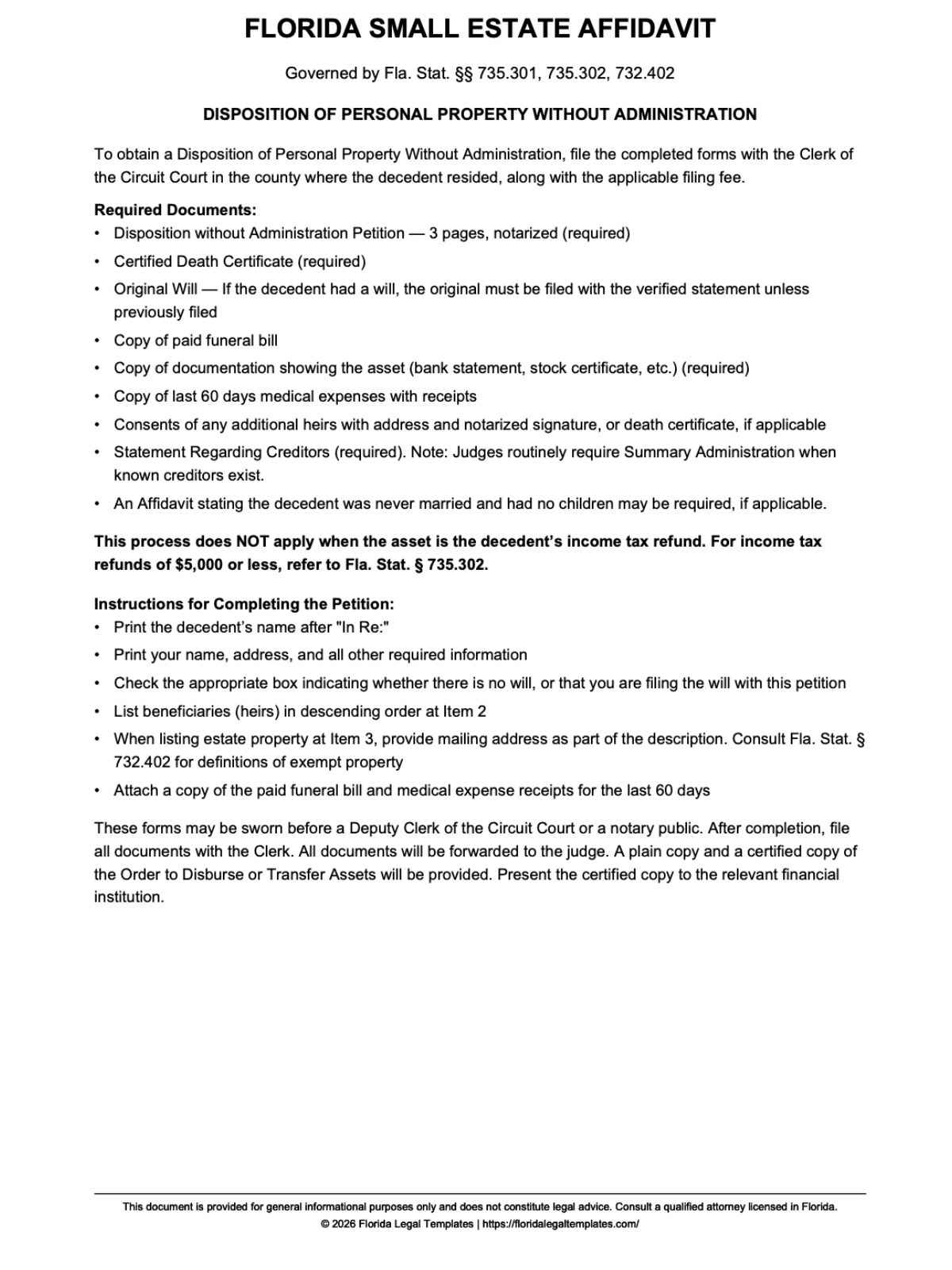
A Florida small estate affidavit form provides a structured format for requesting court-authorized payment, transfer, or disposition of qualifying personal property from a deceased person’s estate.
What the document includes:
- Petitioner identification (person filing the request)
- Decedent details (name, date of death, residence)
- Itemized list of personal property assets
- Exact values (e.g., bank account balances)
- Statement confirming payment of funeral or medical expenses
- Supporting documentation (receipts and proof of payment)
- Sworn affidavit language requiring notarization
Who should use this:
- Interested parties seeking court-authorized payment, transfer, or disposition of qualifying personal property
- Estates with only qualifying personal property
- Situations involving qualifying funeral and last-60-days medical expenses
- Situations where the court must authorize disposition of personal property
Note: If the decedent was domiciled in Florida, qualifying exempt property under Fla. Stat. §732.402 includes household furniture, furnishings, and appliances up to a $20,000 net value and two qualifying motor vehicles; §735.301 separately excludes exempt property from its nonexempt-property limit.
When this template may NOT be sufficient:
- The estate includes real estate (automatically disqualified)
- The total value exceeds allowable limits
- There are creditors beyond funeral/medical expenses
- A probate case has already been opened
- Assets need to be distributed to heirs rather than reimbursed
This is where most users get it wrong. The state of Florida small estate affidavit is not a general estate transfer tool—it is a narrow reimbursement mechanism.
What Is a Florida Small Estate Affidavit?
A Florida small estate affidavit is legally known as a Disposition Without Administration under Florida probate law.
Because Florida treats this as a limited Disposition Without Administration procedure rather than a simple transfer affidavit, families often compare it with other probate-related sworn statements and estate procedures. Readers unfamiliar with Florida probate terminology may also benefit from reviewing broader legal affidavit formats used in Florida courts and situations where an heirship declaration may help establish family relationships during estate administration.
Legal framework:
- Governed by Fla. Stat. § 735.301
Legal nuance:
Florida’s Disposition Without Administration procedure does not give a person automatic authority to collect estate property. Under §735.301, an interested party may make an informal application, and the court may authorize payment, transfer, or disposition of qualifying personal property.
Critical distinction:
- Disposition Without Administration (Fla. Stat. § 735.301)
→ Allows court-authorized payment, transfer, or disposition of qualifying personal property - Summary Administration (Fla. Stat. § 735.201+)
→ Used for qualifying estates with a value subject to administration, less exempt property, of no more than $150,000, or when the decedent has been dead for more than 2 years (effective July 1, 2026) - Formal Administration
→ Full probate process
Key implication:
If an estate does not qualify for §735.301, check the facts before defaulting to Summary Administration: Florida also has the separate intestate-estate procedure in §735.304, while Summary Administration under §735.201 now covers qualifying estates up to $150,000, less exempt property, effective July 1, 2026.
Key Florida Laws That Affect Florida Small Estate Affidavit
Summary of Applicable Laws
| Topic / Issue | Florida Legal Rule | Governing Statute |
|---|---|---|
| Governing Procedure | Disposition Without Administration | Fla. Stat. § 735.301 |
| Max Estate Value | Limited to nonexempt personal property whose value does not exceed the amount of preferred funeral expenses, plus reasonable and necessary medical and hospital expenses from the last 60 days of the last illness; §733.707(1)(b) caps Class 2 funeral, interment, and grave-marker expenses at $6,000. | Fla. Stat. § 735.301(1) |
| Notary Requirement | Must be sworn affidavit or verified petition | Fla. Stat. § 735.301 |
| Asset Restrictions | Personal property only (no real estate) | Fla. Stat. § 735.301(1) |
| Exempt Property | Certain exempt assets excluded from value cap | Fla. Stat. § 732.402 |
The court’s review process depends heavily on documentation accuracy, especially when verifying ownership details, correcting clerical inconsistencies, or validating estate-related records. In situations involving errors in financial or ownership paperwork, a sworn correction statement for inaccurate records may help clarify discrepancies before filing probate-related documents.
Practical Impact & Document Clauses
Florida law sets a narrow eligibility test for Disposition Without Administration. Before filing, check the type of property involved and compare the nonexempt personal property with the funeral and last-60-days medical expenses allowed under §735.301.
The value limitation is the biggest constraint. Under Fla. Stat. § 735.301, the estate must not exceed the amount of funeral and final medical expenses. If the nonexempt personal property exceeds the amount permitted by §735.301, the estate does not qualify for Disposition Without Administration under that section.
Your filing should identify the personal property clearly enough for the court to determine whether §735.301 applies. For a bank account, for example, use the account information and balance shown by the financial institution rather than a rough estimate.
- Exact bank account balances
- Specific property descriptions
- Accurate dollar values
Describe each asset clearly enough for the court to identify the property and its value, especially when the request involves a bank account or other financial asset.
Additionally, If the application relies on funeral or medical expenses, organize the records that support those amounts so the court can evaluate whether the statutory expense requirements are met.
Finally, this process only applies to personal property. Because §735.301 applies to estates leaving only qualifying personal property, an estate that includes real property does not qualify for Disposition Without Administration under that section.
In practical terms:
- Missing receipts → petition denied
- Incorrect asset values → delays or rejection
- Real estate included → forced into probate
- Assets exceeding the §735.301 limit may require another probate procedure, such as §735.304 for a qualifying intestate estate or Summary Administration when its statutory requirements are met.
When to Use Florida Small Estate Affidavit
A Florida small estate affidavit should be used only in very specific situations.
Common use cases:
Use §735.301 when the estate contains only qualifying personal property and the nonexempt property falls within the statutory funeral-and-medical-expense limit. If the estate is intestate and meets the separate conditions in §735.304, including the one-year death requirement, that procedure may also be relevant.
Practical scenarios:
A more useful way to decide is to identify the asset first: a bank account with no POD beneficiary, a small refund, or other personal property may be reachable through a qualifying small-estate procedure, while real estate requires a different probate route
When NOT to use:
- The estate includes real estate
- The estate has significant value
- Multiple creditors exist
- Probate has already started
Choosing the wrong probate procedure can mean additional filings or delay, so confirm the estate’s eligibility before preparing the filing.
How to Create or Fill Out the Florida Small Estate Affidavit
Filling out a small estate affidavit Florida pdf requires accuracy and supporting documentation.
Step-by-step process:
- Identify the petitioner and decedent
- Confirm eligibility under Florida law
- Itemize all personal property assets
- Assign exact values to each asset
- Confirm payment of funeral or medical expenses
- Attach receipts as proof
- Draft the sworn affidavit or verified petition
- Notarize the document
- File with the Clerk of the Circuit Court (county of residence)
- If the court finds §735.301 applicable, it may authorize the payment, transfer, or disposition of the personal property by a letter or other writing under the court’s seal. The exact document and acceptance process may depend on the court and financial institution involved.
Before You File: Check Whether the Asset Has a Payable-on-Death (POD) Beneficiary
One issue that catches families off guard is that the account they are trying to access may never become part of the probate estate at all. Many Florida checking, savings, and credit union accounts are titled with a Payable-on-Death (POD) or Totten Trust designation. When the sole party or last surviving party dies, §655.82 generally provides that funds in an account with a valid pay-on-death designation belong to the surviving beneficiary or beneficiaries rather than the decedent’s estate, even if the balance is small. See Fla. Stat. § 655.82.
That distinction matters because a Disposition Without Administration only reaches assets that actually belong to the probate estate. If a bank confirms a valid POD beneficiary is on file, the court’s reimbursement order under Fla. Stat. § 735.301 typically does not override that contractual designation. The beneficiary generally deals directly with the financial institution, which may require proof of death and other documentation under the account agreement and its procedures.
Before preparing this petition, ask each bank whether the account has a POD or other beneficiary designation. Spending five minutes confirming account ownership can prevent filing for an asset that was never probate property in the first place, and it may save both filing fees and several weeks of unnecessary court processing.
Before filing, many petitioners organize supporting estate records alongside other probate planning documents to avoid delays during court review. If the decedent left estate planning instructions or healthcare directives, reviewing a Florida estate planning document or an existing advance medical directive can help confirm how assets and final affairs were intended to be handled.
Practical tips:
- Verify eligibility before preparing the document
- Use exact dollar amounts—no estimates
- Organize receipts clearly for submission
Give the court enough information to identify the decedent, the property involved, the applicable statutory requirements, and the basis for the requested disposition.
Limitations and Legal Considerations
This is not a general “small estate shortcut.” Section 735.301 applies only when the estate meets its specific personal-property and expense requirements.
Key limitations:
- Cannot include real estate
- Cannot exceed reimbursement threshold
- Cannot bypass creditor priority rules
Florida-specific constraints:
- Must strictly comply with Fla. Stat. § 735.301
- Requires court approval before assets can be collected
High-risk scenarios:
- Treating §735.301 as a general asset-transfer procedure
- Overlooking whether an account passes outside probate
- Failing to account for the statutory treatment of creditors and exempt property
Edge cases:
- Exempt property under Fla. Stat. § 732.402 may be excluded from value limits
- Estates that do not qualify under §735.301 should be checked against other available Florida probate procedures, including §735.304 for qualifying intestate estates and Summary Administration under §735.201.
- Pending probate or litigation blocks eligibility
The Homestead Real Estate Disqualification Trap
A widespread mistake among families handling a deceased relative’s affairs is assuming that because Florida protected homestead property is constitutionally excluded from the claims of general creditors under Art. X, § 4 of the Florida Constitution, the family home does not count as “estate property” when evaluating eligibility for Disposition Without Administration. Families frequently attempt to file a Disposition petition to recover a $3,000 bank account while believing they can address the house separately.
This assumption triggers an immediate statutory rejection by the probate court clerk. Under Fla. Stat. § 735.301(1), Disposition Without Administration applies only when the estate leaves qualifying personal property. If the estate also includes real property, the family should review the appropriate probate procedure for that property, which may include Summary Administration and a proceeding concerning homestead, depending on the circumstances.
When the estate exceeds Florida’s narrow reimbursement limits, families often need a more formal probate or financial authority process instead of relying on Disposition Without Administration. In some cases, reviewing broader financial decision-making authorization documents may help families understand what authority existed before death and whether additional probate proceedings are necessary.
Common Mistakes to Avoid
Assuming all “small estates” qualify
Consequence: Petition denied and process restarted under probate.
Failing to provide receipts
Consequence: Court rejects reimbursement request.
Listing assets vaguely
Consequence: Delays or outright denial.
Attempting to include real estate
Consequence: Immediate disqualification under Florida law.
Before Filing: Three Checks That Prevent the Most Common Problems
Before filing, confirm three things: the property is actually part of the probate estate, the estate meets the statutory requirements for the procedure you are using, and the filing contains enough information for the court to evaluate the request. For a bank account, check whether a POD beneficiary is already designated. For an intestate estate, also check whether §735.304 may apply.f
Frequently Asked Questions (FAQ)
Does Florida allow a small estate affidavit without court involvement?
No. Under Fla. Stat. § 735.301, this is a court-filed process requiring judicial approval.
What is the maximum value allowed for a Florida small estate affidavit?
The estate is limited to the amount of funeral expenses and medical costs from the last 60 days of illness.
Can this be used to transfer real estate?
No. Florida law strictly prohibits using this procedure for real property.
What happens if the estate is too large?
The estate must go through Summary Administration or Formal Administration instead.
A Florida small-estate filing can simplify the handling of qualifying personal property, but the correct procedure depends on the estate’s assets, whether the decedent died intestate, the applicable statutory limits, and whether another probate procedure is required.
Legal Disclaimer: This article provides general information about Florida probate law and is not legal advice. Laws and court procedures may change, and individual circumstances vary. Consider consulting a qualified Florida probate attorney for advice about your specific situation.