
Florida Financial Affidavit [Free Fillable PDF Template]
A Florida financial affidavit is required in many Florida family-law proceedings involving financial relief, but Rule 12.285 contains specific exemptions and a joint waiver procedure; when an affidavit is required, the form generally depends on the party’s gross annual income.
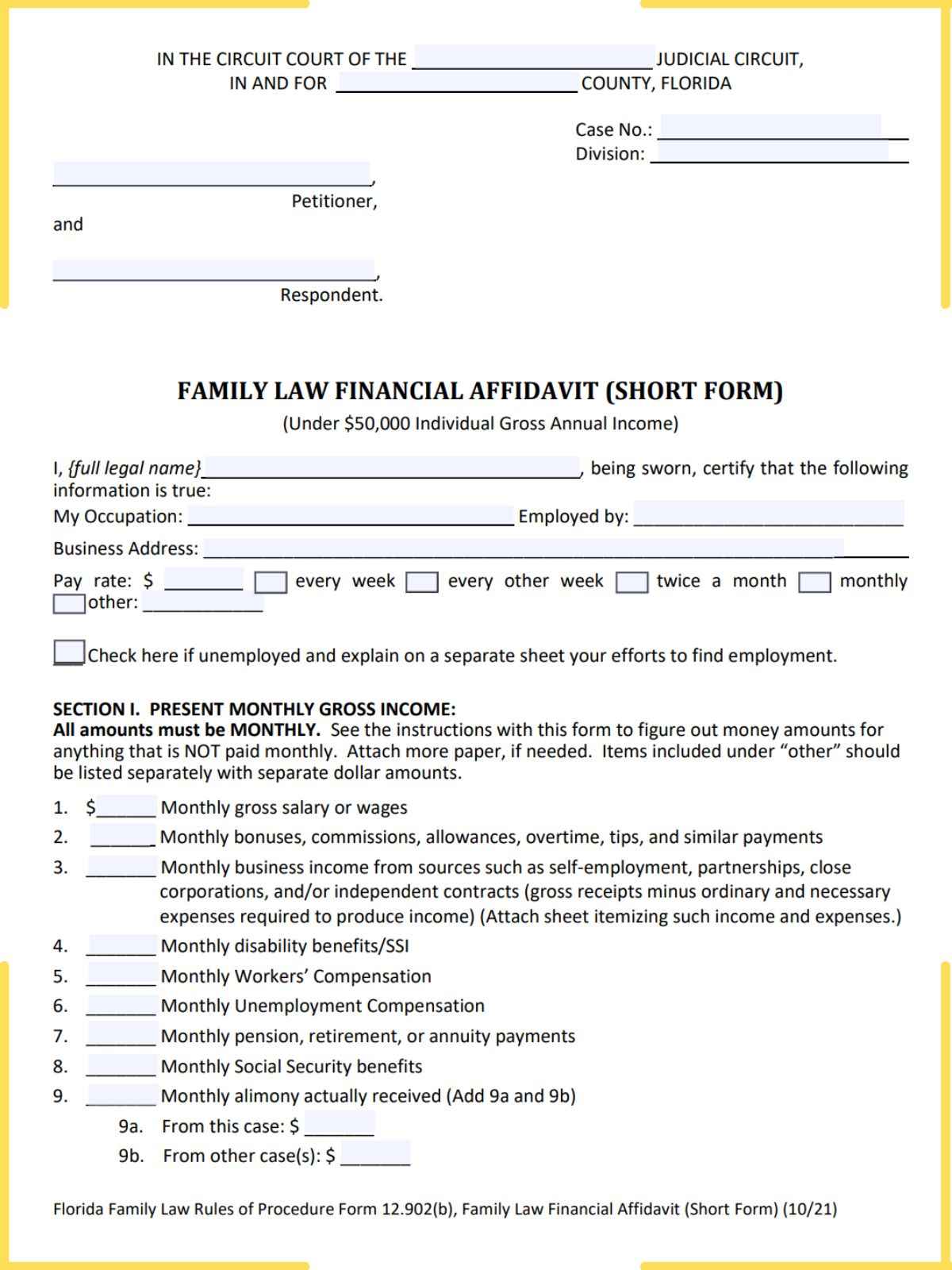
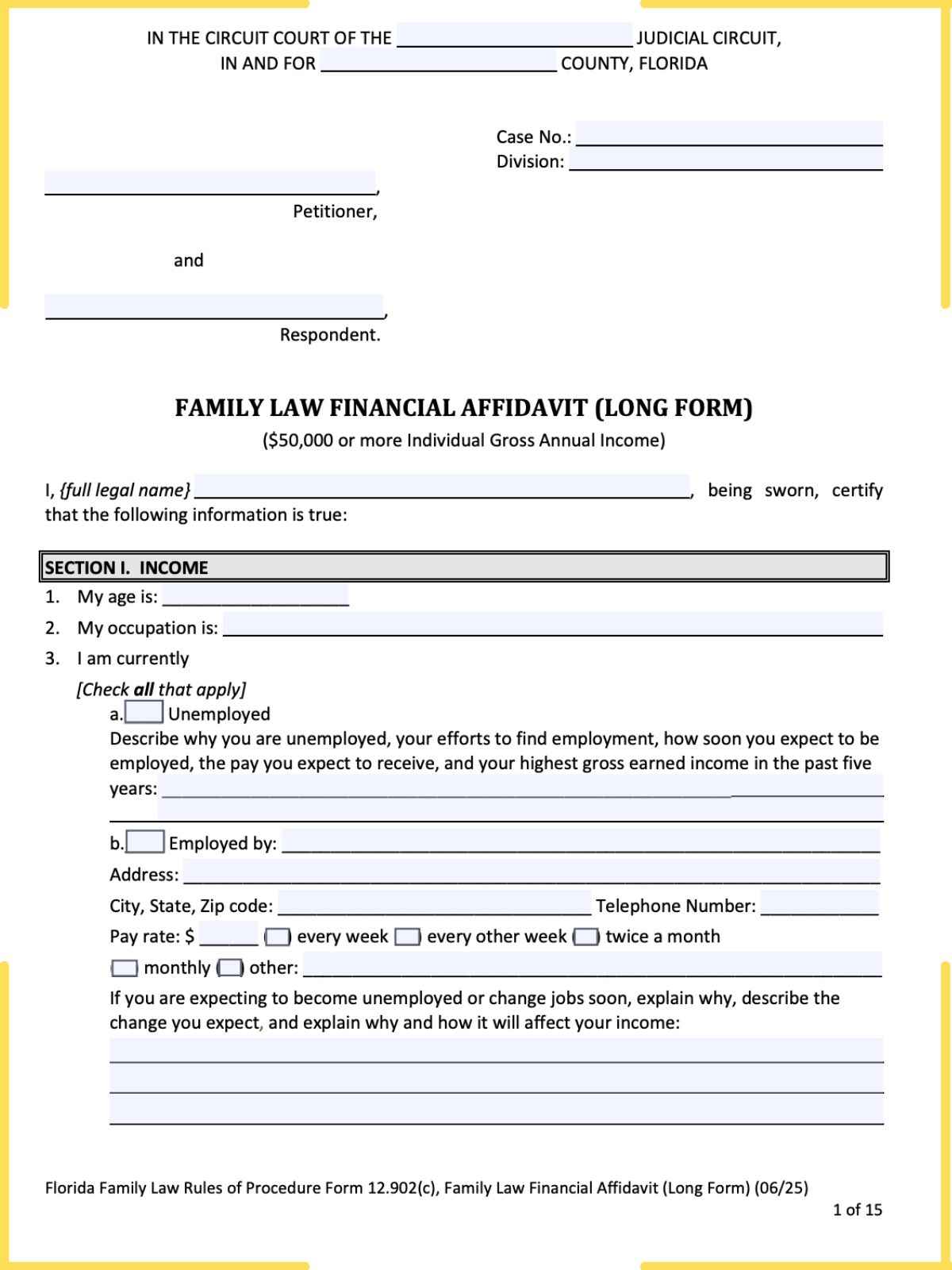
Under Florida Family Law Rules of Procedure, filers earning under $50,000 use the short form 12.902(b) while those earning $50,000 or more use the financial affidavit florida long form 12.902(c), Even when gross annual income is below $50,000, the short form is not necessarily the end of the inquiry: under Rule 12.285(e)(1), a party may request the long form through the Standard Family Law Interrogatories, or the court may order Form 12.902(c) on its own motion. Self-employed filers can also run into problems when the short form does not give the other party or the court enough information to understand how business income is being reported, particularly when the party’s income is below $50,000 but the circumstances support use of the long form.
The forms and instructions below cover both versions, the monthly conversion requirement that trips up most filers, and the situations where the threshold alone won’t decide which form the court expects from you.
Candice Hayden, Legal Writer
Maria Rosso, Florida Probate, Guardianship and Estate Planning Attorney
Florida Financial Affidavit (Long Form & Short Form PDF)
Get PDF
Florida provides two official versions of the financial affidavit Florida form, based on your income level:
- Short Form (Form 12.902(b)) → Income under $50,000
- Long Form (Form 12.902(c)) → Individual gross annual income of $50,000 or more. The applicable financial affidavit requires disclosure of income from the sources identified in the form, with amounts converted to the required monthly figures.
These forms are available as fillable and printable documents used in court proceedings.
Get PDF
What the document includes:
- Income from all sources (salary, business income, rental income, etc.)
- Monthly expenses (housing, utilities, insurance, child-related costs)
- Assets (bank accounts, real estate, vehicles, investments)
- Liabilities (loans, credit cards, obligations)
- Net income and net worth summary
Who should use this:
- Individuals filing for divorce in Florida
- Parties involved in child support or alimony disputes
- Anyone in a family law case involving financial issues
When this template may NOT be sufficient:
- Cases falling within a specific Rule 12.285 exemption, such as a qualifying simplified dissolution or a case in which the court lacks jurisdiction over financial issues
- Situations where the court specifically waives disclosure (very limited)
- Using the wrong form (short vs long form error)
- Simplified Dissolution of Marriage (Rule 12.105). If you meet all the criteria for a simplified divorce and have no support issues, the court may not require an affidavit.
The mistakes that cause the most trouble are usually tied to the Rule 12.285 disclosure requirements. Check the form threshold first, make sure every income source and financial account is reported consistently with the supporting records, and do not treat the expense section as an estimate that can be filled in later.
What Is a Florida Financial Affidavit?
A Florida financial affidavit is the sworn financial disclosure used in Florida family-law proceedings involving financial relief. Rule 12.285 generally requires the applicable 12.902(b) or 12.902(c) form, depending on the party’s gross annual income, while the rule also provides specific exemptions and a joint filing-waiver procedure.
Legal framework:
- Governed by the Florida Family Law Rules of Procedure, Rule 12.285
Legal nuance:
The affidavit is a court-filed financial disclosure in proceedings where Rule 12.285 requires filing, although qualifying parties can use the Rule 12.285(c)(2) procedure to waive filing while still exchanging their sworn affidavits. The financial information can affect issues such as child support, alimony, equitable distribution, and attorney’s fees.
- Child support obligations
- Alimony awards
- Attorney’s fees
What the $50,000 threshold does — and does not — decide:
- Rule 12.285 uses the $50,000 gross-annual-income threshold to identify the presumptive form, but a party below $50,000 can still be ordered to complete Form 12.902(c). The court may order the long form on its own motion, and a party may request it through the Standard Family Law Interrogatories.
Why accuracy matters:
The affidavit feeds into financial issues such as child support, alimony, equitable distribution, and attorney’s fees. Rule 12.285 also requires supporting financial records to be produced, so a number that cannot be reconciled with the underlying records can become a discovery problem.
Because this disclosure becomes part of the official court record, many filers first review other sworn affidavit formats commonly used in Florida proceedings to better understand how verified statements are structured and why accuracy matters in family law litigation.
Key Florida Laws That Affect Florida Financial Affidavit
Summary of Applicable Laws
| Topic / Issue | Florida Legal Rule | Governing Statute |
|---|---|---|
| Mandatory Requirement | Must be filed in most family law cases | Fla. Fam. L. R. P. 12.285(d)-(e) |
| Form Selection | Short vs long form based on $50,000 income | Fla. Fam. L. R. P. 12.285(e)(1) |
| Filing Deadline | For initial or supplemental proceedings, required disclosure documents generally must be served within 45 days of service of the initial pleading on the respondent; temporary financial-relief proceedings have separate deadlines under Rule 12.285 | Fla. Fam. L. R. P. 12.285(e) |
| Execution Requirement | Must be properly verified, either under oath before an authorized officer or by the written declaration permitted by Fla. Stat. § 92.525 | Fla. Stat. § 92.50; Fla. Fam. L. R. P. 12.902 |
| Duty to Amend | Must update if financial situation changes | Fla. Fam. L. R. P. 12.285(f) |
Practical Impact & Document Clauses
Florida law generally treats financial affidavits as mandatory disclosures in proceedings covered by Rule 12.285, although the rule allows qualifying parties to waive filing the affidavits with the court while still exchanging them. Under Fla. Stat. § 92.50, an oath or affidavit may be administered before an authorized judge, clerk, deputy clerk, or notary, subject to the verification methods permitted by law.
Timing is equally strict. Under Fla. Fam. L. R. P. 12.285, the document must be served within 45 days of the initial petition. Missing this deadline can delay proceedings or result in sanctions.
The affidavit must also include a sworn verification clause under Fla. Stat. § 92.525, confirming that all statements are true under penalty of perjury.
In Three practical risks are worth separating:
- Late disclosure can expose a party to Rule 12.380 sanctions
- Knowingly making a false written declaration can constitute third-degree felony perjury under Fla. Stat. § 92.525(3), and inaccurate financial disclosures can also create separate consequences in the family-law proceeding.
- Failing to supplement after a material financial change can leave the court working from outdated information.
Parties have a continuing duty under Rule 12.285(f)(1) to supplement their financial disclosures, including financial affidavits, whenever a material change in their financial status occurs.
Financial affidavits often require supporting records that confirm housing costs, rental obligations, or recurring living expenses disclosed under oath. When a case involves shared housing or rental disputes, reviewing a Florida residential tenancy agreement can help parties document payment responsibilities and monthly obligations more clearly.
When to Use Florida Financial Affidavit
A family law financial affidavit Florida is required in most cases involving financial issues.
Common use cases:
- Divorce proceedings
- Child support determinations
- Alimony disputes
- Attorney fee hearings
Practical scenarios:
- Filing for divorce and disclosing finances
- Responding to a child support request
- Modifying existing support obligations
When NOT to use:
- Non-family law matters
- Informal agreements that are not part of a court proceeding
- A case that falls within a specific Rule 12.285 exemption, such as a qualifying simplified dissolution or a case in which the court lacks jurisdiction to determine financial issues
In a Florida case involving permanent financial relief, the affidavit is only one part of the disclosure package: Rule 12.285 also requires specified tax returns, income records, account statements, and other financial documents, depending on the proceeding.
How to Create or Fill Out the Florida Financial Affidavit
Completing a financial affidavit for divorce Florida requires careful attention to detail.
Step-by-step process:
- Determine whether to use short or long form
- Gather all financial records (income, expenses, assets, debts)
- Accurately list all income sources
- Itemize monthly expenses in detail
- List all assets and liabilities
- Calculate totals and net income
- Include required perjury statement
- Complete and serve the required financial-disclosure documents and file the Certificate of Compliance required by Rule 12.285(j), using the applicable service rules for the documents served. You must also file the Certificate of Compliance required by Rule 12.285(i), Florida Supreme Court Approved Family Law Form 12.932, identifying the documents delivered and certifying the date of service.
- Redact sensitive information (account numbers, SSNs)
- Complete the verification required by the applicable form, either before an authorized officer or by the written declaration permitted by Fla. Stat. § 92.525.
- File with the Clerk of the Circuit Court
- Serve on the opposing party within 45 days
Self-employed individuals and business owners should carefully organize supporting income documentation before filing, especially when income comes from contract work or consulting arrangements. Reviewing an existing independent work arrangement document or professional consulting services agreement may help confirm recurring compensation structures disclosed in the affidavit.
If Your Income Changes Month to Month, Explain the Math
One issue that catches self-employed people, real estate agents, contractors, tipped workers, and commission employees by surprise is that the affidavit asks for monthly income even when earnings are anything but monthly. Rule 12.285 requires complete financial disclosure, but it does not require you to pretend an unusually good or bad month represents your normal finances.
A practical approach is to calculate a reasonable monthly average from recent earnings and keep a worksheet showing how you arrived at the figure, using documents such as tax returns, profit and loss statements, 1099s, or year-to-date pay records. If your income has changed because you started a new job, lost a major client, or your business slowed, note that in the affidavit or an attached explanation instead of leaving the court to guess why the numbers differ from prior tax returns. That small explanation often prevents unnecessary discovery requests and makes it easier for the judge to understand whether the reported income reflects your actual earning capacity or only a temporary fluctuation. If the court later enters temporary support, updated financial information may still be required if your circumstances materially change during the case under Fla. Fam. L. R. P. 12.285(e)(1).
Practical tips:
Compare the affidavit against the records you are required to produce under Rule 12.285. In particular, check the income figures against recent pay records and tax documents, and make sure the monthly figures use the conversion method required by the applicable form.
Limitations and Legal Considerations
The financial-affidavit process is rule-driven, but it is not identical in every family-law case. Rule 12.285 contains exemptions, permits a qualifying joint waiver of filing, and uses different disclosure requirements for temporary and permanent financial relief.
Key limitations:
- Child-support proceedings have additional affidavit requirements under Fla. Stat. § 61.30(14), although Rule 12.285 permits the filing of financial affidavits to be waived in qualifying cases while the affidavits themselves are still exchanged
- Must reflect complete and accurate financial information
Florida-specific constraints:
Rule 12.285 controls the mandatory financial disclosure process, while Fla. Stat. § 92.525 governs verification and provides that a person who knowingly makes a false written declaration under subsection (2) commits a third-degree felony.
High-risk scenarios:
Rule 12.285 does not stop at the affidavit itself. In a permanent-financial-relief proceeding, the required disclosure can extend to tax returns, income records, account statements, loan records, and documents supporting claims about assets or liabilities, depending on the case.
Edge cases:
- Self-employed individuals with fluctuating income
- Commission-based or seasonal earnings
- Changes in financial circumstances during litigation
Failure to comply can result in sanctions under Rule 12.380, evidentiary consequences, and other remedies depending on the circumstances of the case.
The Joint Verified Waiver of Filing Trap (Rule 12.285(c)(2))
A common misconception among divorcing spouses seeking privacy is that “waiving” the financial affidavit means they do not have to fill one out. Under Fla. Fam. L. R. P. 12.285(c)(2), parties can execute a Notice of Joint Verified Waiver of Filing Financial Affidavits (Form 12.902(k)) to keep their detailed financial information out of the public court record.
However, this is a waiver of filing, not a waiver of preparation and exchange. To legally utilize Form 12.902(k), both parties must still fully execute, swear to, and privately exchange their respective financial affidavits (Form 12.902(b) or 12.902(c)). Furthermore, If child support is at issue and the parties use the Rule 12.285(c)(2) filing waiver, Form 12.902(l), Affidavit of Income for Child Support, is used for the income information that must still be filed with the court under Fla. Stat. § 61.30(14). Failing to make the required financial disclosures can create serious litigation risk, including potential relief from a judgment in appropriate circumstances under Rule 12.540; the consequences depend on the facts and the basis for the requested relief.
Cases involving incomplete disclosures, disputed ownership interests, or complex financial transfers may require additional sworn documentation beyond the affidavit itself. In situations where financial records contain clerical mistakes or inaccurate account information, a corrective sworn statement for document errors can sometimes help resolve inconsistencies before court review.
Common Mistakes to Avoid
Using the wrong form
Consequence: Using the wrong form can create a disclosure problem, particularly because Rule 12.285 allows the court to require Form 12.902(c) even when the party’s gross annual income is below $50,000.
Underreporting income or assets
Consequence: A knowingly false or fraudulent financial affidavit can create serious litigation consequences, and Rule 12.540 provides a mechanism for seeking relief from a judgment in cases involving fraudulent financial affidavits.
Missing the 45-day deadline
Consequence: Sanctions or case delays.
Failing to include Certificate of Service
Consequence: Filing may be considered incomplete.
Not updating the affidavit
Consequence: Inaccurate rulings and potential penalties.
Frequently Asked Questions (FAQ)
Can a Florida financial affidavit be waived in a divorce case?
The requirement to file the affidavit with the court can be waived under Fla. Fam. L. R. P. 12.285(c)(2) by filing Form 12.902(k), provided both parties privately exchange fully executed affidavits. However, the obligation to prepare and exchange the affidavit cannot be waived unless the case is a simplified dissolution or involves no minor children, no support issues, and a written settlement agreement. If child support is requested, Form 12.902(l) must still be filed.
What happens if I lie on a financial affidavit in Florida?
A knowingly false written declaration can constitute third-degree felony perjury under Fla. Stat. § 92.525(3), with punishment governed by the statutes cited in that subsection.
Do I need to update my financial affidavit during the case?
Yes. Under Florida law, you have a continuing duty to amend the affidavit if your financial situation changes.
Which form should I use for a Florida financial affidavit?
Use the short form if your income is under $50,000 and the long form if it is $50,000 or more, as required by Rule 12.285.
A properly completed Florida financial affidavit gives the court and the other party the financial information required under Rule 12.285. Before serving it, check the applicable form, reconcile the figures with your supporting records, and make sure any required disclosure documents and the Certificate of Compliance are handled on time.
Legal Disclaimer: This article provides general information about Florida financial affidavits and is not legal advice. Florida family-law requirements can depend on the facts of the case, the relief requested, and applicable court rules or orders. Consider consulting a Florida family-law attorney about your specific situation.