
Florida Affidavit of Residency (Free Printable PDF Template)
A Florida affidavit of residency is the sworn component of a residency verification — it’s not the entire process, and treating it like a standalone document is exactly why people show up at the DMV or a school district office with a notarized form and still get turned away.
Each agency that accepts an affidavit of residency florida has its own list of supporting documents that must accompany it, and the affidavit without that documentation doesn’t satisfy the requirement on its own regardless of how carefully it was prepared or who notarized it. A common problem is getting the affidavit itself right but missing the agency’s separate address-document requirement. A school, DMV office, or other organization may still ask for a lease, utility bill, or another document showing the same residence. The template below includes the affidavit language Florida agencies expect under F.S. §92.525, along with a breakdown of what each major agency typically requires as supporting documentation so the affidavit does what you actually need it to do.
Candice Hayden, Legal Writer
Maria Rosso, Florida Probate, Guardianship and Estate Planning Attorney
Florida Affidavit of Residency (PDF, Printable, Fillable)
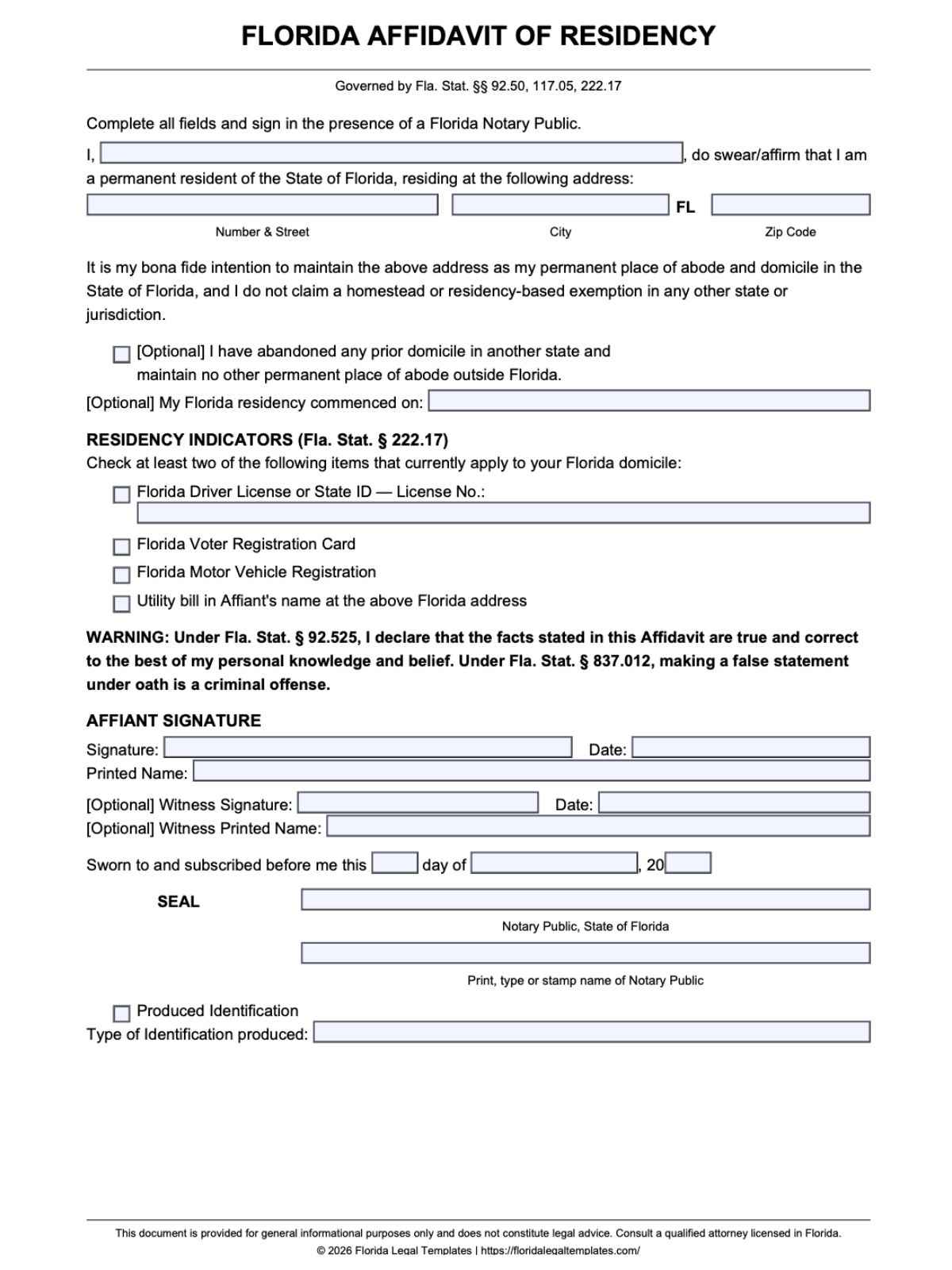
A standard affidavit of residency Florida template gives the affiant a structured place to identify the residence and make the required sworn or statutory declaration. Whether that document is enough depends on what the receiving Florida agency requires.
What the document includes:
- Affiant identification (full legal name and address)
- Statement confirming residency
- Supporting details (how long you’ve lived there, nature of residence)
- Oath or affirmation clause
- Signature block
- Notary jurat section (if notarized)
Who should use this:
- Individuals proving residency for:
- School enrollment
- DMV or driver’s license applications
- Employment verification
- Banking or insurance purposes
When this template may NOT be sufficient:
- Establishing or documenting Florida domicile when a formal domicile declaration is appropriate
- Claiming a Florida homestead exemption
- Resolving multi-state tax residency issues
A key limitation:
Florida does not use one universal statutory form called an ‘affidavit of residency.’ The execution requirements depend on the document’s purpose. Chapter 117 governs Florida notarizations, while § 92.525 provides a statutory verification method when a document is authorized or required to be verified.
What Is an Affidavit of Residency in Florida?
A Florida affidavit of residency is a statement used to confirm where a person lives. The execution requirements depend on how the document is being used, including whether the recipient requires a sworn affidavit, a statutory verification, or its own form.
Legal framework:
- Florida Statutes Chapter 92 (sworn declarations)
- Florida Statutes Chapter 117 (notaries public)
Legal nuance
Florida recognizes two related—but very different—documents:
1. Affidavit of Residency
- Used for administrative purposes
- Confirms current address
- A generic residency affidavit does not have the filing-and-recording procedure prescribed for a Declaration of Domicile under § 222.17.
2. Declaration of Domicile
- Used to manifest and evidence Florida domicile and an intent to maintain a Florida home as a permanent home
- A Declaration of Domicile under § 222.17 is a sworn statement filed with the circuit-court clerk to manifest and evidence Florida domicile; the statute also preserves other methods of proving domicile.
Because Florida recognizes several different affidavit formats depending on the legal purpose, readers who are unsure whether they need a residency affidavit or another sworn declaration may also want to review a broader guide to Florida affidavit formats and sworn statement requirements. In situations involving inherited property or estate matters, a family relationship affidavit used in probate-related transfers may be more appropriate than a residency-based declaration.
Key implication
The distinction matters because the two documents serve different purposes. A residency affidavit can describe where you live, while a Declaration of Domicile is a separate statutory filing used to manifest and evidence Florida domicile under Fla. Stat. § 222.17.
Key Florida Laws That Affect Florida Affidavit of Residency
Summary of Applicable Laws
| Topic / Issue | Florida Legal Rule | Governing Statute |
|---|---|---|
| Notary Requirement (Jurat) | Must be sworn before notary | Fla. Stat. § 117.05(13) |
| Alternative Declaration | Allowed with perjury wording | Fla. Stat. § 92.525(1)(b) |
| Identity Verification | Notary must verify ID | Fla. Stat. § 117.05(5) |
| Declaration of Domicile | Must declare permanent residence intent | Fla. Stat. § 222.17(2) |
| Recording Requirement | Must be recorded if domicile declaration | Fla. Stat. § 222.17(1) |
Practical Impact & Document Clauses
Florida law strictly controls how a state of Florida affidavit form must be executed. When a residency statement is notarized, Florida’s notary law governs the jurat or other notarial certificate; however, when verification is authorized or required, Fla. Stat. § 92.525 also permits the statutory written-declaration method instead of an oath before a notary. A simple acknowledgment is not a substitute for a jurat when the document must be executed as a sworn statement.
Florida also allows an alternative under Fla. Stat. § 92.525 when a document is authorized or required by law, agency rule, or court rule or order to be verified. In that situation, the verification may be made by a written declaration containing the statutory perjury language:
“Under penalties of perjury, I declare that I have read the foregoing document and that the facts stated in it are true.”
For those establishing permanent residency, the rules change significantly. Under Fla. Stat. § 222.17, a Declaration of Domicile is a sworn statement filed with the clerk of the circuit court that includes the statutory statements concerning the person’s Florida residence and intent to maintain it as a permanent home; the clerk records the declaration after filing.
The practical problem is that an improperly executed document may not satisfy the requirement for which it was prepared:
- Incomplete Notary Block → Document rejected. In 2026, Florida’s current notary statute requires the notarial certificate to state whether the signer appeared by physical presence or authorized online notarization. A missing or defective certificate can create a notarization problem, so the notary should complete the certificate in accordance with § 117.05.
- Missing required oath, affirmation, or statutory verification → execution may not satisfy the receiving agency’s requirements
- False statements → criminal penalties
- Misuse for tax benefits → exposure to homestead fraud penalties
When to Use Florida Affidavit of Residency
Use a Florida affidavit of residency when the receiving person or organization wants a formal statement about where you live and accepts that form of verification. Before signing, check whether the agency requires its own form or supporting address documents.
Common use cases:
- Providing proof of residency to institutions
- Supporting administrative applications
- Verifying address when standard documents are unavailable
Practical scenarios:
For DMV use, do not assume a generic affidavit will satisfy FLHSMV. When the applicant lacks the required address documents in their own name, FLHSMV provides Form HSMV 71120, Certification of Address, for use with qualifying documents from the person whose address the applicant shares
Living With Family? A Notarized Affidavit Alone Usually Won’t Get You a Florida Driver License
One situation catches new Florida residents off guard. If you live with a parent, relative, or friend and none of the required residency documents are in your name, a standard affidavit of residency is usually not enough for a Florida driver license or ID application.
The Florida Department of Highway Safety and Motor Vehicles (FLHSMV) generally requires the person you live with to complete the agency’s Certification of Address form, while also presenting qualifying proof of their own Florida address. You must still provide acceptable identification documents, and the address listed on your application must match the address certified by the person with whom you reside. Agency procedures may also require both individuals to appear together at the licensing office. (Florida DHSMV Certification of Address procedure).
This is different from using a generic affidavit downloaded online. A notarized affidavit may satisfy a school, employer, or private institution, but DHSMV staff follow their own document checklist and can refuse an application that does not comply with the department’s residency verification process. Before your appointment, confirm whether your situation requires the Certification of Address instead of, or in addition to, a general residency affidavit.
- Confirming address for employment
- Opening bank or insurance accounts
When NOT to use:
- Establishing permanent legal residency
- Claiming homestead tax exemptions
- Avoiding out-of-state tax obligations
For homestead exemptions, the property appraiser determines permanent residency based on the applicable statutory factors.
One of the most common supporting documents requested alongside a residency affidavit is a housing agreement showing where the individual actually lives. For tenants, providing a Florida residential lease agreement used for proof of occupancy can strengthen residency verification and reduce the risk of rejection by schools, DMV offices, or financial institutions.
How to Create or Fill Out the Florida Affidavit of Residency
Start by identifying the purpose of the affidavit, because the execution method can change depending on who will receive it. If the document is notarized, the notarial certificate should comply with Fla. Stat. § 117.05; if § 92.525 applies, the statutory written-declaration method may be available instead.
Step-by-step process:
- Identify the affiant
- Include full legal name
- State your residential address
- Provide complete and accurate details
- Describe residency duration
- Include how long you have lived at the address
Note: If you are establishing residency to obtain a Florida Driver’s License, be aware that under Fla. Stat. § 322.031, certain nonresidents who accept employment or enter their children in Florida public schools must obtain a Florida driver license within 30 days after beginning that employment or education if they operate a motor vehicle on Florida highways.
- Include supporting facts
- Example: lease, family residence, or living arrangement
- (If applicable) declare intent to remain
- Required for domicile-related use
- Choose execution method
- Notarized affidavit OR unsworn declaration
- If the document is being verified under Fla. Stat. § 92.525 without an oath before a notary, use the statutory written-declaration language::
- “Under penalties of perjury, I declare that I have read the foregoing document and that the facts stated in it are true.”
- Add signature block
- Complete notary jurat (if notarized)
- Must include “Sworn to or affirmed…” language
- Verify identity
- Present valid government-issued ID
- Sign in presence of notary
If the affiant lives with roommates or under an informal shared housing arrangement, additional occupancy documentation may help verify the address listed in the affidavit. In those situations, a shared living arrangement agreement or a private room rental document can provide useful supporting evidence when standard utility bills or leases are unavailable.
Practical tips:
- Be precise about your address and timeline
- Avoid vague or general statements
- Always match the format to your intended use
Limitations and Legal Considerations
A proof of residency affidavit Florida is not the same document as the Declaration of Domicile described in Fla. Stat. § 222.17. The two serve different purposes, and the receiving agency or legal proceeding determines what supporting documentation is needed.
Key limitations:
A residency affidavit verifies facts about where someone lives; it does not by itself establish Florida domicile or guarantee acceptance by a particular agency. The receiving agency may require its own form or supporting documents.
Florida-specific constraints:
The execution method depends on the document’s purpose. A notarized statement is governed by Florida’s notary requirements, while § 92.525 provides a written-declaration method when verification is authorized or required. A Declaration of Domicile follows the separate filing and recording procedure in § 222.17.
High-risk scenarios:
- Using affidavit instead of Declaration of Domicile
- Missing required jurat
- Providing inaccurate residency information
Edge cases:
- Multi-state residency conflicts
- Tax residency disputes
- Remote notarization requirements
The practical consequence is usually straightforward: the receiving agency may reject the document or ask for additional proof if the affidavit does not match its required form or supporting records.
The FLHSMV Form HSMV 71120 Trap
For a Florida Class E driver license or ID card, FLHSMV requires proof of residential address. If an applicant cannot provide two approved address documents in the applicant’s own name, the department’s HSMV 71120 Certification of Address may be used with qualifying documents from the person whose address the applicant shares. Instead, you must use Form HSMV 71120 (Certification of Address), signed by the certifier, together with the qualifying residential-address documentation required by FLHSMV.
A generic residency affidavit may not satisfy FLHSMV’s residential-address documentation requirements when the applicant needs to use another person’s address documents.
A residency affidavit should not be confused with financial disclosure affidavits used in court proceedings or support-related matters. Readers dealing with income disclosure, divorce filings, or sworn financial reporting should instead review the Florida financial affidavit requirements and template guide, which serves a very different legal purpose under Florida procedure rules.
Common Mistakes to Avoid
Confusing affidavit with declaration of domicile
Consequence: Loss of tax benefits or rejection of residency claim.
Missing required jurat language
Consequence: The document may not satisfy the receiving agency’s requirements if a sworn statement or other required verification was not properly completed.
Not using perjury wording (for unsworn declaration)
Consequence: Document is unenforceable.
Signing without notary present
Consequence: Notarization is invalid.
Providing false residency information
Consequence: Criminal liability. Under Fla. Stat. § 92.525(3), knowingly making a false declaration under subsection (2) is perjury by false written declaration, a third-degree felony. The applicable felony penalties are provided through §§ 775.082-.084.
Misusing document for homestead exemption
Consequence: Knowingly and willfully giving false information to claim a homestead exemption is a first-degree misdemeanor under Fla. Stat. § 196.131(2), punishable under § 775.082 or by a fine of up to $5,000, or both.
Frequently Asked Questions (FAQ)
Do I need a notarized affidavit of residency in Florida?
It depends on why the affidavit is being used and what the receiving agency or proceeding requires. If the document must be verified, Fla. Stat. § 92.525 permits a written-declaration method when verification is authorized or required; otherwise, a sworn affidavit may require an oath or affirmation before an authorized officer.
What is the difference between an affidavit of residency and a declaration of domicile in Florida?
An affidavit proves your current address, while a Declaration of Domicile establishes permanent legal residency and must be recorded under Fla. Stat. § 222.17.
Can I use an affidavit of residency to claim Florida homestead exemption?
No. A Declaration of Domicile is not universally required for a Florida homestead exemption; under Fla. Stat. § 196.015, a recorded declaration is one of several factors the property appraiser may consider when determining permanent residency.
Does a Florida affidavit of residency need to be recorded?
A generic residency affidavit does not have the filing-and-recording procedure prescribed for a Declaration of Domicile under § 222.17. Whether another document is filed or recorded depends on its legal purpose and the requirements of the receiving agency
People attempting to establish permanent Florida residency sometimes assume an affidavit alone is enough for tax or estate-related purposes. In addition to a Declaration of Domicile, other estate-planning documents such as a Florida last will and testament may also become important when proving long-term residency intent and legal ties to the state.
A properly prepared Florida affidavit of residency can document where you live, but the receiving agency still controls what it will accept. For DMV matters, compare your situation with FLHSMV’s current residential-address requirements before relying on a generic affidavit.
Legal Disclaimer: This information is for general informational purposes only and is not legal advice. Requirements for affidavits and proof of residency may vary by agency and individual circumstances. Consider consulting a Florida attorney for advice about your specific situation.