
Florida Health Care Surrogate Form (Free PDF & Printable)
A Florida health care surrogate designation is the document that gives gives someone you trust authority to make health care decisions on your behalf when the designation is properly executed and its authority becomes effective under Florida law. Under F.S. §765.202 the designation requires two witnesses and at least one of them cannot be a spouse or blood relative, which means a document signed with two witnesses who are both the principal’s blood relatives does not satisfy Florida’s statutory witness requirement, even if the document clearly states the principal’s wishes.
I’ve watched families discover this during a hospitalization when the document they brought was rejected because both witnesses were the patient’s adult children leaving the designated surrogate without legal authority at exactly the wrong moment. The florida health care surrogate form and breakdown below cover the witness requirements, the practical step of making sure your health care providers and surrogate have current copies, and why both matter as much as the document itself.
Candice Hayden, Legal Writer
Maria Rosso, Florida Probate, Guardianship and Estate Planning Attorney
Free Florida Health Care Surrogate Form (PDF & Printable)
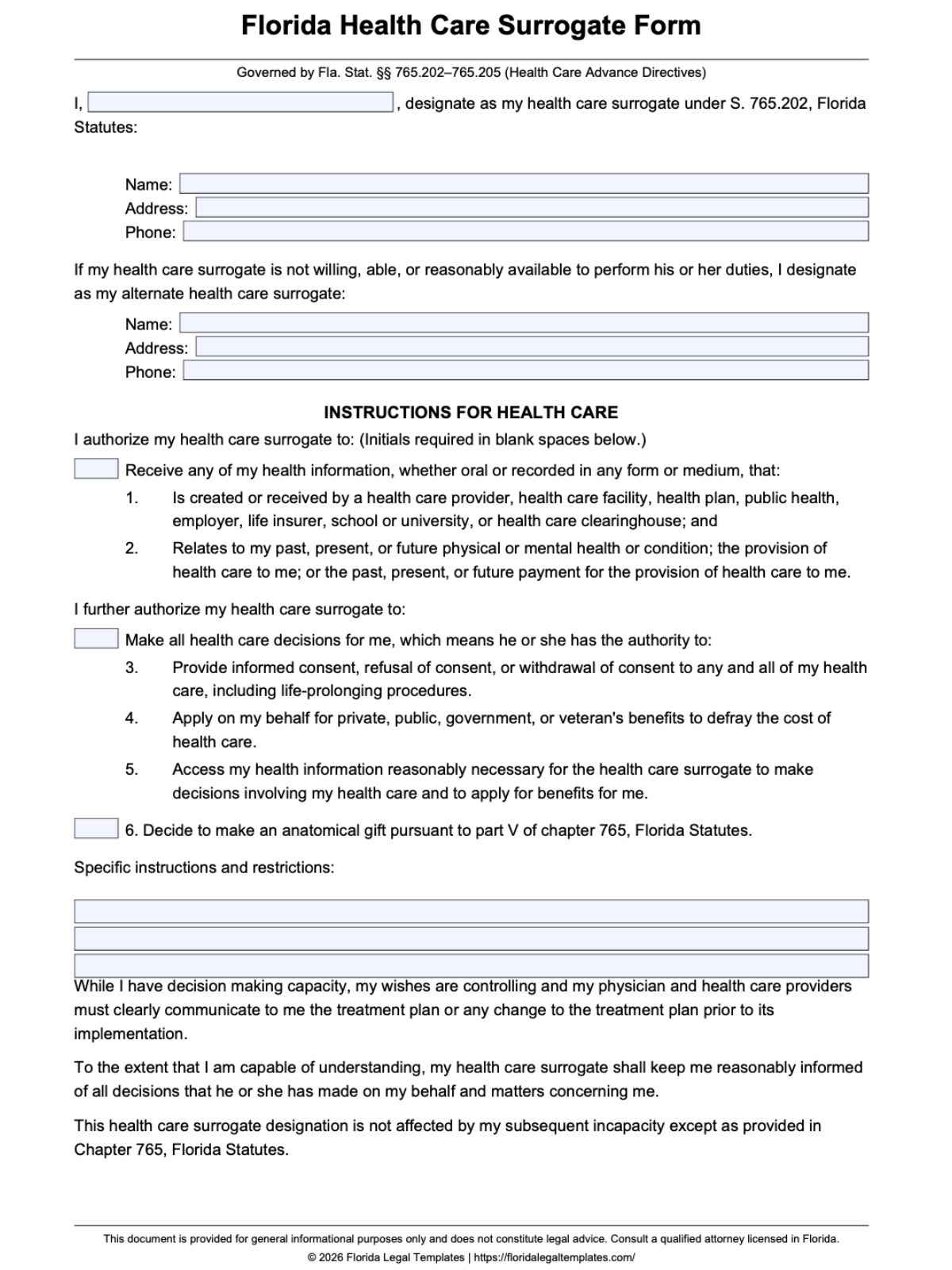
A standard Florida health care surrogate form typically includes:
- Appointment of a primary surrogate
- Appointment of an alternate surrogate
- Authority to make healthcare decisions
- HIPAA medical records authorization
- Life-prolonging procedure instructions
- Witness signatures
If you are looking for a Florida health care surrogate form PDF, the practical goal is usually a document you can print, complete, and execute under Florida’s two-witness rule in Fla. Stat. § 765.202. A properly prepared designation can generally be executed without court involvement or a state filing, provided it satisfies Florida’s execution requirements.
This type of document is commonly used by:
- Seniors planning for future incapacity
- Adults undergoing surgery
- Individuals with chronic medical conditions
- Parents coordinating emergency healthcare planning
- People creating broader estate planning documents
However, a free health care surrogate form Florida template may not always be sufficient for complex situations. For example, additional drafting may be needed if:
- Family members disagree about treatment decisions
- Multiple children are involved in caregiving
- The principal wants expanded mental health authority
- Religious treatment restrictions apply
- The surrogate lives out of state
Under Florida law, notarization is optional. The document’s validity primarily depends on proper witnessing requirements rather than notarization formalities.
What Is a Florida Health Care Surrogate?
A Florida health care surrogate is a person authorized to make healthcare decisions for another individual, known as the principal, when the principal cannot make or communicate decisions independently.
Pursuant to Florida’s advance directive laws, the surrogate’s authority may include:
- Consenting to medical treatment
- Refusing medical procedures
- Accessing protected health information
- Coordinating hospital care
- Applying for healthcare benefits
- Making end-of-life treatment decisions
The document itself is formally called a “Designation of Health Care Surrogate.”
A healthcare surrogate Florida designation differs from several related legal documents:
- A living will focuses primarily on end-of-life treatment preferences.
- A durable power of attorney addresses financial and legal authority.
- Guardianship involves court supervision and judicial oversight.
- A health care surrogate designation generally operates without routine court involvement, although Florida law allows judicial intervention in certain disputes.
Florida law also allows the principal to decide when the surrogate’s authority begins. Some forms become effective only after incapacity is medically determined, while others grant immediate authority for healthcare communication purposes.
Even after signing the document, the principal remains fully in control while mentally competent. Under Florida law, a competent principal’s decisions override any conflicting decisions made by the surrogate.
A health care surrogate is often prepared alongside other advance planning documents. Readers who want broader control over end-of-life instructions may also benefit from reviewing a Florida living will form, while those handling financial matters during incapacity should understand how a general power of attorney in Florida works separately from medical decision-making authority.
Key Florida Laws That Affect This Document
| Topic / Issue | Florida Legal Rule | Governing Statute |
|---|---|---|
| Execution Formalities | Must be signed before two adult witnesses | § 765.202(1) |
| Witness Restrictions | Surrogate cannot serve as witness; one witness must be non-relative | § 765.202(2) |
| Notary Requirement | Notarization is optional under Florida law | § 765.202 |
| Effective Date Selection | Authority may be immediate or springing | § 765.202(6) & § 765.204 |
| Principal Control | Competent principal’s wishes override surrogate authority | § 765.203 & § 765.204(3) |
| Divorce Revocation | Spousal designation automatically revoked upon the execution of a final judgment of dissolution or annulment, unless explicitly stated otherwise in the document or court order. | § 765.104(2) |
| Restricted Medical Acts | Certain procedures require explicit authorization | § 765.113 |
| Proxy Fallback Rule | Florida may appoint a statutory proxy if designation fails | § 765.401 |
Florida’s healthcare surrogate laws are contained within Chapter 765 of the Florida Statutes. The governing framework for surrogate designations appears in Part II of the Health Care Advance Directives law. See Fla. Stat. Chapter 765.
The witness rules create one of the most common validity problems. Under Fla. Stat. § 765.202, the surrogate cannot act as a witness, and at least one witness must not be a spouse or blood relative. A document signed incorrectly may become unusable during a medical emergency.
Florida law also places operational limits on surrogate authority. Certain sensitive medical procedures cannot be authorized unless the document specifically grants heightened authority. Additionally, if no valid surrogate exists, Florida may rely on the statutory healthcare proxy hierarchy under Fla. Stat. § 765.401, which can remove flexibility from family decision-making.
Who Should Be Named as a Health Care Surrogate?
A health care surrogate should be someone capable of handling stressful medical situations calmly and responsibly.
Strong surrogate candidates typically:
- Understand the principal’s medical preferences
- Can communicate clearly with doctors
- Are available during emergencies
- Can manage family disagreements
- Are emotionally reliable under pressure
Many principals appoint:
- A spouse
- Adult child
- Close relative
- Long-term partner
- Trusted friend
Naming an alternate surrogate is equally important. If the primary surrogate becomes unavailable, the alternate can immediately assume authority without court involvement.
Practical family dynamics also matter. A technically qualified person may still create problems if they have ongoing conflicts with siblings or other caregivers. Medical disputes often escalate quickly during emergencies, especially when treatment decisions involve life support or end-of-life care.
When to Use Florida Health Care Surrogate Form
A Florida medical surrogate designation is commonly used in situations involving potential incapacity or emergency healthcare decisions.
Common scenarios include:
- Planned surgery
- Serious illness diagnosis
- Long-term hospitalization
- Dementia or cognitive decline planning
- Emergency preparedness
- Travel-related planning
This document is frequently paired with:
- A living will
- HIPAA authorization forms
- Durable financial powers of attorney
- Broader estate planning documents
However, there are situations where a healthcare surrogate alone may not fully address legal needs.
For example:
- Financial authority requires a separate power of attorney
- Guardianship disputes may still require court involvement
- Minor child healthcare authority follows separate statutory rules
- Expanded mental health treatment authority may require specialized drafting
Many Florida residents create a healthcare surrogate designation as part of a larger estate planning strategy. Individuals organizing long-term family planning may also consider preparing a document for distributing property after death so healthcare wishes and estate instructions remain coordinated during emergencies or incapacity situations.
How to Fill Out the Florida Health Care Surrogate Form
Choose the Primary and Alternate Surrogate
Select someone trustworthy who understands your healthcare values and can communicate effectively with physicians.
Many people also designate at least one backup surrogate in case the primary agent cannot serve.
Decide When Authority Begins
Florida law allows two common options:
- Immediate authority
- Springing authority after incapacity determination
Immediate authority can help surrogates communicate with doctors before incapacity occurs. Springing authority provides additional privacy and control until medical incapacity is formally determined.
Add Medical Instructions and Limitations
The form may include instructions regarding:
- Life-prolonging procedures
- Religious treatment preferences
- Artificial nutrition and hydration
- Organ donation coordination
Specific instructions can reduce family disputes during emergencies.
Include HIPAA Authorization Language
Florida’s statutory form separates authority to receive health information from authority to make health care decisions, so check the authorization language carefully if you want your surrogate to access medical records while you remain competent.
The form should contain language substantially similar to:
“I authorize my health care surrogate to receive any of my health information… reasonably necessary to make decisions involving my health care and to apply for benefits for me.”
Without proper authorization language, hospitals may limit access to records and medical discussions.
Sign the Form Properly
Under Florida law, the principal must sign the document before two adult witnesses. Neither the primary nor the alternate surrogate can serve as a witness. Additionally, under Fla. Stat. § 765.202(2), at least one of the two required witnesses must be an independent, non-related legal stranger (not a spouse or blood relative).
Notarization is optional and does not replace witness requirements.
Distribute Copies Properly
Florida does not maintain a centralized registry for healthcare surrogate documents.
Executed copies should be provided directly to:
- Primary physicians
- Specialists
- Hospitals
- Surrogates
- Close family members
A properly executed form may still be ineffective if medical providers cannot access it during an emergency.
Your Surrogate Cannot Help if the Hospital Cannot Find Them
A signed designation is only half the job because Florida law considers whether a designated surrogate is ‘reasonably available,’ keeping the surrogate’s current contact information readily accessible can help avoid problems during an emergency. If your surrogate’s phone number is outdated, they are travelling, or staff cannot reach them quickly, treatment decisions may instead move to Florida’s statutory proxy process under Fla. Stat. § 765.401 while attempts to locate your surrogate continue.
A simple way to avoid this problem is to treat the document like an emergency contact record instead of a file you sign once and forget. Each time you change doctors, move, or your surrogate changes their telephone number or email address, update every copy held by:
- Your primary care physician
- Any specialists treating an ongoing condition
- The primary and alternate surrogate
- The hospital system where you most often receive care
Many experienced estate planning attorneys also recommend carrying a wallet card stating that you have a Designation of Health Care Surrogate, identifying your surrogate by name, and listing a current telephone number. Florida does not maintain a statewide registry for these documents, so medical providers generally rely on the copies and contact information available at the time of the emergency. Keeping those details current can prevent unnecessary delays and reduce the chance that providers must fall back on the statutory proxy hierarchy.
Immediate vs. Springing Health Care Surrogate Authority
A major drafting decision involves determining when the surrogate’s authority becomes active.
Immediate authority allows the surrogate to communicate with providers immediately after execution. However, to review protected health records while you are still competent, you must explicitly initial the statutory disclosure authorization block under Fla. Stat. § 765.203.
This option may help with:
- Ongoing medical coordination
- Elder care assistance
- Insurance issues
- Long-term treatment planning
Springing authority activates only after a physician determines the principal lacks decision-making capacity. This approach preserves greater personal privacy while the principal remains competent.
Under Florida law, either structure can be valid if drafted clearly.
Before signing the form, many principals review related healthcare authorization documents to avoid gaps in authority. For example, a Florida medical decision-making authorization form can help readers better understand how medical authority is structured and when additional healthcare instructions may be appropriate.
Limitations and Legal Considerations
A Florida health care surrogate does not have unlimited authority.
Pursuant to Florida Statutes § 765.113, certain procedures require explicit authorization within the document itself. These include:
- Abortion
- Sterilization
- Psychosurgery
- Electroshock therapy
- Voluntary admission to a mental health facility
The surrogate must also follow the principal’s expressed wishes whenever known.
A health care surrogate designation only covers medical decision-making authority. If the principal also wants someone to manage banking, property, or financial affairs during incapacity, a separate Florida durable financial authority document is generally required under Florida law.
Florida law further provides that if a spouse is designated as surrogate and the marriage later ends through dissolution or annulment, the designation is automatically revoked unless the document states otherwise.
The Mental Health & Baker Act Surrogate Trap (§ 765.202(5) & § 394.4598)
A major legal pitfall occurs when a principal experiences an acute mental health crisis. Under Fla. Stat. § 765.202(5), courts will generally assume a standard health care surrogate has authority to make mental health decisions. However, if an emergency involuntary examination occurs under Florida’s Baker Act (Fla. Stat. § 394.463) or a court appoints a Guardian Advocate under § 394.4598, generic surrogate templates that omit explicit mental health provisions often face challenge by facility medical staff.
Fla. Stat § 765.202(5) generally treats the designated health care surrogate as the principal’s choice for mental health treatment unless the document states otherwise, readers who want different or more specific mental-health arrangements should address those instructions expressly in the designation. If the principal prefers a different individual to manage psychiatric care versus medical care, Florida law permits executing a separate, dedicated Mental Health Surrogate Designation under Chapter 394.
This document also does not replace:
- Financial powers of attorney
- Guardianship court orders
- Living wills
- Estate administration documents
Common Mistakes to Avoid
One of the most serious mistakes is improper witnessing.
If the form violates Florida’s witness requirements, hospitals may reject the designation entirely during a medical emergency.
Other common issues include:
- Naming unavailable surrogates
- Failing to appoint alternates
- Forgetting to update the document after divorce
- Leaving conflicting instructions in estate documents
- Using generic forms that ignore Florida-specific rules
- Failing to provide copies to healthcare providers
Another common misunderstanding involves notarization. Many people incorrectly believe a notary alone makes the document valid. Under Florida law, the two-witness requirement remains the controlling execution standard.
Execution mistakes can create serious legal problems during medical emergencies, especially when multiple family members disagree about treatment authority. In situations where supporting sworn statements become necessary, readers sometimes also rely on other Florida affidavit document formats to address related legal or administrative issues.
Frequently Asked Questions
Does a Florida health care surrogate form need to be notarized?
No. Florida’s statutory execution rule requires two subscribing adult witnesses, and at least one witness must be neither the principal’s spouse nor blood relative. Notarization is not listed as an execution requirement in Fla. Stat. § 765.202.
Can a spouse automatically lose surrogate authority after divorce in Florida?
Yes. Under Florida law, a spouse’s designation is generally revoked automatically after divorce or annulment unless the document specifically states otherwise.
When does a health care surrogate become effective in Florida?
The designation may become effective immediately or only after incapacity is medically determined, depending on how the document is drafted.
Can a Florida health care surrogate access medical records immediately?
Yes, if the document includes proper HIPAA authorization language permitting access to protected health information.
People preparing healthcare directives often revisit other Florida planning documents at the same time, especially when updating family records after illness, aging, or divorce. Readers managing smaller estates may also want to review Florida’s simplified estate transfer process for qualifying assets to understand how healthcare and estate administration planning can work together.
Legal Disclaimer: This article provides general information about Florida health care surrogate designations and is not legal advice. Florida laws may change, and individual circumstances can affect how the law applies. Consider consulting a qualified Florida attorney for advice about your specific situation.