
Florida Business Purchase Agreement Template (Free PDF & WORD)
When ownership of a Florida business changes hands, the deal lives or dies on one document: the business purchase agreement. This is the binding contract that actually transfers the business—whether you’re buying the assets or the equity—and it governs price, what conveys, what liabilities follow, and what each side promises.
Candice Hayden, Legal Writer
Carly Johansson, Florida Contract Attorney
Florida Business Purchase Agreement Template (PDF & Word)
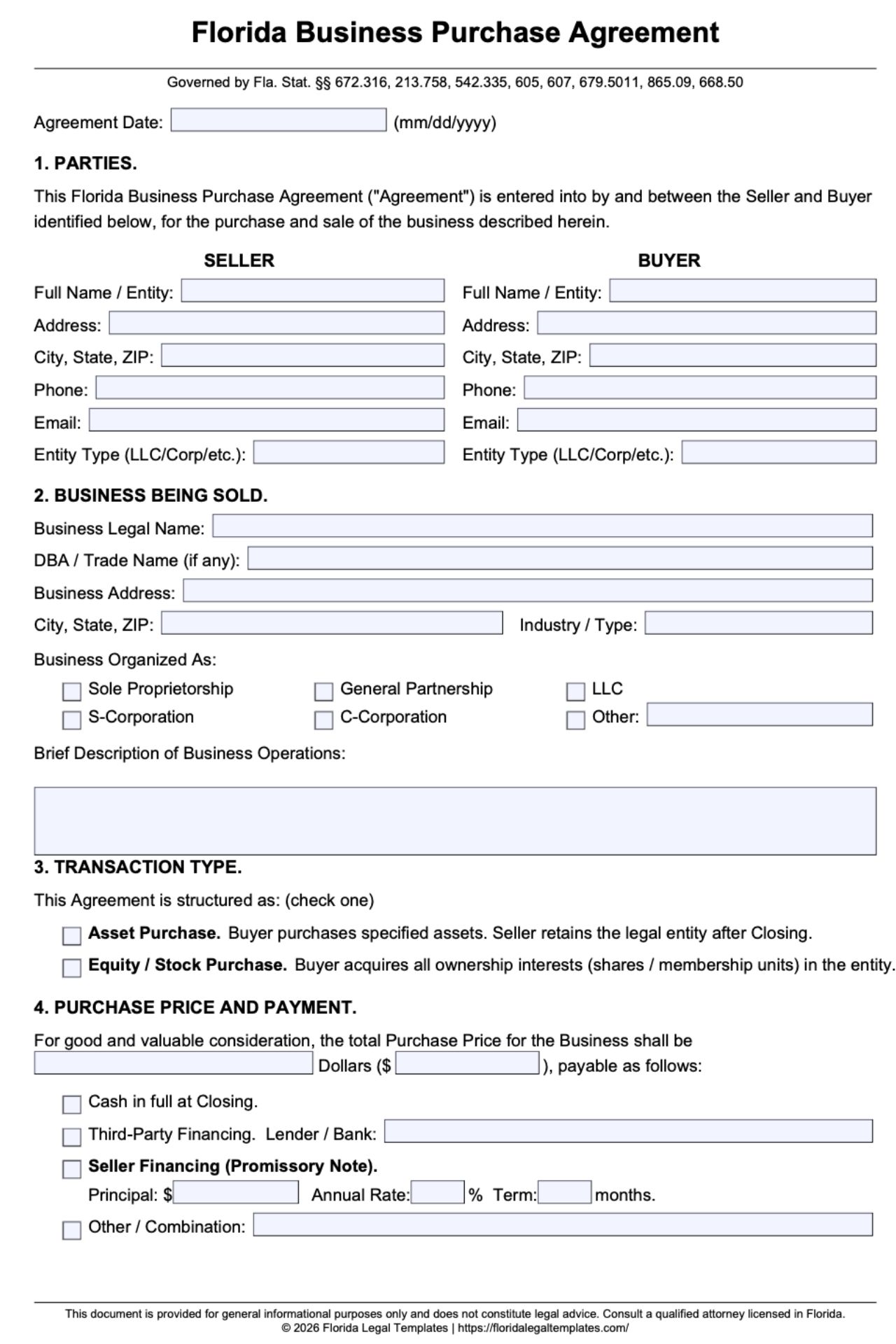
A standard template fits buyers and sellers transferring an existing, operating business—a restaurant, a service company, a retail store with goodwill and customers. It is the wrong tool for startups raising investment capital or for someone offloading a single piece of equipment (a Bill of Sale handles that).
The template alone stops being sufficient the moment the deal grows more complex. Watch for three triggers:
- Real property or a commercial lease assignment is included. This pulls in the Radon Gas Disclosure language, possible notarization, and witness requirements all at once.
- The seller is financing part of the price. You’ll need a separate Promissory Note and a UCC-1 Financing Statement to perfect the lien.
- Multiple owners or shareholders exist. Separate consent resolutions are usually required to authorize the sale.
If any of these apply, treat the template as a starting skeleton, not a finished contract.
Asset Purchase vs. Equity Purchase: Why Structure Changes This Agreement
Before drafting a single clause, decide the structure—because it determines which body of law controls.
An asset purchase can involve both goods and non-goods. Chapter 672 applies to the sale-of-goods portion, while other Florida law governs assets such as goodwill, trade names, intellectual property, and lease rights.
An equity purchase—buying stock or membership interests—is governed primarily by Florida’s business-entity statutes, including Ch. 607 for corporations and Ch. 605 for LLCs, together with the entity’s governing documents and the terms of the transaction.
That single election cascades through everything. It decides which liabilities transfer, which statutes apply, and which clauses become load-bearing. An asset deal leans heavily on assumption-of-liabilities language; an equity deal leans on detailed representations about corporate records and undisclosed obligations. This is precisely why a Florida business acquisition agreement is not a generic “sales agreement”—the structure choice is the first drafting decision, not a footnote buried in the boilerplate.
Equity & Asset Transfers Under the Series LLC Framework (§§ 605.2101–605.2802)
A major structural evolution taking effect on July 1, 2026, directly impacts business purchase agreements involving multi-unit, franchise, or real-estate-heavy acquisitions. Under Florida’s newly enactedProtected Series LLC legislation, a buyer can acquire—or a seller can convey—a specific “protected series” within an umbrella LLC without transferring the entire parent entity or executing individual asset deeds for every location.
When structuring an asset or equity purchase agreement involving a Series LLC, the contract must explicitly state whether the transaction conveys the parent entity, a specific protected series, or the segregated assets of an individual series. Furthermore, The agreement should address the protected series being transferred and the records, liabilities, and ownership interests associated with that series, because Florida’s protected-series framework took effect on July 1, 2026.
Laws That Control Enforceability of Florida Business Purchase Agreement
How These Statutes Shape Specific Clauses
For the goods covered by Chapter 672, § 672.201 generally requires a sufficient signed record for a sale of goods priced at $500 or more, subject to the statute’s exceptions. That rule does not automatically govern every part of a broader business acquisition.
The 15-day post-transfer filing period reshapes the closing checklist, while a certificate of compliance can affect whether the transferee is liable under § 213.758. Because the buyer inherits real exposure for the seller’s unpaid sales tax, a well-drafted agreement builds in a tax clearance contingency or a portion of the price held back until compliance is confirmed.
The capacity requirement drives the signature block. Confirm that each signer has authority to bind—an individual signing personally is straightforward, but an entity signer must show the officer or manager actually has authority to execute. Skip this and you risk a contract challenged as unenforceable or, worse, a buyer left holding unwaivable state tax liability.
The Buyer’s Hidden Tax Liability Problem (Fla. Stat. § 213.758)
Here is the trap that surprises buyers most. If you acquire more than 50% of the business, its assets, or its stock of goods, Fla. Stat. § 213.758 can make you jointly and severally liable for certain unpaid taxes arising from the seller’s operation of the business, subject to the statute’s exceptions and liability limits.
The indemnification clause you negotiated? It does not save you. A private contract can shift liability between the buyer and seller, but it cannot waive the buyer’s obligation to the State of Florida. That waiver is void as to the Department of Revenue.
A certificate of compliance from the Florida Department of Revenue can provide important protection before closing, but the parties should review all of § 213.758 because the statute contains additional conditions and exceptions. For high-exposure businesses—restaurants, retail, anything moving significant sales-tax volume—no agreement language is a substitute for that certificate. If the seller resists getting one, treat it as a red flag, not a formality.
Licenses Do Not Automatically Transfer With the Business
One closing mistake that surfaces only after the keys change hands is assuming the business’s licenses move with the sale. In Florida, many state and local licenses belong to the licensed person or entity, not to the business assets themselves. Buying the equipment, customer list, and trade name does not automatically give the buyer the legal authority to keep operating under the seller’s permits.
Restaurants are a common example. Alcoholic beverage licenses administered by the Florida Division of Alcoholic Beverages and Tobacco require a separate transfer or new application process under Florida law, and operating before approval can create immediate enforcement problems. Likewise, many county and municipal business tax receipts must be updated or reissued after a change in ownership.
The contract should not simply state that licenses are “included.” Instead, list every permit required to operate the business and make closing contingent on the buyer obtaining, or the agency approving the transfer of, each one that is legally transferable. If a license cannot be transferred, the agreement should specify whether closing waits for the buyer’s replacement license or whether the parties will use a temporary transition arrangement that complies with the applicable agency’s rules. This is often the difference between acquiring a functioning business and inheriting a business that cannot legally open its doors on Monday morning.
Drafting the “As-Is” and Disclosure Clauses Correctly
Generic “as-is” wording needs care. For goods governed by Chapter 672, Fla. Stat. § 672.316(3)(a) recognises expressions such as “as is” or “with all faults” as language that can exclude implied warranties when the circumstances do not indicate otherwise. The statute protects specific magic words: phrases like “as is” or “with all faults” that plainly call the buyer’s attention to the exclusion of warranties.
If the deal includes real property or a commercial lease assignment, Florida law mandates the exact statutory Radon Gas Disclosure at or before execution under Fla. Stat. § 404.056(5), beginning “RADON GAS: Radon is a naturally occurring radioactive gas…” This is a trigger condition tied to real estate—not a default requirement for every business sale.
The practical takeaway: flag early whether real estate or a lease is in the deal. That single fact cascades simultaneously into witness, notary, and radon disclosure obligations.
Step-by-Step: Completing the Business Purchase Agreement
- Elect the structure—asset or equity. This drives every clause that follows.
- Identify and schedule the assets and assumed liabilities (or the shares/membership units) being transferred.
- Set the purchase price and payment structure—cash, seller financing, or an earnout.
- Draft representations and warranties tailored to the structure you chose.
- Add a restrictive covenant only where it protects a legitimate business interest.
- Confirm real property or lease triggers—if present, add witnesses, notarization, and the radon disclosure together.
- Execute with proper signing authority, then file Sunbiz updates if officers or managers change after closing.
Build the tax-clearance issue into the closing timeline from the start. Waiting until the final days of the transaction can delay closing if the parties still need documentation from the Florida Department of Revenue.
Non-Compete Clauses: What Florida Courts Will Actually Enforce
Business sale non-competes protect goodwill under Fla. Stat. § 542.335(1)(b)4. Under subsection (1)(d)3, specific thresholds apply to these sales: durations of three years or less are statutorily presumed reasonable, while any restriction exceeding seven years is presumed unreasonable.
When the geographic scope or duration is unreasonable, § 542.335 directs the court to modify the restraint and grant only the relief reasonably necessary to protect the legitimate business interest. That cuts both ways: an overbroad covenant won’t kill your deal, but a seller shouldn’t expect aggressive terms to hold as written. Tie the covenant explicitly to the goodwill or trade secrets being purchased, and it will stand on far firmer ground.
Limitations and Legal Considerations
This agreement is a private contract—nothing needs to be filed or recorded for it to be valid. But the transaction can trigger secondary filings:
- Sunbiz amendment or annual report if officers, managers, or the registered agent change.
- UCC-1 Financing Statement under Fla. Stat. Ch. 679 if the seller retains a security interest in a financed deal.
- Deed recording with the County Clerk if real property is part of the transfer.
While Fla. Stat. § 672.209 enforces written modifications for physical goods, Florida common law rules equity transfers and intangibles. Under common law, parties can orally waive a no-oral-modification clause through mutual consent, new consideration, or a clear pattern of performance.
Finally, know when this document doesn’t apply: a simple equipment-only sale calls for a Bill of Sale, and pre-acquisition negotiations belong in a Letter of Intent.
Common Mistakes That Derail Florida Business Sales
- Closing without a tax clearance certificate. The buyer inherits the seller’s unpaid sales tax liability to the state—no indemnification clause repairs it.
- Relying on a verbal price adjustment after signing a no-oral-modification agreement. The change is legally void.
- Drafting an overbroad non-compete expecting full enforcement. Courts blue-pencil it, often leaving weaker protection than intended.
- Forgetting Sunbiz updates after an equity purchase. Officer and registered-agent records stay wrong, creating compliance gaps.
- Treating real estate as a minor detail. Missing the witness, notary, or radon requirements can jeopardize the entire transaction.
Frequently Asked Questions (FAQ)
Can the buyer be held responsible for the seller’s unpaid sales tax even if the contract says otherwise?
Yes. Under Fla. Stat. § 213.758, the buyer is jointly and severally liable to the Florida Department of Revenue up to the fair market value of the transferred assets. A private indemnification clause can shift cost between the parties but cannot waive liability to the state. Obtain a Certificate of Compliance before closing.
Does a Florida business purchase agreement need to be notarized to be valid?
No. Notarization is not generally required for the business purchase agreement itself. If the transaction includes an instrument concerning real property that must be recorded, § 695.03 addresses the acknowledgment or proof required for recording that instrument.
What happens if we verbally agree to change the purchase price after signing?
For a contract governed by Chapter 672, a signed no-oral-modification clause generally requires a signed writing for modification, although an attempted modification that does not satisfy the statute can still operate as a waiver under § 672.209(4).
Is a non-compete clause in a business sale automatically enforceable in Florida, or can a court rewrite it?
Not automatic. It must protect a legitimate business interest under Fla. Stat. § 542.335. If the scope or duration is unreasonable, the court will narrow it under the blue-pencil doctrine rather than enforce it as written.
Legal Disclaimer:This article provides general information about Florida business purchase agreements and is not legal advice. Laws and requirements can change, and the information may not apply to your specific transaction. Consider consulting a qualified Florida attorney before signing or relying on a business purchase agreement.