What Florida Law Says About Security Deposits
When money changes hands at the beginning of a lease, Florida law focuses less on how much a landlord collects and more on how that money is handled afterward. Under Florida Statutes § 83.49, residential landlords have strict responsibilities for safeguarding security deposits, notifying tenants where the funds are held, and returning the deposit or properly claiming against it within specific statutory deadlines.
For both landlords and tenants, most security deposit disputes don’t arise because of the amount collected. They arise because someone missed a deadline, used the wrong bank account, failed to send the required notice, or deducted money without following Florida’s statutory procedure. Those mistakes can determine whether a landlord keeps part of the deposit or loses the legal right to claim against it altogether.
Understanding Florida security deposit laws before a lease begins and again when it ends helps prevent avoidable disputes and ensures both parties know what the law actually requires.
Candice Hayden, Legal Writer
Ross Bridger, Real Estate Attorney Last Updated: November 14, 2026
What are Florida Security Deposit Laws
For most private residential rentals, Florida law does not set a general cap on the security deposit. Different rules can apply where another law or a public program regulates the rent or deposit. The statute focuses instead on how deposits must be held, disclosed, and returned.
Florida also allows a landlord to offer a fee in lieu of a security deposit under § 83.491 for rental agreements entered into or renewed on or after July 1, 2023. The fee is not a security deposit and does not relieve the tenant of rent or damage obligations. If offered, the law requires written disclosures and agreement terms, allows the tenant to switch to a deposit, and requires the option to be offered to other new tenants at the same premises while the program remains open.
From a practical standpoint, every residential landlord should focus on three core obligations established under Fla. Stat. § 83.49:
- Hold the tenant’s deposit using one of the legally permitted methods.
- Provide the required written disclosure within the statutory deadline (subject to the small-landlord exception).
- Return the deposit promptly or follow the statutory claim procedure before withholding any portion of it.
Rather than viewing these as administrative formalities, landlords should treat them as compliance requirements that directly affect whether they can legally retain any part of a tenant’s Florida rental security deposit. Missing one procedural step can eliminate rights that otherwise would have existed.
For tenants, these same rules create important protections. They establish where deposit funds must be kept, when a landlord must communicate, and how a tenant can challenge deductions they believe are improper.
Where Your Deposit Legally Has to Sit
One of the most misunderstood aspects of Florida security deposit law is that the landlord cannot simply deposit security money into any business or personal account.
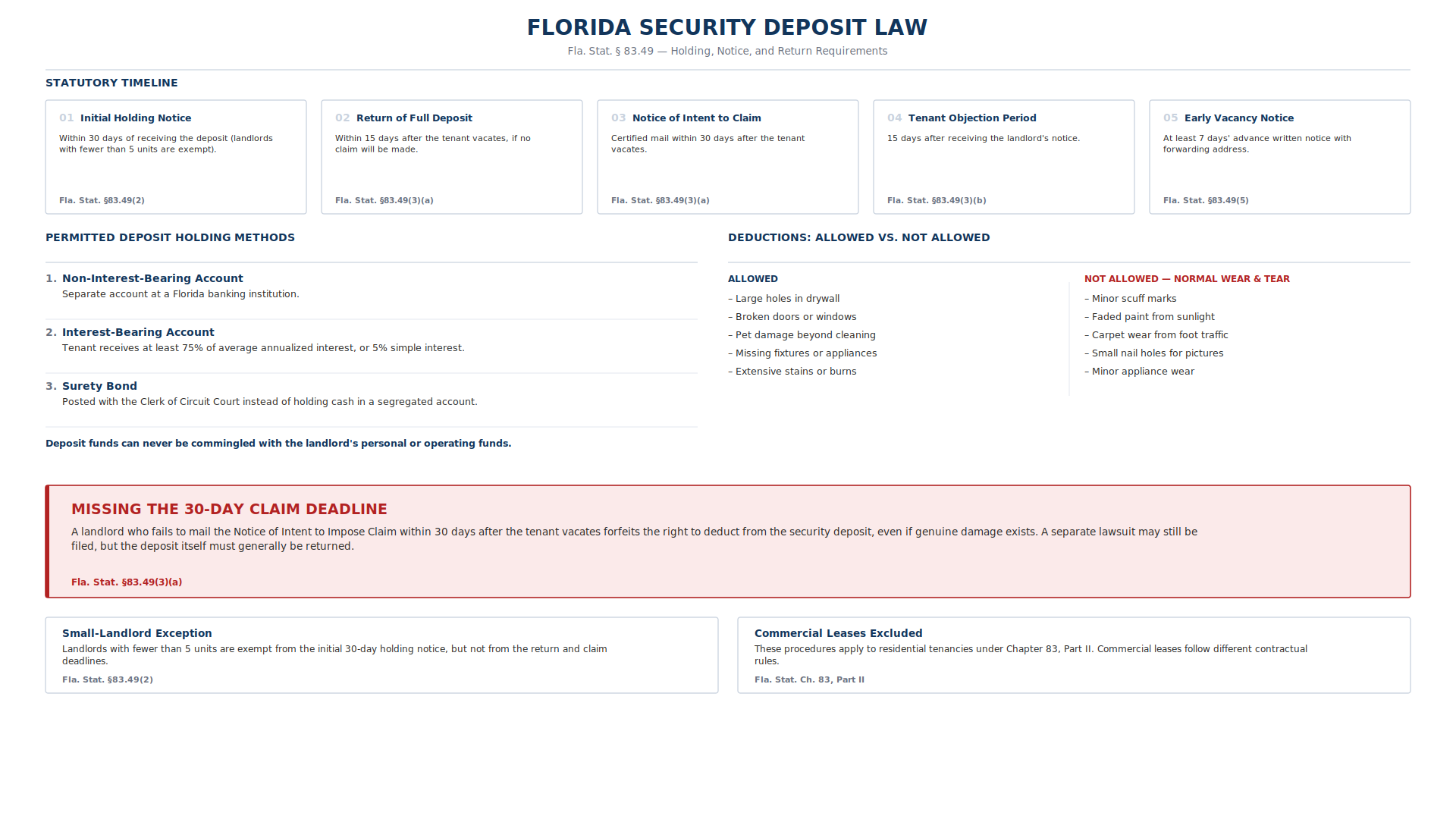
Florida requires security deposits to be maintained in one of three legally authorized ways:
- A separate non-interest-bearing account at a qualifying Florida financial institution. Since May 17, 2024, § 83.49 has used that broader term for eligible banks, credit unions, trust companies, savings banks, and savings or thrift associations authorized to transact business in Florida with insured deposits.
- A separate interest-bearing account, with the tenant receiving at least 75% of the annualized average interest rate payable on the account or 5% per year simple interest, whichever the landlord elects.
- A surety bond posted with the Clerk of the Circuit Court in the county where the rental property is located instead of maintaining the cash in a segregated account.
For landlords using either account option, the statute prohibits commingling deposit funds with other money. The surety-bond option is different: it allows the landlord to hold deposits without a segregated account, subject to the bond requirements.
Another point that often surprises landlords is that security deposits themselves are not registered with the State of Florida, the Department of Business and Professional Regulation (DBPR), or Sunbiz. The deposit is governed by the lease and by Florida’s statutory rules for handling and returning deposits.
A county-clerk bond covers the deposits and advance rent held for tenants or $50,000, whichever is less, and requires 5% simple interest for the tenant. A landlord or agent renting dwelling units in five or more counties may instead file a bond with the Secretary of State, capped at the amount held or $250,000, whichever is less; that option also requires 5% simple interest.
Landlords who rent fewer than five individual dwelling units are exempt from the initial holding notice requirement. Other landlords must give the written notice in the lease or within 30 days after receiving the deposit. The notice may be delivered in person, by mail, or by e-mail in accordance with § 83.505.
The Statutory Timeline That Controls Everything
The deadlines in Florida’s security deposit statute are where many disputes are won or lost. Each deadline serves a different purpose, and missing one can significantly affect the landlord’s legal rights.
| Topic / Issue | Florida Legal Rule | Governing Statute |
|---|---|---|
| Initial holding notice | In the lease agreement or within 30 days after receiving the deposit (except landlords who rent fewer than 5 individual dwelling units) | Fla. Stat. § 83.49(2) |
| Return of full deposit | Within 15 days after termination of the rental agreement if the tenant has vacated and no claim will be made. | Fla. Stat. § 83.49(3)(a) |
| Notice of intent to impose claim | Certified mail to the tenant’s last known mailing address, or e-mail in accordance with § 83.505, within 30 days after termination of the rental agreement | Fla. Stat. § 83.49(3)(a) |
| Tenant objection period | 15 days after receiving the landlord’s notice | Fla. Stat. § 83.49(3)(b) |
| Early vacancy notice by tenant | At least 7 days’ written notice by certified mail or personal delivery, unless the written rental agreement provides otherwise, with an address where the tenant may be reached | Fla. Stat. § 83.49(5) |
These timelines work together rather than independently. For example, a landlord who intends to deduct for property damage cannot simply send an itemized bill whenever it is convenient. The required notice must be sent within the statutory 30-day period after termination of the rental agreement, by certified mail to the tenant’s last known mailing address or by e-mail in accordance with § 83.505. Once that deadline expires, the legal consequences become much more serious.
Likewise, tenants should avoid assuming that silence means everything is resolved. If a statutory claim notice arrives, the law provides only 15 days to submit a written objection. Waiting too long may allow the landlord to proceed with the claim under the statutory process.
What Happens When Landlords Miss the 30-Day Window
Few procedural mistakes carry consequences as severe as failing to send the Notice of Intent to Impose Claim within the required 30 days.
Under Florida law, a landlord who misses this deadline forfeits the right to impose a claim against the security deposit. That means the landlord generally cannot keep part of the deposit for alleged damages through the statutory security deposit process, even if actual damage exists.
That does not necessarily eliminate every legal remedy. The landlord may still pursue a separate lawsuit for property damage, but only after returning the security deposit to the tenant. What is lost is the ability to satisfy that claim by withholding money from the tenant’s security deposit under Fla. Stat. § 83.49.
The claim notice must substantially follow the statutory form; since July 1, 2025, a landlord may send it by certified mail to the tenant’s last known mailing address or by e-mail in accordance with § 83.505. In practice, disputes often center less on the damage itself and more on whether the landlord can prove timely statutory compliance. Certified mail receipts, mailing records, and properly drafted notices frequently become the most important evidence if litigation follows.
What Can (and Can’t) Be Deducted
A security deposit is intended to protect a landlord against actual financial loss—not to cover every expense associated with preparing a rental unit for the next tenant. Under Florida security deposit laws, a landlord may assert a claim against the deposit for amounts properly owed under the rental agreement or for qualifying damages, but must still follow the statutory notice process before retaining any portion of the deposit.
In practice, landlords commonly make deductions for:
- Unpaid rent owed under the lease.
- Unpaid utility charges that the lease makes the tenant responsible for but were billed to the landlord.
- Physical damage caused by the tenant, occupants, or guests that goes beyond ordinary use of the property.
What landlords cannot deduct for is normal wear and tear. Florida law distinguishes ordinary wear from damage claims, and landlords using the deposit framework should not treat routine deterioration from ordinary use as tenant-caused damage.
Examples of normal wear and tear include:
- Minor scuff marks from everyday living.
- Faded interior paint caused by sunlight.
- Carpet wear from regular foot traffic.
- Small nail holes used to hang pictures.
- Minor appliance wear from normal use.
Examples of damage that may justify a deduction include:
- Large holes in drywall.
- Broken doors or windows.
- Pet damage beyond ordinary cleaning.
- Missing fixtures or appliances.
- Extensive stains or burns requiring replacement rather than routine cleaning.
The distinction matters at move-out. A tenant can object to a claim within 15 days after receiving the landlord’s notice, so landlords should be able to connect each charge to an actual condition rather than treating routine aging as damage.
Situations Where a Deduction May Not Hold Up
Even if legitimate damage exists, a landlord’s claim can still fail if the statutory procedure is ignored. A deduction becomes difficult to enforce when:
- The required notice was never sent.
- The notice was mailed after the statutory 30-day deadline.
- The landlord used a notice-delivery method not permitted by the statutory procedure.
- The deduction relates to conditions that existed before the tenant moved in.
- The landlord cannot reasonably document the claimed damage.
One practical example involves a tenant who leaves before the lease expires without providing the required 7-day advance written notice under Fla. Stat. § 83.49(5). In that situation, Florida law relieves the landlord of the obligation to send the formal 30-day notice of claim. That does not mean the landlord automatically keeps the entire deposit. The tenant may still recover any undisputed balance after legitimate claims are resolved.
Sending (or Responding to) the Notice of Intent to Claim
The Notice of Intent to Impose Claim is the document that determines whether a landlord may legally retain part of a tenant’s Florida tenant security deposit. Because Florida law specifies both timing and content, overlooking either requirement can jeopardize the entire claim.
Steps for Landlords
If you intend to withhold any portion of the deposit:
- Determine the amount of the proposed deduction.
- Prepare a written notice identifying the damages or other basis for the claim.
- Include language substantially matching the statutory notice required by Fla. Stat. § 83.49(3)(a).
- Send the notice by certified mail to the tenant’s last known mailing address, or by e-mail if both parties signed the § 83.505 addendum, provided valid e-mail addresses, and the tenant opted in to receive landlord notices through the linked written lease addendum.
- When the tenant vacates, use the rental-agreement termination date to calculate the 30-day deadline for providing the claim notice.
The notice must substantially follow the statutory form prescribed by Florida law. Rather than paraphrasing it, landlords should closely follow the statutory language to avoid disputes over compliance. See Fla. Stat. § 83.49 for the required notice language.
From a practical standpoint, landlords should also retain:
- Certified mail receipts.
For e-mailed notices under § 83.505, keep a copy of the notice and evidence of transmission. The notice is deemed delivered when sent unless the e-mail is returned as undeliverable.
- Photographs documenting damage.
- Move-in and move-out inspection reports.
- Repair invoices and estimates.
These records often become the strongest evidence if the tenant disputes the deduction.
Steps for Tenants
Receiving a notice of claim does not automatically mean the landlord is entitled to keep the money.
If you disagree with the proposed deductions:
- Review the notice carefully.
- Compare the claimed damage with your move-in records and photographs.
- Submit a written objection within 15 days after receiving the notice.
- Keep copies of your objection and proof that it was delivered.
If the tenant does not object within 15 days after receiving the notice, the landlord may deduct the claim and must remit any remaining balance within 30 days after the date of the notice. The tenant may still bring a separate action to challenge the claim.
Limitations and Legal Considerations
Not every lease falls under Florida’s residential security deposit rules.
The procedures discussed in this guide apply to residential tenancies governed by Chapter 83, Part II of the Florida Statutes. Commercial leases often contain different contractual provisions and are not controlled by the same statutory framework.
Another common misconception concerns the amount of the deposit. A large deposit does not give landlords unlimited discretion; they still must follow the holding, disclosure, accounting, and return requirements imposed by law. In reality, collecting a larger deposit also means assuming greater responsibility for complying with the holding, disclosure, accounting, and return requirements imposed by law.
Interest is another area where confusion arises. Florida law allows landlords to choose among several approved methods of holding security deposits. The tenant cannot require the landlord to select an interest-bearing account if another statutory method is used. The decision belongs to the landlord, provided the chosen method complies with Fla. Stat. § 83.49. See the Florida Residential Landlord and Tenant Act for the governing residential tenancy framework.
Finally, landlords using the surety bond option should remember that the bond must be filed with the appropriate Clerk of the Circuit Court. Many small landlords overlook this filing obligation because security deposits themselves are never registered with Sunbiz or DBPR.
Common Landlord Mistakes That Cost the Entire Deposit
Security deposit disputes often turn on a handful of compliance details. The most important are the 30-day claim-notice deadline, the required notice method under § 83.49 and § 83.505, proper segregation of deposit funds, and records showing the condition of the property.
Missing the 30-Day Claim Deadline
This can be one of the most costly compliance mistakes. Use the move-out process above to prepare the notice and keep proof of how it was delivered. The notice must be provided within 30 days after termination of the rental agreement. If the landlord misses that deadline, Florida law bars a claim against the security deposit, even if legitimate damage exists. The landlord may still pursue a separate lawsuit for damages, but only after returning the deposit to the tenant.
Mixing Deposit Funds With Operating Accounts
Commingling security deposits with business or personal funds violates the statutory holding requirements and creates unnecessary legal exposure during disputes or audits.
If the property is sold or the designated rental agent changes, the deposit and any earned interest must be transferred to the new owner or agent with an accurate accounting for each tenant. The former owner or agent’s duty to hold the funds ends once the funds and records are transferred and a written receipt is provided.
Using an Incomplete Notice
Many landlords prepare their own deduction letters without including the required statutory language. Omitting the required wording can create avoidable challenges to the notice’s validity. The statutory form also gives the tenant the address where an objection must be sent, so complete the landlord-address field before sending the notice.
Charging for Normal Wear and Tear
Replacing an aging carpet, repainting faded walls, or performing routine turnover cleaning are common expenses of property ownership. Attempting to recover those costs through a Florida landlord security deposit frequently leads to objections and may weaken the landlord’s overall claim.
Poor Documentation
Even when damage is genuine, photographs, inspection reports, repair invoices, and certified mail receipts often determine whether the landlord can successfully defend the deduction. Waiting until after litigation begins to organize evidence is usually too late.
Frequently Asked Questions (FAQ)
Can a landlord in Florida still sue me for damages after the 30-day window to claim against my deposit has passed?
Yes. Missing the statutory 30-day notice generally prevents the landlord from claiming against the security deposit. The landlord may still file a separate lawsuit for property damage, but only after returning the security deposit to you.
What happens if my landlord never sent me the required 30-day holding notice when I moved in does that affect their right to deduct later?
Landlords who rent five or more individual dwelling units are generally required to provide the initial holding notice within 30 days after receiving the deposit. That requirement is separate from the procedures governing deductions at the end of the tenancy, and landlords should comply with both. See Fla. Stat. § 83.49.
If I object to my landlord’s deduction notice within 15 days, what actually happens next do I have to go to court?
Submitting a timely written objection preserves your disagreement with the proposed deduction. Whether the dispute proceeds to court depends on whether the parties can resolve the matter voluntarily. Florida law does not automatically require litigation simply because an objection is filed.
Does a landlord with fewer than five rental units still have to follow the 15/30-day return and claim deadlines?
Yes. The small-landlord exception applies only to the initial 30-day holding notice after receiving the deposit. It does not remove the statutory deadlines governing the return of deposits or notices of intent to impose claims after the tenancy ends.
Legal Disclaimer: This article provides general information about Florida security deposit laws and is not legal advice. Laws may change, and individual circumstances can affect how the law applies. For advice about a specific situation, consult a qualified Florida attorney.