Florida Month to Month Lease Agreement (Free PDF & Word)
A Florida month to month lease feels like the most flexible rental arrangement available, and for a lot of landlords that flexibility is exactly the point, but flexibility doesn’t mean either side can walk away without proper notice. Since July 1, 2023, F.S. §83.57(3) requires at least 30 days written notice before the end of any monthly period to terminate a month to month rental agreement Florida landlords or tenants want to end, which is double the 15 days the old law required and a change many landlords are still running their rentals under the wrong assumption about.
I’ve seen termination notices served on the right day of the month but calculated from the wrong date entirely, because the monthly rental period is based on the rent-payment cycle, not necessarily the first day of the calendar month. The month to month rental agreement PDF and the breakdown below focus on the practical details that matter most, including the monthly rental period, required disclosures, and the notice rules that determine when the tenancy actually ends.
Candice Hayden, Legal Writer
Ross Bridger, Real Estate Attorney Last Updated: November 7, 2026
Florida Month to Month Lease Agreement (PDF, Printable, Fillable)
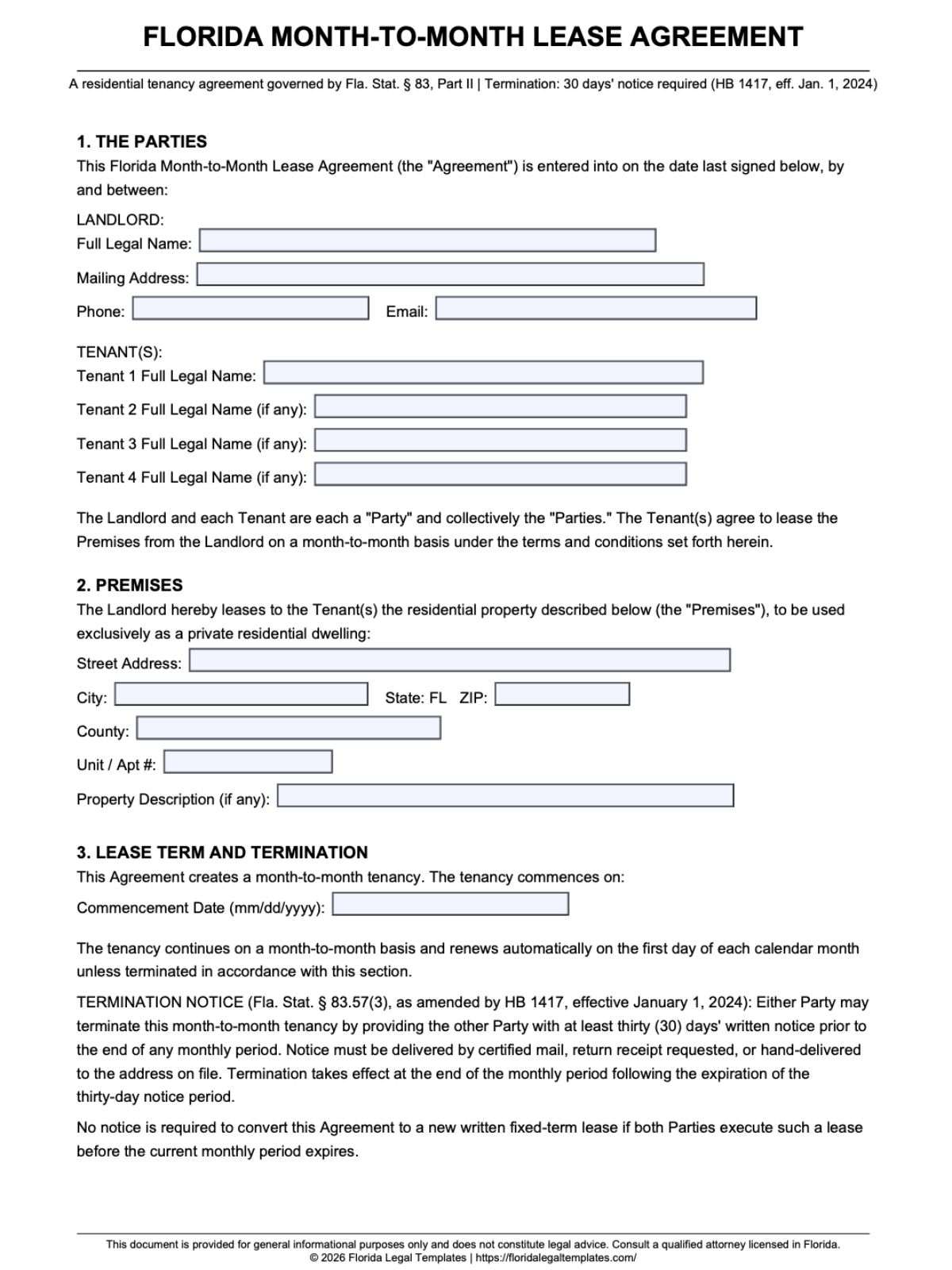
A Florida month to month rental agreement PDF or printable template provides a structured way to set out the terms of a periodic tenancy.
What the document includes:
- Monthly tenancy structure with automatic renewal
- Rent amount, due date, and payment terms
- Security deposit provisions
- Termination clause aligned with Florida’s 30-day rule
- Exemption from the separate Flood Risk Disclosure framework (Fla. Stat. § 83.512 applies strictly to residential leases of 1 year or longer, making month-to-month tenancies completely exempt)
Who should use this:
- Landlords needing flexible rental arrangements
- Tenants seeking short-term or open-ended housing
- Property managers managing transitional occupancy
When this template may NOT be sufficient:
- Long-term lease arrangements requiring fixed terms
- Commercial rental situations
- Complex agreements requiring customized legal drafting
A periodic lease Florida structure works best where flexibility is needed, but both parties must understand the legal obligations tied to termination and compliance.
Before entering into a flexible tenancy, landlords often verify tenant reliability using a tenant screening and background verification form. This step can help landlords assess an applicant before deciding whether to enter into a lease.
What Is a Florida Month to Month Lease?
A Florida month to month lease is a periodic tenancy that renews automatically at the end of each monthly rental period unless properly terminated.
These agreements are governed by the Florida Residential Landlord and Tenant Act (Fla. Stat. §§ 83.40–83.684), which defines rights and obligations for residential leasing.
Key distinction:
- Month-to-month lease: Automatically renews
- Fixed-term lease: Ends on a specified date
Execution validity:
- No notarization required
- No witness requirement (per Fla. Stat. § 689.01)
The flexibility is useful, but the tenancy still follows Chapter 83. In particular, a month-to-month tenancy generally requires at least 30 days’ written notice before the end of the monthly rental period under Fla. Stat. § 83.57(3).
While periodic leases offer flexibility, they differ significantly from fixed-term agreements. For a more structured arrangement with defined start and end dates, you can review a standard fixed-term residential lease structure to understand how obligations and timelines are typically locked in.
When a Fixed-Term Lease Quietly Becomes Month-to-Month
A common problem arises when a fixed-term lease expires but the tenant remains in possession with the landlord’s permission. If the tenant remains in possession with the landlord’s consent after a fixed-term lease expires and the landlord accepts rent, the parties may establish a month-to-month tenancy. Under Fla. Stat. § 83.46(2), the duration of a tenancy without a specified term is determined by the periods for which rent is payable, although the continuing terms may depend on the original agreement and the parties’ conduct. This means provisions covering rent, pets, maintenance responsibilities, late fees, and other ongoing obligations usually continue to apply unless the parties agree otherwise.
The practical mistake is assuming the old lease simply “ended.” Once the tenancy has converted, the landlord generally cannot require the tenant to leave on a few days’ notice just because the written lease expired. The termination rules for month-to-month tenancies under Fla. Stat. § 83.57(3) now control instead, including the requirement to give at least 30 days’ written notice before the end of the monthly rental period.
Since July 1, 2025, Fla. Stat. § 83.575(3) also provides that a tenant who remains on the premises with the landlord’s permission after the rental agreement has terminated and fails to give the notice required by § 83.57(3) is liable for an additional month’s rent.
For landlords who want to change the rent or other lease terms after the fixed lease expires, the safest practice is to present a new written month-to-month agreement before accepting another rental period. Otherwise, accepting rent may unintentionally continue the tenancy under the existing lease conditions, making later disputes much harder to resolve.
Key Florida Laws That Affect Florida Month to Month Lease Agreement
Summary of Applicable Laws
| Topic / Issue | Florida Legal Rule | Governing Statute |
|---|---|---|
| Termination Notice | Minimum 30 days’ written notice before end of rental period | Fla. Stat. § 83.57(3) |
| Security Deposit Return | 15 days to return the deposit if no claim is made, or 30 days to provide notice of a claim; if a claim is made, the tenant generally has 15 days after receipt to object. | Fla. Stat. § 83.49(3)(a) |
| Default Notice (Unpaid Rent) | 3-day notice to pay rent or vacate (excluding Saturdays, Sundays, and court-observed legal holidays) | Fla. Stat. § 83.56(3) |
| Execution Formalities | No witness requirement for lease validity | Fla. Stat. § 689.01 |
| Prohibited Actions | Cannot waive tenant rights or use self-help eviction | Fla. Stat. §§ 83.47, 83.67 |
In some cases, landlords may transition between lease types depending on tenancy needs. For example, moving from a periodic arrangement to a comprehensive long-term rental contract can provide greater stability while still complying with Florida statutory requirements.
Effective July 1, 2026, a separate, limited program under Fla. Stat. § 83.684 may also matter to eligible landlords in Broward, Escambia, Hillsborough, and Santa Rosa Counties who rent eligible units to veterans participating in HUD-VASH. Subject to annual legislative appropriation and program requirements, eligible landlords may seek proportional rent for up to 45 days while holding a unit vacant until the veteran moves in. In qualifying circumstances, they may also seek up to $2,000 beyond the deposit for property loss caused by the veteran after the veteran moves out.
Practical Impact & Document Clauses
These laws directly control how a Florida month to month lease agreement must be structured and enforced.
- The agreement should clearly address the 30-day termination notice rule under Fla. Stat. § 83.57, including the requirement to deliver written notice using a method permitted by § 83.56(4), so the parties understand how a month-to-month tenancy can be ended.
- The landlord must follow the statutory 3-day notice procedure for unpaid rent under Fla. Stat. § 83.56(3), allowing three days after delivery of the written demand and excluding Saturdays, Sundays, and court-observed legal holidays.
Effective October 1, 2026, § 83.56(2)(a) also identifies an act of fraudulent entry of a residential dwelling unit that violates Fla. Stat. § 817.537(2), regardless of whether criminal proceedings have commenced, as an example of noncurable tenant noncompliance; after the written termination notice is delivered, the tenant has 7 days to vacate.
Section 817.537(2) limits this ground to knowing and willful conduct: materially false written identity information in a rental application, forged, fictitious, or counterfeit documents presented to the landlord, or impersonation of the person named in the application.
- Security deposit terms must comply with statutory timelines under Fla. Stat. § 83.49
Florida also requires mandatory disclosures:
- Radon Gas Notice: The statutory radon notification must appear verbatim on at least one document, form, or application executed at the time of or before the rental agreement, as required by Fla. Stat. § 404.056(5)
The notification requirement does not apply to residential transient occupancy of 45 days or less, as described in Fla. Stat. § 509.013(12).
- Security Deposit Statement: For landlords subject to Fla. Stat. § 83.49(2), written notice describing how the security deposit or advance rent is being held must be provided in the lease or within 30 days after receipt, subject to the statute’s exception for landlords renting fewer than five individual dwelling units.
- Landlord Identity Data: The name and address of the landlord or a person authorized to receive notices and demands, provided in writing at or before the commencement of the tenancy under Fla. Stat. § 83.50.
- Flood Risk Exemption Notice: Under Fla. Stat. § 83.512, the separate flood-risk disclosure is not required for a month-to-month rental agreement because the statute applies to residential rental agreements for a term of one year or longer.
- Electronic Delivery Opt-In: A separately signed addendum under Fla. Stat. § 83.505 may authorize email delivery of notices if both parties voluntarily agree, provide valid email addresses, and are informed of their right to revoke or update their election.
Since July 1, 2025, the addendum must substantially follow the form in § 83.505; an e-mailed notice is deemed delivered when sent unless returned as undeliverable, and the sender must keep a copy and evidence of transmission.
Failure to comply with these rules can:
- Make termination notices invalid
- Prevent landlords from claiming deposit deductions
- Expose landlords to damages for unlawful eviction
Florida law also prohibits “self-help eviction,” meaning landlords cannot remove tenants or shut off utilities without a court process.
When to Use Florida Month to Month Lease Agreement
A Florida month to month lease works well when the parties want a residential tenancy that renews by monthly rental periods without committing to a fixed end date.
Common use cases:
- Temporary housing situations
- Transition between long-term leases
- Short-term occupancy with uncertain duration
Typical property types:
- Apartments
- Single-family homes
- Condominiums
When NOT to use:
- Long-term fixed lease agreements
- Commercial leasing arrangements
- Transient occupancy excluded from Part II under Fla. Stat. § 83.42(3); under § 509.013(12), occupancy at a hotel, motel, vacation rental, bed and breakfast inn, or timeshare is generally transient unless a written rental or lease agreement expressly states that the unit is the guest’s sole residence.
Using a periodic lease when a fixed-term lease is more appropriate can create instability or legal confusion.
If occupancy involves multiple tenants sharing the same unit, using a shared living agreement outlining responsibilities can help prevent disputes that are not fully addressed in a standard lease structure.
How to Create or Fill Out the Florida Month to Month Lease Agreement
Creating a month to month rental agreement Florida requires careful attention to both structure and compliance.
Step-by-step process:
- Identify landlord and tenant
- Include required disclosure of owner or authorized agent (Fla. Stat. § 83.50)
- Describe the property
- Full address and unit details
- Define rent terms
- Monthly rent amount
- Due date and payment method
- Include security deposit terms
- Amount collected
- Location of funds
- For deposits held in an account, § 83.49(1) requires a separate, noncommingled account at a qualifying Florida financial institution. The definition of a Florida financial institution in § 83.43(7) has applied since May 17, 2024.
- Required statutory disclosure language
- Add termination clause
- Must include 30-day written notice requirement
- Insert mandatory disclosures and optional notice frameworks
- Radon Consumer Warning: Include the exact statutory notification on at least one document, form, or application executed at the time of or before the rental agreement, as required by Fla. Stat. § 404.056(5).
- Security Deposit Allocation: For landlords subject to Fla. Stat. § 83.49(2), written notice identifying the depository and its address or stating that a surety bond is posted, stating whether the tenant is entitled to interest, and including the statute’s required deposit disclosure.
- Electronic Notice Addendum: An addendum executed under Fla. Stat. § 83.505 if both parties voluntarily choose to authorize email delivery of notices, while retaining the right to use other delivery methods permitted by law.
- Define landlord entry rules
- For repairs, provide at least 24 hours’ notice and schedule entry between 7:30 a.m. and 8:00 p.m., subject to the exceptions in Fla. Stat. § 83.53.
- Execute the agreement
- Signatures required
- No notarization needed
Practical tips:
- Align notice timing with rent cycle to avoid disputes
- Clearly define move-out expectations
- Keep written records of all notices
Limitations and Legal Considerations
A Florida month to month lease agreement generally does not require filing with a government office, but the parties still need to follow Chapter 83 requirements governing the tenancy, notices, disclosures, and possession.
Key limitations:
- Requires strict compliance with 30-day notice rule
- Offers less stability than fixed-term leases
Legal constraints:
- Cannot waive tenant rights under Fla. Stat. § 83.47
- Cannot use self-help eviction methods under Fla. Stat. § 83.67
Edge cases:
- Verbal agreements are legally possible but difficult to enforce
- Incorrect notice timing can invalidate termination
A defective notice can delay possession, while mishandling a security deposit can limit the landlord’s ability to impose a claim under Fla. Stat. § 83.49.
A lease agreement governs possession but not financial structuring or secured obligations. In situations involving repayment arrangements between parties, a formal agreement outlining repayment terms may be necessary to clearly define financial responsibilities beyond tenancy.
Common Mistakes to Avoid
1. Using outdated 15-day notice rule
Florida now requires 30 days’ notice.
Consequence: The notice may fail to terminate the tenancy on the date stated, leaving the tenancy in place until a legally effective termination date.
2. Misaligning notice with rental period
Notice must match the monthly cycle.
Consequence: Lease continues longer than expected.
3. Missing required disclosures
Radon, deposit notice, and landlord identity are mandatory.
Consequence: Lease may be partially unenforceable.
4. Mishandling security deposits
Failing to meet the statutory 15-day or 30-day deadlines can create problems with a security-deposit claim. Under Fla. Stat. § 83.49, a landlord intending to impose a claim must provide written notice within 30 days after termination by certified mail or, if authorized under § 83.505, by e-mail.
Consequence: Loss of deposit claims and potential liability.
Section 83.49(5) also requires a tenant vacating or abandoning a month-to-month tenancy to give at least 7 days’ written notice by certified mail or personal delivery, unless the written rental agreement provides otherwise; the notice must include an address where the tenant may be reached. Failure to give this notice relieves the landlord of the deposit-claim notice requirement under § 83.49(3)(a), but does not waive the tenant’s right to the deposit.
5. Ignoring 3-day rent notice requirement
Skipping required notice before eviction.
Consequence: Eviction delays and legal setbacks.
6. Attempting self-help eviction
Lockouts or shutting off utilities.
Consequence: Liability for actual and consequential damages or three months’ rent, whichever is greater, plus costs, including the tenant’s attorney fees. Florida law provides these remedies when a landlord violates Fla. Stat. § 83.67.
Frequently Asked Questions (FAQ)
How much notice is required to end a month-to-month lease in Florida?
Florida law requires at least 30 days’ written notice before the end of the monthly rental period, so the termination date depends on the tenancy’s actual rental cycle rather than automatically falling on the same calendar date the following month.
Can a landlord evict a month-to-month tenant immediately?
No. The landlord must follow proper notice procedures and obtain a court order if eviction is necessary.
Is a written agreement required for a month-to-month lease in Florida?
Not strictly, but written agreements are strongly recommended to avoid disputes and ensure enforceability.
What happens if a tenant does not pay rent in a month-to-month lease?
The landlord must issue a 3-day written notice to pay rent or vacate before starting eviction proceedings.
A properly drafted Florida month to month lease agreement can make the parties’ obligations easier to follow, particularly when it clearly identifies the rent period, deposit terms, required disclosures, and the 30-day termination rule in Fla. Stat. § 83.57(3).
Legal Disclaimer:This article is intended to provide general information about Florida month-to-month leases and is not legal advice. However, Florida landlord-tenant laws can change over time, and the rules that apply may also depend on the circumstances of a particular tenancy. Therefore, consider consulting a Florida attorney for guidance about your specific situation.