
Florida Rent Receipt Template [Free Printable PDF]
A florida rent receipt is one of those documents that feels unnecessary until the moment it becomes the only thing standing between a tenant and an eviction filing they cannot disprove. Florida’s landlord-tenant framework under Fla. Stat. § 83.56(3) sets the notice procedure for nonpayment before a landlord may terminate the rental agreement but it places the burden of proving payment squarely on the tenant, and a tenant who pays cash without getting a rent receipt florida has nothing to show a judge if that proof is ever demanded.
The same documentation gap cuts the other way: landlords who accept cash without issuing receipts lose the paper trail that supports their version of events in any disputed security deposit accounting under F.S. §83.49.
I’ve seen straightforward payment disputes turn into contested eviction proceedings simply because neither party could produce a written record of what was paid and when. The florida rental receipt template below is built for both sides of the transaction — it captures the information Florida courts look for when payment history becomes relevant and takes less than two minutes to fill out after every rent collection.
Candice Hayden, Legal Writer
Ross Bridger, Florida, Real Estate Attorney
Free Florida Rent Receipt Template
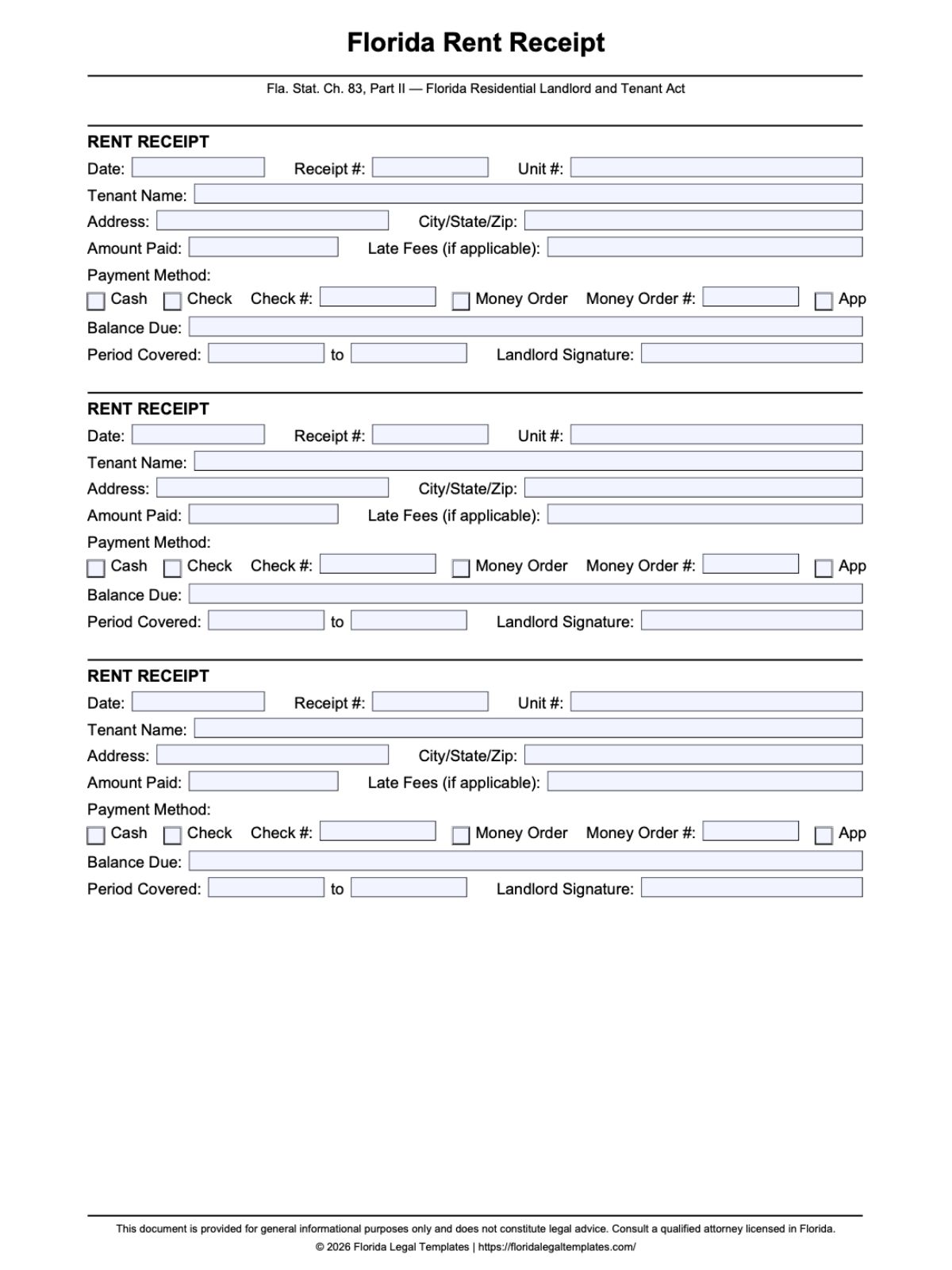
A properly drafted Florida rent receipt template should work in three formats: a printable version for in-person transactions, a PDF for record-keeping and email delivery, and a fillable or e-sign compatible version for digital workflows. Under Fla. Stat. Chapter 668 (Florida Electronic Signatures Act) and the federal ESIGN Act, Florida law generally gives a qualifying electronic signature the same force and effect as a written signature, so electronically signed rental records can be used in place of paper records when the applicable requirements are met.
What the Template Includes
A complete Florida rent receipt template should contain:
- Tenant and landlord legal names — not nicknames or trade names
- Property address and unit number
- Payment date — the date funds were actually received, not the date due
- Rent period covered — e.g., “for the month of July 2026”
- Payment amount received
- Payment method — cash, check, ACH, money order, Zelle, Venmo, etc.
- Outstanding balance section — especially critical for partial payments
- Landlord or authorized property manager signature
- Optional “subject to bank clearance” language — strongly recommended for checks and digital transfers
Who Should Use This Template
- Residential landlords renting under Chapter 83, Part II of the Florida Statutes
- Property managers acting on behalf of property owners
- Tenants who need proof of payment for a dispute or court proceeding
- Short-term rental operators (with additional tax recordkeeping obligations)
- Roommate and shared housing arrangements where payment accountability matters
Shared housing arrangements often create payment disputes over who paid rent and when. For roommate-based living situations, readers may also benefit from using a co-tenant responsibility agreement or a single-room rental contract to document rent allocation and household obligations more clearly.
When This Template May NOT Be Enough
A standard receipt template is not the right tool for every situation:
- Active eviction proceedings — partial rent acceptance requires the statutory safe-harbor language from § 83.56(5), not just a generic receipt
- Commercial leases — governed by Part I of Chapter 83, with different rules
- Security deposit acknowledgment — requires verbatim statutory disclosure language from § 83.49(2)
- Short-term transient rentals — subject to Florida Department of Revenue audit requirements and state sales tax tracking under Chapter 212
- Complex installment arrangements — a detailed accounting ledger is more appropriate
What Is a Rent Receipt in Florida?
A rent receipt is a written document that confirms a tenant has made a rent payment and a landlord has accepted it. Under Florida landlord-tenant practice, it functions as a transactional record — not a lease amendment, not a ledger, and not a substitute for a formal security deposit notice.
Florida law does not generally require landlords to issue written receipts for standard monthly rent payments, whether the tenant pays by cash, check, or digital transfer. There is no standalone statute mandating a monthly receipt for routine full payments. The obligation arises only in specific circumstances — most notably when partial payments are accepted after a 3-Day Notice has been served, or when advance rent or security deposits are collected.
The evidentiary purpose of a receipt is rooted in Florida contract law and the Florida Evidence Code. A properly documented receipt can be introduced in an eviction defense, a security deposit dispute, or a tax audit as a business record under Fla. Stat. § 90.803(6). Without proper documentation practices, a landlord may find themselves unable to prove payment was never received — or a tenant may have no evidence that it was.
Key distinctions:
- A rent receipt confirms a specific payment was made and accepted on a given date
- A lease agreement establishes the terms and obligations of the tenancy
- A payment ledger tracks a running history of all charges and payments over time
- A security deposit notice is a mandatory disclosure document with its own statutory requirements
A rent receipt works alongside — not in place of — the underlying lease documents that define the tenancy terms. If readers need a broader understanding of Florida rental contracts, referencing a standard residential rental agreement or a flexible month-to-month tenancy arrangement here helps clarify how receipts fit into the larger landlord-tenant relationship.
Difference Between a Standard Receipt and a Legal Compliance Receipt
A standard monthly payment receipt is a straightforward acknowledgment — date, amount, period, signature. No special language is required by statute.
When partial rent is accepted after a nonpayment notice, § 83.56(5)(a) gives the landlord three ways to preserve the claim: provide a receipt stating the date, amount received, agreed payment date and balance due; place the partial rent in the court registry when filing; or post a new 3-day notice reflecting the new amount due.
A security deposit or advance rent receipt-disclosure must follow the verbatim statutory format under § 83.49(2)(d), including mandatory disclosure text about deposit handling and tenant obligations upon move-out.
A digital receipt — whether emailed, generated by a payment app, or produced by property management software — is legally equivalent to a paper receipt under Chapter 668, provided the electronic signature requirements are met.
Key Florida Laws That Affect Rent Receipts
Summary of Applicable Laws
| Topic / Issue | Florida Legal Rule | Governing Statute |
|---|---|---|
| Standard monthly receipts | No statutory requirement to provide a written receipt for full monthly rent, regardless of payment method | General contract law; no specific statute |
| Partial rent after 3-Day Notice | Landlord must issue a receipt stating the amount received, balance due, and agreed payment date — or risk waiving eviction rights | Fla. Stat. § 83.56(5) |
| Security deposits & advance rent | Written notice/receipt required within 30 days of receipt, disclosing the Florida banking institution holding funds | Fla. Stat. § 83.49(2) |
| Electronic signatures & digital receipts | Digital receipts and e-signatures are fully valid and admissible in Florida courts | Fla. Stat. Chapter 668 & Federal ESIGN Act |
| Business record admissibility | A receipt meeting self-authentication rules is admissible without a live witness | Fla. Stat. § 90.803(6) & § 90.902 |
| Transient rental recordkeeping | Short-term rental receipts must be retained for Florida Dept. of Revenue audits; state sales tax (6%) and local surtaxes apply | Fla. Stat. Chapter 212 |
The practical stakes here are significant. Most landlords focus on the lease and the security deposit — and largely ignore the evidentiary infrastructure around rent payments. That works fine until a dispute arises. At that point, a landlord without proper receipt documentation faces a tenant who can claim payment was made, with no paper trail to contradict it.
The partial payment trap is particularly dangerous. Florida courts have consistently held that accepting rent — even a small portion — without the proper safe-harbor language constitutes a waiver of the pending eviction. That means the landlord must start the notice process over from scratch, losing weeks and potentially months of legal standing.
Short-term rental operators face an entirely different set of obligations. Receipts are not just internal records for them — they are audit-sensitive financial documents subject to Department of Revenue review.
Why Partial Rent Receipts Are Legally Sensitive in Florida
Under Florida law, once a landlord serves a 3-Day Notice to pay rent or vacate, they enter a legally fragile period. Accepting rent after a nonpayment notice can affect the landlord’s eviction rights, but partial rent is specifically addressed by § 83.56(5)(a), which provides three ways to proceed.
The law is unambiguous: an unconditional receipt issued after a 3-Day Notice has been served waives the landlord’s right to proceed with eviction based on that month’s default. The landlord must re-serve a new 3-Day Notice and restart the process. In a rental market where courts are backed up, this can add months to an already expensive eviction.
To avoid this outcome, the receipt must contain three elements:
- The exact amount received
- The remaining unpaid balance
- An explicit statement that acceptance of the partial payment does not waive the landlord’s eviction rights
The Court Registry Deposit Trap for Partial Rent (§ 83.56(5)(a)2)
A critical procedural trap frequently catches Florida landlords during eviction litigation. Providing the receipt described in Fla. Stat. § 83.56(5)(a)1 is one of three statutory ways a landlord can proceed after accepting partial rent.
If the tenant fails to pay the remaining balance by the agreed date and the landlord files an eviction lawsuit for possession, Fla. Stat. § 83.56(5)(a)2 strictly mandates that the landlord must deposit the accepted partial rent into the court registry upon filing the eviction complaint.
If the landlord chooses the court-registry option, § 83.56(5)(a)2 requires the accepted partial rent to be placed in the registry when the possession action is filed, forcing the landlord to restart the notice process from the beginning.
When landlords begin documenting nonpayment issues or preparing for eviction-related disputes, payment records should align with the underlying tenancy paperwork. In practice, disputes are easier to manage when the original Florida lease documentation clearly defines due dates, grace periods, and late-payment obligations referenced in the receipt trail.
Safe-Harbor Language That Protects Landlords
For a partial-rent receipt, the safest approach is to track the statutory details in Fla. Stat. § 83.56(5)(a), the date and amount received, the agreed payment date, and the remaining balance due.
“Landlord acknowledges receipt of partial rent in the amount of $____. The remaining balance of $____ remains due and unpaid. Tenant agrees to pay the remaining balance on or before [Date]. Acceptance of this partial payment does not waive Landlord’s right to seek eviction or maintain an action for nonpayment under the previously served 3-Day Notice.”
Why does exact wording matter? Because eviction judges in Florida look for the specific statutory elements — amount received, balance due, agreed date, and non-waiver declaration — before ruling that the landlord preserved their rights. A vague receipt that simply says “partial payment received” gives the tenant grounds to argue the landlord voluntarily accepted a reduced amount and waived their claim.
Security Deposit and Advance Rent Receipt Rules
For landlords covered by § 83.49(2), collecting a security deposit or advance rent beyond the next immediate rental period triggers a statutory written-notice requirement. Florida law requires the landlord to provide written notice within 30 days of receiving those funds, disclosing:
- The name and address of the Florida banking institution holding the funds
- Whether the account is interest-bearing or non-interest-bearing
- If interest-bearing, the rate and how interest will be applied
The initial disclosure requirement is separate from the move-out claim procedure in § 83.49(3), which governs the notice a landlord must give when claiming against a security deposit. Courts have ruled that a landlord who improperly handles deposit documentation forfeits the right to withhold funds — even for legitimate damages.
Required Florida Disclosure Language
Section Fla. Stat. § 83.49(2)(d), contains a statutory disclosure that should be reproduced from the current statute rather than shortened or paraphrased in the template.
“YOUR RENTAL AGREEMENT REQUIRES PAYMENT OF CERTAIN DEPOSITS. THE LANDLORD MAY TRANSFER ADVANCE RENTS TO THE LANDLORD’S ACCOUNT AS THEY ARE DUE AND WITHOUT NOTICE. WHEN YOU MOVE OUT, YOU MUST GIVE THE LANDLORD YOUR NEW ADDRESS SO THAT THE LANDLORD CAN SEND YOU NOTICES REGARDING YOUR DEPOSIT. THE LANDLORD MUST PROVIDE YOU WRITTEN NOTICE IN PERSON, BY MAIL, OR BY E-MAIL IN ACCORDANCE WITH SECTION 83.49, FLORIDA STATUTES, WITHIN 30 DAYS AFTER YOU MOVE OUT, OF THE LANDLORD’S INTENT TO IMPOSE A CLAIM AGAINST THE DEPOSIT. IF YOU DO NOT REPLY TO THE LANDLORD STATING YOUR OBJECTION TO THE CLAIM WITHIN 15 DAYS AFTER RECEIPT OF THE LANDLORD’S WRITTEN NOTICE, THE LANDLORD WILL COLLECT THE CLAIM AND MUST MAIL YOU THE REMAINING DEPOSIT, IF ANY…”
This is not boilerplate that can be paraphrased. The statute requires this exact language. Omitting it or rewording it can render the deposit documentation non-compliant, exposing the landlord to liability for the full deposit amount plus attorney’s fees.
Are Digital Rent Receipts Valid in Florida?
Yes. Florida’s Electronic Signatures Act (Chapter 668) and the federal ESIGN Act make digital rent receipts fully valid, legally binding, and admissible in court. This includes:
- Email receipts from landlords or property managers
- Automated receipts generated by payment apps like Zelle, Venmo, or Cash App
- PDF receipts signed through DocuSign or similar platforms
- Transaction logs from property management software platforms
The one practical caveat is that digital receipts generated by consumer payment apps typically do not include partial payment non-waiver language or security deposit disclosures. Landlords who rely solely on Zelle confirmations for sensitive transactions are not protected under § 83.56(5).
Practical Risk With Instant “Paid” Receipts
If a payment has not cleared, landlords may want the receipt to make that status clear rather than describing the payment as final. A receipt should accurately reflect whether funds have actually been received and settled.
The fix is simple: add the following language to any receipt issued before funds have cleared:
“Subject to clearing and final bank settlement.”
This single clause preserves the landlord’s right to re-initiate collection or eviction proceedings if the payment fails.
When to Use a Florida Rent Receipt
Common Real-World Scenarios
- Cash payments — always issue a receipt; cash leaves no independent record
- Partial payments — mandatory safe-harbor receipt required if a 3-Day Notice is pending
- Tenant reimbursement disputes — receipts establish the timeline and amount of payments
- Shared housing and roommate situations — receipts clarify which tenant paid what portion
- Mobile home lot rentals — governed by Chapter 723, but receipt best practices apply
- Vacation and short-term rentals — receipt documentation is essential for Florida sales tax compliance
Situations Where Receipts Become Critical Evidence
In a Florida possession action based on nonpayment, § 83.60 allows the tenant to raise payment as a defense, and payment records may be relevant evidence. To be automatically admissible without requiring a live witness, those receipts should meet the business record exception under § 90.803(6) — meaning they were created in the regular course of business, at or near the time of the transaction.
Receipts also become pivotal in security deposit disputes (where landlords must justify any withholding), habitability claims (where tenants argue rent was withheld for cause), late fee disputes, and tax audits for short-term rentals.
When a Simple Receipt May Not Be Appropriate
A basic receipt template is not the right instrument for:
- Ongoing eviction litigation, where every document becomes a potential exhibit and should be reviewed by an attorney
- Commercial tenancy accounting, which typically requires formalized ledgers
- Court-ordered payment plans, which should be documented in a stipulated agreement, not a receipt
How to Fill Out a Florida Rent Receipt
Step 1 — Enter Landlord and Tenant Information
Use legal names as they appear on the lease agreement. For property managers, include both the management company’s name and the property owner’s name. Include the full property address and unit number.
Step 2 — Identify the Payment Details
List the exact dollar amount received. Specify the rental period covered — do not leave this blank, as ambiguity about which month’s rent was paid can become a significant dispute point. If accepting a partial payment, identify the remaining balance and the agreed date by which it will be paid.
Step 3 — Specify Payment Method
Document the payment method precisely:
- Cash — note denomination if relevant
- Check — include check number
- ACH or bank transfer — include transaction ID
- Zelle, Venmo, Cash App — include the platform and confirmation number
- Money order — include serial number
Why Payment Method Matters in Florida Disputes
Payment method affects traceability, the risk of returned funds, and fraud claims. A cash payment with no receipt is entirely unverifiable. A check with no clearance disclaimer leaves the landlord exposed if it bounces. Digital transfers are traceable but don’t automatically generate compliant partial payment receipts.
Step 4 — Add Any Required Legal Language
- For partial payments after a 3-Day Notice: include the full safe-harbor language from § 83.56(5) as described above
- For security deposits or advance rent: include the verbatim § 83.49(2)(d) disclosure block
- For checks or pending digital transfers: add “Subject to clearing and final bank settlement”
Step 5 — Sign and Store the Receipt Properly
Only the landlord or an authorized property manager needs to sign. No witnesses or notarization are required under Florida law. However:
- Store receipts digitally (cloud backup recommended) with a consistent naming convention
- Florida does not set a general five-year statutory retention period specifically for ordinary rent receipts; landlords should choose a retention period appropriate to their legal, accounting, and tax obligations and ensures you have documentation available for any tax audit of a short-term rental
- For short-term rentals subject to Chapter 212, receipts must be retained and available for Department of Revenue inspection
Before issuing receipts, landlords should confirm that tenant identity, occupancy terms, and screening information match the original rental file. This is particularly important for property managers using a tenant screening and application form as part of their onboarding and recordkeeping process.
Essential Clauses and Fields in a Florida Rent Receipt
Receipt Number or Transaction ID
Assigning a sequential receipt number creates an audit trail. In eviction court, a numbered series of receipts can demonstrate consistent payment history — or gaps in it. Without numbering, a disputed “missing receipt” becomes much harder to address.
Never “Fix” an Issued Receipt. Void It Properly Instead.
One issue that shows up in real landlord-tenant disputes is a receipt that was edited after it was handed to the tenant. Someone changes the amount, swaps the rental month, or overwrites the payment method. That creates a credibility problem because the court can no longer tell which version reflects what actually happened.
A better practice is to leave the original receipt exactly as issued. If a mistake is discovered, issue a second document that clearly references the original receipt number, identifies the correction, and explains why the change was necessary. For example: “Corrected Receipt No. 0148. Original receipt dated July 2, 2026 incorrectly stated the payment period as June 2026. All other terms remain unchanged.” Keep both copies together in the tenant’s file.
This approach preserves a complete record of the transaction and supports the reliability of your payment records if they are later offered as business records under Fla. Stat. § 90.803(6). It also prevents a tenant from arguing that the landlord altered evidence after a dispute began. In practice, an audit trail showing both the original and the correction is usually far more persuasive than a receipt that appears to have been rewritten after the fact.
Outstanding Balance Section
Even on a full-payment receipt, having a designated balance field (showing $0.00) removes ambiguity. On a partial payment receipt, omitting the balance field is a legal error that can cost a landlord their eviction rights.
Non-Waiver Language
For partial rent accepted after a nonpayment notice, the receipt should accurately state the date and amount received, the agreed payment date, and the balance due, as required by § 83.56(5)(a)1.
Payment Allocation Clause
If a tenant owes both rent and late fees, the receipt should specify which amounts are being applied to which obligation. Without an allocation clause, a payment may be applied to fees first, leaving the rent technically unpaid — or vice versa. Florida courts look at the receipt to determine intent.
Bank Clearance Disclaimer
For any payment that has not yet settled — including personal checks and ACH transfers — this clause protects the landlord from being bound by a “Paid” receipt before the funds actually arrive.
Limitations and Legal Considerations
A Rent Receipt Does NOT Replace a Lease Agreement
A receipt confirms a payment occurred. It does not establish tenancy rights, define rent amounts, or set lease terms. Landlords who issue receipts for informal cash arrangements without a written lease may inadvertently create month-to-month tenancies with limited legal remedies.
Rent Receipts Do Not Automatically Prove Lease Compliance
A receipt shows money was received, not that the payment was timely, complete, or applied correctly. In a dispute about late fees or unpaid balances, receipts must be read alongside the lease and a payment ledger to establish the full picture.
Florida Courts May Interpret Ambiguous Receipts Against the Landlord
Under general principles of contract construction, ambiguities in a document prepared by one party are typically interpreted against the drafter. A poorly worded receipt — particularly one that is unclear about whether a partial payment is conditional — may be read by a court in the tenant’s favor.
Special Rules for Short-Term and Transient Rentals
Florida generally imposes a 6% tax on taxable transient rentals under § 212.03, while bona fide written agreements for continuous residence longer than six months are generally outside that tax. Under Chapter 212, operators must collect these taxes, remit them to the Florida Department of Revenue, and maintain detailed records — including receipts — for audit purposes. A basic rent receipt template is not sufficient; operators need a receipt format that captures tax collected, tax rate applied, and rental period.
A rent receipt only proves a payment transaction occurred — it does not create independent contractual protections for business relationships or outside service arrangements. For maintenance vendors, property consultants, or third-party contractors involved in rental operations, a separate written service contract is often necessary to define payment obligations and liability terms.
Common Mistakes to Avoid
Issuing an Unconditional Receipt After a 3-Day Notice
This is the most expensive mistake a Florida landlord can make. An unconditional receipt — one that simply says “Received $X from Tenant” — issued after a 3-Day Notice has been served voids the notice entirely. The landlord loses all legal momentum and must restart the eviction process. The cost in lost rent, legal fees, and court delay can easily run into thousands of dollars.
Marking Payments “Paid” Before Funds Clear
A “Paid in Full” receipt issued before a check clears creates a legal presumption of payment. If the check is returned, the tenant can point to the receipt in court. Always include “Subject to clearing and final bank settlement” when payment by check or pending transfer.
Failing to Separate Security Deposit Receipts From Rent Receipts
Commingling deposit and rent documentation creates compliance confusion. Security deposit receipts require specific statutory language and must reflect a separate banking arrangement. Using a generic rent receipt for a deposit — without the § 83.49(2)(d) disclosure — is a compliance failure with real financial consequences.
Omitting Remaining Balance Information
A receipt that acknowledges partial payment but doesn’t state the outstanding balance gives tenants grounds to later claim the payment was accepted as full satisfaction of the debt. Always document exactly what remains unpaid.
Using Informal Text Messages as Sole Proof of Payment
A text message may help document a payment, but it may not contain all of the details that § 83.56(5)(a) calls for when partial rent is accepted after a nonpayment notice.
Frequently Asked Questions
Does Florida law require landlords to provide rent receipts?
No — Florida has no statute that requires landlords to issue written receipts for standard monthly rent payments. The obligation to provide a specific written receipt arises in two circumstances: when accepting partial rent after serving a 3-Day Notice (§ 83.56(5)), and when receiving a security deposit or advance rent (§ 83.49(2)). Outside of those situations, written receipts are best practice, not a legal mandate.
Can a Florida landlord refuse to give a receipt for cash rent?
Florida does not generally require a written receipt for an ordinary cash rent payment under Chapter 83. Even so, a receipt gives both sides a clearer record of the date, amount and rental period covered.
Is a digital or emailed rent receipt legally valid in Florida?
Yes. Under Florida’s Electronic Signatures Act (Chapter 668) and the federal ESIGN Act, digital rent receipts — including email receipts and receipts generated by property management software — are fully valid, legally binding, and admissible in Florida courts. The same legal standards apply to e-signatures as to handwritten signatures.
Can accepting partial rent stop an eviction in Florida?
Accepting partial rent after a nonpayment notice does not automatically end the landlord’s ability to proceed. Section 83.56(5)(a) provides three statutory options: the required receipt, court-registry deposit, or a new 3-day notice reflecting the reduced balance. Under § 83.56(5), if a landlord accepts partial rent after serving a 3-Day Notice without issuing a receipt that includes the required non-waiver language, the pending notice is nullified and the eviction is effectively paused. With proper safe-harbor documentation, a landlord can accept partial payment and preserve their right to evict.
How long should landlords keep rent receipts in Florida?
There is no single statute specifying a retention period for rent receipts. As a practical rule, landlords should retain receipts for at least five years, which aligns with Florida’s general statute of limitations for written contract claims. Short-term rental operators subject to Chapter 212 should retain receipts for the period specified by the Florida Department of Revenue for sales tax audit purposes — For records supporting taxes administered under Chapter 212, the applicable retention period is tied to the Department’s tax-assessment period under §§ 213.35 and 95.091, which generally provides a three-year assessment period but includes exceptions.
Legal Disclaimer: This article provides general information about Florida rent receipts and landlord-tenant laws. It is not legal advice and does not create an attorney-client relationship. Florida laws may change, and individual circumstances can affect your legal rights. For advice about a specific situation, consult a qualified Florida attorney.