
Florida Notice to Vacate Template [Free Printable, Fillable PDF]
A florida notice to vacate and a Florida eviction notice are two different documents that do two different things and confusing them is one of the more common mistakes both landlords and tenants make when a Florida tenancy is coming to an end. A notice to vacate florida is a communication of intent: it tells the other party that the tenancy is ending and establishes the date by which the property needs to be vacated, but it does not initiate court proceedings and it does not carry automatic enforcement authority.
An eviction lawsuit filed under F.S. § 83.59 is what happens after a proper notice to vacate goes unheeded and a landlord who skips the pre-suit notice step and goes straight to court without proper grounds risks immediate dismissal. The notice period matters too: month-to-month tenancies in Florida now require 30 days written notice to terminate ollowing the enactment of HB 1417 (effective July 1, 2023), which amended F.S. § 83.57(3) to double the required notice window from 15 to 30 days, and a florida vacate notice that does not satisfy that requirement does not start the clock regardless of when it was delivered.
I’ve worked with landlords who sent a notice to vacate expecting the tenant to be gone by the deadline and were genuinely surprised to find the tenant still there with no court order to enforce removal and tenants who vacated immediately after receiving one without realizing they had a full statutory notice period remaining. The florida notice to vacate form and breakdown below cover when to use this document, what it must include, and how it fits into the larger Florida eviction timeline.
Candice Hayden, Legal Writer
Ross Bridger, Florida, Real Estate Attorney
Florida Notice to Vacate Template (PDF, Printable & Fillable)
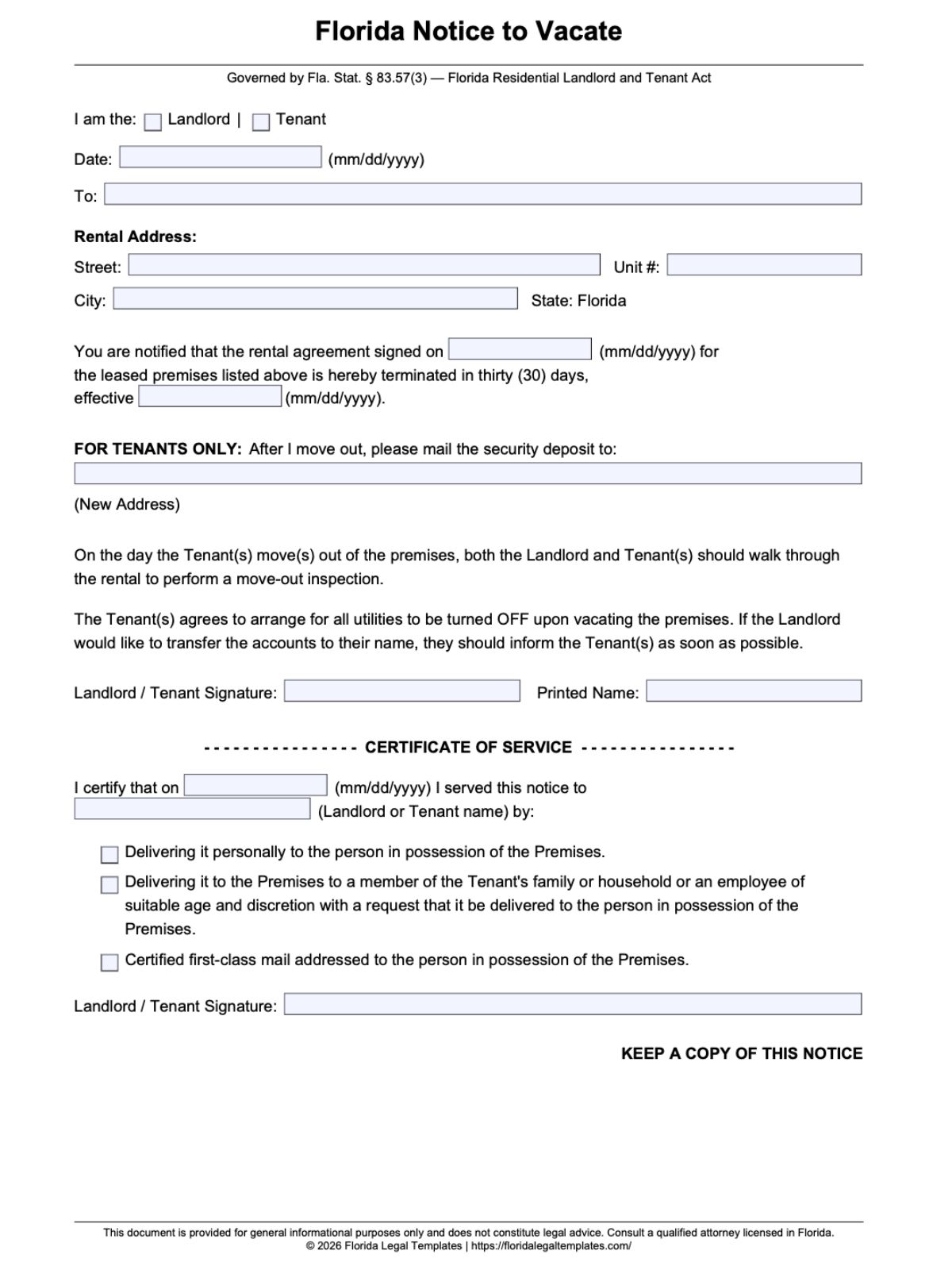
A standard Florida notice to vacate template typically includes:
- Landlord and tenant names
- Rental property address
- Date the notice is issued
- Lease termination date
- Delivery method
- Signature of the party giving notice
These templates are commonly used by:
- Landlords terminating month-to-month tenancies
- Tenants giving advance move-out notice
- Landlords or tenants issuing a contractually required Notice of Non-Renewal prior to fixed-term lease expiration (F.S. § 83.575).
Most forms are available as:
- Printable PDF versions
- Fillable digital forms
- Basic text templates for customization
However, a generic notice to vacate Florida template may not always be sufficient. Some leases contain automatic renewal clauses, special move-out procedures, or liquidated damages provisions that change the legal obligations of the tenant or landlord.
For example, under Florida Statutes § 83.575, a fixed-term lease may require advance notice before expiration. If the lease imposes penalties for failing to provide notice, the landlord must separately notify the tenant about applicable fees and penalties within a legally required timeframe.
This document is also frequently confused with eviction notices. A Florida notice to vacate is not:
- A 3-day notice to pay rent
- A 7-day notice to cure lease violations
- A court eviction filing
- A writ of possession
Those documents serve different legal purposes and follow different statutory procedures.
What Is a Florida Notice to Vacate?
A Florida notice to vacate is a written notice used to terminate a residential tenancy. It is most commonly associated with month-to-month rental agreements, but it may also apply to fixed-term leases that require advance notice before the lease expires.
Under Florida law, periodic residential tenancies generally cannot be terminated through oral notice alone. Pursuant to Florida Statutes § 83.57, the notice must be in writing and delivered in the manner provided by § 83.56(4).
This distinction matters because many landlords and tenants mistakenly believe that a text message, verbal conversation, or casual email automatically ends the tenancy. In many situations, that assumption creates disputes over rent liability, security deposits, or possession rights.
A notice to vacate is also fundamentally different from an eviction notice. A standard tenant notice Florida document is procedural rather than punitive. It simply communicates that the tenancy will end on a specified date. An eviction notice, by contrast, usually alleges a lease breach or nonpayment and may lead to court action if the tenant does not comply.
Situations Where a Florida Notice to Vacate Is Used
Month-to-Month Rental Terminations
This is the most common use case.
A landlord may issue the notice because they:
- Want to regain possession of the property
- Plan to sell or renovate the property
- No longer wish to continue the tenancy
A tenant may use the notice when:
- Relocating
- Purchasing a home
- Moving for work
- Ending a flexible rental arrangement
Florida law requires the timing of the notice to align with the rental period itself. A month-to-month tenancy generally requires at least 30 days’ written notice before the end of the rental period.
Fixed-Term Lease Expiration
Some Florida leases require advance notice even when the lease has a fixed expiration date.
This often appears in leases containing:
- Automatic renewal clauses
- Lease extension provisions
- Liquidated damages terms
Failing to comply with these provisions may expose the tenant to additional fees or continued rent liability.
Property Sale or Occupancy Changes
Landlords may also use move out notice Florida documents when:
- The owner plans to occupy the property
- Management companies change operational plans
- Significant renovations are planned
- The property is being removed from the rental market
When This Document Should NOT Be Used
A notice to vacate should not be used for:
- Unpaid rent
- Lease violations
- Illegal activity allegations
- Immediate lockouts
- Utility shutoff threats
Those issues typically require separate statutory notices and formal eviction procedures.
Key Florida Laws That Affect a Notice to Vacate
| Topic / Issue | Florida Legal Rule | Governing Statute |
|---|---|---|
| Written Notice Requirement | Notice must be written and signed | Fla. Stat. § 83.57 |
| Month-to-Month Termination | At least 30 days’ notice before end of rental period | Fla. Stat. § 83.57(3) |
| Fixed-Term Lease Notice | Lease may require 30–60 days’ advance notice | Fla. Stat. § 83.575(1) |
| Service Methods | Notice may be mailed, delivered as a true copy, e-mailed in accordance with § 83.505, or, if the tenant is absent from the premises, left at the residence. | Fla. Stat. § 83.56(4) |
| Electronic Delivery | Email delivery is permitted when the parties have signed an addendum agreeing to electronic delivery and have provided valid email addresses as required by Fla. Stat. § 83.505. | Fla. Stat. § 83.505 |
| Retaliatory Conduct | Retaliatory notices are prohibited | Fla. Stat. § 83.64 |
Under the Florida Residential Landlord and Tenant Act, notice timing and delivery procedures directly affect enforceability.
A defective notice may delay possession proceedings, undermine an eviction case, or create disputes over rent obligations. Florida courts generally expect strict compliance with statutory notice rules, especially regarding timing calculations and delivery procedures.
Florida’s rules also create practical risks for tenants. A tenant who misunderstands lease notice obligations may unintentionally trigger lease renewal clauses or liquidated damages provisions.
Why Rental Period Timing Matters in Florida
One of the most misunderstood rules involves the end-of-rental-period requirement.
Under Fla. Stat. § 83.57, the tenancy generally must terminate at the end of a rental period rather than mid-cycle.
For example:
- A notice delivered on June 10 generally cannot terminate the tenancy on June 25
- The termination date usually must align with the monthly rental cycle
Improper date calculations are one of the most common reasons notices become legally defective.
Delivery Rules and Proof of Service
Florida permits several delivery methods, including:
- Hand delivery
- Mailing
- Leaving a copy at the residence if the tenant is absent
Electronic delivery is more limited. Under Fla. Stat. § 83.505, email delivery generally requires prior written agreement through a signed lease addendum.
Practical documentation matters. Many landlords use certified mail, photographs, or written delivery logs because the notice may later become evidence in court.
Lease Clauses That Can Change Notice Requirements
Some leases modify the default statutory framework through:
- Automatic renewal clauses
- Extended notice periods
- Early termination penalties
- Liquidated damages provisions
Under Florida Statutes § 83.575, certain leases may require advance notice ranging from 30 to 60 days.
Retaliatory Notice Restrictions
Florida landlords cannot lawfully issue retaliatory notices against tenants who:
- Report code violations
- Exercise legal tenant rights
- Participate in protected tenant activities
Under Fla. Stat. § 83.64, retaliatory conduct may serve as a defense in court.
Florida Notice to Vacate vs Florida Eviction Notice
These documents are frequently confused, but they serve very different purposes.
A Florida notice to vacate:
- Ends the tenancy relationship
- May be issued without wrongdoing
- Does not automatically remove the tenant
- Often applies to ordinary lease expiration or move-outs
An fl eviction notice generally alleges a lease violation such as:
- Nonpayment of rent
- Unauthorized occupants
- Lease breaches
- Property damage
Eviction notices may eventually lead to formal court proceedings. A notice to vacate, by itself, does not authorize lockouts, utility shutoffs, or forced removal.
How to Fill Out a Florida Notice to Vacate
Identify the Correct Parties
The notice should accurately identify:
- Landlord name
- Tenant name
- Rental property address
- Unit number if applicable
Minor address errors sometimes create disputes over which tenancy is being terminated.
Calculate the Proper Termination Date
The termination date should:
- Match the rental cycle
- Provide sufficient statutory notice
- Avoid mid-period termination dates
This is one of the most legally sensitive parts of the document.
State Clear Intent to End the Tenancy
Florida law does not require special “magic words,” but the notice should clearly communicate unequivocal intent to terminate the tenancy.
Vague language such as “thinking about ending the lease” may create ambiguity.
Include Forwarding Address Instructions
Although not mandatory inside the notice itself, requesting a forwarding address helps facilitate future security deposit communications under Fla. Stat. § 83.49.
Sign and Deliver the Notice Properly
Florida law generally does not require notarization or witnesses for a notice to vacate.
However, the notice should still:
- Be signed
- Be dated
- Be retained for records
- Include proof of delivery when possible
Important Clauses and Information Often Included
A notice can also include practical move-out instructions, such as where to return keys, how to coordinate a final inspection, and where to send future security-deposit communications. These details are not substitutes for the notice requirements imposed by Florida law or the lease.
These provisions help reduce disputes after possession is returned.
Common Legal Mistakes With Florida Move-Out Notices
Common errors include:
- Giving oral rather than written notice
- Miscalculating the 30-day requirement
- Attempting mid-month termination
- Using email without proper written consent
- Ignoring lease-specific notice clauses
- Sending retaliatory notices
- Using eviction terminology improperly
These mistakes may create:
- Delayed move-outs
- Continued rent liability
- Security deposit disputes
- Failed eviction cases
- Court delays
What Happens After a Notice to Vacate Is Delivered?
If the Tenant Moves Out Voluntarily
The tenancy usually ends once:
- Possession is returned
- Keys are surrendered
- Final inspections occur
The landlord then addresses security deposit procedures and property turnover.
If the Tenant Refuses to Leave
If the tenant remains after the termination date, the landlord may need to initiate a formal eviction lawsuit for possession.
At that stage, the notice to vacate often becomes an exhibit filed with the county court.
If the Landlord Rejects a Tenant’s Notice
Disputes sometimes arise when:
- The notice violates lease terms
- The timing is defective
- The landlord claims insufficient notice
These disagreements may affect ongoing rent obligations or lease renewal claims.
Be Careful About Accepting Rent After the Termination Date
One mistake that regularly creates avoidable litigation is accepting rent after a tenancy has already ended under a notice to vacate. Imagine a month-to-month tenancy is validly terminated under Fla. Stat. § 83.57, but the tenant remains in the property past the move-out deadline. Accepting rent after a termination date can create waiver or other tenancy issues depending on the circumstances, so landlords should document how any post-termination payment is being accepted and whether the tenant is being permitted to remain in possession.
The safer practice is to decide before the termination date passes exactly how post-deadline payments will be handled. If the tenant remains after the rental agreement has ended, the landlord should carefully document whether the tenant has permission to remain and how any payment is being treated before pursuing possession.
If an eviction case is already pending, landlords should follow the statutory rules governing rent payments and the court registry rather than assuming that accepting a payment automatically resolves or waives the possession claim.
Consistency between your notices, your bank account, and your legal actions is important when a tenant remains after the lease termination date. A landlord dealing with a holdover should document whether continued possession is permitted and should consider the consequences of accepting any post-termination payment before taking further action.
Legal Limitations and Florida-Specific Considerations
A Florida notice to vacate does not automatically remove a tenant from the property.
Florida law also does not require filing or recording the notice with:
- Sunbiz
- County recording offices
- The clerk of court
The notice remains a private document unless later used in litigation.
Commercial lease rules may differ substantially from residential tenancy rules discussed here. In addition, lease agreements themselves may impose stricter notice requirements than Florida’s default statutory minimums.
A notice can create problems if the termination date is calculated incorrectly, the lease imposes a notice requirement that was ignored, or the delivery method does not comply with the applicable statute. For example, § 83.57 expressly ties termination notice to the delivery method in § 83.56(4).
The Tenant “1-Month Rent Penalty” Trap (§ 83.575(3))
A critical statutory nuance occurs when a tenant under a fixed-term lease vacates or holds over without providing the lease-required advance notice of non-renewal. Under Fla. Stat. § 83.575(3), if a tenant remains on the premises with the landlord’s permission after the lease expires but failed to provide the required 30-to-60-day notice under the rental agreement, the tenant is statutorily liable to the landlord for anadditional one month’s rent.
The 15-day reminder requirement in § 83.575(2) applies to liquidated damages authorized by the rental agreement. Section 83.575(3) separately provides that, when a tenant remains on the premises with the landlord’s permission after the rental agreement has ended and fails to give the notice required by § 83.57(3), the tenant is liable for an additional one month’s rent.
Frequently Asked Questions
Does Florida require a 30-day notice to vacate for all leases?
No. The 30-day rule primarily applies to month-to-month residential tenancies under Fla. Stat. § 83.57(3). Fixed-term leases may contain different contractual notice requirements.
Can a landlord email a notice to vacate in Florida?
Usually only if the parties previously agreed to electronic delivery through a signed addendum under Fla. Stat. § 83.505.
Can a tenant give notice in the middle of the month in Florida?
The notice can be delivered mid-month, but the termination date generally must align with the end of the rental period rather than an arbitrary calendar date.
What happens if a Florida lease requires 60 days’ notice?
The lease provision may control if it complies with Florida Statutes § 83.575. Failing to provide required notice could trigger fees or continued rent liability.
Is a Florida notice to vacate the same as an eviction notice?
No. A notice to vacate ends the tenancy relationship, while an eviction notice generally alleges a lease violation and may lead to court proceedings.
Legal Disclaimer:This article is for general informational purposes only and does not constitute legal advice. Florida landlord-tenant laws can change, and the application of the law depends on the specific facts of each situation. Consider consulting a qualified Florida attorney for advice about your circumstances.