
Florida Generic Bill of Sale Template (PDF, Word & Printable)
A florida generic bill of sale is the correct document for the majority of private sales that happen in Florida every day — used furniture, appliances, tools, collectibles, livestock, and equipment that change hands without requiring a government title, a specific form number, or a trip to the tax collector’s office. Florida’s Statute of Frauds under Fla. Stat. § 672.201 generally requires a record sufficient to indicate that a contract for the sale of goods priced at $500 or more was made and signed by the party against whom enforcement is sought, meaning that while the UCC exception for payment or acceptance can make an otherwise noncompliant sale enforceable as to goods that were paid for and accepted or received and accepted (Fla. Stat. § 672.201(3)(c)), proving the exact terms, final price, or condition can still be difficult without a dedicated instrument.
The express warranty exposure that applies to asset-specific sales applies here too — F.S. §672.313 allows oral representations made during a sale to create warranty obligations that survive the transaction, so a generic bill of sale florida that documents the condition of the item and the as-is nature of the sale protects the seller from claims based on things said during the walkthrough. I’ve worked with buyers who paid significant amounts for used equipment with nothing but a text thread to show for it, then had no standing when a dispute arose over condition or ownership because an informal text exchange may not clearly establish the required record and signature, particularly when the parties’ intent to authenticate or sign the agreement is disputed.
The florida general bill of sale template and breakdown below cover the essential fields every personal property sale needs, the condition documentation that protects both parties, and why this document works for transactions that do not fit any of Florida’s asset-specific transfer forms.
Candice Hayden, Legal Writer
Carly Johansson, Florida Contract Attorney
Florida Generic Bill of Sale Template
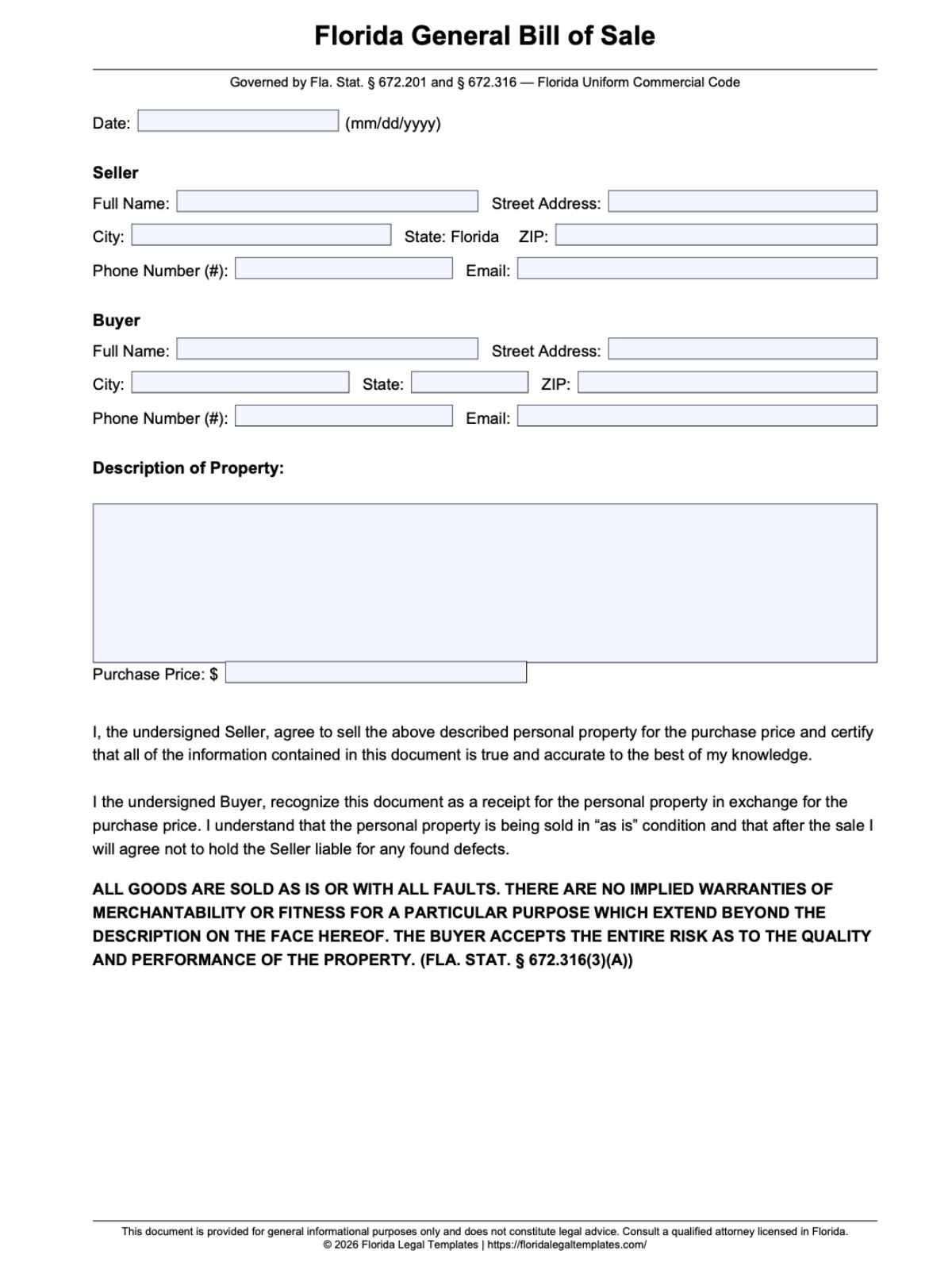
A standard Florida generic bill of sale template usually includes:
- Buyer and seller names and addresses
- Description of the property being sold
- Purchase price and payment method
- Delivery terms
- “As-Is” warranty disclaimer language
- Signature and date sections
This type of document is frequently used by:
- Private individuals
- Small business owners
- Occasional sellers
- Marketplace and classified-ad users
Common transaction types include:
- Furniture sales
- Electronics transfers
- Farm equipment transactions
- Tool and machinery sales
- Livestock transfers, including cattle and hog sales governed by Fla. Stat. § 672.316(3)(d), which provides no implied warranty that the animals are free from sickness or disease unless the seller knowingly sells diseased cattle or hogs.
- Appliance purchases
Many people choose a generic bill of sale instead of a specialized state form because Florida generally does not require government-issued forms for ordinary personal property transfers. The document remains a private agreement between the parties.
However, a generic template may be insufficient for:
- Vehicles or titled assets
- Commercial inventory transactions
- Sales involving secured collateral
- High-value business assets subject to UCC financing statements
In those situations, additional contractual or regulatory requirements may apply.
What Is a Florida Generic Bill of Sale?
A Florida generic bill of sale is a document used to record the transfer of un-titled tangible personal property from one party to another.
Its primary legal functions include:
- Showing ownership transfer
- Confirming agreed sale terms
- Proving payment or consideration
- Supporting dispute resolution if conflicts arise later
For transactions involving goods, Chapter 672 of the Florida Statutes contains Florida’s version of the Uniform Commercial Code (UCC) governing sales, although other laws may also apply depending on the property and transaction.
A generic bill of sale differs from:
- Vehicle bills of sale
- Vessel or boat bills of sale
- Firearm bills of sale
- Basic purchase receipts
For example, a receipt may only show payment, while a properly drafted bill of sale also addresses warranties, delivery terms, ownership rights, and liability allocation.
Unlike vehicle transfers handled through FLHSMV regulations, generic personal property sales primarily exist within Florida contract and UCC law. That distinction becomes critical when disputes arise over defects, non-payment, delivery problems, or undisclosed liens.
When a Generic Bill of Sale Is Commonly Used in Florida
Florida residents commonly use generic bills of sale for:
- Household goods sales
- Used equipment transfers
- Facebook Marketplace transactions
- Farm and livestock sales
- Estate sale purchases
- Garage sale transactions involving valuable property
- Business-to-business equipment transfers
Written documentation becomes especially important when:
- Large amounts of cash are exchanged
- Payment will occur in installments
- Delivery happens after payment
- High-value electronics or machinery are involved
- One party later disputes ownership or condition
For example, if a buyer pays for commercial equipment but pickup occurs a week later, the bill of sale can clarify when the risk of loss transfers and who bears responsibility if damage occurs before delivery.
A generic bill of sale should not be used for:
- Motor vehicles
- Boats or vessels
- Mobile homes
- Other assets requiring title registration under Florida law
Attempting to use a generic template for titled assets can create registration failures and continuing liability issues for the seller.
Key Florida Laws That Affect a Generic Bill of Sale
Florida Statutes Governing Generic Bills of Sale
| Topic/Issue | Precise Legal Rule | Governing Statute /Code |
| Statute of Frauds | Sales of goods priced at $500 or more generally require a record sufficient to indicate a contract and signed by the party against whom enforcement is sought; enforcement under this subsection is limited to the quantity shown in the record. | Fla. Stat. § 672.201(1) |
| Warranty of Title | Subject to statutory exceptions and any valid exclusion or modification, a contract for sale includes a warranty that the title conveyed is good, its transfer is rightful, and the goods are delivered free from security interests or other liens or encumbrances of which the buyer had no knowledge when contracting. | Fla. Stat. § 672.312(1) |
| Implied Warranty of Merchantability | When the seller is a merchant with respect to goods of that kind, the goods are generally subject to an implied warranty of merchantability unless excluded or modified as permitted by law. A written exclusion of merchantability must mention merchantability and be conspicuous. | Fla. Stat. § 672.314 & § 672.316(2) |
| Implied Warranty of Fitness | Arises when the seller has reason to know the buyer’s particular purpose and that the buyer is relying on the seller’s skill or judgment; an exclusion of the implied warranty of fitness must be in writing and conspicuous. | Fla. Stat. § 672.315 & § 672.316(2) |
| “As-Is” Safe Harbor Clauses | Implied warranties can generally be excluded by language such as as is or with all faults when the wording makes the exclusion clear and the circumstances do not indicate otherwise. | Fla. Stat. § 672.316(3)(a) |
| Livestock Health Warranty Exemption | Sales of cattle or hogs generally carry no implied warranty that the animals are free from sickness or disease, unless the seller knowingly sells diseased cattle or hogs. | Fla. Stat. § 672.316(3)(d) |
| Risk of Loss Transfer | In transactions not governed by the shipping or bailee rules, risk of loss generally passes to the buyer on receipt when the seller is a merchant and on tender of delivery when the seller is not a merchant, unless the parties agree otherwise. | Fla. Stat. § 672.509(3) |
| Open Price Terms | Parties can validly form a sales agreement even if the price is left open; if unspecified, the court defaults the obligation to a reasonable price calculated at delivery. | Fla. Stat. § 672.305 |
| Civil Court Jurisdictional Framework | Small Claims (up to $8,000), County Court (up to $50,000), and Circuit Court for matters outside the county court’s jurisdiction. | Fla. Stat. § 34.01 & § 26.012 |
Using a sloppy, generic bill of sale can easily backfire. Where an implied warranty applies, failing to properly disclaim it can leave a seller exposed to post-sale warranty claims. Furthermore, an inadequate record can limit enforcement under the Statute of Frauds, including limiting enforcement to the quantity of goods shown in the record, and the seller’s warranty of title may apply unless it is validly excluded or modified as permitted by Fla. Stat. § 672.312(2).
Practical Impact of These Florida Laws
Transactions involving goods worth $500 or more should always be documented in writing. Oral agreements become much harder to enforce when payment, delivery timing, or item condition is disputed.
Florida law can create implied warranties in sales transactions. However, a seller who is subject to an implied warranty and does not properly disclaim it may face claims that the goods were not fit for their ordinary use.
“As-Is” wording must be conspicuous. Hidden disclaimer language buried in fine print may fail to protect the seller if the buyer later claims the item was defective.
Delivery timing also affects liability. Under Florida law, risk of loss can shift at different moments depending on whether the seller qualifies as a merchant. That distinction becomes important when property is damaged between payment and physical delivery.
Clauses Florida Sellers Should Not Omit
A strong Florida generic bill of sale should include:
- Detailed property identification
- Purchase price and payment terms
- Delivery conditions
- Conspicuous “AS IS” language
- Lien disclosure provisions
- Signature sections
- Transfer date
Missing these clauses often creates avoidable disputes later.
Important Clauses in a Florida Generic Bill of Sale
The property description section should identify the item clearly enough to distinguish it from similar property. Additionally, useful identifiers include:
- Serial numbers
- Brand names
- Models
- Color or condition details
- Unique markings
Payment clauses should explain:
- Total purchase price
- Deposits paid
- Remaining balances
- Installment schedules
- Trade arrangements
As-is clauses deserve special attention. Under Florida law, applicable disclaimer language should be clear and conspicuous. Many sellers use all-capital formatting such as:
THE PROPERTY IS SOLD AS IS AND WITH ALL FAULTS, TO THE EXTENT PERMITTED BY FLORIDA LAW, AND ANY APPLICABLE IMPLIED WARRANTIES ARE DISCLAIMED.
Ownership warranty language protects buyers by confirming the seller has authority to transfer the property.
If liens exist, they should be disclosed explicitly. Otherwise, the seller may face claims relating to the warranty of title if a previously undisclosed security interest or lien affects the property.
Delivery clauses help determine when possession and risk transfer. This becomes especially important when payment and delivery occur on different dates.
Although Florida generally does not require notarization or witnesses for generic bills of sale, notarization may still strengthen evidentiary value in contested disputes.
How to Fill Out a Florida Generic Bill of Sale
Identify the Parties
Include:
- Full legal names
- Addresses
- Contact information
Nicknames or incomplete identification can complicate enforcement later.
Describe the Property Properly
Include as much identifying detail as practical, including:
- Serial numbers
- Model information
- Condition notes
- Distinguishing features
A vague description such as used equipment may create ownership disputes later.
State the Purchase Terms Clearly
Specify:
- Exact purchase price
- Payment deadlines
- Deposit amounts
- Installment schedules
- Trade-in property if applicable
Unclear payment terms frequently lead to “meeting of the minds” disputes under Florida contract law.
Add Warranty or “As-Is” Language
Warranty disclaimers should be conspicuous and easy to notice. Sellers often strengthen visibility by using:
- Bold text
- Capital letters
- Separate sections
Improper formatting can weaken legal protection.
Sign and Exchange Copies
For goods priced at $500 or more, Florida’s Statute of Frauds generally requires a record sufficient to indicate that a contract was made and signed by the party against whom enforcement is sought. Accordingly, the required signature depends on which party is seeking enforcement, rather than requiring both parties to sign in every transaction.
Although notarization is optional, it may help prove authenticity in high-value transactions.
Florida “As-Is” Sales and Warranty Risks
Florida law recognizes implied warranties in many sales transactions.
One of the most important is the implied warranty of merchantability, which generally applies when the seller is a merchant with respect to goods of that kind and is not properly excluded or modified.
Florida law also recognizes an implied warranty of title. Sellers generally provide an implied warranty that title is good and the transfer is rightful, subject to the exclusion and modification rules in Fla. Stat. § 672.312(2).
Selling property “as is” does not protect fraudulent conduct. A seller who intentionally conceals known defects or misrepresents the condition of the property may still face liability.
Common dispute scenarios include:
- Broken electronics sold as functional
- Equipment with hidden defects
- Undisclosed financing liens
- Misrepresented condition issues
These disputes often arise because the document failed to clearly allocate warranty risks.
Legal Risks That Commonly Create Disputes
Using the Wrong Bill of Sale Template
Using a generic form for vehicles or vessels can prevent legal ownership transfer and create continuing liability problems for the seller.
Poor Property Descriptions
Vague descriptions make it difficult to prove what was actually sold.
Missing or Hidden Warranty Disclaimers
Therefore, improper disclaimer formatting may expose sellers to breach-of-warranty lawsuits after the sale.
Unclear Delivery Arrangements
Damage occurring before possession transfers often creates risk-of-loss disputes.
Open or Unclear Payment Terms
Unresolved price or installment disagreements can create enforcement problems if the parties never formed a clear agreement.
Does a Florida Generic Bill of Sale Need To Be Notarized?
Florida generally does not require notarization for a generic bill of sale involving ordinary personal property.
However, signatures still matter significantly because they help establish enforceability under Florida contract law.
Notarization may still strengthen evidence in:
- High-value sales
- Long-distance transactions
- Commercial equipment transfers
- Deferred-payment arrangements
Legal validity and evidentiary strength are not always the same thing. A non-notarized bill of sale may still be enforceable, but notarization can reduce authenticity disputes later.
Florida Sales Tax and UCC Filing Considerations
Occasional Private Sales
Florida generally does not treat occasional or isolated sales of tangible personal property by a person who does not hold themselves out as engaged in business as a “business” for sales-tax purposes, subject to statutory exceptions.
Dealer or Merchant Transactions
Registered dealers and merchants may still need to collect and remit Florida sales tax using Florida Department of Revenue procedures.
The “Merchant Marketplace” Collection Exception (F.S. § 212.0596)
A vital distinction occurs when a private individual uses an online platform or peer-to-peer consignment network to execute the sale of high-value collectibles, electronics, or used equipment. Under Florida’s marketplace-sales law (Fla. Stat. § 212.05965), if a transaction is processed through a registered remote platform that meets the statutory definition of a marketplace facilitator, a qualifying marketplace provider that is a dealer generally must certify that it will collect and remit the tax imposed under Chapter 212 on taxable retail sales made through the marketplace, subject to the statute’s requirements and exceptions.
Even if a private seller is personally exempt under the casual sales tax framework, transactions completed through a marketplace may include sales tax collected through the platform when the statutory marketplace-collection requirements apply. When drafting a private bill of sale for an item paid for digitally through an app-based marketplace, keep the marketplace transaction record with the bill of sale. This can help document the transaction and any tax collected through the platform.
UCC-1 Financing Statement Risks
A bill of sale alone does not automatically eliminate existing liens.
Buyers purchasing high-value commercial equipment sometimes search the Florida Secured Transaction Registry before completing a transaction. If a creditor previously filed a UCC-1 financing statement, that lien may survive the sale.
Why a Bill of Sale Does Not Automatically Cut Off a Secured Creditor’s Rights
One mistake commonly made in private equipment and business asset sales is assuming that a signed bill of sale wipes out an old lender’s interest. However, it does not. If the seller previously granted a security interest in the property to a bank or equipment financier, and that creditor properly perfected its interest by filing a UCC-1 financing statement, selling the item does not necessarily eliminate the creditor’s rights.
Under Fla. Stat. § 679.3151(1)(a), a security interest generally continues in collateral after its sale or other disposition unless the secured party authorized the disposition free of the security interest. This means that, in some circumstances, a secured lender may still have rights in the machinery or tools even after the seller transfers them to you.
This catches private buyers by surprise because the transaction looks perfectly legitimate; they have a signed bill of sale, proof of payment, and physical possession of the asset. However, while a general “Buyer in the Ordinary Course” rule under Fla. Stat. § 679.320 protects retail consumers buying inventory from an established dealer, whether a buyer is protected depends on the circumstances and the applicable provisions of Fla. Stat. § 679.320, so a purchaser of used commercial equipment should not assume that a bill of sale alone eliminates an existing security interest.
Before purchasing high-value business assets, ask the seller for a certified payoff letter or formal lien release from their lender. For additional due diligence, conduct a search of the seller’s legal entity name on the Florida Secured Transaction Registry before handing over payment. Spending a few minutes checking the public records is far less expensive than defending against a repossession claim months down the road.
Florida Court Enforcement and Real-World Disputes
Florida generic bill of sale disputes are typically resolved in civil court based on the amount in controversy:
- Small Claims Court: up to $8,000
- County Court: $8,001 to $50,000
- Circuit Court: over $50,000
Common disputes involve:
- Non-payment
- Failure to deliver property
- Fraud allegations
- Ownership conflicts
- Defective goods claims
Related Florida Documents Often Confused With a Generic Bill of Sale
- Florida Vehicle Bill of Sale
- Florida Boat/Vessel Bill of Sale
- Florida Firearm Bill of Sale
- Purchase Agreements
- Sales Receipts
The major distinction is whether the property is titled or un-titled.
Vehicle and vessel transfers involve state registration systems and title requirements. In contrast, generic bills of sale primarily function as private contracts documenting ordinary property transfers.
Similarly, Purchase agreements also tend to be more detailed and may contain financing, inspection, or delivery contingencies that exceed the scope of a simple bill of sale.
Frequently Asked Questions About Florida Generic Bills of Sale
Is a handwritten bill of sale legally valid in Florida?
Yes. A handwritten bill of sale can be useful evidence of the transaction, and for goods priced at $500 or more, the Statute of Frauds generally requires a sufficient signed record by the party against whom enforcement is sought, subject to statutory exceptions.
Can I use a generic bill of sale for a car in Florida?
No. However, motor vehicles require separate title-transfer procedures under Florida law. A generic bill of sale alone does not legally transfer vehicle ownership.
What happens if a seller does not disclose a lien on the property?
Additionally, the seller may breach Florida’s implied warranty of title obligations, potentially allowing the buyer to rescind the transaction or pursue damages.
Does a Florida generic bill of sale protect against future disputes?
It can significantly improve evidence in ownership, payment, and delivery disputes, but it does not automatically eliminate all legal claims or prevent fraud allegations.
Do both parties need to keep a signed copy?
Yes. Both parties should retain signed copies for proof of the transaction, payment records, and dispute resolution purposes.
Can a Florida generic bill of sale include installment payments?
Yes. Installment arrangements can be included, but the payment schedule, default terms, and delivery conditions should be clearly documented to reduce enforcement disputes.
Legal Disclaimer:This article provides general information about Florida bills of sale and is not legal advice. Laws and legal requirements may change, and the information may not apply to your specific circumstances. For advice regarding a particular transaction, consult a qualified Florida attorney.