
Power of Attorney in Florida: Rules, Risks, and Validity
A Florida power of attorney can become completely unenforceable over a single execution mistake. Florida does not treat these documents as casual authorization forms. Under the Florida Power of Attorney Act, the state imposes strict statutory rules governing how a power of attorney must be signed, witnessed, notarized, and drafted before banks, title companies, courts, and financial institutions will recognize it.
That strict approach catches people off guard because the problem is often not the document’s appearance but whether it satisfies the specific Chapter 709 requirements. A missing witness, defective durable provision, improperly granted gift authority, or ineffective future-effective provision can surface when a bank, title company, or court is asked to rely on the POA.
This article focuses specifically on Florida power of attorney requirements, enforceability rules, agent authority limits, revocation procedures, and operational compliance issues under Florida law — not generic estate-planning definitions.
Candice Hayden, Legal Writer
Maria Rosso, Florida Probate, Guardianship and Estate Planning Attorney
What Florida Law Requires for a Valid Power of Attorney
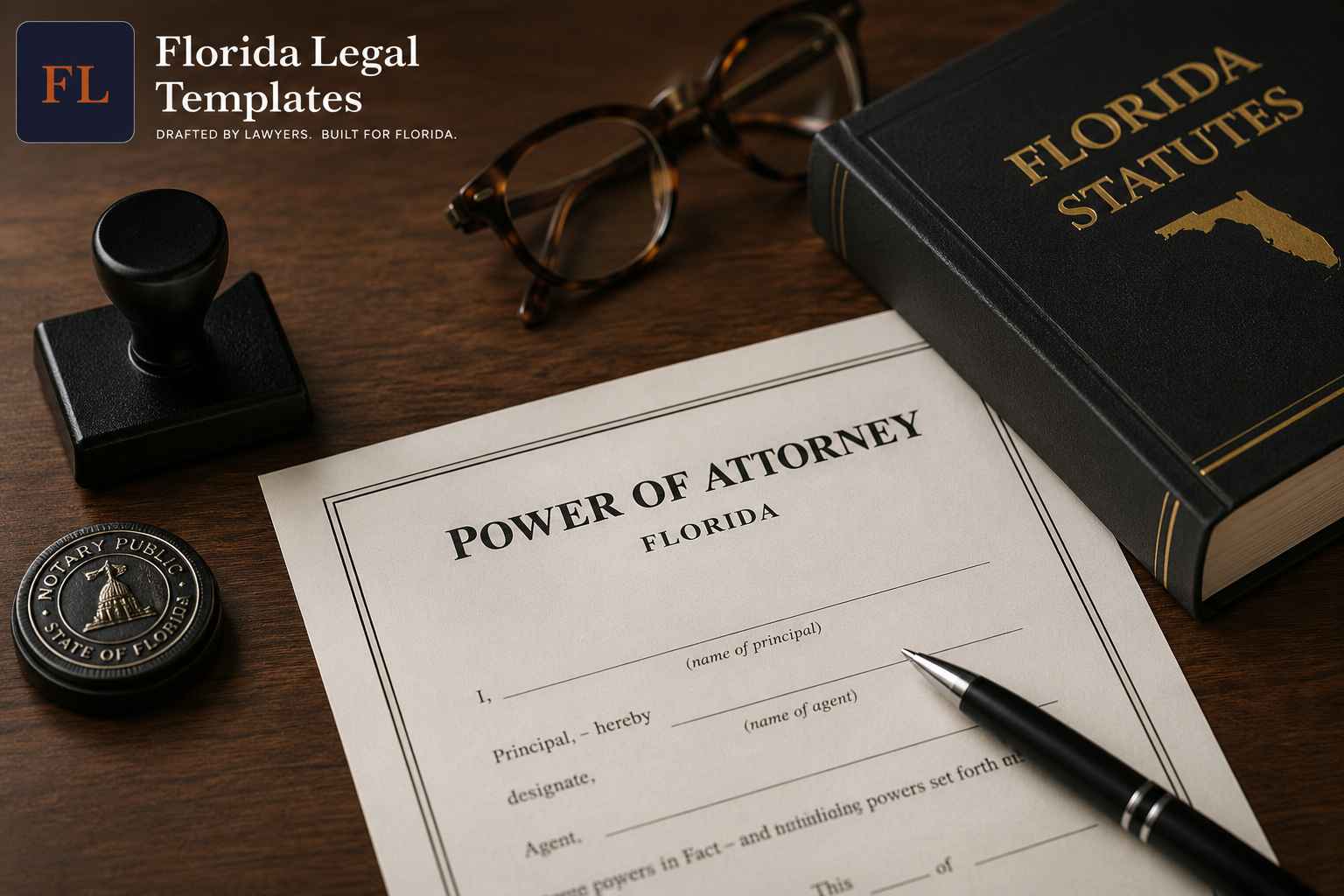
Under Florida law, a valid power of attorney must satisfy several independent legal requirements at the same time. The document must:
- Be signed by a legally competent adult principal
- Be signed by the principal, witnessed by two subscribing witnesses, and acknowledged by the principal before a notary public, as required by Fla. Stat. § 709.2105
- Contain language showing the principal intends the authority to remain exercisable despite subsequent incapacity if durable authority is intended
- Properly authorize any heightened “super powers”
- Comply with Florida’s restrictions on springing authority
Florida imposes specific statutory execution requirements on powers of attorney under Chapter 709, particularly for documents executed in Florida after October 1, 2011. That means courts and financial institutions often reject documents that fail to follow statutory execution rules precisely, even if the principal’s intent appears obvious.
Many users confuse four separate legal concepts that Florida treats differently:
| Requirement Category | What It Controls |
|---|---|
| Execution formalities | Whether the POA is legally valid |
| Durable language | Whether authority survives incapacity |
| Agent authority limits | What the agent may legally do |
| Recording requirements | Whether the POA can affect real estate title |
Florida generally requires a power of attorney to be exercisable when executed and makes a post-October 1, 2011 POA ineffective if it provides for effectiveness upon a future event or contingency, subject to statutory exceptions. Under Florida law, powers of attorney generally become effective immediately once properly signed and notarized. Language attempting to delay effectiveness until future incapacity is usually void.
This area of law also differs from broader estate planning. A power of attorney governs delegated authority during the principal’s lifetime. It does not control inheritance distribution, probate administration, or post-death estate authority.
When a Florida Power of Attorney Is Actually Needed
Most Florida powers of attorney are created long before any emergency occurs. The document exists to prevent operational and financial paralysis if the principal later becomes unavailable, incapacitated, hospitalized, or physically unable to manage affairs personally.
Common real-world situations include:
- An elderly parent who can no longer travel to banks or government offices
- Temporary incapacity after surgery or hospitalization
- Long-term management of investments, taxes, and bills
- Real estate closings while the owner is out of state
- Business delegation during extended travel
- Managing financial matters during progressive illness
A power of attorney is fundamentally a preventive authority document. It is designed to keep transactions moving during incapacity or absence.
There are also important limits many families misunderstand. Even a broad Florida POA cannot authorize an agent to:
- Vote in a public election on behalf of the principal
- Execute or revoke a will or codicil for the principal
- Perform duties under a contract requiring the principal’s personal services
Testamentary decisions instead require separate estate-planning documents such as a Florida last will and testament.
The document also terminates upon the principal’s death. At that point, authority transfers to the estate’s personal representative or executor.
After death, authority typically shifts into probate or estate-settlement procedures that may involve documents such as a Florida small estate affidavit in qualifying estates.
Florida powers of attorney are frequently confused with related estate-planning documents, but they serve different operational purposes:
| Document | Primary Purpose |
|---|---|
| Power of Attorney | Financial and legal delegation during life |
| Living Will | End-of-life treatment instructions |
| Healthcare Surrogate | Medical decision-making authority |
| Guardianship | Court-supervised incapacity management |
| Trust Administration | Asset management through trust ownership |
| Executor Authority | Estate administration after death |
Financial authority under a POA also differs from a Florida medical power of attorney or a Florida health care surrogate form, both of which focus primarily on medical treatment and healthcare decision-making rather than banking or property authority.
Florida Power of Attorney Laws That Control Validity and Enforcement
Florida Statutes That Govern Power of Attorney Requirements
| Topic / Issue | Florida Legal Rule | Governing Statute |
|---|---|---|
| Execution witness requirements | Two subscribing witnesses required during signing | Fla. Stat. § 709.2105(2) |
| Notary acknowledgment requirements | Principal must acknowledge signature before notary | Fla. Stat. § 709.2105(2) |
| Durable POA language requirements | Express incapacity-survival language required | Fla. Stat. § 709.2104 |
| Prohibition on springing POAs | Most springing POAs prohibited after Oct. 1, 2011 | Fla. Stat. § 709.2108 |
| Agent eligibility requirements | Agent must be a natural person age 18 or older or a qualifying financial institution | Fla. Stat. § 709.2105(1) |
| Real estate recording requirements | A POA used to affect real-property title may need to be recorded, and § 695.01 requires the POA to be recorded before certain creditor or purchaser rights arise | Fla. Stat. § 709.2106(5) |
| “Super powers” initialing requirements | Certain enumerated powers require the principal to sign or initial next to each specific authority under Fla. Stat. § 709.2202 | Fla. Stat. § 709.2202 |
| Agent limitations and prohibited acts | Certain personal acts cannot be delegated | Fla. Stat. § 709.2201 |
| Automatic termination upon death | Authority ends upon the principal’s death | Fla. Stat. § 709.2109(1)(a) |
Florida’s statutory framework exists largely because powers of attorney can transfer enormous financial authority with little immediate supervision. Banks and title companies scrutinize these documents aggressively because fraudulent or defective POAs create major liability exposure.
Operationally, most POA disputes arise during stressful events — stroke, dementia progression, family conflict, or emergency property sales. By the time institutions review the document, the principal may already lack capacity to correct drafting or execution defects.
Why Florida Strictly Enforces Power of Attorney Formalities
Florida courts interpret Chapter 709 narrowly because a POA can authorize sweeping control over finances, investments, and property. Improper execution can create:
- Invalid authority
- Frozen bank accounts
- Delayed healthcare funding access
- Rejected deeds and mortgages
- Guardianship litigation
- Family fiduciary disputes
A financial institution may question a POA that appears incomplete, improperly executed, altered, or insufficient to establish the authority requested. Section 709.2120 also gives third parties specific grounds for rejecting a POA rather than treating every refusal as automatically wrongful.
Durable Language and the “Magic Words” Requirement
A Florida power of attorney is durable only when its language shows that the authority remains exercisable despite the principal’s subsequent incapacity.
Without proper durable language, a power of attorney terminates once the principal becomes incapacitated — precisely when the document is usually needed most.
Many families specifically use a Florida durable power of attorney for long-term incapacity planning because ordinary non-durable authority can collapse during medical emergencies.
Florida law requires language substantially similar to:
“This durable power of attorney is not terminated by subsequent incapacity of the principal except as provided in chapter 709, Florida Statutes.”
If that incapacity-survival concept is omitted, the agent may suddenly lose authority during a medical emergency. Families often discover this problem only after hospitals, banks, or financial institutions refuse to honor the document.
Florida’s “Super Powers” Rules and Initialing Requirements
Florida imposes heightened protections on certain high-risk powers involving estate transfers and asset control.
General authority language is not enough for powers involving:
- Gifting assets
- Changing beneficiaries
- Creating survivorship rights
- Creating or modifying trusts
- Waiving annuity beneficiary rights
Under Florida law, these enumerated powers generally must be separately stated and signed or initialed by the principal as required by § 709.2202.
These rules exist because gifting and beneficiary manipulation are among the most common forms of elder financial abuse litigation. Unless the power of attorney provides otherwise, an agent generally may not use the enumerated authority to create an interest in the principal’s property for themselves or for someone they must legally support, unless the agent is the principal’s ancestor, spouse, or descendant.
Who Can Create and Serve Under a Florida Power of Attorney
The principal must be an adult with sufficient capacity to understand the nature and consequences of executing the power of attorney.
Capacity focuses on whether the principal understands the nature and consequences of delegating authority when executing the document.
An agent may be:
- A natural person age 18 or older
- A qualified financial institution authorized to conduct trust business in Florida
Choosing the wrong agent creates far more problems than drafting technicalities in many cases. The ideal agent should be:
- Financially competent
- Trustworthy under pressure
- Organized
- Accessible geographically
- Capable of handling conflict professionally
Naming co-agents can create practical complications, particularly when the power of attorney requires joint action or a third party requests additional documentation.
Successor-agent planning also matters. If the primary agent dies, resigns, or becomes incapacitated, the POA may become unusable unless backups are named.
How to Get Power of Attorney in Florida
Decide What Type of Authority Is Actually Needed
Different situations require different scopes of authority. For example, vehicle-title transfers or registration matters sometimes use a specialized Florida DMV power of attorney instead of broader financial authority documents.
Some principals need:
- Broad financial management
- Limited transaction authority
- Real estate signing authority
- Temporary delegation for travel
- Durable incapacity planning
Overly broad documents sometimes trigger institutional scrutiny, while overly narrow documents may fail during emergencies.
Choose the Agent Carefully
Agents are fiduciaries under Florida law and must act within the authority granted, in good faith, and consistent with the principal’s best interests subject to the statutory exceptions.
Poor agent selection often causes:
- Family litigation
- Suspicious transfers
- Asset depletion
- Beneficiary disputes
- Elder abuse allegations
Draft the Powers Precisely
Vague authority language creates operational problems quickly.
Banks frequently reject generic forms that fail to address:
- Digital banking authority
- Trust powers
- Real estate authority
- Gifting permissions
- Tax representation authority
Customized drafting becomes especially important for business owners, blended families, and large asset portfolios.
Execute the Document Correctly
Florida execution formalities are strict.
The document must be:
- Signed by the principal
- Witnessed by two subscribing witnesses
- Acknowledged before a notary public
- Executed in compliance with the applicable Florida witnessing and notarization requirements
Mistakes at signing commonly invalidate otherwise well-drafted documents.
Store and Distribute the Document Properly
The original document should be protected but accessible during emergencies.
Agents often need copies for:
- Banks
- Brokerage firms
- Tax professionals
- Insurance companies
- Healthcare billing departments
If the POA will be used for real estate transactions, recording requirements may also apply.
Recording Requirements for Real Estate Powers in Florida
Most Florida powers of attorney remain private documents and do not require court filing or state registration.
Real estate authority is different.
If an agent signs:
- A deed
- Mortgage
- Lease
- Other instrument affecting title
When a POA is used to affect real-property title, recording requirements may apply, including the recording rule in Fla. Stat. § 695.01. This complies with Fla. Stat. § 709.2106(5) and the recording mandates of § 695.01. To convey real estate title validly, the POA’s execution must also perfectly mirror deed formalities required by Fla. Stat. § 689.01.
Title companies routinely verify:
- Proper execution
- Recording status
- Agent authority scope
- Consistency with deed language
Failure to record can cause:
- Rejected deeds
- Delayed closings
- Chain-of-title defects
- Mortgage funding problems
How to Revoke a Power of Attorney in Florida
A principal may revoke a power of attorney by expressing the revocation in a subsequently executed power of attorney or other writing signed by the principal.
Best practice usually involves:
- Signing a written revocation
- Notifying financial institutions
- Recovering distributed copies where possible
- Recording revocations affecting real estate authority
Destroying the original does not itself constitute the statutory method of revocation, and third parties may have reliance rights under Chapter 709.
Operational notification matters. Banks or title companies unaware of the revocation may still honor the prior POA.
A Florida POA also terminates automatically upon:
- Death of the principal
- Revocation
- Court invalidation
- Incapacity if the POA is non-durable
Florida Power of Attorney Mistakes That Commonly Cause Rejection
Using a Non-Florida Generic Form
Many online forms omit Florida-specific execution language or fail to comply with Chapter 709 requirements.
Florida may recognize a POA executed in another state if the principal followed that state’s execution laws, although third parties may request an opinion of counsel in certain circumstances.
Users looking for a usable Florida power of attorney form should still verify that the document complies with Florida’s witness, notarization, and durable-language requirements before signing.
Missing Witnesses or Improper Notarization
Florida requires two subscribing witnesses and a notary acknowledgment under Fla. Stat. § 709.2105(2). Remote online witnessing is permitted under Fla. Stat. § 117.285, but special requirements apply to specified powers of attorney, and remote witnessing is not effective when the principal is a vulnerable adult as defined in § 415.102.
Attempting to Use a Springing POA
Many older templates still contain prohibited springing language tied to future incapacity.
Florida generally bars these delayed-effectiveness provisions for post-2011 POAs.
Failing to Initial “Super Powers”
Gifting authority and beneficiary-change powers often fail because the principal never separately initialed them.
This becomes especially problematic during Medicaid planning or family asset transfers.
Assuming Authority Continues After Death
Agents lose authority immediately upon the principal’s death.
Continuing to access accounts afterward can create fiduciary and fraud exposure.
Naming the Wrong Agent
Most POA litigation centers on abuse of authority rather than drafting language.
Poor agent choices commonly lead to:
- Asset diversion claims
- Undue influence allegations
- Sibling litigation
- Guardianship proceedings
The Emergency Guardianship Suspension Exception (§ 709.2109(3))
A critical statutory nuance occurs if a family member or third party files a judicial petition to determine the principal’s capacity under Chapter 744. Under Fla. Stat. § 709.2109(3), the filing of an incapacity petition automaticallysuspends all agent authority under the Power of Attorney.
However, if the agent is the principal’s parent, spouse, child, or grandchild, the authority is not suspended unless a verified motion under Fla. Stat. § 744.3203 is also filed.
Situations Where a Florida Power of Attorney May Not Solve the Problem
A POA does not eliminate every incapacity or guardianship issue. For example, Chapter 709 contains specific rules governing what happens when judicial proceedings to determine incapacity are initiated, including suspension rules under § 709.2109.
Problems still arise when:
- The principal already lacks capacity before signing
- Family members challenge competency
- Institutions suspect fraud
- Financial abuse allegations emerge
- The POA appears stale or suspicious
Some families eventually require guardianship proceedings despite having a POA.
Trust structures may also provide better continuity planning for large estates or complex asset management situations. Trust structures such as a Florida revocable living trustmay provide stronger continuity planning for large estates, rental properties, business ownership interests, or situations where families want asset management to continue smoothly without relying entirely on agent authority under a POA.
Healthcare directives remain separate documents. A financial POA alone may not authorize an agent to make medical treatment decisions unless the principal specifically grants healthcare authority through appropriate Florida healthcare planning documents.
Frequently Asked Questions
Can a Florida bank refuse to honor a power of attorney?
No, not arbitrarily. Under Fla. Stat. § 709.2120, Four days, excluding Saturdays, Sundays, and legal holidays, is presumed to be a reasonable time for a financial institution or broker-dealer to accept or reject a POA for specified banking or investment transactions. Rejections must be delivered in writing. If a third party rejects a power of attorney in violation of Fla. Stat. § 709.2120, a court may mandate acceptance and award damages, including reasonable attorney fees and costs.
Does a Florida power of attorney remain valid if the principal becomes incapacitated?
Only if the document contains proper durable language under Fla. Stat. § 709.2104. Without durability language, authority generally terminates upon incapacity.
Can an agent transfer the principal’s assets to themselves in Florida?
Florida restricts self-gifting and self-benefiting transactions heavily, especially for non-family agents. Certain transfers require explicit authority under Fla. Stat. § 709.2202.
What happens if a Florida power of attorney was signed without proper witnesses?
The document may be legally invalid and unenforceable. Financial institutions and courts frequently reject improperly executed POAs outright.
Does a Florida power of attorney need to be recorded with the court?
Ordinary financial powers of attorney usually do not require recording. However, POAs used for real estate transactions generally must be recorded in the county where the property is located.
Can family members challenge a power of attorney in Florida?
Yes. Common challenges involve:
- Lack of mental capacity
- Undue influence
- Fraud
- Improper execution
- Fiduciary abuse
- Unauthorized gifting or transfers
Legal Disclaimer:This article provides general information about Florida power of attorney laws and is not legal advice. Laws and legal requirements can change, and individual circumstances may affect how the law applies. For advice about your specific situation, consult a qualified Florida attorney.