
Florida Vendor Agreement Template (Free Fillable PDF)
A Florida vendor agreement is the contract that governs how a business buys products or services from a supplier, distributor, contractor, or procurement vendor. It defines the operational rules of the relationship what is being supplied, when delivery happens, how payment works, who carries risk if something fails, and what happens if the relationship breaks down. In practice, these agreements are used everywhere from restaurant supply chains and SaaS procurement deals to construction materials contracts and municipal technology projects.
Florida makes vendor agreements more complicated than many businesses realize because the governing law changes depending on what the vendor is providing. Goods-only transactions fall under Florida’s version of the Uniform Commercial Code (UCC), specifically Chapter 672. Service-based vendor relationships are governed by Florida common law contract principles instead. Hybrid agreements — where a vendor supplies both products and services create additional drafting risk because Florida courts apply the “predominant factor test” to determine which legal framework controls. That single classification decision affects warranty rules, liability exposure, statute-of-limitations periods, and enforceability of key clauses.
Candice Hayden, Legal Writer
Carly Johansson, Florida Contract Attorney
Printable Florida Vendor Agreement Template
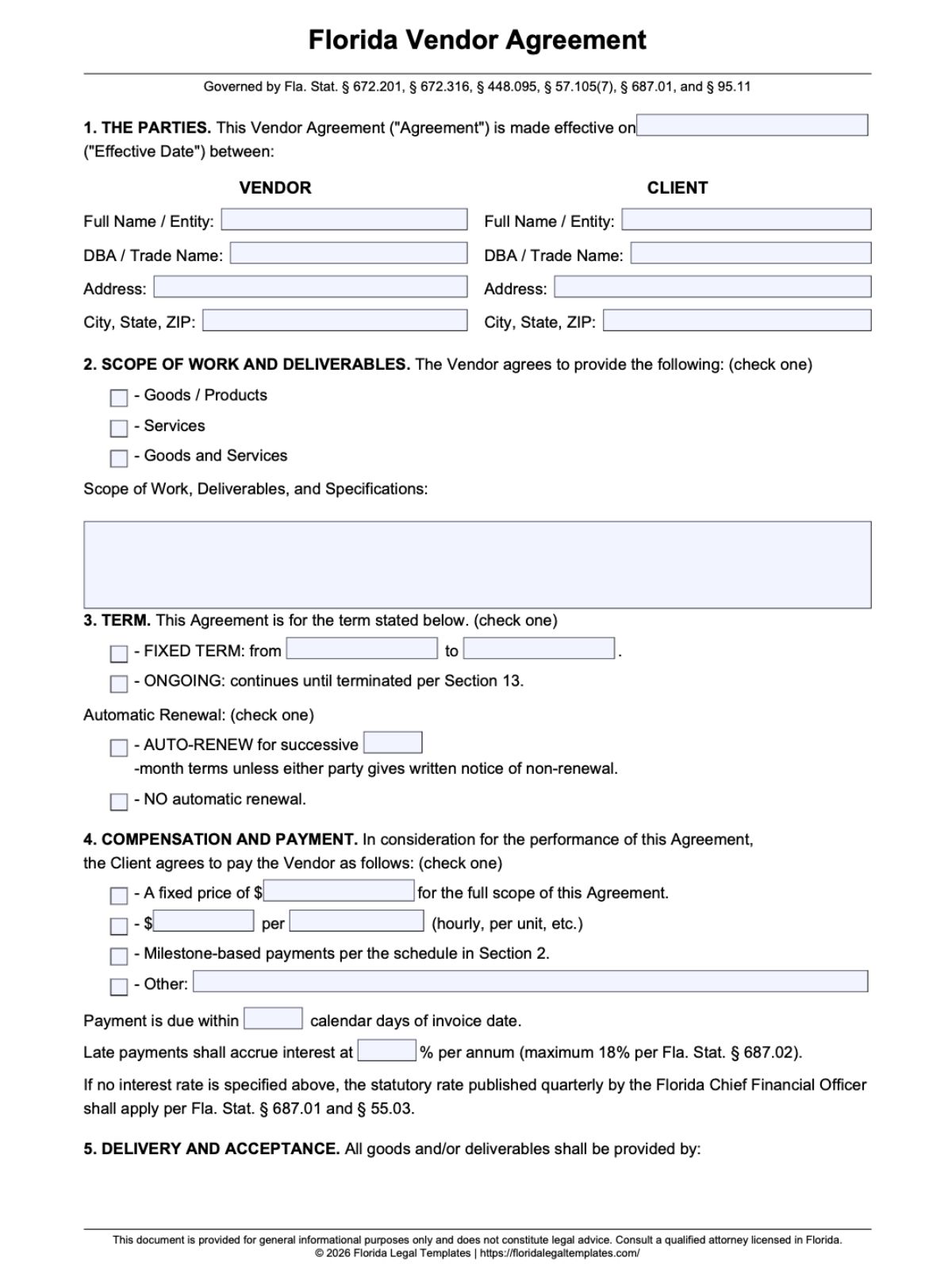
A Florida vendor agreement template can give a business a consistent starting point for recurring purchases or services. The exact provisions should match the relationship, but most agreements address the following areas:
- Scope of goods or services
- Pricing and payment terms
- Delivery obligations
- Risk allocation
- Warranty terms
- Confidentiality
- Termination rights
- Dispute resolution
- Governing law
Different vendor relationships require different drafting structures:
- Product or goods suppliers → UCC-governed template under Chapter 672
- Service providers → Florida common-law services agreement structure
- Hybrid supply + service deals → customized hybrid agreement addressing the predominant-factor issue directly
There are several situations where a basic template is not enough:
- Contracts involving Florida public agencies
- Vendors subject to Florida E-Verify mandates
- Out-of-state vendors that are foreign corporations transacting business in Florida may need a Florida certificate of authority, subject to statutory exceptions
- Goods transactions worth $500 or more that exist only verbally
Under Florida law, goods contracts priced at $500 or more must be in writing to be enforceable. A verbal arrangement for goods priced at $500 or more can create enforcement problems because Fla. Stat. § 672.201 generally requires a signed record showing a contract for sale.
What Is a Vendor Agreement Under Florida Law?
A Florida vendor agreement is a legally binding contract between a business and a third-party supplier, product vendor, distributor, or service provider that governs the procurement relationship between the parties.
The legal framework depends entirely on what the vendor is supplying:
- Goods only → governed by Chapter 672 of the Florida Statutes (UCC: Sales)
- Services only → governed by Florida common law
- Hybrid contracts require a closer analysis under Fla. Stat. § 672.102, which now specifies how Chapter 672 applies depending on whether the sale-of-goods aspects predominate
That distinction matters operationally. For example, a product supplier agreement needs provisions dealing with risk of loss, product acceptance, warranty disclaimers, and UCC rejection rights. A service-oriented vendor services agreement Florida businesses use for consulting or recurring support work focuses more heavily on performance standards, milestones, confidentiality, and termination procedures.
A vendor services agreement Florida businesses use for consulting or recurring support work focuses more heavily on performance standards, milestones, confidentiality, and termination procedures.
Businesses also commonly confuse vendor agreements with other commercial documents:
- Purchase Order (PO): a transactional ordering document, not a long-term procurement framework
- Independent Contractor Agreement: focused on worker classification and labor status
- General Service Agreement: broader services relationship, not specifically procurement-driven
A vendor contract Florida businesses use for recurring supply relationships usually governs ongoing operational exposure, not just a one-time transaction.
Florida Laws That Govern Vendor Agreements
The Florida Statutory Matrix for Vendor Contracts
| Topic / Issue | Florida Legal Rule | Governing Statute |
|---|---|---|
| Statute of Frauds — Goods | Writing required for goods priced at $500 or more | Fla. Stat. § 672.201(1) |
| Statute of Frauds — Services | A writing is generally required when an agreement is not to be performed within 1 year from the date it is made | Fla. Stat. § 725.01 |
| E-Verify — Public Agency Vendors | Public-agency contracts must require contractors and subcontractors to register with and use E-Verify to verify the work authorization status of covered new employees | Fla. Stat. § 448.095(2)(a) |
| E-Verify — Private Vendors (25+ employees) | Private employers with 25 or more employees must use E-Verify to verify the employment eligibility of covered new employees | Fla. Stat. § 448.095(2)(b)2 |
| UCC Warranty Disclaimers | “Merchantability” must appear conspicuously to disclaim implied warranty | Fla. Stat. § 672.316(2) |
| UCC “AS IS” Language | “AS IS” or “WITH ALL FAULTS” language must satisfy the conspicuousness requirement in Fla. Stat. § 672.316(3) | Fla. Stat. § 672.316(3)(a) |
| Statute of Limitations — Services | Florida generally makes contractual provisions shortening the applicable statute of limitations void under Fla. Stat. § 95.03 | Fla. Stat. § 95.03 |
| Statute of Limitations — Goods | For current Florida goods contracts, do not rely on the former Fla. Stat. § 672.725 one-year contractual limitation rule; current Chapter 672 no longer contains § 672.725 | Fla. Stat. § 672.725(1) |
| Public Records Compliance | Public-agency contracts for services must include the required Chapter 119 statement in substantially the statutory form and at least 14-point boldfaced type | Fla. Stat. § 119.0701(2)(a) |
| Sales Tax Registration | Vendors selling taxable goods/services must register with FL DOR | Fla. Stat. Chapter 212 |
| Fictitious Name Registration | Trade names must be registered | Fla. Stat. § 865.09 |
| Foreign Vendor Authority | Out-of-state vendors need certificate of authority | Fla. Stat. § 607.1501 |
Under Florida law, these rules are not technicalities. They directly affect whether a vendor agreement can be enforced when something goes wrong.
For example, many businesses copy generic national vendor templates that contain warranty disclaimers which fail Florida’s conspicuousness standard. If the disclaimer does not specifically reference “merchantability” in conspicuous formatting, the vendor may remain fully liable for implied warranty claims despite believing the contract eliminated that risk.
Omitting the required public-records provisions can create compliance and enforcement risks, and a contractor may be liable for reasonable enforcement costs, including attorney fees, when the statutory conditions for a civil action under Fla. Stat. § 119.0701(4) are satisfied.
For reference, see:
How These Laws Translate Into Your Contract Clauses
Under updated Florida UCC definitions, traditional ‘writing’ standards are expanded to ‘signed records’ under Fla. Stat. § 672.201(1). This framework explicitly solidifies digital logs, encrypted electronic signatures, and automated data exchanges (EDI) as legally binding records for procurement orders valued at $500 or more.
Hybrid vendor agreements create another common litigation problem. A supplier agreement Florida companies use for equipment installation might involve both physical products and labor. If the contract never specifies which element predominates, a court decides later — and that determination controls which warranty rules and limitation periods apply.
The UCC “AS IS” issue is one of the biggest drafting traps in commercial supply agreements. Vendors regularly include generic limitation-of-liability language that fails to satisfy Florida’s conspicuousness requirements. A buried disclaimer in standard body text often does not work.
When Florida Businesses Actually Use Vendor Agreements (And When They Shouldn’t)
Florida businesses commonly use vendor agreements in situations such as:
- Retail sourcing relationships
- Restaurant food distribution contracts
- SaaS procurement and technology vendor relationships
- Construction materials supply agreements
- Warehousing and logistics contracts
- Municipal procurement projects
A vendor agreement is usually the right document when:
- The relationship is ongoing
- Orders will recur over time
- Sensitive pricing or operational data is involved
- Financial exposure is significant
- The vendor relationship exceeds $500
- The vendor operates under a trade name or from another state
A vendor agreement is usually the wrong document when:
- The transaction is a one-time low-dollar purchase
For straightforward one-time product transactions rather than ongoing procurement relationships, a Florida Sales Agreement is typically the more appropriate and proportionate document.
- The relationship concerns worker classification
When engaging independent creative professionals or project-based contractors rather than product or service suppliers, a Florida Freelance Contract addresses the relevant deliverable, IP ownership, and payment terms more precisely than a vendor agreement framework.
- The deal centers primarily on intellectual property licensing
- The services are highly regulated professional services
Businesses often overcomplicate simple procurement relationships with overly aggressive master agreements. In smaller transactions, a purchase order combined with standard terms may be enough.
What a Legally Effective Florida Vendor Agreement Must Include
Scope of Supply or Services
The agreement should clearly define whether the vendor is providing goods, services, or both.
For hybrid contracts, the agreement should expressly state the predominant purpose of the relationship. That single drafting decision can reduce later disputes about whether Chapter 672 or common law controls.
Attach specifications, service schedules, SKUs, or deliverable descriptions as exhibits whenever possible.
Pricing, Payment Terms, and Tax Obligations
The contract should define:
- Payment schedule
- Net payment terms
- Late fees
- Deposits
- Price escalation procedures
Florida sales tax responsibility should also be addressed directly. Vendors providing taxable goods or services in Florida generally must register with the Florida Department of Revenue under Chapter 212.
If the buyer is using a Florida Annual Resale Certificate (DR-13), the agreement should document delivery of the certificate at signing.
Delivery, Acceptance, and Risk of Loss (Goods Vendors)
A supplier agreement Florida businesses use for physical goods should address:
- FOB origin vs. FOB destination
- Delivery deadlines
- Inspection rights
- Product rejection procedures
- Risk-of-loss transfer timing
These provisions become critical when goods are damaged in transit or arrive nonconforming.
Don’t Let Purchase Orders Rewrite Your Master Vendor Agreement
Many businesses assume a signed master agreement automatically controls every future transaction. In reality, that assumption can be dangerously tested if your procurement team routinely exchanges purchase orders, invoices, or acknowledgments packed with conflicting boilerplate terms.
While Florida’s famous “Battle of the Forms” rule (Fla. Stat. § 672.207) allows invoice terms to become part of a deal between merchants, that rule only applies when a contract is being formed without a master agreement. Once a master contract is executed, subsequent forms fall under Fla. Stat. § 672.209 (Modifications). Under this statute, a vendor’s boilerplate invoice cannot unilaterally rewrite a fully executed master agreement.
However, expensive litigation still happens if a vendor’s form sneaks in a hostile out-of-state forum selection clause or slashes your warranty remedies, and your employees accidentally sign it upon delivery. A court may have to parse whether your team’s conduct amounted to a legal waiver or modification.
The Solution: Protect your business by inserting a strict order-of-precedence and “no unilateral modifications” clause directly into your master agreement:
“The terms of this Master Agreement shall govern all transactions. In the event of a conflict between this Agreement and any subsequent purchase order, invoice, or shipping document, this Master Agreement shall strictly control unless a formal amendment is executed in writing by both parties.”
Pairing this contract language with routine training for your procurement team ensures that standard logistics paperwork remains a record of delivery, rather than an accidental legal rewrite of your commercial relationship.
Warranty and “AS IS” Disclaimer Language (Goods Vendors)
Florida’s UCC disclaimer rules are strict.
If the vendor intends to disclaim implied warranty protections, the agreement must:
- Specifically use the word “merchantability”
- Make the disclaimer conspicuous
- Use prominent formatting for “AS IS” or “WITH ALL FAULTS” language
Failing these requirements can leave the vendor exposed to warranty liability the business assumed had already been waived.
Term, Renewal, and Termination
Strong vendor contracts define:
- Contract duration
- Renewal mechanics
- Notice periods
- Termination for cause
- Termination for convenience
- Cure periods before default remedies apply
A vendor agreement should make the exit process just as clear as the day-to-day relationship. Set out the term, renewal procedure, notice period, cure period, and termination rights so the parties are not forced to reconstruct those rules after a dispute starts.
Limitation of Liability and Indemnification
Commercial agreements often cap damages at the contract value or a negotiated multiplier.
Public-agency indemnification clauses require careful review because enforceability can depend on the governmental entity, the authority for the contract, and the scope of the indemnification obligation See: Fla. Stat. § 768.28
Confidentiality and Data Protection
Vendor agreements frequently involve access to:
- Pricing structures
- Customer data
- Operational systems
- Internal business processes
The agreement should clearly define confidentiality obligations and post-termination handling of sensitive information. When the vendor relationship involves particularly sensitive pricing structures, proprietary systems, or customer data, a standalone Florida Non-Disclosure Agreement may be warranted alongside the vendor contract rather than relying solely on an embedded confidentiality clause.
Governing Law, Dispute Resolution, and Venue
A Florida vendor agreement should specify:
- Florida law governs
- Venue location
- Litigation vs. arbitration procedures
- Jurisdiction selection
Without venue language, disputes often become more expensive immediately.
E-Verify and Subcontractor Compliance (Public Agency and Large Private Vendors)
Public-agency vendor agreements require E-Verify compliance under Florida law.
Private employers with 25 or more employees performing labor or services in Florida must also comply with Florida’s E-Verify requirements for newly hired workers.
Covered public-agency contracts require subcontractor affidavits concerning unauthorized workers under Fla. Stat. § 448.095(5)(b).
Public Records Act Disclosure (Public Agency Contracts Only)
Florida public-agency vendor agreements must include this statutory warning language:
“IF THE CONTRACTOR HAS QUESTIONS REGARDING THE APPLICATION OF CHAPTER 119, FLORIDA STATUTES, TO THE CONTRACTOR’S DUTY TO PROVIDE PUBLIC RECORDS RELATING TO THIS CONTRACT, CONTACT THE CUSTODIAN OF PUBLIC RECORDS AT [INSERT TELEPHONE NUMBER, E-MAIL ADDRESS, AND MAILING ADDRESS].”
This is a statutory contract requirement for covered public-agency service contracts and should be included in the required substantially similar form
Florida-Specific Restrictions That Can Void Provisions in Your Vendor Agreement
Florida courts routinely strike certain vendor-contract provisions even when both parties signed the agreement.
A services-based vendor agreement cannot shorten the right to sue below Florida’s statutory limitations period. Moreover, Under Florida law, attempts to reduce that timeframe are void. Goods contracts governed by the UCC are treated differently and may reduce the limitations period to as little as one year — but not longer than four years.
Warranty disclaimers are another frequent failure point. Vendors often assume generic “no warranties” language eliminates liability. Under Florida law, disclaimer formatting and wording matter heavily.
Unregistered trade names also create operational enforcement risk. A vendor operating under an unregistered fictitious name may face challenges enforcing the contract.
A foreign corporation that transacts business in Florida without the required certificate of authority may be unable to prosecute or maintain an action in Florida until it obtains the certificate, but the lack of authority does not by itself invalidate the underlying contract
The Public Catering “Operations Charge” Mandatory Disclosures (§ 509.214)
A vital compliance pitfall under recent statutory updates (Chapter 2025-113 amended Fla. Stat. § 509.214 effective July 1, 2026) applies to public food service establishments that charge an operations charge, including covered banquet, catering, or event services. Under the newly amended Fla. Stat. § 509.214, any mandatory, non-tax fee added to a contract—defined broadly as an “operations charge” (encompassing automatic gratuities, delivery surcharges, credit card fees, or setup charges)—must be disclosed with total transparency.
The statute strictly mandates that the exact amount or percentage, alongside the explicit purpose of the charge, must be featured prominently on all written contracts and digital menus in a font size equal to or larger than the surrounding general provisions. Furthermore, receipts provided to customers must separately state gratuity, any operations charge, and sales tax. While the law creates no private right of action, failure to comply exposes vendor contracts to immediate administrative citation and structural enforcement actions by the DBPR.
Drafting and Execution Mistakes That Create Legal Exposure
Many vendor disputes start with small drafting problems that become expensive once performance breaks down. Common trouble spots include:
- Relying on verbal agreements for goods over $500
- Using a services template for product-supply relationships
- Ignoring the predominant-factor issue in hybrid contracts
- Copying generic national templates without Florida compliance language
- Failing to confirm signatory authority
- Missing Florida sales-tax registration obligations
- Overlooking subcontractor affidavit rules in public contracts
One recurring problem is assuming notarization equals enforceability. Florida generally does not require notarization for commercial vendor agreements. But a properly notarized agreement signed by someone without authority to bind the company can still become voidable.
Frequently Asked Questions
Q1: Does a Florida vendor agreement need to be notarized or witnessed to be legally binding?
No. Florida generally imposes no statutory witness, seal, or notarization requirement for commercial vendor agreements between private entities.
Notarization can still be useful as evidence of signatory identity if the agreement is later disputed, but enforceability primarily depends on proper contract formation and actual authority to sign.
Operationally, confirming corporate authorization matters far more than notarization.
Q2: If our vendor agreement doesn’t specify whether Florida’s UCC or common law applies, which one governs?
Florida courts apply the predominant factor test.
Courts examine:
- The primary purpose of the agreement
- Allocation of contract pricing
- Whether goods or services dominate operationally
- The nature of the parties’ obligations
That determination affects warranty rules, statute-of-limitations periods, and enforceability standards.
Drafting the agreement to expressly identify the governing framework reduces that uncertainty significantly.
Q3: Can we use the same vendor agreement template for both private and public-agency clients in Florida?
Usually no.
Public-agency contracts trigger additional compliance obligations including:
- E-Verify enrollment
- Public Records Act disclosures
- Subcontractor affidavit requirements
- Restrictions on indemnification clauses
Most businesses maintain separate commercial and public-procurement versions for that reason.
Q4: Our vendor is based in another state. Do Florida vendor agreement rules still apply to our contract?
Yes, if the vendor is performing work or supplying goods within Florida.
Out-of-state vendors may need:
- A Florida certificate of authority
- Florida sales-tax registration
- E-Verify compliance for covered contracts
Without proper authorization, an out-of-state vendor may face serious enforcement limitations in Florida courts.
Legal Disclaimer:This article provides general information about Florida vendor agreements and is not legal advice. Laws and requirements can change, and the rules that apply may depend on the specific facts of your situation. Consider consulting a qualified Florida attorney before using or signing a vendor agreement.