
Florida Special Warranty Deed (Free PDF & WORD Form)
A Florida special warranty deed allows a property owner (grantor) to transfer real estate while limiting the promises they make about the property’s title. Instead of guaranteeing the entire history of ownership, the grantor only warrants that no title defects or encumbrances arose during their own period of ownership. This makes the document a practical middle ground between a General Warranty Deed and a Quitclaim Deed.
A special warranty deed is commonly used when the seller is a bank, trustee, builder, corporation, estate representative, or another party that cannot reasonably guarantee the property’s complete ownership history. Buyers receive more protection than they would under a quitclaim deed, but they do not receive the broad title warranties offered by a general warranty deed.
Our Florida special warranty deed form is designed to include the statutory language and execution requirements commonly needed for recording in Florida. Even with a properly drafted deed, however, compliance with Florida’s execution, witness, notarization, disclosure, and recording requirements remains essential to avoid rejected filings or future title disputes.
Candice Hayden, Legal Writer
Maria Rosso, Florida Probate, Guardianship and Estate Planning Attorney
Florida Special Warranty Deed Form (Free Download)
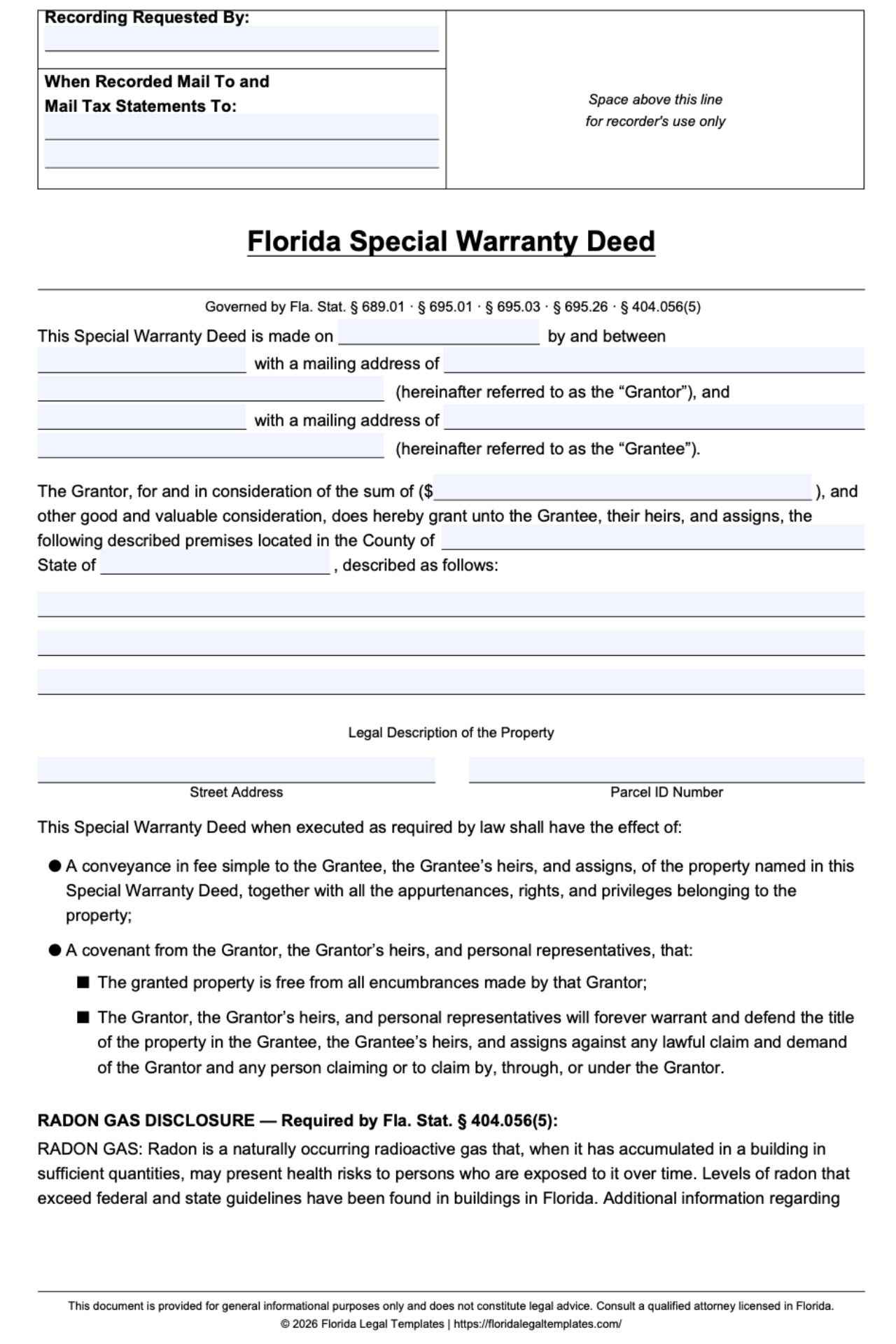
The special warranty deed Florida form is available in both fillable PDF and editable Microsoft Word formats, making it suitable for transactions that require either electronic completion or customized drafting.
A properly prepared template should include:
- Florida statutory granting language
- Limited warranty clause restricting liability to the grantor’s ownership period
- Grantor and grantee information
- Legal property description
- Parcel Identification (Folio) Number field
- Consideration clause
- Signature block for the grantor
- Two subscribing witness signature blocks
- Witness printed names and mailing addresses
- Notary acknowledgment
- Preparer’s name and mailing address
- Grantee mailing address
- Florida’s mandatory Radon Gas Disclosure
Unlike a generic deed template found online, a Florida-compliant form contains numerous statutory fields that recording offices expect to see before accepting the document.
Who Should Use This Form?
A Florida Special Warranty Deed is frequently used by:
- Banks selling foreclosed (REO) properties
- Mortgage lenders disposing of acquired real estate
- Builders transferring newly constructed homes
- Corporate property owners
- Trustees
- Estate personal representatives
- Investment companies selling recently acquired property
These sellers usually have limited firsthand knowledge of the property’s ownership history and therefore restrict their warranty to the period during which they held title.
When This Form May Not Be Enough
A Special Warranty Deed is not appropriate for every transaction.
For example, if a buyer’s lender or title insurance company requires a General Warranty Deed, using a Special Warranty Deed alone may delay or even prevent closing until the seller provides broader warranty language.
Likewise, if the property qualifies as Florida homestead property and the owner is married, additional constitutional requirements apply. Even where only one spouse appears on title, the non-owner spouse may still need to join in the conveyance. Simply completing the deed form does not satisfy those requirements.
What Is a Special Warranty Deed in Florida?
A Florida Special Warranty Deed transfers fee simple ownership while limiting the grantor’s promises regarding title.
Rather than guaranteeing the property’s entire ownership history, the grantor only promises that:
- they did not create undisclosed liens,
- they did not voluntarily encumber the property beyond disclosed interests,
- they have not conveyed the property to someone else, and
- they will defend the title only against claims arising through their own ownership.
This limited warranty is the defining feature of the document.
How It Differs From Other Florida Deeds
Understanding this distinction is often more important than understanding the deed itself.
| Deed Type | Warranty Protection |
|---|---|
| General Warranty Deed | Covers the property’s entire chain of title, including ownership before the grantor acquired it. |
| Special Warranty Deed | Covers only defects arising during the grantor’s ownership. |
| Quitclaim Deed | Provides no warranties whatsoever regarding ownership or title. |
The Special Warranty Deed therefore occupies the middle ground.
The seller limits future liability while still providing the buyer with meaningful assurances regarding their own conduct.
Why Buyers Should Care
Suppose a title problem surfaces involving an unpaid mortgage recorded twenty years before the current seller ever purchased the property.
Under a General Warranty Deed, the buyer may have recourse against the seller.
Under a Special Warranty Deed, that same claim generally falls outside the seller’s warranty because the defect existed before the seller owned the property.
This difference explains why buyers frequently obtain title insurance. The insurance policy—not the deed—often becomes the buyer’s primary protection against historical title defects.
Why Banks and Builders Prefer This Deed
Institutional sellers rarely possess complete knowledge of every prior transaction affecting a property.
A lender selling a foreclosed home, for example, cannot realistically guarantee events occurring decades before foreclosure.
Similarly, builders developing subdivisions generally warrant only matters occurring during their ownership.
Limiting liability through a Special Warranty Deed allows these sellers to transfer ownership without assuming unknown historical risks.
Key Florida Statutes Governing This Deed
Execution, Recording & Disclosure Requirements
| Topic / Issue | Precise Legal Rule | Governing Statute / Code |
| Two-Witness Mandate | Requires all real property deeds to be signed in the presence of exactly two subscribing witnesses. | Fla. Stat. § 689.01(1) |
| Witness Address Trap | Dictates that both the name and the complete post office address of each witness must be legibly printed below their signature block. | Fla. Stat. § 695.26(1)(c) |
| Limited Warranty Anchor | Restricts the grantor’s liability strictly to title defects or encumbrances created by, through, or under the grantor’s own tenure. | Florida Common Law Deeds & Case Precedents |
| Grantee Metadata Rule | Explicitly blocks recordation unless the full name and post office address of every grantee are clearly displayed on the instrument. | Fla. Stat. § 695.26(1)(f) |
| Homestead Joinder Rule | Bars third-party transfers without spousal signatures on primary homes, but explicitly permits one-sided direct inter-spousal deeds. | Florida Constitution Art. X, § 4(c) & Fla. Stat. § 708.08 |
| Anti-Fraud Verification | Empowers county clerks to demand a valid government-issued photo ID from the party submitting real property conveyances for recordation. | Fla. Stat. § 28.2225 |
| Documentary Stamp Tax | Charges a baseline transfer tax of $0.70 per $100 of consideration across 66 counties; Miami-Dade utilizes a unique local rate of $0.60 per $100. | Fla. Stat. § 201.02 |
Florida recording offices examine much more than signatures. Recording clerks routinely review deeds for statutory formatting requirements, required addresses, acknowledgment language, and mandatory identifying information before accepting an instrument for recording.
Many rejected deeds involve simple omissions rather than complex legal errors. Missing witness addresses, omitted preparer information, or incomplete acknowledgment blocks frequently require the document to be corrected and re-executed before recording can proceed. That can delay closings, postpone funding, and create unnecessary title complications.
Practical Impact & Document Clauses
Every required field on the deed serves a practical legal purpose.
The witness lines establish compliance with Florida’s execution requirements. The preparer block identifies who drafted the instrument. The parcel identification number helps county officials accurately associate the deed with the correct parcel. The grantee’s mailing address ensures future tax notices and ownership records can be maintained correctly.
Perhaps the most important clause is the limited warranty language itself:
“…and the Grantor does hereby warrant the title to said land, and will defend the same against the lawful claims of all persons claiming by, through, or under the Grantor, but against none other.”
Those final words fundamentally distinguish a Special Warranty Deed from a General Warranty Deed. They expressly limit the grantor’s liability to claims arising through the grantor’s own ownership, excluding defects originating earlier in the chain of title.
While Florida law mandates a specific radon gas warning, this consumer notification applies strictly to initial purchase contracts and long-term lease agreements under Fla. Stat. § 404.056(5). Including this block of text on the deed itself is a legacy boilerplate habit rather than a statutory mandate. Florida county clerks do not check deeds for radon language, and its absence will never cause a deed to be rejected or voided.
When a Special Warranty Deed Fits and When It Doesn’t
A Florida Special Warranty Deed is designed for transactions where the seller is willing to stand behind their own ownership of the property, but not the actions of previous owners. In commercial and institutional real estate transactions, this allocation of risk is common because the seller often lacks firsthand knowledge of the property’s complete history.
Common Situations Where This Deed Makes Sense
A Special Warranty Deed is frequently used by:
- Banks selling foreclosed (REO) properties
- Mortgage lenders disposing of acquired real estate
- Builders conveying newly constructed homes
- Limited liability companies (LLCs) and corporations selling investment properties
- Trustees transferring trust-owned real estate
- Personal representatives administering an estate
In these situations, the seller typically did not occupy the property or investigate decades of prior ownership. Instead of guaranteeing the entire chain of title, they only warrant that they did not create title defects while they owned the property.
For example, a bank that acquires a home through foreclosure cannot reasonably promise that a prior owner did not create an undisclosed easement or leave behind an unreleased lien years earlier. A Special Warranty Deed limits the bank’s responsibility to issues arising during its ownership.
When Buyers May Request Stronger Protection
Some residential transactions require broader warranties.
If the buyer’s lender or title insurance underwriter expects a General Warranty Deed, presenting only a Special Warranty Deed may delay underwriting or require additional negotiations before closing. Although title insurance often protects against historical defects, lenders may still require broader contractual warranties from the seller.
Before preparing closing documents, buyers and sellers should confirm the deed type required by the purchase agreement, lender, and title company.
Situations Where This Deed Is Usually Not Appropriate
A Special Warranty Deed may not be the best choice when:
- The seller has owned and occupied the property for many years.
- The property’s ownership history is well established.
- The buyer expects full title protection.
- The purchase contract specifically requires a General Warranty Deed.
Refusing to provide the deed type required under the sales contract can delay or even jeopardize closing.
Another important consideration involves Florida homestead property. Constitutional protections apply regardless of which deed form is used. A correctly drafted Special Warranty Deed cannot override Florida’s homestead requirements if a required spouse fails to join in the conveyance.
How to Complete and Record the Deed
Preparing a Florida Special Warranty Deed involves much more than filling in names and obtaining signatures. Every section of the document serves a legal purpose, and overlooking a required element can prevent the deed from being recorded.
Step 1: Identify the Grantor and Grantee
Begin by entering the legal names of the grantor (seller) and grantee (buyer). The deed should also include each grantee’s mailing address, as required for recording.
Double-check spelling against government-issued identification and the existing deed. Minor name discrepancies can create unnecessary title questions later.
Step 2: Insert the Property Description
Include:
- The complete legal description from the current deed
- The property’s Parcel Identification Number (Folio Number)
- County where the property is located
Do not rely solely on the street address. The legal description—not the mailing address—is what legally transfers ownership.
Step 3: State the Consideration
The deed should accurately state the consideration exchanged for the transfer.
This amount also affects the documentary stamp tax collected at recording.
Step 4: Evaluate Optional Radon Boilerplate and Mandatory Grantee Details
Under Fla. Stat. § 404.056(5), the statutory radon disclosure is legally mandated for sales contracts and lease agreements, not the final executed deed. Including it on a deed is optional boilerplate that recording offices completely ignore. However, you must ensure that every single grantee’s full name and physical post office address are legibly printed, typed, or stamped on the instrument as strictly required by Fla. Stat. § 695.26(1)(f) to prevent immediate clerical rejection.
Step 5: Execute the Deed Properly
The grantor must sign:
- In the presence of two subscribing witnesses
- Before a notary public
Each witness should also sign the deed and have their printed name and mailing address included. Missing witness information is one of the more common reasons deeds are rejected for recording.
Step 6: Record the Deed
After execution, the original deed should be submitted to the Clerk of the Circuit Court (or County Comptroller) in the Florida county where the real estate is located.
Recording establishes priority against later purchasers and creditors and becomes part of the county’s public records.
Documentary Stamp Tax
Florida imposes documentary stamp tax when real property is transferred.
The standard rate is:
- $0.70 per $100 (or fraction thereof) of the consideration paid.
Miami-Dade County follows different rules for certain transfers, including a lower rate for single-family residences and additional surtax provisions applicable to many commercial properties.
Failure to pay the required tax can delay recording.
Identity Verification
Florida clerks also utilize identity verification procedures designed to combat deed fraud.
Anyone presenting the deed for recording should be prepared to provide a photocopy of a government-issued photographic identification card under the county’s Identity Verification Program.
Practical Tip
Because the seller’s warranty is intentionally limited, buyers should strongly consider obtaining a title search or title insurance before closing.
If a title problem predates the seller’s ownership, the buyer’s protection will often come from the title insurance policy—not from the Special Warranty Deed itself.
Homestead, Spousal Joinder, and Other Limitations
Florida’s constitutional homestead protections create one of the most significant limitations on the use of a Special Warranty Deed.
Homestead Property Requires Spousal Joinder
Under Article X, Section 4(c) of the Florida Constitution and Fla. Stat. § 708.08, a married titleholder is barred from conveying or encumbering a protected primary residence to a third party without spousal joinder. However, a major statutory exception exists under Fla. Stat. § 708.08(1) for inter-spousal transfers: an owner may freely execute a deed transferring homestead title directly to their spouse, or vest it in both spouses as a tenancy by the entirety, without requiring the non-titled spouse to sign as a grantor.
Missing Witnesses Create More Than a Technical Error
Florida requires two subscribing witnesses.
A deed lacking the required witness signatures does not merely create a recording inconvenience—it creates a significant title problem that often requires a corrective deed or, in some situations, quiet title litigation to resolve.
Because the execution itself is defective, simply recording the document later will not cure the problem.
Limited Warranty Means Limited Recovery
Another commonly misunderstood limitation involves historical title defects.
Suppose a buyer later discovers:
- an unreleased mortgage from thirty years ago,
- an undisclosed utility easement,
- a restrictive covenant recorded decades before the current seller purchased the property.
Under a Special Warranty Deed, the buyer generally cannot recover damages from the seller for defects that arose before the seller acquired title.
In practice, the buyer’s primary remedy is usually a claim under their title insurance policy rather than litigation against the seller.
Costly Mistakes Sellers and Buyers Make With This Deed
Many title disputes originate from assumptions rather than intentional misconduct.
Assuming Every Warranty Deed Provides Full Protection
The word “warranty” often causes confusion.
Some buyers believe every warranty deed guarantees the property’s entire ownership history.
A Special Warranty Deed does not.
Understanding this distinction before closing can prevent expensive misunderstandings later.
Forgetting Spousal Joinder
Florida homestead rules are unforgiving.
A transaction that appears perfectly valid can later be challenged if a required spouse never joined in the conveyance.
Correcting that mistake after closing can become significantly more expensive than obtaining the proper signature at the outset.
Missing Recording Information
Common recording problems include:
- omitted witness addresses,
- missing preparer information,
- incomplete acknowledgment certificates,
- missing parcel identification numbers.
These omissions frequently result in rejected recordings and delayed closings.
Using the Wrong Deed Type
Even a perfectly drafted Special Warranty Deed cannot satisfy a purchase agreement or lender that specifically requires a General Warranty Deed.
Confirming document requirements early in the transaction helps avoid last-minute closing delays.
Frequently Asked Questions (FAQ)
Can a Special Warranty Deed be recorded if a witness’s address is missing?
Generally, no. Florida recording requirements call for each subscribing witness’s post office address to appear on the instrument. Omitting that information may cause the recording clerk to reject the deed until it is corrected.
Does a Special Warranty Deed protect a Florida buyer if a lien from a previous owner surfaces later?
Usually not. The seller’s warranty only covers claims arising through the seller’s ownership. Liens or defects created before the seller acquired the property generally fall outside the warranty. This is why title insurance is so important in Special Warranty Deed transactions.
Is a Special Warranty Deed valid if the seller’s spouse does not sign but the property is not homestead?
The homestead requirement specifically applies to protected homestead property. If the property is not legally homestead, the constitutional spousal joinder requirement generally does not apply under the facts provided. However, other ownership interests or contractual obligations may still require additional signatures.
What happens if a lender requires a General Warranty Deed but the seller only provides a Special Warranty Deed?
The lender or title company may refuse to proceed until the deed satisfies the transaction requirements. In many cases, the parties must renegotiate the deed type or amend the purchase agreement before closing can occur.