
Short Term Rental (Vacation) Agreement Florida [PDF Template]
A florida short term rental agreement is a fundamentally different document from a residential lease and property owners who treat it as the same thing by handing a vacation guest a standard Florida lease agreement are unintentionally granting that guest tenant rights, security deposit protections, and eviction procedures that Florida law never intended to apply to a transient occupancy. Under F.S. § 83.42(3), transient occupancy in a public lodging establishment is explicitly excluded from the residential landlord-tenant protections of Chapter 83 which means a short term rental agreement florida drafted as a lodging contract rather than a lease keeps the owner firmly in the position of a lodging operator with the right to immediate summary removal of a problem guest under F.S. §509.141, rather than a landlord who must file for eviction in county court.
The tax and licensing obligations travel with the document too: Florida targets rentals of six months or less for transient rental tax under F.S. § 212.03, while F.S. § 509.013(12) defines transient status based on the intent of the parties, triggering DBPR vacation rental licensing requirements under F.S. § 509.241 for properties booked for stays shorter than 30 days—a compliance requirement that the short-term agreement should explicitly reference by its license number.
I’ve worked with property owners who used a standard residential lease for a two-week Airbnb stay, then faced a formal eviction proceeding when the guest refused to check out — a process that took weeks, cancelled future bookings, and cost far more than any security deposit would have covered. The florida vacation rental agreement template and breakdown below cover the transient occupancy framework, the mandatory disclosures Florida law requires, and the key clauses that keep an owner operating as a lodging operator rather than an accidental landlord.
Candice Hayden, Legal Writer
Ross Bridger, Florida, Real Estate Attorney
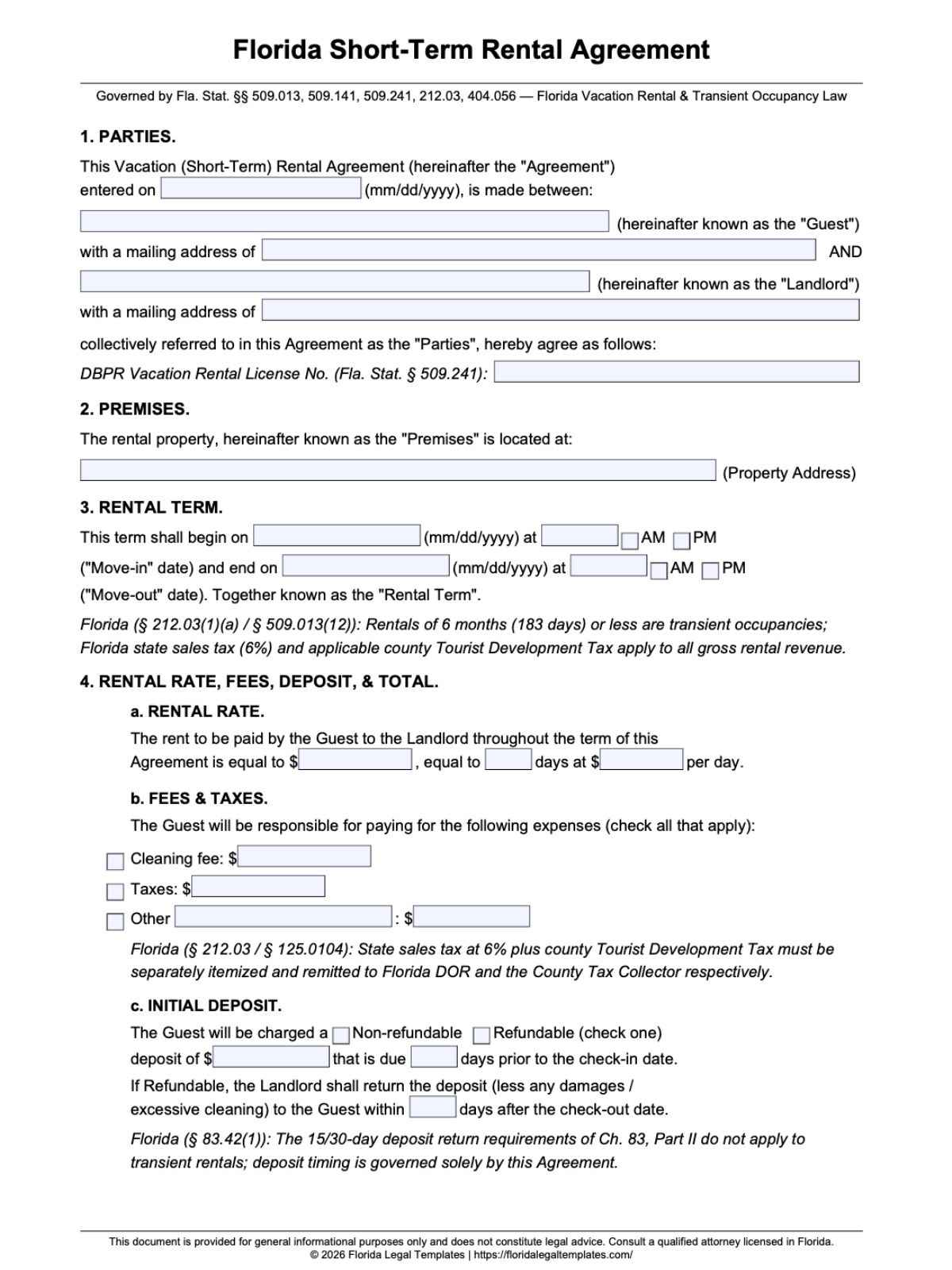
Florida Short Term Rental Agreement Template
A Florida short-term rental template is designed to provide a standardized framework for temporary lodging arrangements. Most templates are available in PDF, printable, and fillable formats that can be customized for individual properties.
Who Should Use This Form?
This agreement is commonly used by:
- Vacation rental owners
- Airbnb hosts
- VRBO hosts
- Property managers
- Seasonal rental operators
- Owners of beach and resort properties
What the Form Typically Includes
A well-drafted agreement generally contains:
- Guest identification information
- Property description
- Rental dates
- Occupancy limits
- House rules
- Rental charges and fees
- Tax collection provisions
- Security deposit terms
- Cancellation policies
- Damage responsibility clauses
When Short Term Rental Agreement Florida May Not Be Sufficient
A standard form may require modification when dealing with:
- Long-term residential occupancies
- Properties subject to strict HOA restrictions
- Condominium communities with rental limitations
- Luxury vacation rentals requiring extensive liability provisions
- Complex multi-property management operations
In some situations, a lease addendum may be needed to address property-specific requirements.
What Is a Short Term Rental Agreement in Florida?
A Florida short-term rental agreement is a private contract governing a temporary lodging arrangement between a property owner or manager and a transient guest.
Unlike residential leases, vacation rental agreements generally involve short stays intended for tourism, recreation, seasonal travel, or temporary accommodations.
Under Florida law, many vacation rentals are regulated as transient public lodging establishments under Chapter 509, Part I of the Florida Statutes. This distinction is significant because transient guests are not treated the same as residential tenants.
Even when bookings occur through platforms such as Airbnb or VRBO, hosts benefit from having a separate written agreement. Platform terms may not address property-specific rules, occupancy restrictions, parking requirements, or local compliance obligations.
Common property types include:
- Single-family vacation homes
- Condominium units
- Beachfront rentals
- Resort accommodations
- Seasonal tourism properties
When to Use a Florida Short Term Vacation Rental Agreement
This agreement is appropriate for:
- Vacation stays
- Weekend rentals
- Holiday accommodations
- Seasonal tourism rentals
- Resort and beach properties
- Event-related lodging
- Snowbird rentals that remain transient in nature
A written agreement creates clear expectations before arrival and can reduce disputes regarding fees, occupancy, damages, and cancellations.
When Not to Use Florida Short Term Rental Agreement
A short-term rental agreement generally should not be used for:
- Traditional Florida residential leases agreements
- Month-to-month housing arrangements
- Long-term tenant occupancy
- Permanent residence situations
- Properties where HOA or condominium documents prohibit short-term rentals
Florida law does not allow private contracts to override valid HOA or condominium restrictions. If community governing documents prohibit short-term occupancies, a rental agreement that violates those restrictions may be unenforceable and expose the owner to penalties.
Essential Clauses Every Florida Short Term Rental Agreement Should Include
Property and Occupancy Information
The agreement should clearly identify:
- Property address
- Unit number (if applicable)
- Check-in date and time
- Check-out date and time
- Maximum guest occupancy
- Vehicle parking limitations
Occupancy and parking provisions are especially important because local governments retain authority to enforce local density, parking, and noise regulations.
Rental Charges and Tax Collection
The financial section should address:
- Rental amount
- Cleaning fees
- Security deposits
- Additional service charges
- Applicable taxes
Florida operators generally must collect state sales tax and applicable local taxes associated with short-term rentals. Failure to address tax collection in the agreement can create accounting and compliance problems.
Guest Conduct and Property Rules
House rules commonly cover:
- Noise restrictions
- Parking requirements
- Trash disposal procedures
- Pet policies
- Smoking restrictions
- Community rules
These provisions help protect the property while supporting compliance with local ordinances and association requirements.
Cancellation and Refund Terms
A cancellation clause should explain:
- Cancellation deadlines
- Refund eligibility
- Partial refund calculations
- Force majeure events
- Reservation modification procedures
Without clear cancellation language, disputes regarding refunds can become difficult to resolve.
Property Damage and Liability Allocation
The agreement should establish:
- Damage reporting procedures
- Guest responsibility for losses
- Repair reimbursement obligations
- Inspection rights after departure
These provisions help allocate financial responsibility when property damage occurs during the rental period.
Florida Laws That Affect Short Term Rental Agreements
| Topic / Issue | Florida Legal Rule | Governing Statute |
|---|---|---|
| Vacation rental licensing | A mandatory DBPR license is required if an entire residential unit is rented out more than three times a year for short stays of less than 30 days or 1 calendar month (or advertised as such). | Fla. Stat. § 509.241 & § 509.013 |
| Transient lodging regulation | Governs structural operations, safety standards, mandatory county inspections, and guest safety rules under the state public lodging framework. | Fla. Stat. Chapter 509, Part I |
| Sales tax obligations | Accommodations rented for a duration of six months or less are legally classified as transient and are subject to the 6% state sales tax plus local county tourist development taxes (TDT). | Fla. Stat. § 212.03 |
| Human trafficking awareness | Public lodging operators must implement certified employee training programs and prominently display visible informational warning signage regarding human trafficking. | Fla. Stat. § 509.096 |
| Radon gas disclosure | Mandatory structural warning text must be displayed inside the contract if the occupancy arrangement has the potential to exceed 45 consecutive days. | Fla. Stat. § 404.056(5) |
| Local government enforcement | Local city and county zoning registrations, local short-term vacation rental ordinances, noise rules, parking limits, and occupancy density caps remain strictly enforceable alongside state-level laws. | Fla. Stat. § 509.032(7)(b) |
| Removal of transient guests | Authorizes immediate, summary law enforcement ejection of uncooperative, nonpaying, or holdover vacation guests without requiring the landlord to file a multi-week court eviction lawsuit. | Fla. Stat. § 509.141 |
Florida hosts operate within multiple regulatory layers. Vacation rental operators must obtain the appropriate state license before offering transient lodging accommodations pursuant to Fla. Stat. § 509.241.
Tax compliance is a separate obligation. In addition to rental income reporting, operators are generally responsible for collecting applicable state sales tax and related surtaxes under Fla. Stat. § 212.03.
Property owners should also understand that local governments retain authority to enforce occupancy limits, parking regulations, and noise ordinances regardless of what a rental agreement states. Contract provisions that conflict with local rules may be ineffective under Fla. Stat. § 509.032(7)(b).
If a transient guest refuses to leave after the agreed rental period, Florida law provides specialized removal procedures that differ from standard residential eviction processes under Fla. Stat. § 509.141.
Practical Impact on the Agreement
Including the property’s license number can demonstrate operational compliance.
Occupancy and parking clauses help align guest conduct with local regulations.
Tax collection language helps document the amounts charged and collected from guests.
Local ordinance compliance provisions reduce the risk of disputes arising from municipal enforcement actions.
Florida-Specific Compliance Requirements for Vacation Rental Hosts
DBPR Vacation Rental License Requirements
Florida requires transient lodging operators to obtain appropriate licensing through the Department of Business and Professional Regulation (DBPR).
License classifications generally include:
- Vacation Rental-Dwelling
- Vacation Rental-Condominium
Under Fla. Stat. § 509.241 and DBPR Division of Hotels and Restaurants regulations, displaying your active, state-issued DBPR license number (Vacation Rental-Dwelling or Vacation Rental-Condo) in all public listings, digital advertisements, social media promos, and the rental agreement itself is a mandatory legal requirement. Booking platforms and municipal code enforcement officers continuously audit online listings for missing or unverified DBPR license numbers, issuing administrative notices, daily fines, and listing removals for non-compliant properties.
Tax Registration Obligations
Before renting to guests, operators generally must register with:
- Florida Department of Revenue
- Applicable county tax authorities
Collection obligations can include:
- State sales tax
- Discretionary surtaxes
- Tourist Development Taxes (TDT)
Combined tax obligations often exceed the statewide sales tax rate alone.
Human Trafficking Awareness Requirements
Under Florida law, public lodging operators must comply with human trafficking awareness requirements that include:
- Staff training obligations
- Required warning signage
- Reporting awareness procedures
These requirements apply independently of the rental agreement itself.
Required Disclosures for Florida Short Term Rentals
Radon Gas Disclosure
If the rental arrangement has the potential to exceed 45 consecutive days, Florida law requires inclusion of the following disclosure language:
“RADON GAS: Radon is a naturally occurring radioactive gas that, when it has accumulated in a building in sufficient quantities, may present health risks to persons who are exposed to it over time. Levels of radon that exceed federal and state guidelines have been found in buildings in Florida. Additional information regarding radon and radon testing may be obtained from your county health department.”
The disclosure should appear clearly within the agreement whenever the occupancy could trigger the statutory requirement.
For additional information, see Fla. Stat. § 404.056(5).
Additional Property-Specific Disclosures
Hosts should also disclose:
- HOA rules
- Condominium restrictions
- Parking limitations
- Occupancy caps
- Community regulations
Failing to communicate these restrictions can create avoidable guest disputes.
How to Fill Out a Florida Short Term Rental Agreement
Step 1 – Identify the Parties
Include:
- Property owner information
- Property manager details (if applicable)
- Guest names and contact information
Unlike long-term rentals, hosts generally do not rely on a formal rental application process for transient guests.
Step 2 – Describe the Rental Property
List:
- Full property address
- Unit details
- Amenities provided
- Parking accommodations
Step 3 – Define the Rental Period
Specify:
- Arrival date
- Departure date
- Check-in procedures
- Check-out requirements
Clear arrival and departure provisions help avoid holdover occupancy disputes.
Step 4 – List Financial Terms
Document:
- Rental charges
- Deposits
- Cleaning fees
- Applicable taxes
- Additional charges
Step 5 – Establish House Rules
Address:
- Occupancy limits
- Parking restrictions
- Noise expectations
- Pet policies
- Trash disposal procedures
Each rule should be consistent with local ordinances and community requirements.
Step 6 – Review and Sign
Before execution:
- Verify all information
- Review disclosures
- Confirm tax calculations
- Ensure signatures are completed
Electronic signatures may be appropriate when permitted by applicable law and platform procedures.
Removing a Holdover Guest in Florida
Florida distinguishes transient guests from residential tenants.
Under Fla. Stat. § 509.141, operators generally do not use the residential eviction procedures found in Chapter 83 to remove a transient guest who refuses to depart after the rental period ends.
Instead, Florida law provides summary removal mechanisms for qualifying transient occupancy situations.
The classification of the occupancy arrangement is critical. Misclassifying a long-term tenant as a transient guest can create legal complications and procedural challenges.
Don’t Accidentally Convert a Vacation Guest Into a Residential Tenant
One mistake I see is owners assuming that calling a document a “short-term rental agreement” automatically preserves their right to use the summary removal procedure under Fla. Stat. § 509.141. It does not. Law enforcement and, if litigation follows, a court will look at the actual nature of the occupancy, not just the title of the agreement.
If the arrangement starts looking like ordinary housing instead of transient lodging, the owner may lose the ability to treat the occupant as a transient guest. Warning signs include repeatedly extending the stay without a new booking, accepting rent in monthly installments, allowing the property to become the guest’s primary residence, or otherwise operating the relationship as an ongoing residential tenancy rather than temporary lodging. Whether someone qualifies as a transient guest depends on the facts surrounding the occupancy and the parties’ intent, including the definitions in Fla. Stat. § 509.013(12).
A practical way to reduce this risk is to require every extension to be documented as a new transient booking with fresh arrival and departure dates, while continuing to operate the property as a licensed vacation rental rather than a residential lease. That creates a record showing the occupancy remained temporary instead of evolving into a traditional landlord-tenant relationship.
HOA, Condominium, and Local Government Restrictions
HOA Rental Restrictions
Many associations impose:
- Minimum rental periods
- Registration requirements
- Complete short-term rental bans
Owners should verify governing documents before accepting reservations.
Condominium Restrictions
Condominium declarations may impose:
- Occupancy restrictions
- Rental frequency limits
- Minimum stay requirements
A rental agreement cannot override these governing documents.
Local Ordinance Compliance
Local governments may enforce:
- Noise ordinances
- Parking regulations
- Occupancy caps
- Trash management requirements
Any contract term that conflicts with local rules may be ineffective and unenforceable.
Common Mistakes Florida Vacation Rental Hosts Make
Common errors include:
- Using a residential lease instead of a transient rental agreement
- Failing to obtain a DBPR license
- Not collecting required taxes
- Ignoring HOA restrictions
- Exceeding occupancy limits
- Omitting cancellation provisions
- Failing to include required disclosures
- Assuming booking-platform terms replace a written contract
These mistakes can result in guest disputes, regulatory issues, tax liabilities, fines, and operational interruptions.
Frequently Asked Questions
Do I need a written short term rental agreement for Airbnb properties in Florida?
A written agreement is not always mandated by booking platforms, but it provides important protection by documenting occupancy limits, fees, house rules, damage responsibilities, and cancellation terms.
Can a Florida short term rental agreement override HOA rental restrictions?
No. A private rental agreement cannot override valid HOA or condominium restrictions. Community governing documents remain enforceable.
What taxes must be collected under a Florida vacation rental agreement?
Florida vacation rental operators generally must collect applicable state sales tax, discretionary surtaxes, and local Tourist Development Taxes when required under applicable law.
Can a host evict a short term guest using Florida landlord-tenant laws?
Generally, qualifying transient guests are treated differently from residential tenants. Under Fla. Stat. § 509.141, summary removal procedures may apply instead of traditional residential eviction processes.
When is the Florida radon disclosure required in a short term rental agreement?
The statutory radon disclosure becomes relevant when the occupancy arrangement may extend beyond 45 consecutive days. The disclosure must use the exact statutory language required by Fla. Stat. § 404.056(5).