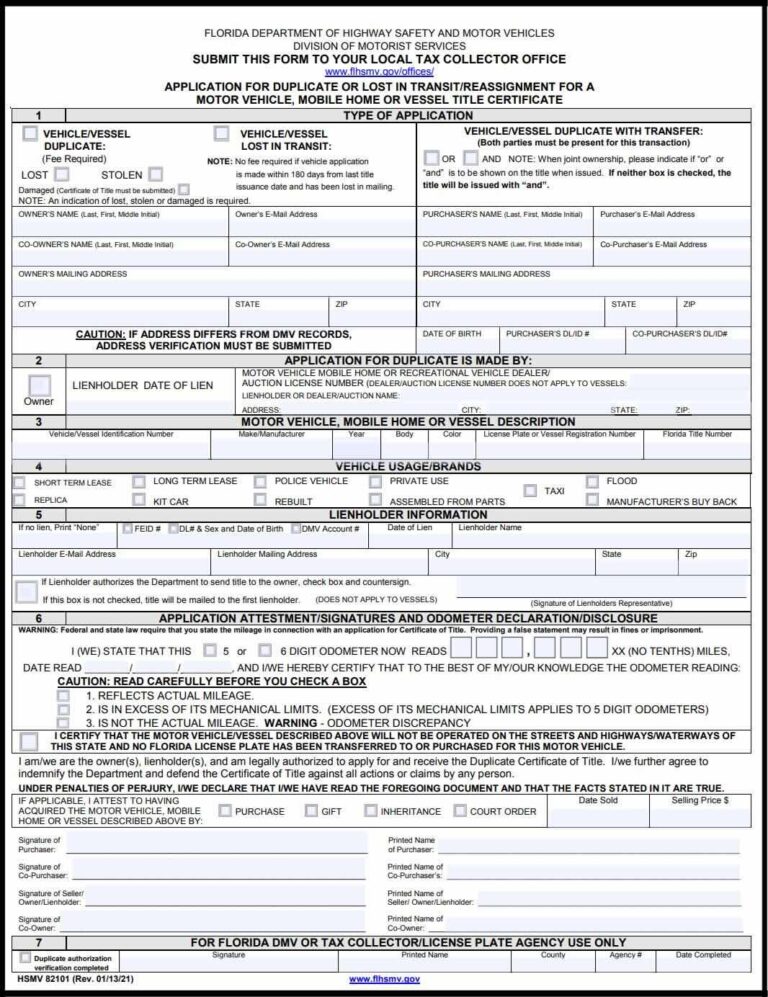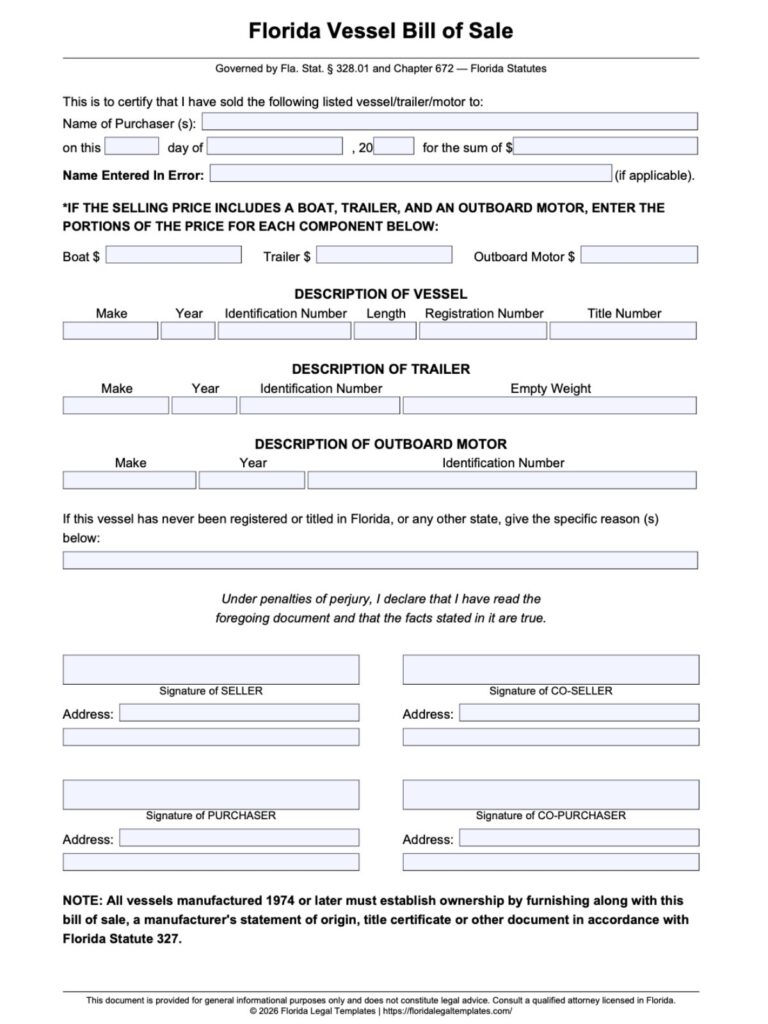
Florida Boat Bill of Sale [Free Printable, Fillable PDF]
A Florida boat bill of sale has two jobs that most generic templates only do one of — it documents the ownership transfer for title purposes and it serves as your legal proof of temporary registration on the water during the 30-day window Florida law gives you to complete the titling process. Under Fla. Stat. § 328.46, the bill of sale must be aboard the vessel and available for inspection during the 30-day period after purchase. It serves as the vessel’s temporary certificate of number during that period, and a violation of § 328.46 is classified as a noncriminal infraction under Fla. Stat. § 327.73(1)(a).
I’ve seen buyers show up at the tax collector’s office with a boat bill of sale florida template they printed from a generic site, only to run into problems when the ownership paperwork lacks the vessel details Florida requires for the title application, including the hull identification number, overall vessel length, hull material, propulsion type, and other required specifications. The vessel bill of sale florida template below is built to satisfy both requirements — the description details FLHSMV needs for the title application and the on-board documentation FWC expects if you’re stopped on the water.
Candice Hayden, Legal Writer
Carly Johansson, Florida Contract Attorney Last Updated: November 2, 2026
What Is a Florida Boat Bill of Sale?
A Florida boat bill of sale can document the sale and, when it contains the information required by Fla. Stat. § 328.46, serve as the vessel’s temporary certificate of number during the first 30 days after purchase.
Legal framework:
- Governed primarily by Chapter 328 of the Florida Statutes, subject to the exemptions and exceptions provided by that chapter.
- Administered through FLHSMV and County Tax Collectors
Legal nuance:
This document is more than a private receipt: depending on the transaction, a bill of sale can serve as supporting ownership documentation in Florida’s title and registration process.
Critical distinction:
- Bill of sale: Evidence of the sale and supporting ownership documentation
- Certificate of title: Prima facie evidence of the vessel’s ownership and the information in the title record
When a vessel already has a certificate of title, the seller must properly sign and deliver the title or the required electronic ownership record, and the buyer must complete the applicable title-transfer process rather than rely on a bill of sale alone.
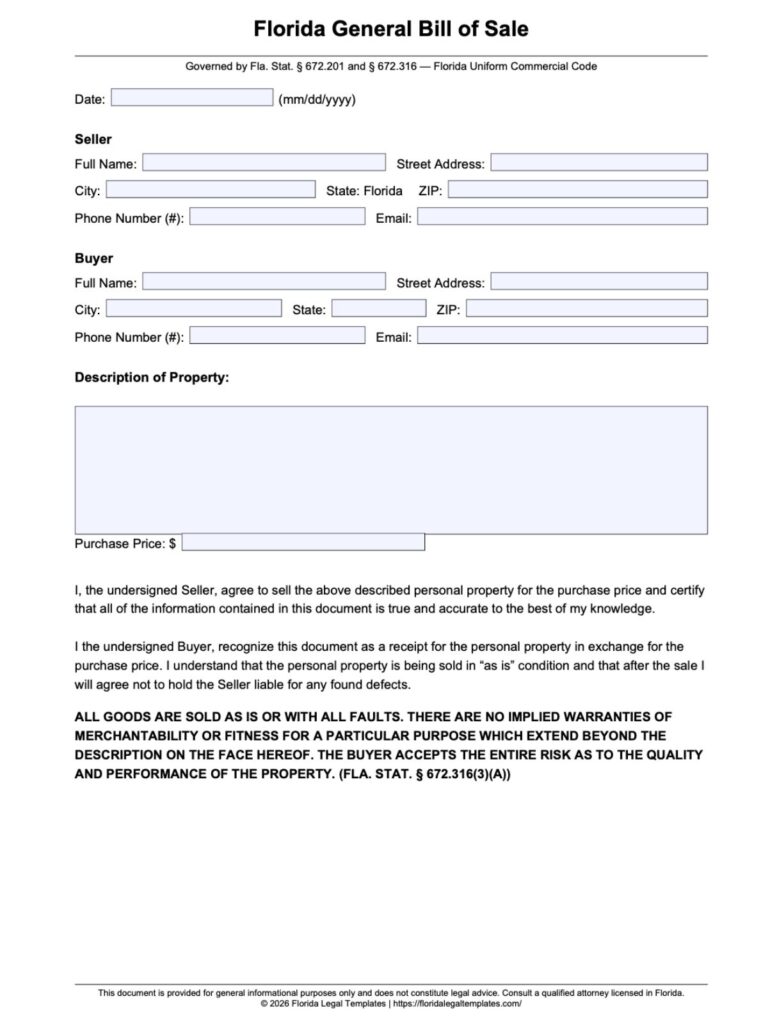
Because vessel transfers are treated differently from standard vehicle transactions, buyers often benefit from reviewing how Florida handles broader ownership documentation requirements through a general Florida proof of sale document. If the transaction involves a personal watercraft instead of a traditional vessel, the registration process and transfer structure are also similar to a personal watercraft ownership transfer form.
Execution validity:
- For the bill of sale used as the temporary certificate of number, both the purchaser and seller must sign.
- Notarization may be required for certain ownership-documentation situations, such as some vessels coming from non-titling states, but the requirement depends on the applicable documentation procedure rather than applying to every Florida boat bill of sale.
Practical implication:
If the buyer does not complete the title application, the transfer can still be effective between the buyer and seller. However, under Fla. Stat. § 328.22(3), a transfer that does not satisfy the required title-transfer procedure generally is not effective against another person claiming an interest in the vessel.
Florida Boat Bill of Sale (PDF, Printable, Fillable)
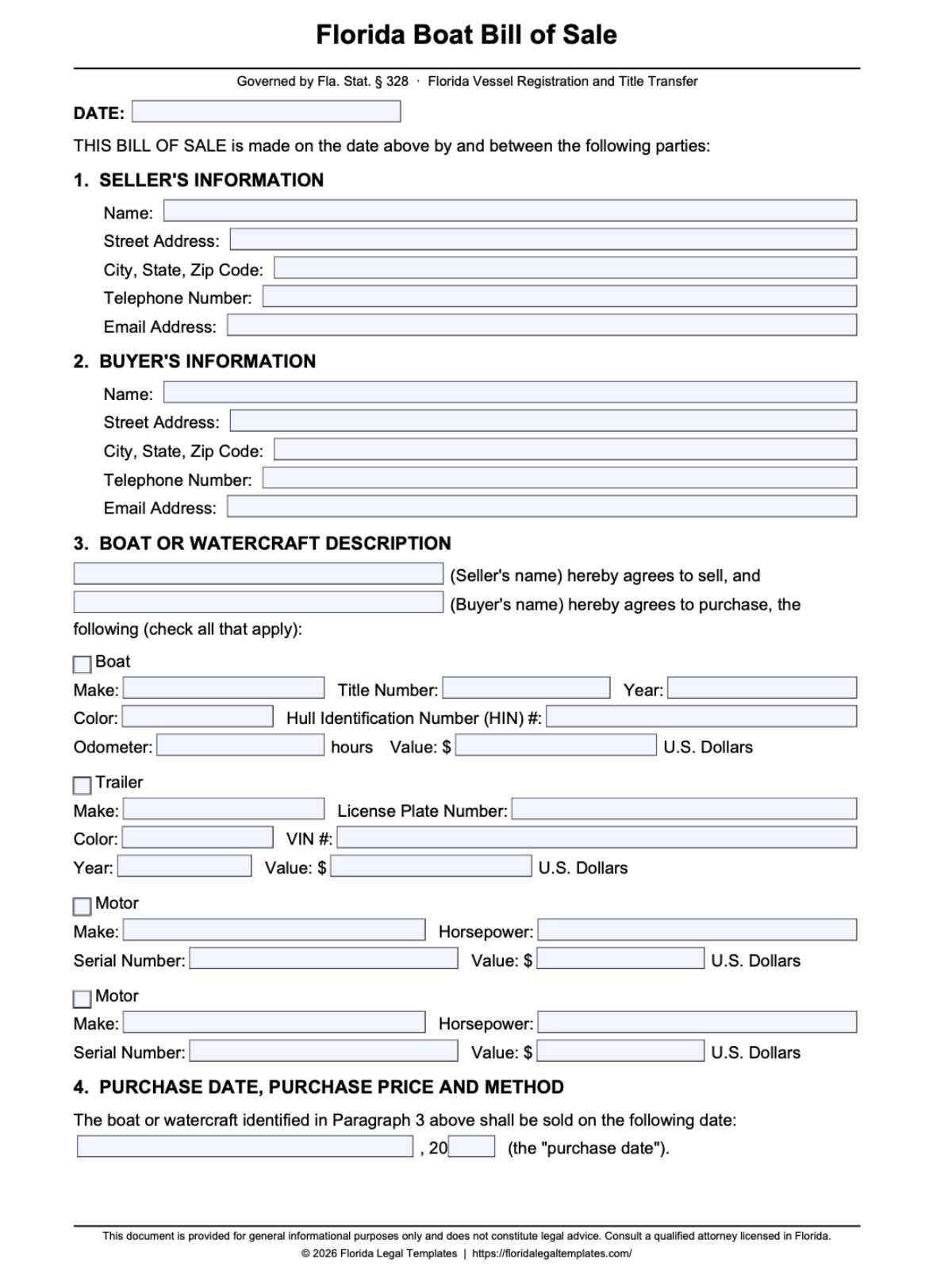
A Florida boat bill of sale pdf or fillable template provides a structured format that aligns with state requirements for vessel transfers.
What the document includes:
- Buyer and seller identification
- Vessel details:
- Hull Identification Number (HIN)
- Year, make, and length
- Type of propulsion
- Purchase price and payment terms
- Required statutory clauses, including the temporary authority notice
- Signatures of both parties
Who should use this:
- Buyers purchasing a privately owned vessel and preparing to apply for a Florida certificate of title.
- Sellers who need a signed record of the transaction and documentation of the ownership transfer.
- Buyers of untitled or out-of-state vessels who need supporting ownership records for the tax collector’s review.
When this template may NOT be sufficient:
- When a vessel already has a Florida title (title must be properly transferred)
- Homemade vessels without inspection and assigned HIN
- Transactions with missing or invalid ownership documentation
Even a complete boat bill of sale Florida will be rejected if it does not align with FLHSMV submission requirements.
Key Florida Laws That Affect Florida Boat Bill of Sale
Summary of Applicable Laws
| Topic / Issue | Florida Legal Rule | Governing Statute |
|---|---|---|
| Governing Law | Vessel titling and registration required | Chapter 328, Fla. Stat. |
| Execution & Proof | Signatures are required for the bill of sale used as the temporary certificate of number, while additional notarization or a perjury clause may apply to certain out-of-state ownership-documentation situations. | Fla. Stat. § 328.01 |
| Registration Timeline | The buyer generally must apply for the vessel title within 30 days after the later of the ownership transfer or the date Florida becomes the vessel’s state of principal use; a title-transfer application filed after that period is subject to an additional $10 fee. | Fla. Stat. § 328.46(1) & § 328.03(4) |
| Identification Requirement | The title application must include the required personal or business identification; an individual applicant may use a valid driver’s license or identification card issued by Florida or another state, or a valid passport. | § 328.01(7) |
| Title Transfer Requirement | A bill of sale does not replace the properly assigned certificate of title or the required electronic ownership record for a titled vessel. | § 328.22 & § 328.01(4) |
Practical Impact & Document Clauses
These laws directly control whether a Florida boat bill of sale will be accepted for registration and title transfer.
First, the document must include specific statutory language. The most critical requirement under Fla. Stat. § 328.46 is the temporary authority notice. The operator must keep the bill of sale on board, and it serves as a temporary certificate of number for exactly 30 days from the date of sale. Operating after day 30 without a permanent registration is a non-criminal infraction.
The document must also include:
- A statement declaring Florida as the state of principal use
- Complete vessel identification details (HIN, year, make, length, propulsion type)
Second, filing requirements are strict. The buyer generally submits the required ownership documents with Form HSMV 82040 VS, Application for Certificate of Vessel Title, through the appropriate county tax collector or authorized agent. The application must include the required vessel description, ownership documentation, identification, and applicable fees. Without this step, ownership is not officially transferred.
Third, both parties must meet identification requirements under Fla. Stat. § 328.01, meaning valid government-issued ID is required for processing.
Finally, the title-priority rule is critical. If a vessel has an existing Florida title, that title must be signed and transferred. For a titled vessel, the buyer should complete the required title-transfer process; a bill of sale alone does not substitute for the required certificate-of-title documentation.
Failure to follow these requirements can result in:
- Rejected title applications
- Delayed registration
- Continued liability for the seller
- Exposure to fraud-related penalties
Florida’s filing rules become even more important when the vessel sale is financed privately or paid in installments. In those situations, parties sometimes also document repayment obligations separately using a written payment agreement to avoid disputes over unpaid balances after the title transfer is submitted.
When to Use Florida Boat Bill of Sale
A Florida vessel bill of sale is especially important in a private sale because the document can support the title application and, during the first 30 days after purchase, can serve as the temporary certificate of number required under Fla. Stat. § 328.46.
Common use cases:
- Purchasing a previously titled boat from a private Florida seller.
- Buying an untitled vessel that requires supporting ownership documentation under §328.01(4).
- Purchasing a vessel from another state that will become principally used in Florida.
Practical scenarios:
-
Cash purchase: Record the full purchase price, payment date, and both parties’ signatures so the transaction is documented.
-
Out-of-state purchase: Keep the previous title or registration records and any additional ownership documents requested by the county tax collector.
-
Untitled vessel: Provide a bill of sale or other ownership record that satisfies the department under §328.01(4)(b).
When NOT to use:
-
As the only transfer document when the vessel already has a certificate of title.
-
As proof of ownership when the seller cannot establish a legitimate ownership interest.
-
As temporary operating authority when the bill of sale omits any information required by §328.46(1).
Before handing over the boat, check that the seller’s title information matches the vessel’s HIN and that the bill of sale contains the information required by §328.46(1). If a trailer is included, complete its ownership paperwork separately so both transfers are documented.
Many private sellers handling multiple recreational vehicle transfers use similar ownership documentation across different asset types. For example, transactions involving campers or towable recreational units often require a Florida RV transfer document, while utility towing equipment sales generally rely on a trailer ownership sale form.
Boat Included? That Does Not Automatically Include the Trailer
One mistake I see regularly is buyers assuming the boat bill of sale also transfers the trailer sitting underneath it. In Florida, the boat and the trailer are separate pieces of property with separate ownership records. A vessel is titled and registered under Chapter 328, while most boat trailers are titled and registered through Florida’s motor vehicle system under Chapter 319 and Chapter 320, depending on the trailer’s weight and title status. Buying one does not legally transfer the other.
If the seller is including the trailer, make sure the paperwork clearly identifies it with its own vehicle identification number (VIN), year, make, and purchase price, or states that the trailer is included in the total sale price. If the trailer requires a Florida title, the seller must also properly assign that title to the buyer. Showing up with only a boat bill of sale is a common reason buyers leave the tax collector’s office with the vessel paperwork completed but the trailer still legally belonging to the previous owner. Handling both transfers at the same time avoids a second trip and prevents registration problems if you plan to tow the boat home immediately.
Florida also has a specific sales-tax rule for boat packages. Under Fla. Stat. § 328.01(9)(b), a title transfer between individuals generally includes the purchase price of the complete vessel rig, including its motor, trailer, and accessories. If the buyer submits an itemized bill of sale that separately identifies the prices paid for each component, the statute provides a different sales-tax treatment. This is another reason to list the boat, motor, and trailer separately when they are sold together.
How to Create or Fill Out the Florida Boat Bill of Sale
Creating a compliant Florida boat bill of sale means getting the vessel identification and temporary-authority information right, because § 328.46 specifies what the bill of sale must contain when it serves as the temporary certificate of number.
Step-by-step process:
- Identify the parties
- Full legal names
- Valid government-issued identification
- Describe the vessel
- Hull Identification Number (HIN)
- Year, make, and length
- Type of propulsion
- State purchase price
- Include amount and payment method
- Insert required statutory clauses
- Temporary authority notice stating that the vessel’s temporary operating authority expires 30 days after the date of sale, as required by Fla. Stat. § 328.46(1)(l)
- Statement of principal use (Florida)
- Add additional disclosures
- Vessel condition
- Any liens or encumbrances
- Sign the document
- Both buyer and seller must sign
- Submit for title transfer
- File with County Tax Collector using Form HSMV 82040
- File Notice of Sale (seller)
- Submit Form HSMV 82050, Notice of Sale and/or Bill of Sale, to the appropriate tax collector or license plate agent, or properly endorse and deliver the certificate of title as permitted by Fla. Stat. § 328.01(7)(d). The seller should keep proof of the completed filing or title transfer to document the transaction.
Practical tips:
- Double-check HIN accuracy—errors can delay registration
- Do not modify statutory language—use exact wording
- Keep copies for both parties
Accuracy in vessel identification details is critical because Florida title offices reject incomplete ownership records across nearly all motorized property transfers. Sellers familiar with highway vehicle transfers often recognize similar documentation standards from the motor vehicle sale paperwork process, especially regarding serial numbers, ownership disclosures, and transfer timelines.
Limitations and Legal Considerations
A Florida boat bill of sale does not eliminate the need to complete the applicable title-transfer process for a titled vessel, but Florida law does not treat an uncompleted title application as automatically voiding the transfer between the buyer and seller.
Key limitations:
- For a previously titled vessel, the buyer should obtain the properly signed certificate of title or the required electronic ownership record under §328.22.
- For an untitled vessel, the buyer may submit a certificate of origin, bill of sale, or another ownership record that satisfies the department under §328.01(4)(b).
Legal constraints:
- The title application must include the vessel’s manufacturer, model year, overall length, vessel type, hull material, propulsion type, and other applicable details under §328.01(2).
- The application must also include the required identification and ownership documentation under §328.01(4) and (7).
High-risk scenarios:
- Selling a vessel without proper title
- Using a bill of sale from a non-titling state without notarization or perjury clause
Edge cases:
- Antique vessels
- Homemade vessels requiring inspection and HIN assignment
- Out-of-state purchases
For a titled vessel, Florida requires the seller to properly endorse and deliver the certificate of title or the appropriate electronic ownership record under §328.22. A signed bill of sale is useful supporting documentation, but it does not replace that transfer procedure.
If ownership records contain errors, missing signatures, or incorrect vessel details, parties may need supplemental corrective documentation before the transfer can be processed. In some situations, a Florida correction affidavit may help clarify clerical mistakes submitted with title paperwork.
Common Mistakes to Avoid
Using a bill of sale instead of transferring title
A bill of sale does not override title requirements.
Consequence: Title application will be rejected.
Omitting the temporary authority clause
This is a statutory requirement.
Consequence: Buyer cannot legally operate the vessel during the initial 30-day period.
Missing vessel identification details
Incomplete HIN or specifications.
Consequence: Registration delays or rejection.
Not filing within the 30-day deadline
The buyer must apply for the vessel title within the applicable 30-day period, while the seller should promptly complete the title endorsement and submit the prescribed notice of sale when using that alternative to document the transfer.
Consequence: Continued liability. If the seller does not properly document the sale, the seller may face continuing ownership-related issues after the transfer, so filing the applicable notice of sale can be an important liability-protection step.
Using a non-compliant document
Missing required language or structure.
Consequence: Rejection by FLHSMV.
Attempting to sell a vessel with invalid ownership
Knowingly possessing, selling, offering to sell, counterfeiting, or supplying certain forged, fictitious, stolen, or fraudulently or unlawfully obtained vessel ownership documents with intent to defraud can constitute a third-degree felony under Fla. Stat. § 328.05(2).
Frequently Asked Questions (FAQ)
Does a Florida boat bill of sale transfer ownership by itself?
No. For a titled vessel, the parties should promptly complete the required title-transfer process, but Florida law provides that failing to apply for a new certificate does not by itself make the transfer ineffective between the buyer and seller.
What is the 30-day rule for vessel registration in Florida?
The buyer generally must complete the required title and registration steps within 30 days, while the seller should promptly submit the applicable notice of sale or properly endorsed title to document the transfer.
Can I use a bill of sale if the boat has no title?
Potentially. When there is no certificate of title, Florida law permits a certificate of origin, bill of sale, or other ownership record that satisfies the department, although additional documentation may be required for particular vessels or transactions.
What happens if I don’t include the required statutory notice?
The document may be rejected, and the buyer may not have legal authority to operate the vessel during the initial period.
A properly completed Florida boat bill of sale gives both parties a written record of the transaction and helps the buyer prepare the required vessel ownership documents. For a titled vessel, the buyer should also obtain the properly assigned title and complete the application process within the applicable 30-day period. Keeping the signed bill of sale and filing records together makes it easier to resolve questions about the purchase or subsequent ownership transfer.
Legal Disclaimer: This article provides general information about Florida vessel title and registration requirements and is not legal advice. Requirements can vary by vessel type, ownership records, and transaction circumstances.