Florida Lady Bird Deed (Free Form PDF & WORD)
A Florida Lady Bird Deed, also known as an Enhanced Life Estate Deed, is an estate-planning deed that can allow real property to pass to designated remainder beneficiaries at the owner’s death while reserving broad powers for the owner during the owner’s lifetime. Unlike a traditional life estate deed, the owner can continue to sell, refinance, mortgage, lease, or even revoke the deed without obtaining the beneficiaries’ permission—provided the deed contains the necessary enhanced powers language recognized under Florida common law.
Many Florida homeowners use this estate planning tool to avoid probate while preserving their homestead benefits and maintaining full ownership rights. However, because Florida has not adopted Transfer-on-Death (TOD) deeds for real estate, a Lady Bird Deed must be drafted carefully. Missing mandatory language, overlooking homestead restrictions, or failing to satisfy execution requirements can defeat the purpose of the deed or even convert it into a traditional life estate with far more restrictive legal consequences.
Candice Hayden, Legal Writer
Maria Rosso, Florida Probate, Guardianship and Estate Planning Attorney
Florida Lady Bird Deed Template (Free PDF & Fillable Form)
A professionally drafted Florida Lady Bird Deed form should contain far more than blank fields for names and property information. Because Florida recognizes this deed through common law rather than statute, the wording of the document plays a critical role in determining whether it functions as intended.
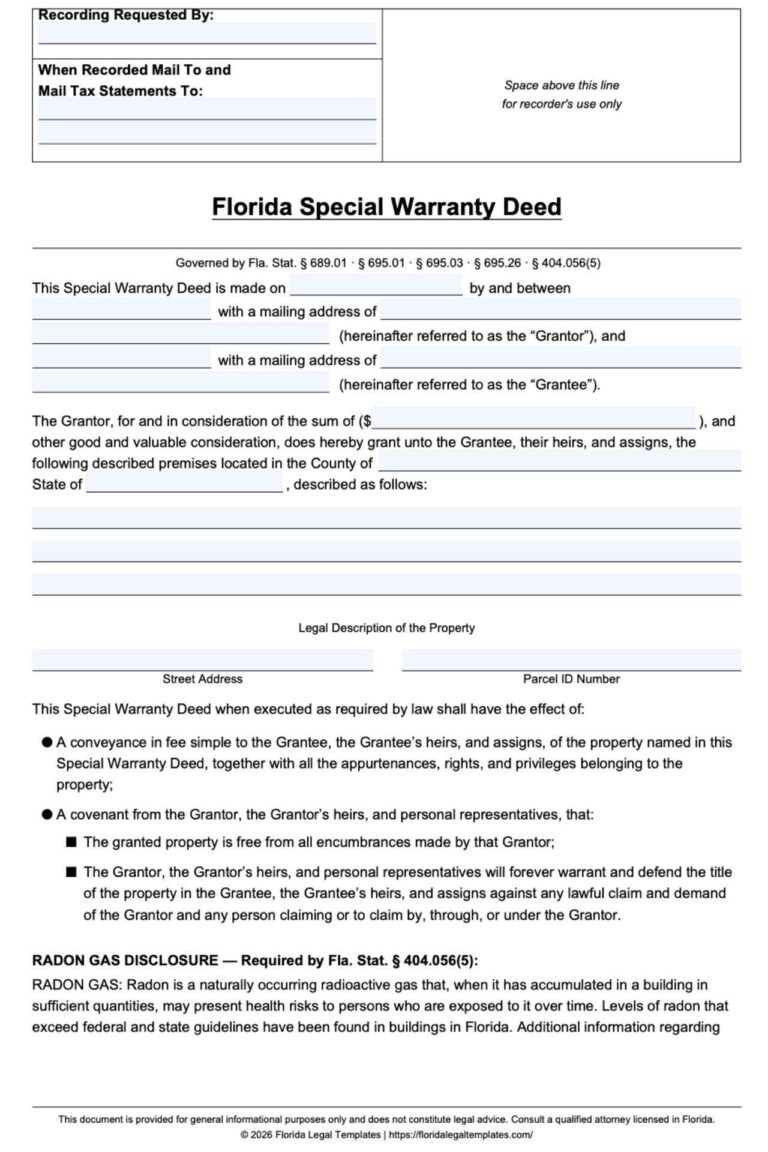
Our Florida Lady Bird Deed template is designed to include the provisions commonly expected during title examination and county recording.
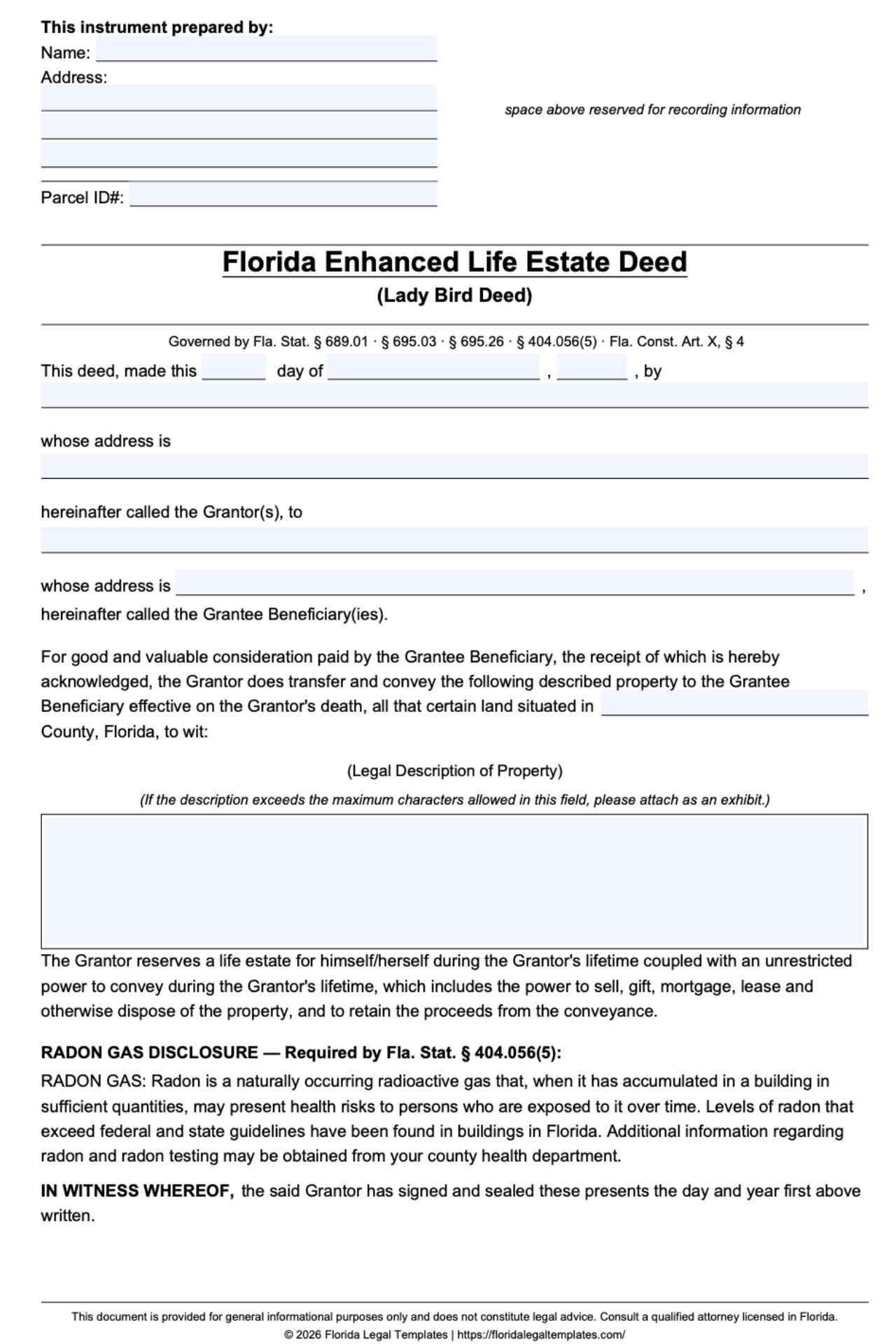
The template includes:
- Enhanced Life Estate reservation clause containing the required retained powers
- Property legal description section
- Grantor and remainder beneficiary information
- Preparer’s name and mailing address block
- Signature lines for grantor(s)
- Two witness signature blocks
- Florida notary acknowledgment
- Recording information section
Unlike generic deed forms found online, a properly drafted Lady Bird Deed Florida PDF should already incorporate the operational language necessary to preserve the grantor’s unrestricted authority over the property.
What the template already includes
Enhanced Life Estate Reservation Clause
The defining feature of an Enhanced Life Estate Deed Florida is the reservation of broad ownership powers.
The deed should expressly reserve the grantor’s right to:
- sell the property
- mortgage it
- lease it
- convey it
- revoke the deed
- retain all sale proceeds
- eliminate remainder beneficiaries without their consent
These are commonly referred to as the deed’s “enhanced powers.” If they are omitted or vaguely drafted, the instrument may function only as a traditional life estate.
The Radon Gas Boilerplate Myth
While Florida law requires a specific radon gas notice under Fla. Stat. § 404.056(5), this mandate applies strictly to initial sales contracts and lease agreements—not the final executed deed. Including this text block on a Lady Bird deed is a legacy drafting habit rather than a statutory recording requirement. The radon notice is not a deed-recording requirement under Fla. Stat. § 404.056(5), which addresses documents executed at or before a contract for sale or a rental agreement.
Recording Compliance Features
A recording-ready template should also include:
- preparer’s printed name and post-office address
- printed names and addresses beneath the grantor’s and witnesses’ signatures
- witness blocks
- notary acknowledgment or other legally sufficient proof
- a 3-inch by 3-inch space at the top right of the first page and a 1-inch by 3-inch space at the top right of every subsequent page
These details are worth checking before submission because Florida’s recording statute specifies what names, addresses, signatures, and reserved spaces an instrument must contain.
When a Fillable Template Is Not Enough
A fillable Florida Lady Bird Deed form works well for many straightforward situations, but certain ownership structures usually require individualized drafting.
Examples include:
- property owned by a trust
- property titled in an LLC
- married homestead owners with unique family circumstances
- multiple remainder beneficiaries receiving unequal shares
- contingent beneficiaries
- out-of-state grantors
- unresolved title defects
- boundary disputes
- probate title issues
In these situations, relying solely on a generic template can create expensive title problems later.
What Is a Lady Bird Deed Under Florida Law?
A Lady Bird Deed is Florida’s name for an Enhanced Life Estate Deed—a deed that provides for the property to pass to designated remainder beneficiaries at the owner’s death while reserving broad powers over the property during the owner’s lifetime.
Unlike states that have enacted specific Transfer-on-Death Deed legislation, Florida relies on its existing real property conveyance rules and common-law principles when dealing with enhanced life estate deeds. Chapter 689 supplies the general execution requirements, but it does not establish a statutory Lady Bird Deed form or prescribe the enhanced powers clause.
This distinction matters because there is no statute describing exactly what language creates a valid Lady Bird Deed. The deed succeeds only if its wording clearly reserves enhanced ownership rights.
How It Differs from a Traditional Life Estate
Many homeowners mistakenly assume the two deeds accomplish the same objective.
They do not.
With a traditional life estate:
- the remainder beneficiaries receive a vested future interest immediately
- selling the property usually requires beneficiary participation
- refinancing often becomes significantly more difficult
- revoking the deed may be impossible without beneficiary consent
A properly drafted Florida Lady Bird Deed, however, allows the owner to continue acting as though the deed had never been signed.
The owner may:
- sell the property
- refinance it
- mortgage it
- lease it
- revoke the deed entirely
- replace beneficiaries
without obtaining permission from the remainder beneficiaries.
That retained flexibility explains why Lady Bird Deeds have become popular estate planning tools in Florida.
Homestead Considerations
Even though the deed provides broad retained powers, Florida’s constitutional homestead protections still apply.
If the property qualifies as the owner’s constitutional homestead, the ability to transfer the remainder interest may be restricted by Article X, Section 4 of the Florida Constitution. These protections exist to safeguard surviving spouses and minor children and can override the owner’s intended distribution if constitutional requirements are not satisfied.
Florida Laws That Govern the Lady Bird Deed
Although Florida has no statute specifically creating Lady Bird Deeds, several statutes and constitutional provisions govern how the deed must be executed, recorded, and enforced.
Execution, Recording & Homestead Compliance Table
| Topic / Issue | Florida Legal Rule | Governing Statute |
|---|---|---|
| Witness requirement | The grantor must sign the deed in the presence of two subscribing witnesses, as required by Fla. Stat. § 689.01(1). | Fla. Stat. § 689.01(1) |
| Notary acknowledgment | The deed must satisfy the acknowledgment or proof requirements of Fla. Stat. § 695.03 to be entitled to recordation. | Fla. Stat. § 695.03 |
| Spousal joinder | For Florida homestead property, the constitutional spousal-joinder rule requires particular care: Article X, § 4(c) provides that the owner, joined by the spouse if married, may alienate the homestead by mortgage, sale, or gift. | Florida Constitution Art. X, § 4(c) |
| Documentary stamp tax | A properly structured Lady Bird Deed generally does not incur documentary stamp tax when it transfers no present beneficial interest. In Technical Assistance Advisement 20B4-004, dated October 16, 2020, the Florida Department of Revenue reached that conclusion for the enhanced life estate deed described in the ruling. | Fla. Stat. § 201.02 |
| Homestead exemption | Recording a properly structured Lady Bird Deed generally does not by itself terminate the owner’s existing homestead benefits while the owner continues to qualify, but property-tax treatment should be confirmed against the applicable change-of-ownership rules. | Fla. Stat. § 196.031 |
How These Rules Shape the Deed’s Clauses
Because Florida recognizes Lady Bird Deeds through judicial precedent rather than legislation, the enhanced powers clause becomes the heart of the document. If the deed merely reserves a “life estate” without expressly allowing the owner to sell, mortgage, revoke, or otherwise dispose of the property independently, title companies may treat it as an ordinary life estate. That dramatically limits the owner’s ability to deal with the property later.
The radon gas disclosure is another provision that often surprises homeowners. Florida requires the statutory notice on at least one document, form, or application executed at or before a contract for sale and purchase of a building or the execution of a rental agreement. It is not a general requirement for recording a Lady Bird Deed.
Homestead rules deserve equal attention. Many people assume only the titled owner must sign the deed. In reality, constitutional homestead protections can require a spouse’s participation even when that spouse does not appear on the existing deed. Ignoring this requirement can render the intended remainder transfer ineffective.
Finally, homeowners often worry that recording a Lady Bird Deed will trigger property tax reassessment or eliminate Save Our Homes protections. Florida’s property-tax treatment depends on whether a transfer of legal or beneficial title has occurred and whether the owner continues to qualify for the homestead exemption. Because the statutes do not expressly establish a blanket Lady Bird Deed exception, homeowners should confirm the deed’s treatment with their county property appraiser before relying on continued assessment protections.
Recording the Deed: Filing Requirements That Trip Up Homeowners
Preparing a legally sound Florida Lady Bird Deed is only half the process. The deed must also be recorded correctly. Recording places the document in the property’s chain of title and allows the remainder interest to pass automatically upon the grantor’s death without opening a probate case.
Even a carefully drafted deed can be rejected by the recording office if it does not satisfy Florida’s recording requirements. Many recording delays result from technical omissions rather than substantive legal issues.
Where to File
A completed Florida Lady Bird Deed must be recorded with the County Clerk of the Circuit Court (or County Comptroller, depending on the county) where the real estate is physically located.
Florida’s recording laws are intended to provide public notice of interests affecting real property. Recording the deed helps establish the future transfer within the property’s chain of title.
Under Florida law, recording should occur in the county where the property is located.
Recording Checklist
Before submitting the deed, verify that it includes:
- Complete legal description copied exactly from the current deed
- Grantor’s full legal name
- Each remainder beneficiary’s full legal name and post-office address
- Enhanced life estate reservation clause
- Mandatory Radon Gas Disclosure
- Two witness signatures
- Proper notary acknowledgment
- Printed names beneath every signature
- Preparer’s printed name and mailing address
- Appropriate recording fees
Missing any of these items may delay recording or require preparation of a corrective deed.
Printed Names Matter More Than Many Owners Realize
Printed names are easy to overlook, but Florida’s recording statute specifically requires the names and addresses of signing parties and witnesses to appear in the prescribed manner.
Florida recording requirements call for the names of signing parties to be printed legibly beneath their signatures. Although the signatures themselves establish execution, printed names allow recording officials, title examiners, and future purchasers to identify each party accurately.
Illegible signatures frequently create unnecessary title questions years later.
Don’t Forget the Preparer Information
The preparer’s information is another small recording detail worth checking before submission.
The deed should identify the natural person who prepared it, or under whose supervision it was prepared, and that person’s post-office address, together with the other names and addresses required by Fla. Stat. § 695.26.
Florida’s recording statute requires the preparer’s name and post-office address to appear on the instrument.
Leaving this section blank often results in avoidable rejection and delays.
Identity Verification During Recording
Florida has used targeted deed-fraud prevention measures, but recording procedures can vary by county. Homeowners should confirm any current identification requirements with the local recording office before submission.
Florida’s former Fla. Stat. § 28.2225 created a Lee County title-fraud identity-verification pilot program, but that provision was repealed effective July 1, 2025, and should not be presented as a current statewide deed-recording requirement.
This requirement helps reduce fraudulent recordings involving forged deeds.
Using Electronic Recording Services
Many Florida county recorders accept electronic recording through approved vendors under Fla. Stat. § 695.27. Availability and submission procedures depend on the county.
For homeowners, e-recording often provides several advantages:
- faster submission
- reduced paperwork
- electronic confirmation of recording
- integrated identity verification procedures
- fewer clerical errors
Even when using an electronic service, the deed must still satisfy Florida’s execution and recording requirements. It must contain the required witness signatures, acknowledgment or legally sufficient proof under Fla. Stat. § 695.03, and complete recording information.
Practical Tip: Before recording, compare your completed deed line-by-line with your current recorded deed. The legal description, parcel identification, and owner names should match exactly unless you are intentionally changing ownership information.
After the Owner Dies: The Deed Doesn’t Automatically Update Public Records
A Lady Bird Deed is intended to transfer the property outside probate, but the county’s land records may continue to show the original grantor after death. The beneficiary should contact the title company and county recording office to determine what supporting documents are needed to establish the new ownership in the public records.
In practice, a remainder beneficiary should expect the title company to request evidence of the grantor’s death and confirmation that the beneficiary survived the grantor and that no later deed revoked or replaced the original Lady Bird Deed. A certified death certificate or supporting affidavit may be requested during a sale or refinancing, but these documents are not a universal statewide statutory filing requirement. This is not a statewide statutory filing requirement, but it is a common underwriting requirement during Florida real estate closings and title examinations.
If the property was the grantor’s homestead, the beneficiary should also consider updating the county property appraiser’s records and, if eligible, filing for any applicable homestead exemption or portability benefits within the required deadlines. Those tax benefits do not transfer automatically simply because the property passed outside probate. County procedures vary, so the local Property Appraiser’s office should be contacted after ownership changes. (Florida property tax procedures: Fla. Stat. Ch. 196; specific filing deadlines and forms are administered by each county Property Appraiser.)
Real-World Scenarios: Who Actually Uses a Lady Bird Deed (and Who Shouldn’t)
A Florida Lady Bird Deed is designed for a specific purpose: allowing real estate to pass outside probate while preserving the owner’s complete lifetime control. It is not a one-size-fits-all estate planning tool, and understanding when it works—and when it does not—can prevent costly mistakes.
Scenario 1: An Aging Parent Wants to Avoid Probate
A widowed homeowner wishes to leave their homestead to an adult child but does not want to give up control of the property.
A Lady Bird Deed often works well because the parent may continue to:
- live in the home
- refinance if needed
- sell the property
- change beneficiaries later
- revoke the deed entirely
The adult child receives no present ownership rights, reducing many of the practical complications associated with traditional life estates.
Scenario 2: Married Homeowners Planning for the Future
Married couples sometimes use a Lady Bird Deed Florida as part of a broader estate plan.
However, Florida’s constitutional homestead protections require special attention.
If the property is protected homestead, transferring the remainder interest without proper spousal participation may invalidate the intended transfer. Even when only one spouse appears on the current deed, constitutional homestead rights may still affect the intended transfer. The Fourth District’s September 23, 2026 decision in McFarlane v. Holness illustrates why the deed’s effect on a surviving spouse’s rights should not be assumed without reviewing the particular circumstances.
Ignoring these requirements can send the property through probate despite the existence of the deed.
Scenario 3: Blended Families
Second marriages often create competing estate planning goals.
A homeowner may wish to:
- continue living with a spouse,
- preserve lifetime control,
- ensure children from a previous marriage ultimately inherit the property.
A carefully drafted Lady Bird Deed can sometimes help accomplish those objectives while avoiding probate. However, Florida’s homestead restrictions still govern what may legally occur if the grantor is survived by a spouse or minor child.
This is one of the situations where individualized legal review is often worthwhile because constitutional protections can override the grantor’s intended distribution.
Scenario 4: Medicaid Planning
Many people hear that Lady Bird Deeds are “good for Medicaid.”
That statement requires context.
A Lady Bird Deed primarily functions as a probate-avoidance tool. It should not be treated as a blanket Medicaid asset-protection strategy because Florida’s Medicaid Estate Recovery Act, Fla. Stat. § 409.9101, provides for recovery against certain deceased recipients’ estates. Whether a particular transfer avoids or remains subject to recovery requires individualized legal review.
If property is non-homestead, or later loses its homestead status, judgment liens, IRS tax liens, and certain Medicaid estate recovery issues may still affect the property because the grantor retains complete ownership and control during life.
Using the deed solely as an asset protection strategy is a common misunderstanding.
When a Lady Bird Deed May Not Be the Best Choice
This deed may not be appropriate when:
- the grantor wants protection from existing creditors
- the property has significant judgment liens
- ownership interests are disputed
- multiple owners disagree about future disposition
- beneficiaries require irrevocable ownership certainty
- property is held in a business entity or trust requiring different planning strategies
Estate planning should always reflect the owner’s objectives rather than forcing every situation into the same document.
How to Fill Out and Execute the Deed Correctly
Completing a Florida Lady Bird Deed form involves much more than filling in names. Small drafting mistakes can affect marketable title years later, particularly when beneficiaries attempt to sell the property after the owner’s death.
Following a structured process helps reduce that risk.
Step 1: Copy the Legal Description Exactly
Never rely on the property’s mailing address alone.
Instead, obtain the legal description from the most recently recorded deed and reproduce it exactly, including:
- lot and block descriptions
- subdivision names
- metes-and-bounds descriptions
- condominium unit information
- parcel references where applicable
Even minor transcription errors may require a corrective deed before title insurance can be issued.
Practical Tip: Consider ordering a title search before preparing the deed. It can reveal existing mortgages, judgment liens, easements, or ownership issues that may complicate future transfers.
Step 2: Identify Every Grantor and Beneficiary Correctly
Use each party’s full legal name exactly as it appears on official identification or the current deed.
Avoid:
- nicknames
- initials in place of legal names
- inconsistent spelling
- outdated marital names
If multiple remainder beneficiaries are named, clearly specify how they will receive ownership. Ambiguous beneficiary designations frequently create title questions after the grantor’s death.
Step 3: Insert the Enhanced Powers Clause in Full
This is the most important provision in the document.
The deed should clearly reserve the grantor’s unrestricted authority to:
- sell the property
- mortgage it
- lease it
- convey it
- revoke the deed
- retain sale proceeds
- remove beneficiaries without notice or consent
Paraphrasing or shortening this language creates unnecessary risk. If the reservation is unclear, the deed may be interpreted as creating only a traditional life estate, significantly limiting the owner’s future control.
Step 4: Omit Redundant Radon Text and Verify Witness/Grantee Data
Because Fla. Stat. § 404.056(5) targets real estate contracts rather than conveyances, you can freely omit the radon text block from the deed. Instead, use this space to verify that the full legal name and complete post office address of every remainder beneficiary are clearly printed to comply with Fla. Stat. § 695.26(1)(f), and that both subscribing witnesses have their full mailing addresses legibly typed beneath their signatures per § 695.26(1)(c).
Step 5: Sign Before Two Witnesses and Complete the Recording Formalities
Florida execution formalities are strict.
The grantor must sign the deed:
- in the presence of two subscribing witnesses; and
- before a notary so the deed can be recorded.
Skipping either requirement can prevent the deed from functioning as intended.
Step 6: Complete Every Signature Block
Before leaving the signing appointment, check that both witnesses have signed, their names and addresses are legible, and the grantor’s signature and recording acknowledgment or proof are complete. Also confirm that the preparer’s name and post-office address appear on the instrument and that the legal description matches the existing recorded deed.
Step 7: Record the Deed Promptly
After execution, record the original deed with the appropriate County Clerk for the county where the property is located.
Bring any required recording fees and comply with applicable identity verification procedures, including providing a government-issued photo ID where required for recording.
Waiting months—or years—to record a properly executed deed increases the possibility of title complications, competing conveyances, or lost original documents.
Limitations, Homestead Restrictions & When the Deed Can Fail
A Florida Lady Bird Deed is an effective probate-avoidance tool when drafted and executed correctly, but it is not immune from legal limitations. Constitutional homestead protections, drafting errors, and creditor issues can all prevent the deed from producing the intended result.
Understanding these limitations before signing the deed is often far less expensive than correcting title problems after the owner’s death.
Constitutional Homestead Restrictions Can Override the Deed
One of the most misunderstood aspects of a Lady Bird Deed Florida involves Florida’s constitutional homestead protections.
If a grantor owns protected Florida homestead and dies survived by a spouse or minor child, Florida’s constitutional and statutory homestead rules may restrict the intended disposition. A Lady Bird Deed should not be assumed to override those protections automatically.
A September 2026 appellate decision highlights why surviving-spouse homestead disputes involving Lady Bird Deeds require careful legal review. In McFarlane v. Holness, No. 4D2025-2750 (Fla. 4th DCA Sept. 23, 2026), the Fourth District Court of Appeal reversed the dismissal of a surviving spouse’s petition to determine homestead status. The trial court had relied on an enhanced life estate deed that was not attached to the petition and used it to decide how the deed affected the deceased owner’s property interest and the surviving spouse’s homestead rights.
The appellate court held that the trial court had gone beyond the proper scope of a motion to dismiss. However, it expressly declined to decide whether the Lady Bird Deed affected the surviving spouse’s homestead rights or whether the homestead devise restrictions applied. Those questions remained open for further proceedings. Accordingly, McFarlane should not be interpreted as establishing that a Lady Bird Deed either defeats or preserves a surviving spouse’s homestead rights.
For example, suppose a widowed homeowner executes a Lady Bird Deed naming an adult child as the remainder beneficiary. If the homeowner later remarries and dies while survived by that spouse without a valid waiver of homestead rights, the constitutional protections may override the intended transfer.
Likewise, if the grantor dies leaving a surviving minor child, constitutional restrictions may prevent the remainder interest from passing as drafted.
In these circumstances, the deed’s effect on the surviving spouse’s homestead rights may require judicial determination. Florida’s constitutional homestead and intestate succession rules must be considered alongside the deed’s retained powers and the circumstances surrounding its execution.
Omitting the Enhanced Powers Language Can Change the Entire Deed
The most important drafting issue is whether the deed clearly reserves the owner’s enhanced powers, including the ability to dispose of the property without obtaining the remainder beneficiaries’ consent.
Because Florida has no statute creating Lady Bird Deeds, the deed depends entirely on clear drafting.
If the deed merely states that the grantor reserves a “life estate,” but does not expressly retain the unrestricted authority to:
- sell,
- mortgage,
- lease,
- convey,
- revoke, or
- otherwise dispose of the property without beneficiary consent,
the document may operate as a traditional life estate rather than an enhanced one.
The practical consequences are substantial.
Instead of maintaining complete control, the owner may suddenly need every remainder beneficiary to:
- approve a sale,
- sign refinancing documents,
- consent to a mortgage,
- participate in future transfers.
What was intended as a flexible estate-planning tool can become a significant obstacle to managing the property.
Practical Example: A homeowner signs what they believe is a Lady Bird Deed using a generic online form. Five years later, they decide to sell the home. During closing, the title company determines the deed lacks the enhanced reservation clause, requiring every remainder beneficiary to join the sale. One uncooperative beneficiary can delay—or even prevent—the transaction.
A Lady Bird Deed Does Not Shield Property from Current Creditors
Another common misconception is that a Lady Bird Deed provides asset protection.
It generally does not.
Because the grantor keeps unrestricted ownership and control during life, the property remains subject to the grantor’s financial obligations.
For non-homestead property, the deed does not prevent:
- judgment liens,
- IRS tax liens,
- creditor claims,
- other valid encumbrances
from attaching to the property.
The deed changes how ownership transfers after death, not who owns the property during life.
Homestead Status Can Change Over Time
Many homeowners execute a Lady Bird Deed while living in the property as their primary residence.
Years later, circumstances change.
The owner may:
- move into assisted living,
- relocate permanently,
- convert the property into a rental,
- establish residency elsewhere.
If the property loses its homestead status, legal protections available to homestead property may no longer apply in the same manner.
That change can increase creditor exposure and affect future estate planning decisions.
For this reason, homeowners should periodically review their estate planning documents whenever the property’s use changes significantly.
Common Drafting Mistakes That Cause Recording Rejection or Probate Anyway
A Lady Bird Deed can create problems years after signing if its enhanced powers clause is unclear or its recording details are incomplete. For example, Fla. Stat. § 695.26 requires the preparer’s information and the prescribed names and addresses, while § 689.01(1) requires two subscribing witnesses.
Below are some of the issues most frequently encountered during title examination and probate administration.
1. Missing or Weak Enhanced Powers Language
This is the most serious drafting error.
If the deed does not clearly reserve the grantor’s unrestricted right to revoke, sell, mortgage, or otherwise dispose of the property independently, the document may be treated as a traditional life estate.
Potential consequences include:
- inability to sell without beneficiary signatures;
- refinancing delays;
- title objections;
- corrective deeds;
- increased closing costs.
This mistake often goes unnoticed until years later when the property is sold.
2. Omitting a Required Spouse on Homestead Property
Many homeowners assume only the person listed on the current deed must sign.
That assumption can create serious problems.
Florida’s constitutional homestead protections may require both spouses to execute the deed even if one spouse never appeared on the original title.
Ignoring this requirement may invalidate the intended remainder transfer and ultimately send the property through probate.
3. Leaving Out the Preparer’s Information
The first page of the deed should identify:
- the person who prepared the document;
- that person’s mailing address.
Without this information, the County Clerk may reject the document for recording.
Fortunately, this is one of the easiest mistakes to avoid.
4. Forgetting to Update Beneficiaries
Estate plans should evolve as families change.
Suppose the named remainder beneficiary dies before the grantor.
If the deed is never updated:
- ownership may not transfer as intended;
- substitute beneficiaries may not exist;
- probate could become necessary to resolve ownership.
Reviewing estate planning documents every few years—or after major life events—helps reduce these risks.
5. Assuming the Deed Eliminates Medicaid Recovery
Another frequent misunderstanding is believing a Lady Bird Deed automatically prevents Medicaid estate recovery.
The deed should not be viewed as a universal Medicaid planning strategy.
Its primary purpose is probate avoidance.
Where non-homestead property is involved, creditor rights and certain Medicaid recovery issues may still affect the property because the grantor retains full ownership during life.
6. Recording Errors
Even a perfectly drafted deed can encounter recording problems if execution formalities are overlooked.
Examples include:
- missing witness signatures;
- incomplete notary acknowledgment;
- omitted printed names beneath signatures;
- missing preparer block;
- incomplete legal description.
These errors frequently result in:
- clerk rejection;
- recording delays;
- corrective deeds;
- additional filing costs.
Reviewing the deed before recording is worthwhile because correcting an execution or recording problem later can require a new deed and additional recording work.
Frequently Asked Questions (FAQ)
Does a Lady Bird Deed still work if my named beneficiary dies before me and I never updated the deed?
Possibly. If the deed names no alternate or contingent beneficiary and the named remainder beneficiary dies first, the result will depend on the deed’s wording and the surrounding circumstances. The beneficiary designation should therefore be reviewed after a major family change rather than assuming the property will pass as originally planned.
Reviewing beneficiary designations after major life events is a practical way to avoid this issue.
Can my spouse challenge the deed after my death if they weren’t listed as a remainderman on our homestead?
Potentially, yes. Florida’s constitutional homestead protections may limit the owner’s ability to transfer homestead property away from a surviving spouse or minor child. If the deed conflicts with those constitutional protections, the intended remainder transfer may be ineffective regardless of the owner’s wishes.
If I forget the enhanced language, can the deed be fixed later without preparing a new deed?
Usually, no. If the deed has already been executed and recorded without clearly reserving the enhanced ownership powers, correcting the problem generally requires executing and recording a properly drafted replacement or corrective deed while the grantor still has legal capacity.
Waiting until after the grantor’s death or loss of capacity typically removes that opportunity
Will recording a Lady Bird Deed trigger a property tax reassessment or affect my Save Our Homes cap?
Generally, no. Because the grantor may retain substantial ownership powers during life, the property-tax consequences of recording a Lady Bird Deed should be evaluated under Florida’s change-of-ownership and homestead assessment rules. The owner should confirm the treatment with the county property appraiser rather than assume that the deed automatically preserves every existing assessment benefit.
Accordingly, the grantor ordinarily continues to receive:
- the Florida homestead exemption; and
- Save Our Homes assessment protections,
provided all other eligibility requirements continue to be satisfied.
Legal Disclaimer: This article provides general information about Florida Lady Bird Deeds and is not legal advice. Laws and individual circumstances vary, so consult a qualified Florida attorney before preparing or executing a deed.