
Florida Livestock Bill of Sale Template (PDF, Printable, Fillable)
Livestock transactions in Florida carry risks that ordinary personal property sales usually do not. A dispute over cattle, horses, goats, swine, or breeding livestock can quickly involve ownership claims, disease allegations, veterinary compliance issues, prompt-payment penalties, and even criminal possession concerns under Florida livestock statutes. A properly drafted Florida livestock bill of sale helps establish lawful ownership, documents payment obligations, identifies the animals being transferred, and creates evidence that can become critical if problems arise after delivery.
Unlike a basic property receipt, livestock transactions in Florida operate under both Florida’s Uniform Commercial Code sales framework and livestock-specific regulatory laws. Under Florida law, livestock are treated as “goods” for sales-contract purposes while also remaining subject to separate statutes governing brands, possession, disease-related liability, and agricultural compliance. That dual regulatory structure is why livestock transfers should be documented carefully — especially in private ranch sales, breeding transactions, auction-related deals, and cross-county or interstate transport situations.
Candice Hayden, Legal Writer
Carly Johansson, Florida Contract Attorney
Florida Livestock Bill of Sale Template
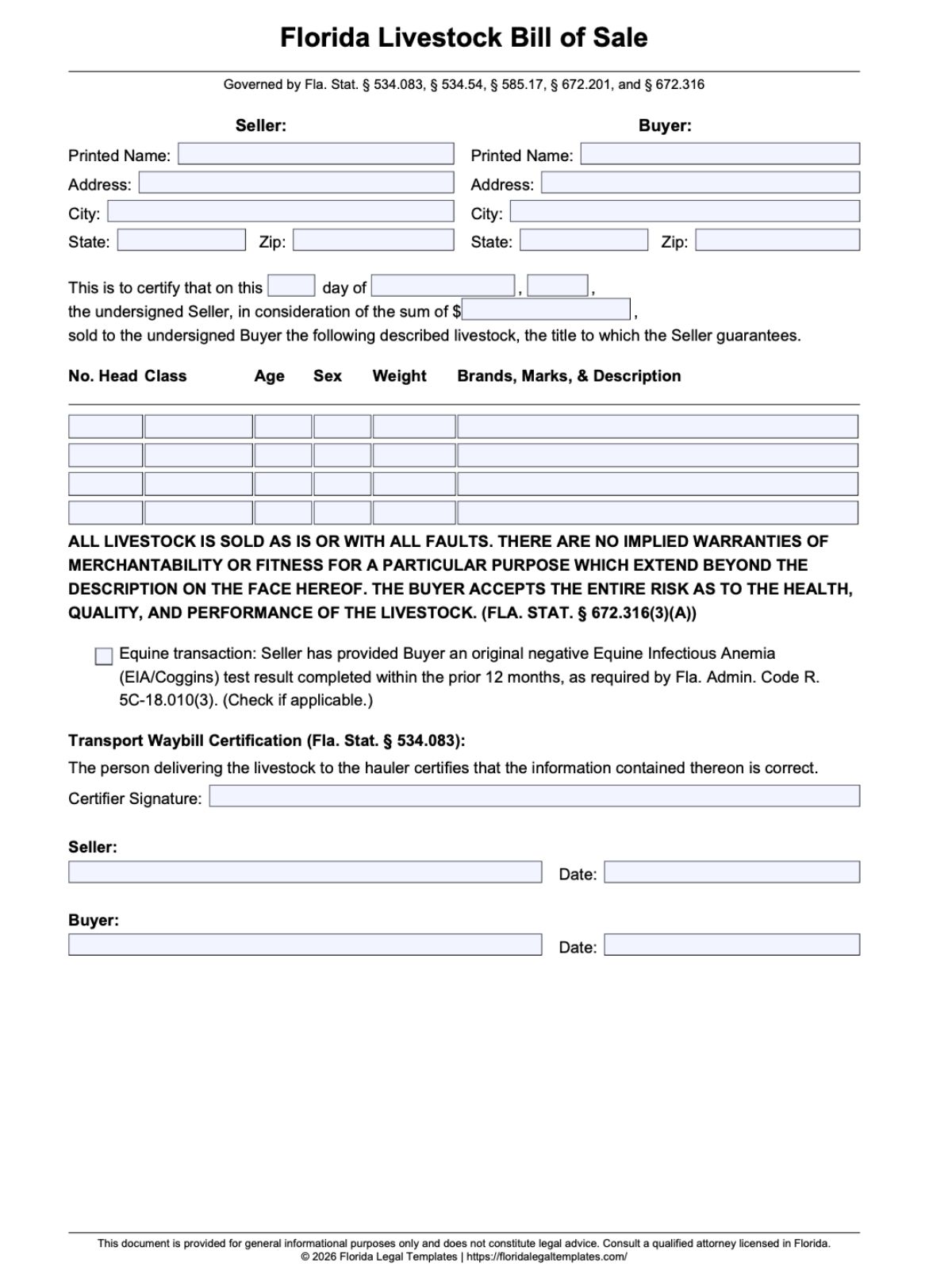
A Florida livestock bill of sale template is designed to create a written record of a livestock transfer and reduce disputes surrounding ownership, payment, warranties, and identification of the animals involved.
In practice, the document commonly serves several operational purposes at once:
- Proof that ownership transferred from seller to buyer
- Evidence of payment terms and delivery timing
- Identification documentation for the livestock sold
- Protection against later title or possession disputes
- Support documentation for transport or veterinary records
Most well-drafted templates include sections for:
- Buyer and seller legal information
- Livestock identification details
- Ear tags, tattoos, or brand information
- Veterinary certificate references
- Warranty disclaimers
- Purchase price and payment timing
- Delivery and possession terms
The document is commonly used by:
- Ranchers
- Farmers
- Livestock breeders
- Horse owners
- Agricultural businesses
- Participants in private auction sales
A simple fillable form may not be sufficient in more complex agricultural transactions. For example, registered brand assignments, financed herd purchases, breeding-right agreements, and dealer-based commercial livestock sales often require additional documentation beyond a standard bill of sale.
High-value breeding livestock transactions also frequently involve separate pedigree certifications, fertility guarantees, transport terms, or veterinary disclosures that should not be handled casually with a generic form.
What Makes a Livestock Bill of Sale Different From a Standard Florida Bill of Sale?
Livestock sales involve operational risks that do not normally exist in ordinary property transactions. A vehicle bill of sale mainly documents title transfer and payment. Livestock transfers can involve disease exposure, breeding capability disputes, veterinary inspection rules, brand ownership questions, and agricultural compliance obligations.
Florida livestock transactions often require attention to:
- Disease-related liability
- USDA identification tags
- Veterinary inspection documentation
- Immediate payment obligations
- Brand and mark ownership
- Possession-related criminal exposure
Under Florida law, livestock are treated as “goods” under the UCC sales framework while simultaneously remaining regulated under Florida livestock-control statutes. That combination matters because a transaction can become both a contract dispute and a regulatory problem at the same time.
For example, pursuant to Fla. Stat. § 672.201, livestock sales priced at $500 or more become difficult or impossible to enforce if the agreement is not properly documented in writing. Oral agreements between ranchers may seem routine in practice, but they create evidentiary problems once payment disputes, delivery disputes, or disease allegations emerge.
Key Florida Laws That Affect a Livestock Bill of Sale
Florida Statutes and Regulatory Rules That Directly Impact Livestock Sales
| Topic / Issue | Florida Legal Rule | Governing Statute |
|---|---|---|
| Statute of Frauds | Livestock sales of $500 or more should be in writing and signed | Fla. Stat. § 672.201(1) |
| Prompt Payment | Payment must generally occur when possession transfers | Fla. Stat. § 534.54(1)(a) |
| Witness Requirement | Witnesses are not legally required | General contract law |
| Notarization | Not required for ordinary livestock transfers | General contract law |
| Brand Assignment Notarization | Registered brand assignments must be notarized and filed | Fla. Stat. § 534.051 |
| Disease Warranty Exception | Cattle and hog sales carry limited implied disease warranties | Fla. Stat. § 672.316(3)(d) |
| OCVI / USDA Identification | While Fla. Admin. Code R. 5C-3.004 requires an OCVI for interstate livestock imports, internal Florida transfers follow R. 5C-31.005. Under this rule, cattle 18 months or older changing ownership intrastate must bear Official Individual Identification (such as a USDA tag, microchip, or registered brand) before movement, unless consigned directly to slaughter. | Fla. Admin. Code § 5C-3.004 |
| Possession Without Title | Possession without lawful title or bill of sale may trigger criminal liability | Fla. Stat. § 534.091 / § 534.101 |
| Farm-Origin Tax Exemption | Certain producer livestock sales may qualify for sales-tax exemption | Fla. Admin. Code Rule 12A-1.049(1) |
Florida’s prompt-payment rules create more risk than many buyers realize. Under Fla. Stat. § 534.541)(a), livestock buyers must pay via cash or check on the sale day (or the next business day if after-hours). Late payments trigger an automatic 12% statutory penalty, maximum interest, and attorney’s fees. Additionally, the seller instantly gains a perfected purchase-money lien on the animal and all transaction proceeds, completely bypassing the need for a UCC-1 filing.
The unlawful-possession statutes also make documentation extremely important in practice. Florida law prohibits possession of livestock under a claim of ownership without lawful title or a valid written bill of sale from the rightful owner. That risk becomes especially serious during transport stops, auction transfers, or disputes involving branded cattle.
Why Later Buyers Should Ask for Proof That the Original Seller Was Paid
One document experienced livestock buyers often request is evidence that the immediate seller actually paid the previous owner. Florida’s livestock prompt-payment law gives qualifying unpaid sellers a statutory purchase-money security interest without requiring a UCC-1 filing. If a buyer purchases cattle shortly after an earlier transaction, the chain of ownership can become much more important than the bill of sale alone. A clean bill of sale from the current seller does not necessarily answer whether an earlier seller still has enforceable rights arising from a failure to pay. See Fla. Stat. § 534.54 and related enforcement provisions.
In higher-value herd purchases, a practical closing checklist often includes: (1) the current bill of sale, (2) proof that the prior livestock purchase was paid in full, or a written lien release if applicable, and (3) matching identification numbers for every animal being transferred. That extra paperwork is inexpensive compared to defending a later ownership or lien dispute after the animals have been transported, resold, or pledged as collateral. It is a step commonly used in commercial cattle transactions but frequently overlooked in private ranch sales.
Practical Impact of These Laws on the Document Itself
A livestock bill of sale should identify the animals with precision. Generic descriptions like “mixed cattle herd” create evidentiary problems later if ownership or condition becomes disputed.
Useful identifiers commonly include:
- Species
- Breed
- Sex
- Approximate age
- Color and markings
- Ear tag numbers
- USDA identifiers
- Brands or tattoos
Payment timing clauses matter because Florida prompt-payment statutes impose operational obligations that ordinary property sales may not have. A poorly drafted payment section can expose both parties to disputes over delivery timing, possession transfer, or incomplete payment.
Warranty language also deserves careful drafting attention. Sellers often assume that “AS IS” language automatically eliminates liability. In Florida livestock sales, that assumption can become dangerous if the disclaimer is vague, inconspicuous, or improperly drafted for the livestock category involved.
Transactions and Situations Where This Document Becomes Critically Important
A Florida livestock bill of sale becomes especially important in:
- Private cattle sales between ranchers
- Horse transactions involving breeding or competition animals
- Sheep, goat, or swine transfers
- Private auction-related transactions
- Herd reduction sales
- Farm succession transfers
- Interstate livestock transport
- Emergency disease-control sales
The document becomes even more valuable when possession transfers immediately upon payment. Without written documentation, buyers may struggle to prove lawful ownership during transport, insurance claims, agricultural inspections, or later resale.
Certain situations usually require more than a standard livestock bill of sale alone:
- Registered brand transfers
- Partnership-owned livestock
- Breeding-right agreements
- Consignment arrangements
- Installment-payment herd purchases
- Secured livestock financing transactions
Information That Should Always Appear in a Florida Livestock Bill of Sale
A properly drafted livestock bill of sale should include:
- Full legal names and addresses of both parties
- Date and location of transfer
- Detailed animal identification
- Purchase price
- Payment structure
- Delivery terms
- Possession-transfer terms
- Disease and warranty language
- OCVI references where applicable
- Brand ownership disclosures
- Signatures of all parties
Animal identification sections should be highly specific. The more valuable the livestock, the more dangerous vague descriptions become.
Supporting attachments commonly include:
- Veterinary records
- Registration certificates
- Breeding certifications
- Transport records
- USDA tag documentation
How to Create or Fill Out a Florida Livestock Bill of Sale
Step 1: Identify all parties correctly
Use full legal names and addresses. Agricultural businesses should use registered business names rather than informal ranch names alone.
Step 2: Describe each animal with legally useful identifiers
Avoid vague references to groups of livestock. Include breed, sex, markings, tags, tattoos, and brands whenever possible.
Step 3: Record brands, tattoos, and USDA tags accurately
Errors in identification numbers create ownership problems later — especially if animals are transported or resold.
Step 4: Specify payment timing and delivery terms
Florida’s prompt-payment laws make payment timing operationally important. Document exactly when payment is due and when possession transfers.
Step 5: Include warranty disclaimers appropriate for the livestock category
For livestock categories outside the cattle-and-hog statutory exception, disclaimers should explicitly reference “merchantability” or use conspicuous “AS IS” language pursuant to Fla. Stat. § 672.316.
Step 6: Reference veterinary inspection certificates where applicable
Include OCVI numbers or attach veterinary inspection documentation when required.
Step 7: Clarify whether any registered brand rights are included
Selling livestock does not automatically transfer ownership of a registered statewide brand.
Step 8: Execute and retain copies before possession transfers
Do not allow animals to leave possession before the document is completed and signed.
Practical drafting precautions include:
- Avoid verbal-only side agreements
- Keep payment-delivery records
- Retain veterinary documentation
- Preserve transport paperwork together with the bill of sale
Warranty Disclaimers, Disease Risks, and “AS IS” Clauses in Florida Livestock Sales
Pursuant to Fla. Stat. § 672.316(3)(d), Florida statutory law explicitlyexcludes all implied warranties of merchantability or fitness regarding sickness or disease in transactions strictly involving cattle or hogs, meaning these animals are legally sold ‘as-is’ for health purposes by default. However, this statutory immunity is entirely forfeited if the buyer demonstrates that the seller possessed actual, operational knowledge that the cattle or hogs were diseased at the time of the transfer. Conversely, equine (horse) and small ruminant (goat, sheep) sales carry fully intact implied warranties of health and soundness under the UCC unless the seller explicitly extinguishes them via a highly conspicuous, written disclaimer that mentions ‘merchantability’ under Fla. Stat. § 672.316(2).
Horse, sheep, and goat transactions operate differently. Implied warranties may still apply unless they are properly disclaimed using legally effective language.
A generic disclaimer often fails because sellers use vague wording buried inside dense text. Disclaimers work best when they are conspicuous, direct, and specifically tailored to the transaction.
Disputes commonly arise from:
- Illness discovered after transfer
- Breeding-capability problems
- Transport injuries
- Misrepresented health conditions
- Undisclosed infections or defects
High-value horse and breeding-livestock transactions frequently generate disputes when health records, fertility expectations, or veterinary findings were discussed verbally but never documented in writing.
Brand Ownership, Veterinary Certificates, and Regulatory Compliance Issues
Selling livestock is legally different from selling a registered livestock brand. A bill of sale may transfer the animals themselves without transferring ownership of a statewide registered brand.
Under Fla. Stat. § 534.051, registered brand assignments must be notarized and filed with the Florida Department of Agriculture and Consumer Services (FDACS).
Veterinary inspection compliance also becomes important during livestock movement. Certain cattle, sheep, goats, swine, and dairy-animal transfers may require an Official Certificate of Veterinary Inspection (OCVI) and USDA identification tags.
The livestock bill of sale itself is generally not filed with the government. However, commercial operators, dealers, and agricultural businesses should maintain organized records for:
- Tax reporting
- Agricultural audits
- Livestock inspections
- Commercial compliance reviews
Common Mistakes That Create Legal or Financial Problems in Livestock Transactions
Several recurring drafting mistakes create avoidable disputes in Florida livestock sales:
- Using vague herd descriptions
- Failing to document payment timing
- Omitting disease disclaimers
- Ignoring OCVI requirements
- Assuming notarization is always required
- Forgetting to document transferred brands
- Using generic personal-property forms
- Many parties mistakenly rely on a generic Florida generic bill of sale that lacks livestock-specific warranty language, identification fields, or OCVI references.
- Allowing possession before execution
- Losing veterinary or transport records
- Misunderstanding sales-tax exemptions
The consequences can become serious quickly. Depending on the situation, parties may face:
- Ownership litigation
- Warranty disputes
- Regulatory violations
- Tax exposure
- Prompt-payment penalties
- Attorney-fee claims
- Criminal possession allegations
One common operational mistake occurs when buyers transport livestock immediately after a verbal agreement without signed documentation. If payment disputes later arise, proving lawful ownership can become far more difficult than parties expected.
Limitations and Legal Considerations Under Florida Law
A livestock bill of sale does not replace:
- Veterinary inspection certificates
- Interstate transport compliance
- Brand assignment filings
- Financing agreements
- Security-interest documentation
The document also may not resolve pedigree disputes, breeding-right disagreements, or installment-payment conflicts by itself.
Under Florida law, parties entering livestock transactions must generally be at least 18 years old and legally competent to contract pursuant to Fla. Stat. § 743.07.
Commercial livestock dealers may face additional compliance obligations involving taxes, records, and payment procedures beyond those applicable to occasional private farm sales.
Joint ownership arrangements, herd-installment sales, and deferred-payment transactions should be documented carefully because oral side agreements often become difficult to enforce once disputes emerge.
Related Florida Agricultural Documents Often Used Alongside a Livestock Bill of Sale
Related agricultural documents frequently used with livestock bills of sale include:
- Livestock purchase agreements
- Brand assignment forms
- Veterinary inspection certificates (OCVI)
- Breeding contracts
- Farm asset purchase agreements
- Promissory notes
- Livestock transport documents
- Agricultural lien records
Each document serves a different legal purpose. A livestock bill of sale mainly establishes ownership transfer and transaction terms, while veterinary certificates address animal-health compliance and financing documents govern repayment obligations or security interests.
Frequently Asked Questions
Is a written livestock bill of sale legally required in Florida?
For livestock sales valued at $500 or more, Florida’s UCC statute of frauds rules under Fla. Stat. § 672.201 make written documentation extremely important for enforceability. Even smaller transactions are safer when documented in writing.
Can someone legally possess cattle in Florida without a bill of sale?
Possession without lawful title documentation can create serious legal problems. Florida statutes prohibit possession of livestock under a claim of ownership without lawful title or valid written documentation from the rightful owner.
Does a Florida livestock bill of sale need to be notarized?
Ordinary livestock transfers generally do not require notarization. However, registered livestock brand assignments require notarization and filing with FDACS.
What happens if diseased livestock are sold in Florida?
Florida law limits certain implied disease warranties for cattle and hog sales, but sellers cannot knowingly sell diseased livestock while relying on those protections. Other livestock categories may still involve implied warranty exposure unless properly disclaimed.
Does a livestock bill of sale need to include veterinary certificate information?
Including OCVI references and veterinary inspection details is often operationally helpful, especially when livestock are transported, resold, or inspected after transfer.
Are livestock sales in Florida subject to sales tax?
Some farm-origin livestock sales by original producers may qualify for exemption under Florida administrative rules. Dealer-based or commercial livestock transactions may still be subject to state sales tax and applicable surtaxes.