
Free Florida Lease Agreement Template [PDF, Word]
A Florida lease agreement that skips even one state-required disclosure can cost a landlord the entire security deposit before a dispute gets anywhere near a judge. I’ve seen it happen with landlords who were right about the damage, had photos, had receipts, but lost the claim because their §83.49 notice went out by regular mail instead of certified mail.
Florida doesn’t grade on effort or intent, and a free Florida lease agreement pulled from a national template site often skips exactly the kind of state-specific language that holds up when something goes wrong. If you’re looking for a Florida lease agreement PDF that’s actually built around what Florida law requires, the details below cover what belongs in a compliant lease and why each section matters.
Candice Hayden, Legal Writer
Ross Bridger, Real Estate Attorney
Florida Lease Agreement (PDF, Printable, Fillable)
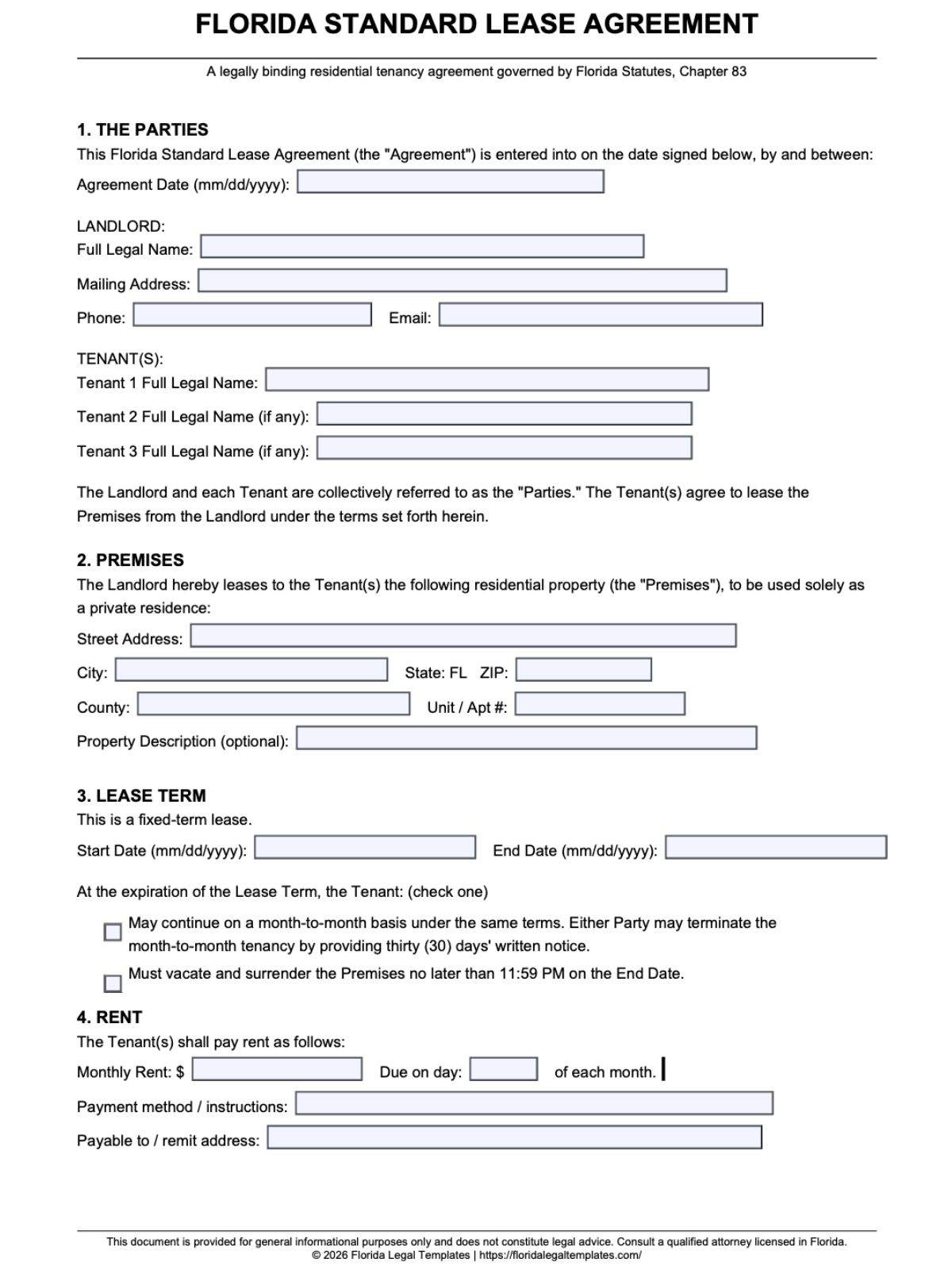
You can use a fillable Florida lease agreement PDF or a printable Florida lease agreement to create a legally enforceable rental contract.
What the template includes:
- Lease term (fixed duration)
- Rent amount, due date, and late fees
- Security deposit terms
- Maintenance and repair responsibilities
- Florida-required disclosures:
- Radon gas warning (Fla. Stat. § 404.056(5))
- Security deposit handling and location terms (Fla. Stat. § 83.49)
- Landlord or authorized agent identification details (Fla. Stat. § 83.50)
- Option for a recurring non-refundable monthly fee in lieu of a deposit (Fla. Stat. § 83.491)
- Mandatory standalone Flood Risk Disclosure form (Required under Fla. Stat. § 83.512 for all leases of 1 year or longer)
Option for non-refundable monthly fee in lieu of security deposit (per 2023/24 statutory updates)
Who should use this:
- Individual landlords renting out property
- Property managers handling residential units
- Tenants reviewing or negotiating lease terms
When this template may NOT be sufficient:
- Commercial leasing arrangements
- Multi-unit properties with complex regulatory layers
- Properties governed by detailed HOA rules
- Situations requiring customized legal drafting
A free Florida lease agreement template works best for standard residential rentals but must be completed carefully to remain legally compliant.
Before finalizing a lease, many landlords first verify tenant eligibility using a screening and background check form. You can also explore other document types within the broader Florida legal template library to ensure your paperwork aligns with current legal standards.
What Is a Florida Lease Agreement?
A Florida lease agreement is a written contract that sets the terms for renting residential property for a fixed period, such as 6 or 12 months.
Under Florida law, this document is governed by the Florida Residential Landlord and Tenant Act (Fla. Stat. §§ 83.40–83.683), which defines the rights and obligations of both parties.
Key distinctions:
- Lease agreement (fixed-term): Ends on a specific date unless renewed using a renewal agreement.
- Rental agreement (month-to-month): Continues until terminated with proper notice.
Enforceability under Florida law:
- No notarization required for validity
- No witness requirement (removed by law in 2020 under Fla. Stat. § 689.01)
- Becomes legally binding once signed by both parties
This means a properly completed rental lease agreement in Florida is enforceable even without formalities like notarization—provided it complies with statutory requirements.
In situations where flexibility is preferred over fixed terms, landlords may instead rely on a short-term renewable rental arrangement. For shared housing setups, using a co-occupancy agreement between tenants can better define individual responsibilities.
Key Florida Laws That Affect Florida Lease Agreement
Summary of Applicable Laws
| Topic / Issue | Florida Legal Rule | Governing Statute |
|---|---|---|
| Governing Law | Residential leases governed by Florida Residential Landlord and Tenant Act | Fla. Stat. §§ 83.40–83.683 |
| Landlord Entry | Minimum 24-hour notice; entry only between 7:30 a.m. and 8:00 p.m. | Fla. Stat. § 83.53(2) |
| Security Deposit Return | 15 days to return deposit (no claims); 30 days to notify claims | Fla. Stat. § 83.49(3)(a) |
| Month-to-Month Termination | Minimum 30 days’ written notice (Statewide preemption: local laws cannot require more or less notice) | Fla. Stat. § 83.57(3) |
| Prohibited Clauses | Cannot waive tenant rights or limit landlord liability | Fla. Stat. § 83.47 |
| Self-Help Eviction | Lockouts, utility shutoffs, or forced removal are illegal | Fla. Stat. § 83.67 |
Practical Impact & Document Clauses
These laws directly shape how a Florida lease agreement template must be written.
For example, the lease must include:
- An entry clause reflecting the 24-hour notice requirement
- A security deposit clause aligned with the 15/30-day rules Fla. Stat. § 83.49 (Security Deposit Rules)
- A termination clause that matches the 30-day notice requirement for periodic tenancies
Florida also mandates specific disclosures:
- A radon gas warning containing the exact statutory warning paragraph (Fla. Stat. § 404.056(5))
- A security deposit notice specifying banking location details delivered within 30 days of fund receipt (Fla. Stat. § 83.49(2))
- The landlord’s name, postal address, and contact disclosures for legal service (Fla. Stat. § 83.50)
- A separate, standalone written Flood Disclosure form mapping out any known structural flooding history during ownership (Fla. Stat. § 83.512)
If these are missing or incorrect:
- Certain lease provisions may become unenforceable
- Landlords may face financial liability
- Tenants may gain legal remedies against the landlord
Additionally, Florida law strictly prohibits:
- Waiving tenant rights in the lease
- “Self-help eviction” tactics such as changing locks or shutting off utilities
Violating these rules can result in damages equal to actual losses or three months’ rent, whichever is greater.
When to Use This Florida Lease Agreement
A Florida lease agreement is appropriate in the following situations:
Ideal use cases:
- Renting property for a fixed term (e.g., 6 or 12 months)
- Establishing a formal landlord-tenant relationship
-
Updating outdated or non-compliant agreements after major changes.
Common property types:
- Single-family homes
- Apartments
- Condominiums (with HOA considerations)
When NOT to use this document:
- Short-term vacation rentals
- Commercial property leases
- Informal roommate arrangements without landlord involvement
Using the wrong type of agreement can create enforcement issues, especially if statutory protections are not properly addressed.
If the rental involves partial occupancy or transferring lease rights, a sublease agreement may be more appropriate than a standard lease. This is especially relevant in shared or transitional housing arrangements where the original tenant remains legally responsible.
How to Create or Fill Out the Florida Lease Agreement
Creating a Florida lease agreement PDF requires more than filling blanks—you must ensure legal compliance.
Step-by-step process:
- Identify the parties
- Include landlord’s full legal name
- Provide authorized agent details if applicable (required disclosure under Fla. Stat. § 83.50)
- Define the property
- Full address and description of the rental unit
- Set the lease term
- Fixed duration (e.g., 12 months)
- Include start and end dates clearly
- Specify rent details
- Monthly rent amount
- Due date
- Late fee structure
- Include security deposit terms
- Amount collected
- Where it will be held
- Required statutory disclosure language (Fla. Stat. § 83.49(2))
- Insert mandatory disclosures (“magic words”)
- Radon gas disclosure explicitly embedded using the exact required statutory text block under Fla. Stat. § 404.056 (Radon Gas Disclosure Requirement)
- Security deposit bank account holding disclosure issued within a strict 30-day structural window under Fla. Stat. § 83.49(2)
- Mandatory standalone written Flood Disclosure under Fla. Stat. § 83.512 for any residential lease lasting 1 year or longer
- Federal Lead-based paint disclosure and informational booklet for residential units built before 1978 (42 U.S.C. § 4852d)EPA Lead-Based Paint Disclosure Requirements
- Radon gas disclosure explicitly embedded using the exact required statutory text block under Fla. Stat. § 404.056 (Radon Gas Disclosure Requirement)
- Define maintenance and entry rules
- Reflect 24-hour notice requirement
- Specify reasonable entry hours
- Add signatures
- Both landlord and tenant must sign
- No notarization required
Practical tips:
- Align rent due dates with lease start date to avoid confusion
- Do not insert clauses that waive tenant rights—they are void under Florida law
- Always keep a signed copy for both parties
Choosing the correct agreement type is essential during drafting. If the property is intended for business use, a commercial leasing contract should be used instead, as residential forms do not address business liability, zoning, or operational clauses required under Florida law.
Limitations and Legal Considerations
A Florida rental agreement is a private contract and does not need to be filed with any government office to be valid.
Key legal limitations:
- Cannot override Florida statutory protections
- Must include required disclosures to remain enforceable
- Must follow deposit handling rules strictly
Important edge cases:
- Older guidance requiring witnesses is outdated (removed in 2020)
- Oral agreements may exist but are harder to enforce
- Multi-year leases may require additional clarity but not additional formalities
Risks of non-compliance:
- Lease provisions may be void
- Disputes may favor tenants
- Financial penalties or legal claims
Common Mistakes to Avoid
1. Missing required disclosures
Failing to include the mandatory radon gas warning, security deposit banking disclosure, landlord contact coordinates, or the separate written flood history form under Fla. Stat. § 83.512.
Consequence: Omitting the standalone flood disclosure grants the tenant an immediate statutory right to terminate the lease and receive a complete refund of all unearned prepaid rent if a flood causes a substantial loss (50% or more of market value) to their personal property.
2. Using outdated templates
Older templates may still include:
- Witness requirements
- Missing statutory language
Consequence: Legal non-compliance and potential disputes.
3. Including illegal clauses
Examples:
- Waiving tenant rights
- Limiting landlord liability
Consequence: Clauses are void under Fla. Stat. § 83.47.
4. Mishandling security deposits
- Not returning deposit within 15 days (no claims)
- Failing to send notice within 30 days (if claiming damages)
Consequence: Loss of claim rights and potential legal penalties.
5. Improper landlord entry
Entering without proper notice or outside permitted hours
Consequence: Violation of tenant rights under Fla. Stat. § 83.53(2).
6. Attempting self-help eviction
- Locking tenant out
- Shutting off utilities
Consequence: Liability for damages or three months’ rent, whichever is greater (Fla. Stat. § 83.67).
7. Omitting an Attorney’s Fee Clause Consequence:
Under Florida’s “reciprocal” fee statute, if you do not include a prevailing party attorney fee clause, you may be unable to recover legal costs even if you win an eviction or damages case.
Frequently Asked Questions (FAQ)
Is a Florida lease agreement valid without notarization?
Yes. Under Florida law, residential leases do not require notarization to be legally binding. A signed agreement is sufficient.
How long does a landlord have to return a security deposit in Florida?
Under Fla. Stat. § 83.49(3)(a):
- 15 days to return the full deposit if no deductions are made
- 30 days to send written notice if making a claim
Can a landlord enter without permission in Florida?
No. Under Fla. Stat. § 83.53 (Landlord Access and Entry), a landlord must provide “reasonable notice,” which the law defines as at least 24 hours prior to repairs, with entry occurring between 7:30 a.m. and 8:00 p.m.
What happens if a lease does not include required disclosures?
Missing required disclosures—such as the radon warning or deposit notice—can:
- Make parts of the lease unenforceable
- Expose the landlord to legal claims
- Weaken the landlord’s position in disputes
A properly drafted Florida lease agreement template is more than a form—it is a legal safeguard. Using a compliant, up-to-date document ensures both parties are protected and reduces the risk of costly disputes.