
Florida Equipment Bill of Sale (PDF, Word & Printable Template)
Buying or selling commercial, agricultural, industrial, or personal equipment in Florida creates more legal and financial exposure than many people realize. A Florida equipment bill of sale helps document the transfer of ownership, confirm payment terms, allocate risk between the parties, and reduce disputes over condition, warranties, or delivery problems. For higher-value equipment transactions, written documentation can also help establish enforceable sale terms, payment obligations, and condition disclosures if disputes later arise.
This page includes a Florida equipment bill of sale template in PDF, Word, and printable formats designed for contractors, farm operators, construction businesses, equipment dealers, and private sellers. The document is commonly used for machinery, tractors, skid steers, trailers attached to equipment operations, generators, shop equipment, landscaping machinery, manufacturing tools, and other high-value business-use property.
A properly drafted equipment bill of sale also becomes important when disputes arise months later over mechanical defects, missing attachments, payment defaults, or damage occurring during transport. In many Florida equipment transactions, the bill of sale works alongside financing documents, lien releases, UCC filings, or separate commercial agreements rather than functioning as the only transaction document.
Candice Hayden, Legal Writer
Carly Johansson, Florida Contract Attorney
Florida Equipment Bill of Sale Template
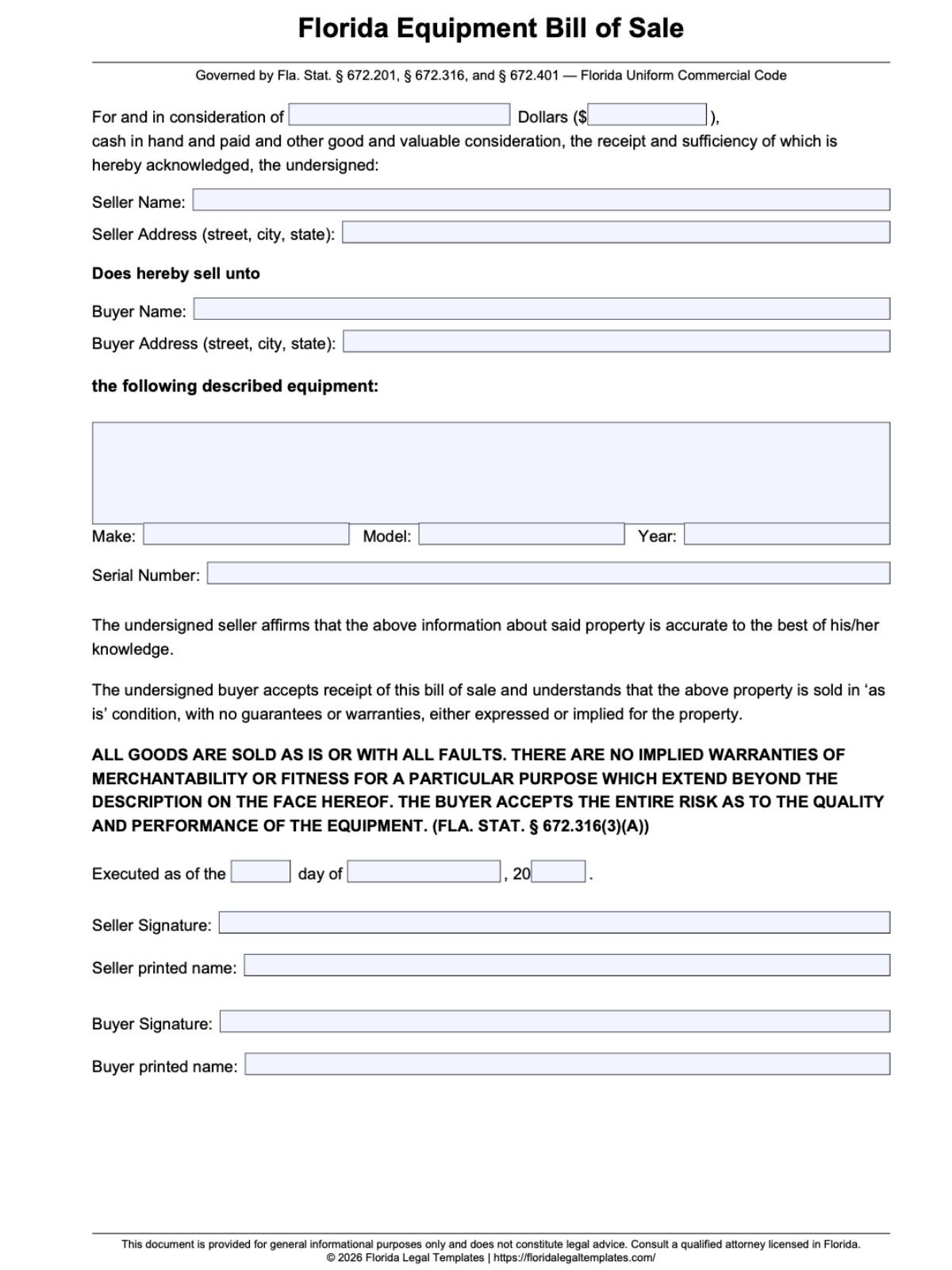
A Florida equipment bill of sale template normally includes:
- Buyer and seller information
- Equipment description
- Model and serial numbers
- Purchase price
- Payment structure
- Warranty disclaimer language
- Delivery terms
- Signature blocks
- Date of transfer
The document is commonly used by:
- Contractors
- Farmers
- Construction companies
- Small business owners
- Landscapers
- Independent equipment operators
Independent operators performing ongoing work with purchased machinery may also use an independent contractor agreement to define operational responsibilities and payment terms.
- Private equipment sellers
Equipment transactions often require much more detailed drafting than general personal property sales. A vague description such as “used tractor” or “commercial equipment” creates evidentiary problems if ownership, condition, or included components later become disputed.
In practice, many disputes arise because parties fail to identify:
- Attachments
- Hydraulic accessories
- Control systems
- Replacement parts
- Existing damage
- Hour-meter readings
- Operational limitations
A simple bill of sale may not be sufficient for:
- Seller-financed transactions
- Equipment subject to liens
- Leased machinery
- Commercial inventory sales
- Multi-unit business asset transfers
- Titled vehicle-based machinery
This document is also different from:
- Motor vehicle bills of sale
- UCC security agreements
- Asset purchase agreements
- Equipment lease agreements
A vehicle bill of sale primarily focuses on title transfer and registration. An equipment bill of sale focuses more heavily on operational condition, commercial risk allocation, warranty limitations, and equipment-specific identification details.
What Makes an Equipment Bill of Sale Different From Other Florida Bill of Sale Forms?
Equipment transactions frequently involve:
- Commercial use
- Higher-value assets
- Operational downtime exposure
- Financing arrangements
- Repair disputes
- Merchantability claims
Unlike casual consumer property transfers, business-use equipment failures can create immediate operational losses. A defective excavator, combine harvester, or industrial compressor may halt an entire project or production schedule.
That changes how parties approach documentation.
For example, serial numbers, maintenance history, operational condition disclosures, and warranty limitations become much more important than they would in an ordinary personal property sale.
Florida equipment sales also differ from motor vehicle transactions because odometer disclosure requirements generally do not apply unless the equipment incorporates a titled motor vehicle chassis. The equipment transaction itself is primarily governed by the Florida Uniform Commercial Code (UCC) Sales provisions (Chapter 672, Florida Statutes) rather than motor vehicle title laws. Crucially, under recent statutory updates enacted via Chapter 2025-92, Laws of Florida, Chapter 672 explicitly regulates ‘hybrid transactions’—such as commercial machinery sales bundled with integrated software licenses, proprietary telemetry systems, or ongoing technical setup. Under Fla. Stat. § 672.102(1), if the sale-of-goods aspect predominates the transaction, Chapter 672 governs the contract in its entirety; if the service or digital component predominates, Chapter 672 applies exclusively to the equipment-transfer aspects of the deal.
Equipment buyers also face different financing and creditor risks. If the seller finances the purchase and retains a security interest, additional secured transaction documentation may become necessary to protect the seller against third-party creditors or bankruptcy complications.
Florida Laws That Directly Affect Equipment Sales
Florida Statutory Requirements That Commonly Affect Equipment Transactions
| Topic / Issue | Florida Legal Rule | Governing Statute |
|---|---|---|
| Statute of Frauds | Contracts for the sale of heavy or commercial equipment priced at $500 or more require a signed, integrated writing to be legally enforceable. | Fla. Stat. § 672.201(1) |
| Legal Capacity | Parties must generally be at least 18 and legally competent | Fla. Stat. § 743.07 |
| Risk of Loss | Risk transfer depends on whether seller is a merchant | Fla. Stat. § 672.509(3) |
| Warranty Disclaimer Rules | Mandates absolute visual conspicuousness and explicit utilization of the word “merchantability” to successfully waive implied fitness guarantees. | Fla. Stat. § 672.316 & Fla. Stat. § 671.201(2)(k) |
| Lawsuit Limitation Period | Parties cannot extend claims beyond Florida’s 4-year statutory limit | Fla. Stat. § 672.725(1) |
| Unconscionable Clauses | Courts may refuse to enforce unfair contract terms | Fla. Stat. § 672.302 |
Florida’s writing requirement becomes extremely important in high-value equipment sales. Verbal agreements involving expensive machinery frequently collapse into evidentiary disputes when parties later disagree about included components, financing terms, repairs, or delivery obligations.
Warranty disclaimer failures also create major exposure for sellers. Under Florida law, hidden or boilerplate “AS IS” language may fail if it is not conspicuous or if it does not properly address merchantability requirements.
Commercial sellers often underestimate how aggressively buyers challenge vague disclaimers after equipment breakdowns. Courts may strike ineffective disclaimers entirely and restore implied warranties back into the transaction.
How These Laws Affect Real Equipment Transactions
Under Florida Statutes § 672.201(1), a sale of goods priced at $500 or more generally must be memorialized in writing. For equipment transactions, relying on text messages or verbal promises creates substantial litigation risk.
Risk-of-loss rules also change depending on the seller’s status.
Under the default provisions of Fla. Stat. § 672.509(3), if the seller is a merchant, the risk of loss passes to the buyer only upon actual physical receipt of the equipment; if the seller is a non-merchant, risk shifts immediately upon the tender of delivery. However, because Florida commercial equipment transactions routinely involve third-party logistics and common carriers, commercial parties regularly supersede these default rules by integrating explicit shipping terms under Fla. Stat. § 672.319. Incorporating a ‘F.O.B. Place of Shipment’ (origin) clause legally shifts the transit risk to the buyer the moment the asset is delivered to the carrier, whereas a ‘F.O.B. Place of Destination’ clause requires the seller to bear all liability until safe delivery at the buyer’s facility.
That distinction becomes critical during:
- Freight transport damage
- Delayed pickup disputes
- Storm-related storage damage
- Third-party carrier accidents
Florida law also limits contractual manipulation of liability periods. Parties may shorten the limitations period to no less than one year, but they cannot extend it beyond the statutory four-year limit.
Courts may also invalidate unconscionable clauses if the contract heavily favors one side in a commercially unfair manner.
Equipment Sales That Commonly Require Additional Documentation
Some transactions require substantially more than a generic bill of sale.
Examples include:
- Seller-financed equipment purchases
- Equipment subject to liens
- Commercial fleet sales
- Auction transactions
- Multi-unit machinery transfers
- Farm equipment shared across entities
- Heavy machinery with titled components
Seller financing transactions often require:
Some parties also execute a separate loan agreement when repayment obligations extend beyond the basic transfer terms outlined in the equipment bill of sale.
- Security agreements
- UCC-1 filings
- Default provisions
- Repossession language
If the seller retains a security interest but fails to properly perfect it through Florida’s secured transaction system, third-party creditors may gain priority rights over the equipment.
Parties also commonly overlook lien-release issues. A buyer may unknowingly purchase equipment already encumbered by financing obligations or tax liens.
How to Properly Complete a Florida Equipment Bill of Sale
Identify the Equipment With Sufficient Detail
Include:
- Model numbers
- Serial numbers
- VIN or chassis numbers if applicable
- Operational condition disclosures
- Included attachments
- Accessories and add-ons
Generic descriptions create enforcement problems later.
For example, disputes frequently arise over whether buckets, trailers, hydraulic tools, generators, GPS systems, or detachable implements were included in the sale price.
Clearly State Payment Terms
The bill of sale should clearly address:
- Lump-sum payments
- Installment structures
- Deposits
- Trade-ins
- Partial exchanges
- Delivery-related payment timing
Ambiguous payment language often creates default disputes and collection problems.
Address Warranty and Condition Terms Carefully
Florida law imposes strict requirements for effective warranty disclaimers.
To legally disclaim the implied warranty of merchantability, the waiver must explicitly use the word ‘merchantability’ and, if executed in writing, must satisfy the strict objective standards for being ‘conspicuous’ under Fla. Stat. § 671.201(2)(k). To withstand litigation in Florida courts, the disclaimer must be visibly set apart from surrounding prose using a contrasting font, all-capital letters, or bolded type. Furthermore, under Fla. Stat. § 672.316(3)(a), general boilerplate such as ‘AS IS’ or ‘WITH ALL FAULTS’ will only protect the seller if it is highly conspicuous and clearly signals to a reasonable commercial buyer that all implied guarantees of operational fitness are fully extinguished.
Practical drafting methods include:
- Bold text
- ALL-CAPS language
- Separate disclaimer sections
- Signature acknowledgment beside disclaimers
Phrases like “AS IS” or “WITH ALL FAULTS” may help disclaim implied warranties when drafted properly.
Signatures, Dates, and Supporting Records
Florida law does not require witnesses for a valid equipment bill of sale.
Notarization is also not legally required to transfer ownership between parties. Still, notarization strengthens evidentiary reliability if authenticity later becomes disputed.
Parties should retain:
- Payment records
- Maintenance logs
- Inspection reports
- Photographs
- Existing lien releases
- Delivery receipts
“AS IS” Equipment Sales and Warranty Risks in Florida
Many sellers assume that adding “AS IS” automatically eliminates liability. Florida law is more demanding than that.
Under Fla. Stat. § 672.316, implied warranty disclaimers must satisfy specific legal standards.
The implied warranty of merchantability generally relates to whether the equipment is reasonably fit for ordinary use. The implied warranty of fitness for a particular purpose may arise when the seller knows the buyer is relying on the seller’s expertise for a specialized operational purpose.
Boilerplate disclaimers buried in dense text frequently fail in litigation.
Florida courts examine whether disclaimer language was actually conspicuous. If the disclaimer blends into ordinary paragraph text without visual emphasis, the court may disregard it entirely.
Disputes commonly involve:
- Hidden mechanical defects
- Misrepresented operational condition
- Hydraulic failures
- Electrical system problems
- Engine damage
- Commercial downtime losses
Well-drafted disclaimer sections reduce — but do not eliminate — litigation risk.
When Risk of Loss Transfers to the Buyer
Risk transfer timing becomes extremely important in equipment sales involving transport, delayed pickup, or third-party carriers.
Under Florida law, merchant and non-merchant sellers are treated differently.
If the seller is a merchant, risk of loss generally transfers upon the buyer’s physical receipt of the equipment. If the seller is a private non-merchant owner, risk may transfer when delivery is tendered.
Disputes often arise involving:
- Freight damage
- Delayed transportation
- Equipment stored after closing
- Pickup scheduling failures
- Weather-related losses
The parties should clearly document:
- Delivery dates
- Pickup obligations
- Storage responsibility
- Freight carrier arrangements
- Insurance responsibility during transit
Tax, Filing, and Registration Issues Buyers Often Overlook
A Florida equipment bill of sale itself is generally not filed with a government agency.
However, the underlying transaction may still trigger Florida sales tax obligations under Chapter 212 of the Florida Statutes.
Florida’s statewide sales tax rate generally applies along with county discretionary surtaxes unless a statutory exemption applies.
Potential exemptions may involve:
- Occasional isolated sales
- Valid resale certificates
- Certain commercial resale transactions
Secured transactions create separate filing considerations.
If the seller finances the equipment and retains a security interest, a UCC-1 financing statement may need to be filed through Florida’s secured transaction registry system to protect the seller’s creditor position.
Failure to perfect the security interest can expose the seller to substantial collection risk if the buyer defaults or becomes insolvent.
Common Mistakes That Cause Equipment Sale Disputes
Frequent problems include:
- Vague equipment descriptions
- Missing serial numbers
- Undisclosed defects
- Invalid warranty disclaimers
- Ignoring existing liens
- Unclear financing terms
- Reliance on verbal side agreements
- Failure to identify included attachments
- Using generic forms designed for unrelated property types
These mistakes create real financial consequences.
For buyers, poor documentation may result in defective equipment claims, ownership disputes, or unexpected creditor problems.
For sellers, weak disclaimers and incomplete documentation can lead to repair liability, breach-of-warranty claims, or payment collection disputes.
Situations Where a Florida Equipment Bill of Sale May Not Be Enough
Some transactions require layered commercial documentation beyond a simple bill of sale.
Complex commercial transactions may also require a separate sales agreement alongside the equipment bill of sale, particularly when the deal involves multiple business assets or ongoing obligations.
Examples include:
- Business asset acquisitions
- Cross-state commercial sales
- Equipment lease-purchase arrangements
- Transactions involving secured creditors
- International exports
- Ongoing maintenance obligations
In some commercial equipment transactions, the parties also use a separate service agreement to govern installation, maintenance, repair, or ongoing operational support obligations.
Additional documents may include:
- Asset purchase agreements
- Security agreements
- UCC filings
- Indemnification provisions
- Inspection certifications
Relying solely on a basic form in a complex commercial transaction often leaves critical operational and liability issues unresolved.
Frequently Asked Questions
Can a Florida equipment bill of sale be enforced if the agreement was only verbal?
For equipment sales priced at $500 or more, Florida law generally requires a written agreement signed by the party against whom enforcement is sought under Fla. Stat. § 672.201(1). Verbal agreements in high-value equipment transactions create major evidentiary and enforceability risks.
Does an “AS IS” clause automatically protect the seller from equipment defects?
No. Under Fla. Stat. § 672.316, disclaimer language must satisfy conspicuousness requirements and properly address merchantability issues. Hidden or vague disclaimer language may be unenforceable.
What happens if purchased equipment is damaged before the buyer picks it up?
The outcome may depend on whether the seller qualifies as a merchant under Florida law. Risk-of-loss rules under Fla. Stat. § 672.509(3) apply differently to merchant and non-merchant sellers.
Do I need to notarize a Florida equipment bill of sale for it to be legally valid?
Florida law does not require notarization for a valid equipment bill of sale between parties. However, notarization can strengthen evidentiary reliability if authenticity later becomes disputed.
Should seller-financed equipment sales use additional legal documents?
Usually yes. Seller-financed transactions often require security agreements and UCC-1 filings to protect the seller’s secured interest against creditors and default risks.
Can a buyer sue years later over defective equipment?
Florida law generally imposes a four-year limitations period for breach-of-contract claims involving equipment sales under Fla. Stat. § 672.725(1). Parties may shorten the period in some cases, but they cannot extend it beyond the statutory limit.